| In which are
suggested the aesthetic import of plein air, the nature of
progress both modernist and postmodernist, why mining Australians
have a bond of belonging with the land, and, inadequately,
what is to be done.
What's going
on down there?
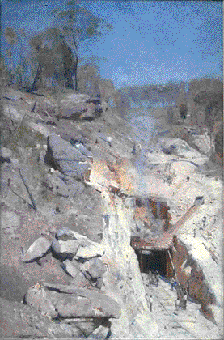
So much for
the basics, les grandes lignes, all well known. Rockface
dominating the entire left half; trees at the top; high
skyline; human figures as dots at middle-and-leg; a hole
with two lines going into it. But what are those figures
doing down there, near the hole? Australian Studies, painting
perhaps? Yet theirs are parallel lines, going from a hidden
place, disappearing to a hidden place. A railway, we are
told. A line of progress, surely not of Australian Studies
or painting. If only we knew which way was which. Only major
lines, a general network, could say.
Are they late
for the train?
Here is a network.
Santiago Rusiñol and Ramon Casas, who met Roberts
and Russell in Spain in 1884, launching Catalan Modernisme
with their 1890 and 1891 exhibitions at Barcelona. Max Liebermann
doing similar things in Berlin with the Gruppe XI in 1892.
And others, as far as Japan, where the Shiro-uma group had
its "secessionist" exhibition in 1895. The corresponding
event in Australia was of course the "9x5" of 1889. All
damned fools spotting texts with dabs of pure French. All
doing it at more or less the same time, all in slightly
different ways, as parts of a general outward movement from
Paris, spread across lands caught up in development ideology.
Little belatedness here; remarkably little anxiety about
influence. Such problems are more properly the stuff of
later Australianists, like Richard White, relating the "9x5"
to the 1878 clash between Whistler and Ruskin because he
- White - has few other fields of comparison. For those
actually in the network, half an eye was certainly on the
centre. But the remaining one-and-a-half were for the regional
object to be painted. Such was the first import of plein
air. It made painters look.
Without plein
air, the studio frames the painter's work. Consciousness
(the subject, humanly carpentering space) frames being (the
object, nature, landscape, uncut yet waiting to be changed).
The studio could be a place for Kantean rationality, reading
all the travelogues without leaving town, understanding
within a room, from books and letters. The studio's subjective
dominance might also be the Romantic scaling of mountains,
to look down and across the land controlled. In its properly
post-Romantic use, however, plein air surrounds consciousness
with a being yet to be controlled. The painter is somewhere
within the object to be painted, which extends beyond and
around. "The objective dialectic," says Lukács, wholly
within this aesthetic of development, "is always richer
and wider than the subjective." The studio relationship
is reversed. A nature to be understood becomes a nature
to be transformed, through work.
At this point
progress is neatly defined as increase in the possibility
that consciousness dominates being. The possibility, not
the fact. No more than a call to work. Putting a railway
through a mountain is an act of such progress. Painting
it in plein air participates in the same progress. The painter
is certainly above the scene, to control it. But he is also
there, surrounded by the same being against which the workers
struggle. He cannot look out very far. This is an element
of post-Romantic collusion, against wholly sanitized history.
They might be
painting, down there in the cave. Yet the frame we have
here places the eye outside, with the workers. The painter
works with the workers. On an opposite rockface, but still
with the workers.
The land is
a woman, of course. The men down there are men. The painter,
on the unseen rockface, our point of vision, is also a man.
Many clever things could be said, the tunnel and all. You
string together a few citations and prove the land is female,
the discourse is male, working within power. You forget
the ones that say otherwise. By unfalsifiable binarism you
are at your destination before you start out. Little is
discovered or transformed by such readings of gender. They
bring extension, not progress. The beauty of the land, although
woman, femme fatale and fatal cutting, should take us elsewhere.
There is also
death in this maiden. Not instead of, but also. Let us risk
a long annotated citation from Streeton the painter ("Smike"),
letter to Roberts ("Bulldog") dated Glenbrook December 17th
1891, found in Bernard Smith's Documents:
"This morning,
hot, windy, and warm [the setting surrounds], as I travel
down the line, and the mirage sizzling and jiggering over
the railway track [the line enables an object to be seen,
opposed, objectified]. I arrive at my cutting [possessed
because object], 'the fatal cutting,' and inwardly rejoice
at the prosperous warmth [whence the profits] all glowing
before me as I descend and re-ascend the opposite side [the
painter's controlling perspective must be worked for] up
to my shady, shelving sandstone rock, perched up high [certainly
much better than toiling down there]. I wipe the wholesome
moisture from my pale brow [a city painter, malgré
tout], and having partaken of a pull at my billy (like a
somewhat lengthy and affectionate kiss [the land is not
the only woman]), I look up and down at [a woman?] my subject
[object possessed]; is it worth painting? Why, of course,
damn it all! that is providing I'm capable of translating
my impression to the canvas [the Impressionist aesthetic
recited, and yet the value of the object has been placed
in the object itself, prior to the value of the painter;
the important relation is between the men and the land,
opposite, and the rest is literature]. All is serene as
I work and peg away [driving spikes into a line?], retiring
under the rock a bit when they light any shots, then, 'Up
with that b____ wagon, Bill.' 11.30: The fish train struggles
over the hill and round to Glenbrook. 12 o'clock: The next
shift comes toddling [micro men against macro nature] down
the hot track with their billies, and I commence to discuss
my lunch and tea (of which I consume over a quart every
lunch [December, it's hot]), and now I hear 'Fire, fire's
on,' from the gang close by; rest my billy on the rock,
take out my pipe [countless references to smoking in these
letters], and listen for the shots, with my eye watching
the bright red-gum yonder [flora as distraction from the
true event]. BOOM! and then rumbling of rock, the navvy
under the rock with me, and watching says, 'Man killed.'
[explanation, not exclamation; the urban painter is not
expected to act]. He runs down the sheltered side, and cries,
'Man killed!' [others should act]. Another takes it up,
and now it has run through the camp. More shots and crashing
rock, and we peep over; he [the unknown soldier] lies all
hidden [already buried?] bar his legs - and now men, nippers
and 2 women [so few they can be counted] hurry down, a woman
with a bottle and rags [their role in the bush, a supplement
when things go wrong]. All the shots are gone but one and
all wait and dare not go near [are we also waiting?]. Then
someone says the last hole was not lit, and they raise the
rock and lift him on to the stretcher, fold his arms over
his chest, and slowly six of them carry him past me [the
painter has presumably descended; the moment of control
is over]. Oh, how full of dread is the grey, mysterious
expression of death - 'tis like a whirlpool for the eyes.
[painfully Victorian literariness, but then:] Blown to death
twenty yards from me [presumably from where the painter
now stands, with the workers and women] and, as a navvy
said, it was an [not a] ''orrible sight.' By Jove! a passing
corpse does chain your eyes [the object acts, not the Impressionist
subject], and indeed all your senses, just as strongly ['strength'
is the main positive value in these letters] as love [strong
love, of tea, of the land, of work, of participation]."
Smith adds (p.
262): "Streeton painted a crow in his watercolour painting
'Fire's On,' but did not include a crow in the large oil
painting of the same subject. Perhaps the tragic death of
the settler described in the letter to Roberts provided
him with a more realistic 'symbol' of melancholy."
Melancholy?
Symbols? Who needs Poe and Paris when the object itself,
as index (smoke, fire, death), produces its own interpretant?
The painter can only hope for adequacy to the objective
dialectic.
One would presume
the men down there are carrying out a body on a stretcher,
while others look on.
However, looking
at the tracks, you can't tell which way the train has gone.
This, said the man brought up on the Nullabor, is a false
Murphy's Law. If you're at the back of the train, looking
straight out to the point de fuite, it's very easy to tell.
Yet the painting is not entirely on any train of linear
progress. And the vanishing point, of escape, is hidden,
somewhere within the cutting, in the folds of the earth.
The men are perhaps coming out along the tracks. But if
not autochthonous, and none that we know of are, this means
they have also gone in.
To leave what?
I can't make
out the details. They belong to the Art Gallery of New South
Wales, I'm told, along with the watercolour. Belonging is
being able to check the details, to gaze more intimately
at the folds. At this distance and unseen, near Sitges,
our vision is only through a scanner darkly:
In this image
of forgotten forebears, an old family photo, two figures
carry something along lines. No doubt the dead man of the
painter's story. If they are going in, the hole might be
a tomb as well as womb. And if coming out, they might be
leaving the site of entombment.
Yet something
else has surely been left in. A tomb not for bodies - the
letter says the body is retrieved, for the women to wash,
for burial elsewhere in the same land -, but certainly an
entombment for expended capital, dead labour, left in the
land channeled and transformed. The fatal cutting is inseminated
with death. Such is progress.
What are they
doing down there, at that moment in history?
Let us say,
generally, that to open the land is to mine. Agriculture,
housing, transport and communication all cut land in their
ways. They are all forms of more general mining. Yet mining
is more so, at this particular point in history. The society
of some 400,000 in 1850 became 4,000,000 by about 1900.
Mining made that society, and that society made Australian
nationalist culture. If an image of mining, the painting
sees truly the essence of its time and place.
But if not a
body, what did they leave down there?
A personal story:
Returning to Westonia, Western Australia, some ten years
after I helped drill and sample the old gold mine there,
I searched in vain for trace of my labour. The mine was
gone. Or rather, it had been buried under a mountain of
its own earth, filled to what the expert says is a height
50% higher than whatever open cut had been made. I spontaneously
thought the land was pregnant, inseminated by the work of
myself and others. But now, through Streeton's painting,
I remember that huge mound as a tomb.
One belongs
to the land where one's forebears are buried. A European
idea, perhaps, and alien to an aboriginal culture for which,
it seems, the land cannot be broken (for agriculture, housing,
transport and communication). Yet not a bad idea. If non-miners
can say the land is in them and we will never take it away,
mining Australians can glibly reply that we are in the land.
Not a bad idea, since we must recognize that not all the
bodies are ours, that others have worked, that possession
is fundamentally shared. But mere work, with its aesthetics
and ethics, cannot tell us what is to be done now, beyond
the age of Streeton's painting. Labour is not enough.
Two attitudes
are possible with respect to those workers down there. Radically,
we could say they were wrong. Perhaps the hill should have
stayed a hill. Perhaps there is no beauty in the rich colours
of exposed rock, the drama of male work against it. We could
simply say they screwed it (up). Turning our back on it,
we would have to look for something else to do, somewhere
else to go. Paraguay? Spain? Or do you think your analyses
are not located anywhere?
Less radically,
we could accept that we are part of them, and they of us.
With five generations buried in that land, I myself cannot
turn my back, I cannot help but find pathos in buried mines
and great beauty in exposed rock. It is my upbringing. Looking
out at the hills around Perth and Adelaide, I never saw
the cuttings as scars marring nature. There was beauty even
there, in the colours of open earth. We could then perhaps
claim a kind of possession, having worked to reveal the
colours. But with such possession would come responsibility,
and with that, the possibility of love and guilt. Only in
terms of this second chain can I contemplate what is to
be done.
One lesson learnt
in the 1890s is so simple that it constantly risks being
forgotten. They - the painters, but also the writers, notably
Lawson - went out and looked. The first thing to be done
is to get out and look. The foreign citations, like plein
air, can help ask questions of what you see, they can help
keep you looking. But the important point is to get out
and see where and when you are acting. Strange things happen
when this is forgotten. Within the cave down there, generations
of studio Australianists could be fretting over problems
of identity, a magic word that, with repetition, could even
create the thing it represents. You could stay there and
create a place for your own burial, if it makes you feel
happier. But there is also the outside.
A second lesson
is harder to explain. As I look, I am now unconvinced that
the objective dialectic is automatically the richer and
wider. I see consciousness intervening within a frame so
wide that it can kill the wealth of being. It can take ozone
away, raise temperatures, kill water, cover land with salt,
and the rest that is much repeated yet, unlike identity,
remains more than mere talk. The move from studio to plein
air must be taken one step further. In an age where the
object as nature can say no to our participation, the task
of consciousness is not merely to understand and control
being. It is to accept responsibility (possession, love,
guilt) for our actions. Of no consequence who owns what
if there is little left to own, if there is no life left
to consume the fruits of work. This wider frame, where consciousness
is restored to a position of dominance, now without innocence,
where modernist development should find its post-modernist
curtailing, is more importantly the level at which this
end of the century needs its own ideas.
What is to be
done? Go out and look. Accept responsibility. Spend little
time on identity and lineal ownership. Remember without
sanitizing.
Why should one
believe the last shot was not lit? As if we had endless
time to sit down and repeat. Perhaps it was lit, and fire's
still on.
Lukács,
György. 1963. Die Eigenart des Ästhetischen. Trans.
Manuel Sacristán Estética 1. La peculiaridad
de lo estético. Barcelona: Grijalbo, 1981. Vol. 1.
64.
Streeton, Arthur.
1891. Letter to Tom Roberts. Bernard Smith (ed.) Documents
on Art and Taste in Australia. Melbourne: Oxford University
Press, 1975. 258-59.
White, Richard.
1981. Inventing Australia: The Australian Experience. Sydney:
George Allen & Unwin. 91.
-
- Last update
1 June 1998
|