4 coses d'escacs
go 2 top
 |
A00
|
A01
|
A02
|
A07 KIA
|
A10, english/anglesa
|
A57,
Benko
|
A60, Benoni
|
A80, dutch/holandesa +
leningrado +
A97 +
against London
|
A00
|
A01
|
A02
|
A07 KIA
|
A10, english/anglesa
|
A57,
Benko
|
A60, Benoni
|
A80, dutch/holandesa +
leningrado +
A97 +
against London
|
Owen,
Mario
|
B01, escandinava
|
B02, Alekhine
|
B07 ,
Pirc
|
B10,
Caro-Kann ,
Panov ,
B15
|
B20, siciliana,
B23, GP,
closed,
B41, Paulsen,
B81, Keres
|
C00, francesa, french
|
C21, gambit danes
|
C22, joc central
|
C33, gambit rei
|
C40, letó
|
C42, Petrov
|
C44, escocesa;
Ponziani
|
C46
|
C50, italiana
|
C60, Ruy Lopez
C63, Schliemann
C64, open
C65, Berlin
|
C68
|
C76
|
C89, Marshall
|
QGA/QGD
|
D43 ,Semi Slav
D80, Grunfeld
|
E00,
Catalana
|
E60 Kings Indian as
E80 or E93
|
open chess.com PGN editor  | |

365chess analysis |
open Lichess.com PGN analyzer |
open PGNplayer
|
Campions del món
chesscorner

Nottingham Chess Tournament 1936 (+133 nice games),
wiki
D'en peu :
R. Fine, Dr. S. Tartakower, Dr. M. Vidmar, E. D. Bogoljuboff, T. H. Tylor, C. H. O'D. Alexander, S. Flohr, S. Reshevsky, M. Botvinnik, A. J. Mackenzie.
Asseguts :
Sir G. A. Thomas, Dr. E. Lasker, J. R. Capablanca, Ald. J. H. Derbyshire, Mrs Derbyshire, Dr. M. Euwe, Dr. A. Alekhine, W. Winter.
|
| Magnus Carlsen : 2013-present
|
|
| Viswanathan Anand : 2007-2013
The first thing is when you work with a team you must learn to suppress your initial desire to say something.
The second and more important skill is trust (in team work).
|
|
| Vladimir Kramnik : 2000 - 2007
WCC 2000 - 15 partides per veure !
Vladimir Kramnik 2770 vs Garry Kasparov 2849.
Final Score: Kramnik 8.5 - 6.5 Kasparov
|

|
|
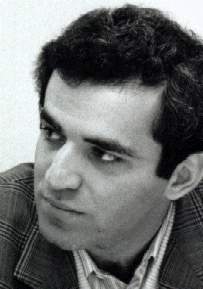
Gary Kasparov : 1985 - 1993
|
|
|
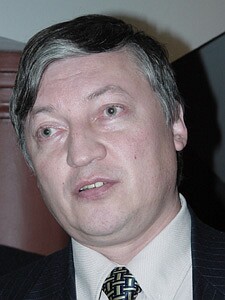
Anatoli Karpov : 1975 - 1985
|
|
|
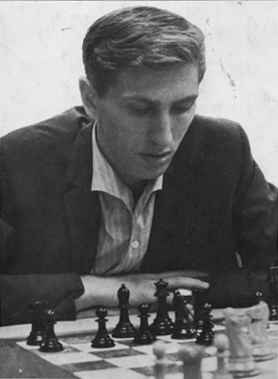
B. Fischer : 1972 - 1975
Fischer in a Internet Café :
see his games as Guest71 (and other),
his absurd openings and still wining the game.
Among others, games 15 and 16 are particularly good.
http://www.chessbase.com/newsdetail.asp?newsid=11
Go to the end of the page, and click on
Here are the games.
Amb en Bob Hope
|
|
|
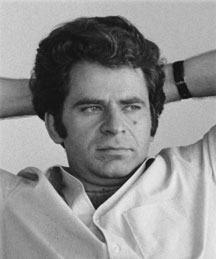
Boris Spassky : 1969 - 1972
|
|
|
T. Petrosian : 1963 - 1969
|

|
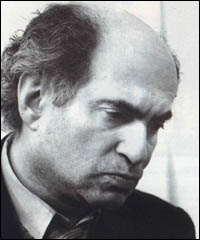
Mikhail Tahl : 1960 - 1961
bcn 1992 :
After winning a game he would phone three different women, and say the same to all of them:
"Thinking of you, I was able to win the game"
|
|
|
V. Smyslov : 1957 - 1958
|
|
|
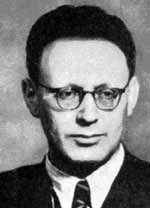
Mikhail Botvinnik : 1948 - 1957, 1958 - 1960, 1961 - 1963
|
|
|
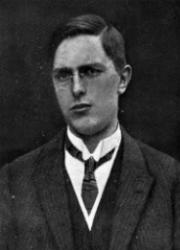
Max Euwe : 1935 - 1937
|
|
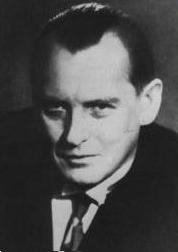
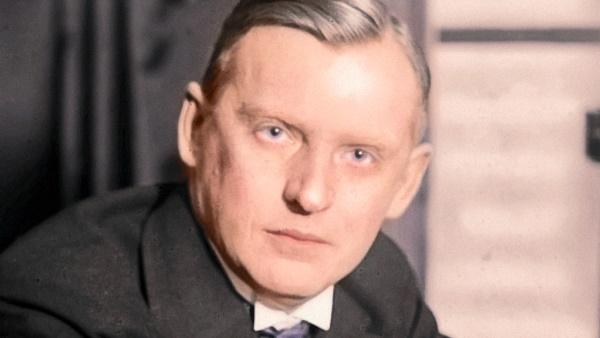
A. Alekhine : 1927 - 1935, 1937 - 1946
bio,
Wiki
|
|
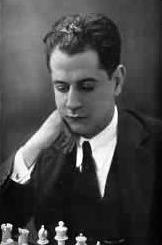
Jose Raul Capablanca : 1921 - 1927
bio (Batista, 7/3/1942)
|
|
|
Emanuel Lasker
|
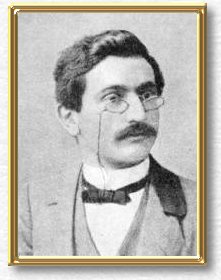
|
|
Steinitz
|
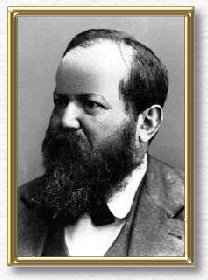
|
|
Their games
|
Altres
Pal Benko,
Eufim Bogoljubov,
Bronstein,
Gulko,
Paul Keres,
Victor Korchnoi,
Marshall,
Morphy,
Najdorf,
Nimzowich,
Lev Polugayevsky,
Zoltan Ribli,
Rubinstein,
Tarrash,
Staunton.
Una altra
foto.
El futur :
Andor Lilienthal
- wiki
- Madrid 1933
- gana a Capablanca en Hastings, en 1935 con sacrificio de dama
Fischer le dice "¡e5xf6!"
Rashid Gibiatovich Nezhmetdinov
wiki
La partida Polugaevsky-Nezhmetdinov de Sochi 1958 es considerada
como una de las mejores partidas de ajedrez de la historia,
luego de un brillante sacrificio de dama por parte de Nezhmetdinov.
chessgames
Nezhmetdinov vs Tal, Baku 1961
els escacs desenvolupen 26 qualitats
- atenció a varies coses a la vegada
- autocrítica
- autoestima
- calcul de riscos
- capacitat de càlcul
- combativitat
- compliment de les regles
- concentració
- creativitat
- dessig d'aprendre
- disciplina
- espotivitat
- imaginació
- lògic
- memòria
- motivació
- paciencia
- pensament científic
- planificació
- previsió de consecuencies
- raonament
- respecte al adversari
- responsabilitat personal
- sang freda
- tenacitat
- visio espacial
El que s'aprèn matant un rei !!!
Chess conventional wisdom
- you develop your pawns in your center
- you develop your knights in the center
- you develop your bishops in the center
- you castle
- you move your queen to a decent square
- you think of a plan
Yasser Seirawan, minute 6:00
Distancies per un cavall
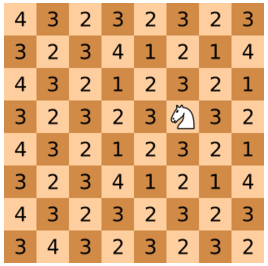
Llocs on puc fer una "forquilla"
Obertures
A00 - Orang-Utan (Tartakower) or Sokolsky
Wikipedia :
the opening is largely based upon tactics on the queenside or the f6 and g7 squares.
Marek's 1.b4
encyclopaedia ->
marek's (gone),
AngeFire
Recopilacio de'n Bill Wall
La respuesta del "pibe", as Y Seirawan :
1.b4 c6 2.Ab2 Db6 3.a3 a5 4.e3 axb4 5.Ad4 c5 6.Axc5 Df6 7.Ad4 e5
Una trampa en aquesta línia :
1.b4 c6 2.Ab2 Db6 3.a3 a5 4.c4 axb4 5.c5 Dxc5 ? 6.axb4 Dxb4 7.Txa8 !
Una altra de millor :
1.b4 c6 2.Bb2 Qb6 3.a3 a5 4.e3 d5 5.Bd4 Qc7 6.f4 axb4 7.axb4 Rxa1 8.Bxa1 Nd7 9.Nf3 Ngf6 10.Qc1 e6
Estil Jordi Bada, jugant 'normal' :
1.b4 e5 2.Ab2 Axb4 3.Axe5 Cf6 4.Cf3 0-0 5.e3 Cc6 5.Bd2 d5
As Bernabe vs Marc in Sants :
1.b4 e5 2.Bb2 Bxb4 3.Bxe5 Nf6 4.Nf3 Nc6 5.Bb2 O-O 6.c4 d5 7.e3 Re8 8.Be2 Bg4 9.Qb3 Qe7 10.O-O dxc4
11.Qxc4 Bh5 12.Nc3 Bxf3 13.Bxf3 Ne5 14.Qe2 Nxf3+ 15.Qxf3 c6 16.d4 Rad8 17.Ne2 Ne4 18.Rfd1 Rd6 19.Ng3 Rf6 20.Qxe4 Qxe4
21.Nxe4 Rxe4 22.d5 Rd6 23.dxc6 bxc6 24.Rxd6 Bxd6 25.Rd1 Be7 26.Rd7 f6 27.Rd4 Re6 28.g3 c5 29.Rd2 Ra6 30.Bc3 Ra3
31.Rc2 Kf7 32.Kf1 Ke6 33.e4 Bd6 34.Ke2 Be5 35.Bxe5 Kxe5 36.Rxc5+ Kxe4 37.Rc4+ Kd5 38.Rc7 Rxa2+ 39.Kf3 g5 40.Rxh7 a5
41.Rd7+ Ke5 42.Re7+ Kd6 43.Re4 f5 44.Re1 g4+ 45.Ke3 a4 46.h4 gxh3 47.Rh1 a3 48.Rxh3 Ra1 49. Rh6+ Kd5 50.Ra6 a2
51.Kf4 Kc4 52.Kxf5 Kb3 1/2-1/2
A01 - Larsen system
1.b3 : wiki
Main lines :
1.b3
1...e5 2.Bb2 Nc6
3.e3 d5 4.Bb5 Bd6 5.c4
3.f4 is the Paschmann Gambit
f5 3.e4 is called the Ringelbach Gambit
1...d5
2.Nf3 to transpose to the A06 line
2.Bb2 to proceed in the A01 line
1...Nf6 2.Bb2
2...g6 then 3.e4
3.g4 is called the Spike Variation
1...c5
2.c4 transposing to an English Opening
2.e4 transposing to a Sicilian Defence
Larsen suffered a setback in the 1970 USSR vs. Rest of the World match in Belgrade,
where Larsen played it against reigning World Champion Boris Spassky and lost in 17 moves -
play it at chessgames
Bobby Fischer employed 1.b3 on at least five occasions in 1970, winning all five,
including games with GM Filip ( play it ),
GM Mecking ( play it ),
GM Tukmakov ( play it ),
and GM Andersson ( play it )
(A02-A03) Bird's opening
A good defense against Bird ?
I would recommend a setup with d5 Nf6 g6 Bg7 0-0 c5 and Nc6, with a flexible position.
Timothy Taylor's book on Bird's Opening puts the main line as follows:
1.f4 d5 2.Nf3 g6(1) 3.e3 Bg7(1) 4.Be2 Nf6 5.0-0 0-0 6.d3 c5
(1) prevent white fianchetto on Queen's side
The possible responses are :
1.f4 d5 - white can
a) fianchetto his king's bishop with Nf3, g3, Bg2, and 0-0 with a reversed Leningrad Dutch
b) adopt a stonewall formation with pawns on d4, e3, and f4 and attempt a kingside attack
c) fianchetto his queen's bishop to increase his hold on the e5 square
d) play e3, Be2, 0-0, d3 and attempt the break e3-e4 by various means, e.g. Ne5, Bf3, Qe2 and finally e4, or simply Nc3 followed by e4
1.f4 e5 - From's gambit
1.f4 Nf6
1.f4 g6 - sort of modern defense
1.f4 c5 - may transpose into Tahl gambit
1.f4 b6
1.f4 b5 - polish defense
1.f4 f5 - simetric reply
1.f4 g5 - Hobbs gambit
Wikipedia
Elementary video
Games :
A02 - From gambit
1.f4 e5
2.fxe5 d6 3.exd6 Bxd6 4.Nf3 g5 {Lasker variation} 5.g3 g4 6.Nh4
5.d4 g4 6.Ne5
2.e4 {C30, King's gambit}
(A07-A08) King's Indian attack
The King's Indian Attack (or KIA), also known as the Barcza system, after Gedeon Barcza,
is a chess opening system for white, characterized by several moves.
The center pawns are developed to d3 and e4, the knights are developed to d2 and f3,
the king's bishop fianchettoes at g2 following the g-pawn's movement to g3, and white castles kingside.
The resulting arrangement has multiple positional themes:
the pawn at d3 and the knight at d2 both defend the pawn at e4, the knight at f3 attacks the center,
the fianchettoed bishop may influence the center following subsequent moves, and castling removes the king to safety while bringing a rook into the game.
Conceptes a wikipedia :
the KIA is often used against the semi-open defences where black responds asymmetrically to e4,
such as in the French defence, Sicilian defence, or Caro–Kann defence.
Punts forts
Punts febles
Harry Golombek once said of Barcza :
"[he] is a most versatile player in the openings.
He plays g2–g3 sometimes on the first, sometimes on the second, sometimes on the third, and sometimes not until the fourth move."
Partides famoses
Fischer–Myagmarsuren, Sousse Interzonal 1967
1.e4 e6 2.d3 d5 3.Nd2 Nf6 4.g3 c5 5.Bg2 Nc6 6.Ngf3 Be7 7.0-0 0-0 8.e5 Nd7
9.Re1 b5 10.Nf1 b4 11.h4 a5 12.Bf4 a4 13.a3 bxa3 14.bxa3 Na5 15.Ne3 Ba6 16.Bh3 d4
17.Nf1 Nb6 18.Ng5 Nd5 19.Bd2 Bxg5 20.Bxg5 Qd7 21.Qh5 Rfc8 22.Nd2 Nc3 23.Bf6 Qe8 24.Ne4 g6
25.Qg5 Nxe4 26.Rxe4 c4 27.h5 cxd3 28.Rh4 Ra7 29.Bg2 dxc2 30.Qh6 Qf8 31.Qxh7+ 1–0
Richard Reti vs Akiba Rubinstein, Karlsbad 1923
Gedeon Barcza vs Robert James Fischer
Zurich (1959), King's Indian Attack: Symmetrical Defense
1. Nf3 Nf6 2. g3 g6 3. b3 Bg7 4. Bb2 O-O 5. Bg2 d6 6. d4 e5 7. dxe5 Nfd7 8. O-O Nc6
9. c4 dxe5 10. Ne1 Nd4 11. Nc3 c6 12. Nd3 f5 13. e3 Ne6 14. Na4 Qe7 15. Qc1 Re8 16. f3 h5
17. Qe1 Ng5 18. f4 e4 19. Bxg7 Qxg7 20. Ndc5 Nxc5 21. Nxc5 Nf7 22. Rd1 b6 23. Na4 Be6
24. Qc3 Rad8 25. Qc2 g5 26. Rf2 h4 27. Rxd8 Rxd8 28. Qb2 Qg6 29. Bf1 gxf4 30. exf4 Nh6
31. Rg2 Kf7 32. gxh4 Qf6 33. Qxf6+ Kxf6 34. Be2 Bf7 35. Nb2 Rd4 36. h3 Ng8 37. Kf1 Ne7
38. h5 Rd2 39. Bd1 Rd8 40. Ke1 c5 41. Rd2 Rd4 42. a3 Nc6 43. Rg2 Nd8 44. Kf2 Ne6
45. Ke3 Rd8 46. Rg3 Rh8 47. Na4 Bxh5 48. Bxh5 Rxh5 49. Nc3 Nxf4 50. Nxe4+ fxe4
51. Kxf4 Rh4+ 52. Ke3 Kf5 53. b4 a5 54. bxc5 bxc5 55. a4 Rh7 56. Kf2 Rb7 57. h4 Kf4
58. Rh3 Kg4 59. Rh1 Kf4 60. Rh3 Ke5 61. h5 Kd4 62. h6 Rh7 63. Rh1 Kd3 64. Rh5 e3+
65. Ke1 Rb7 66. Rd5+ Kxc4 67. Rh5 Rh7 68. Ke2 Kb4 69. Rh4+ c4 70. Kxe3 Kb3
71. Kd2 c3+ 72. Kc1 Rf7 73. Rd4 Rf6 74. Rd8 Rf1+ 75. Rd1 Rxd1+ 76. Kxd1 Kb2 77. h7 c2+
78. Ke2 c1=Q 79. h8=Q+ Kb3 80. Qe8 Qc4+ 81. Kd2 Qd5+ 82. Ke2 Kc2 83. Qc8+ Kb2
84. Qb8+ Kc3 85. Qc8+ Kd4 86. Qh8+ Kc4 87. Qc8+ Kb4 88. Qe8 Qc4+ 89. Kd2 Qd4+
90. Ke2 Qb2+ 91. Kd3 Qc3+ 92. Ke2 Qc2+ 93. Ke3 Ka3 94. Qb5 Qxa4 95. Qxa4+ Kxa4 1/2-1/2
KIA URLs
- exeter chess club
- C1. KIA vs. Alekhin 1. e4 Nf6: 1. e4 Nf6 2. d3 and 3. g3/Bg2
- C2. KIA vs. Caro-Kann 1. e4 c6: 1. e4 c6 2. d3 d5 3. Nd2
- C3. KIA vs. French 1. e4 e6: 1. e4 e6 2. d3 d5 3. Nd2
- C4. KIA vs. Pirc/Modern 1. e4 ...d6/...g6: 1. e4 d6 2. d4 Nf6 3. Nc3 g6 4. Nge2 and 5. g3, 6. Bg2
- C5. KIA vs. Sicilian
- D1. Center Counter (Scandanavian) 1...d5
- D2. Gurgenidze Defence ...c6/...d5/...g6
- D3. Nimzovitch Defence
- D4(a) 1...b6 ( Owen's Defence
- D4(b) St.George's Defence 1...a6,
- D4(c) the Borg Defence 1. e4 g5
- wikipedia, Barcza system
(A10-A39) English opening
chessgames A10, 5348
The ideas behind : Exeter Chess Club [*****]
Good intro + 3 nice games :
Petrosian vs Botvinnik, 1963,
Smyslov vs V Liberzon, 1969,
E Nikolic vs Fischer, 1968
Video apertura inglesa en 15 minutos, Luis Fernandez Siles.
Yasser Seirawan speech - sequence is like this :
1.c4 e5 2.g3 g6 3.Bg2 Bg7 4.Nc3 Nc6
5.e3 + Ne2
5.d3 + Nf3
5.e4 + d3 + Ne2 {Botvinnik's triangle}
5.Rb1 {Seirawan's choice}
Reti's comments :
"Now I will propose a thesis, the proof of which the reader and I can seek together.
It is known that the significance of a single tempo, and thus the significance of development, is greatest in open positions.
In closed positions it plays almost no role.
Consequently, it would seem to be in white's interest to open the game (without loss of tempo, of course).
How can this be achieved?
Most likely by exposing and attacking the opponent's strong points.
One would expect black's strongest point in the center to be d5 since, unlike e5, it has natural protection by the queen.
Therefore, the ideal initial move is 1.c4, immediately taking aim at d5.
Should black support d5 by l...Nf6, then white reinforces the attack by 2.Nc3.
Let's assume that black answers 2...e5.
This weakens d5 and reveals his intention of building his position around e5 by such moves as ...Nc6 and ...d6.
(Even with 2...e6 he could not control d5 in the long run.)
Now white need not continue attacking d5, which black abandoned without a fight, by 3.g3 and 4.Bg2.
Rather, following the logic given above, white should strike the new bastion e5 by 3.Nf3 and (in reply to 3...d6 or ...Nc6) 4.d4,
and he thereby achieves an advantage."
exeter chess club {*** brillant ***}
Botvinnik system :

Variants :
A10 1.c4
A11 1.c4 c6 (Caro-Kann Defence)
A12 1.c4 c6 2.Nf3 d5 3.b3
A13 1.c4 e6
A14 1.c4 e6 2.Nf3 d5 3.g3 Nf6 4.Bg2 Be7 5.0-0
A15 1.c4 Nf6
A16 1.c4 Nf6 2.Nc3
A17 1.c4 Nf6 2.Nc3 e6
A18 1.c4 Nf6 2.Nc3 e6 3.e4 (Mikenas-Carls Variation)
A19 1.c4 Nf6 2.Nc3 e6 3.e4 c5
A20 1.c4 e5
A21 1.c4 e5 2.Nc3
A22 1.c4 e5 2.Nc3 Nf6
A23 1.c4 e5 2.Nc3 Nf6 3.g3 c6 (Bremen System, Keres Variation)
A24 1.c4 e5 2.Nc3 Nf6 3.g3 g6 (Bremen System with ...g6)
A25 1.c4 e5 2.Nc3 Nc6
A26 1.c4 e5 2.Nc3 Nc6 3.g3 g6 4.Bg2 Bg7 5.d3 d6
A27 1.c4 e5 2.Nc3 Nc6 3.Nf3 (Three Knights System)
A28 1.c4 e5 2.Nc3 Nc6 3.Nf3 Nf6
A29 1.c4 e5 2.Nc3 Nc6 3.Nf3 Nf6 4.g3 (Four Knights, Kingside Fianchetto)
A30 1.c4 c5 (Symmetrical Variation)
A31 1.c4 c5 2.Nf3 Nf6 3.d4 (Symmetrical, Benoni Formation)
A32 1.c4 c5 2.Nf3 Nf6 3.d4 cxd4 4.Nxd4 e6
A33 1.c4 c5 2.Nf3 Nf6 3.d4 cxd4 4.Nxd4 e6 5.Nc3 Nc6
A34 1.c4 c5 2.Nc3
A35 1.c4 c5 2.Nc3 Nc6
A36 1.c4 c5 2.Nc3 Nc6 3.g3
A37 1.c4 c5 2.Nc3 Nc6 3.g3 g6 4.Bg2 Bg7 5.Nf3
A38 1.c4 c5 2.Nc3 Nc6 3.g3 g6 4.Bg2 Bg7 5.Nf3 Nf6
A39 1.c4 c5 2.Nc3 Nc6 3.g3 g6 4.Bg2 Bg7 5.Nf3 Nf6 6.0-0 0-0 7.d4
Wiki
Playing against the English opening
There are three major branches after 1. c4:
- 1. ...e5 would suit a 1.e4 player who likes to attack,
especially if they play (as white) the Closed Sicilian or (as black) the Dutch or King's Indian.
I think this is the best approach for beginners.
- 1. ...c5 would suit a Sicilian player who has the patience for a longer game but doesn't mind drawing occasionally.
- 1. ...Nf6 would suit a player who is angling for a version of their favourite Indian defence.
A30 symetrical break
1. c4 c5 2. Nc3 Nc6 3. Nf3 Nf6 4. g3 g6 5. Bg2 Bg7 6. O-O O-O
7. d4 cxd4 8. Nxd4 Nxd4 9. Qxd4 d6 10. Bg5 Be6 11. Qf4 Qa5 12. Rac1 Rab8 13. b3 Rfc8 14. Qd2 a6 15. Be3
GK vs Vassily Ivanchuk
Partida super agresiva, 1988 :
1.c4 Nf6 2.Nc3 e5 3.Nf3 Nc6 4.g3 Bb4 5.Bg2 0-0 6.0-0 e4 7.Ng5 Bxc3 8.bxc3 Re8 9.f3 exf3 10.Nxf3 d5
11.d4 Ne4 12.Qc2 dxc4 13.Rb1 f5 14.g4 Qe7 15.gxf5 Nd6 16.Ng5 Qxe2 17.Bd5+ Kh8 18.Qxe2 Rxe2 19.Bf4 Nd8 20.Bxd6 cxd6
21.Rbe1 Rxe1 22.Rxe1 Bd7 23.Re7 Bc6 24.f6 1-0
MC vs Giri, 2018, Tata
chessgames
Annotations by Dejan Bojkov :
1.Nf3 Nf6 2.c4 e6 3.b3 d5 4.Bb2 Be7 5.e3 O-O 6.Nc3 c5 7.cxd5 Nxd5 8.Nxd5
8... exd5 9.d4 Qa5+
(9... Nc6 10.dxc5 Bxc5 11.a3 Bg4 12.Be2 Votava,J (2522) - Froewis,G (2463) Austria 2016)
10.Qd2 Qxd2+ 11.Kxd2 Nc6 12.dxc5 Bxc5
Carlsen got "his" type of position. An IQP (isolated queens pawn) in an endgame always means a slight, long-term advantage without any counterplay for the opponent.
13.Bb5 Bb4+ 14.Ke2 Be6 15.Rac1 Rac8
16.Rhd1 Carlsen is sticking to his plan of mounting pressure against the isolani.
16... Be7 17.h3 a6 18.Bd3 Nb4 19.Bb1 Rxc1 20.Rxc1 Rc8 21.Rd1! An instructive move. This rook will always be better than its counterpart.
21... Nc6 22.g4 Very classical play. One idea is to push the kingside pawns thus removing the black bishop on e6 from its optimal position.
Another is to open the road for his own bishops later.
22... h6 23.Nd4 Nxd4+ 24.Bxd4 Ba3 25.f4 f6
26.Bg6 Kf8 27.Kf3 Ke7 28.h4 Bb4 29.Bd3 Bd7 30.e4 A sudden change of the rhythm. Instead of a weak black pawn, a strong white bishop.
30... Bc3 31.Bf2 Bc6 32.exd5 Bxd5+ 33.Be4 Bxe4+ 34.Kxe4 With the obvious intention to get on the g6 square with his king.
34... Ke6! Blocking the white's king way in.
35.f5+ Ke7 36.Rc1 Rc6 Breaks the pin but at the expense of other weaknesses.
37.Kd3 Bb4 38.Rxc6 bxc6 39.Kc4 Now there are too many targets into the black camp: a6, c6 and g7 and Carlsen easily finds a way in.
39... Bd6 40.Bc5 Kd7 41.h5! Fixing the target. 41... Bf4 42.Bf8 Ke8 43.Bc5
43... Kd7 44.Kb4 The king will get in through the a5 square.
44... Bd2+ 45.Ka4 Kc7 46.b4 Bf4 47.Bf8 Kb6 48.Bxg7 Bg5 49.Bf8 Bf4 50.Be7 Bg5 51.Kb3 The world champion saw a clear way to break the fortress.
51... Kc7 52.Kc4 Kd7 53.Bc5 Kc7 54.Kd3 Kd7 55.Be3
Una coleccio de partides a chessgames :
English Opening (c4)
A40 - Polish Defence
1.d4 b5 2.e4 Bb7 3.Bd3 e6 4.Nf3 c5
(A43-44, A56-A79) Benoni defence
"Benoni" is a hebrew term meaning "son of my sorrow" (pena, dolor)
Group of chess openings generally characterized by the opening moves 1.d4 c5 2.d5,
although black's ...c5 and white's answer d5 are often delayed
Wiki Benoni
The most usual opening sequence for the Benoni is
1.d4 Nf6 2.c4 c5 3.d5
Black can sacrifice a pawn entering the Benko gambit via 3...b5
3...e6 is the most common move, though 3...d6 or 3...g6 are also seen, typically leading to main lines.
Antiga:
1.d4 c5 2.d5 Cf6
1.d4 c5 2.d5 Cf6 3.Cc3 Da5
1.d4 c5 2.d5 Cf6 3.Cf3
1.d4 c5 2.d5 Cf6 3.Cf3 c4
1.d4 c5 2.d5 Cf6 3.Cf3 g6
1.d4 c5 2.d5 d6
1.d4 c5 2.d5 d6 3.Cc3 g6
1.d4 c5 2.d5 e5
1.d4 c5 2.d5 e5 3.e4 d6
1.d4 c5 2.d5 e6 3.e4
1.d4 c5 2.d5 f5
(A43-A44) Old Benoni defence
Ideas : url,
chessgames A43
(A60-A79) Modern Benoni defence
Wiki on
Modern Benoni - very good
It begins with the moves
1.d4 Nf6 2.c4 c5 3.Nf3 - declines Benoni
cxd4 4.Nxd4 e6
e5 5.Nc2
dxc5 e6 followed by Bxc5 and Qa5+ if neccessary
1.d4 Nf6 2.c4 c5 3.d5 d6 4.Nc3 g6 5.e4 Bg7 6.Nf3 0-0 7.Be2 e6 8.0-0 Re8 {Drazen Marovic book}
1.d4 Nf6 2.c4 c5 3.d5 e6 {modern - black wants to take on d5 before white plays e4}
4.Nc3 exd5 5.cxd5 d6 6.e4 g6 7.Nf3 {A70} a6
6.g3 g6 7.Bg2 Bg7 8.Nf3 0-0 9.0-0
Na6 (Korchnoi vs Tahl)
a6 10.a4 Nd7 11.Nd2 Re8 12.h3 preventing Ng4 then Ne5
b5 {Benko gambit}
1.d4 Nf6 2.c4 e6 3.Nf3 c5 4.d5 d6 5.Nc3 exd5 6.cxd5 g6 7.e4 a6 {to prevent Qa4+} 8.a4 Bg4 {classic idea} 9.Be2 Bxf3 10.Bxf3 Bg7 11.0-0 Nbd7 12.a5 0-0 13.Bf4 {pointing d6 - Qc7, Qe7 and Ne8}
1.d4 Nf6 2.c4 e6 3.Nf3 c5 4.d5 b5!? - Blumenfeld gambit,
E10
After the initial moves, black proceeds to capture on d5, creating a majority of black pawns on the queenside.
To support their advance, the king's bishop is usually fianchettoed on g7.
White has a very strong center, and consequently, his main plan is to crush black's defense with a timely e4-e5 break.
Also, an attack on d6 pawn is usual.
Drazen Marovic says : it is a fortress with an open door : e5
But black :
- will try to use his pawn majority on the queenside to create a passed pawn which will be supported by the powerful Bg7
- will also attack white's center using the semi-open e-file
- surprisingly, an attack against white's King is also one of black's goals
Tahl showed many times the desirability of the exchange Bc8->Bg4->Bxf3,
which has long been a basic tenet (dogma) of the Benoni.
Black de-clutters his pieces and improves his control over the crucial e5-square.
See
25 Tahl games on Modern Benoni
Tahl showed some more typical Benoni motifs:
- the activation of the queen on the queenside
- the advance b5 and c4
- and further combined pressure on the queenside via the pawn majority
and the bishop's influence on the long diagonal along with pressure against e4
Yasser Seirawan excellent road map :
when black plays a6 preparing b5, white must play a4 to prevent it.
And, if white has a knight on c4, white has to try to play a5 to place the knight on b6.
Scary moves for black are e4 plus f4. Alter Bb5+, black is in trouble, except if it plays Nf6-d7.
See
Ivan Farago vs. Dragoljub Velimirovic, Amsterdam 1976
1.d4 Nf6 2.c4 c5 3.d5 e6 4.Nc3 exd5 5.cxd5 d6 6.Nf3 g6 7.Nd2 Bg7 8.Nc4 0-0 9.Bf4 Ne8 10.Qd2 b6
11.a4 Ba6 12.e3 f5 13.h4 Bxc4 14.Bxc4 a6 15.Be2 Nd7 16.e4 fxe4 17.h5 Ndf6 18.hxg6 hxg6 19.Rh3 Qd7 20.0-0-0 b5
21.axb5 axb5 22.Bxb5 Qf5 23.Be3 Ng4 24.Kb1 Nxe3 25.fxe3 Nf6 26.Rf1 Qe5 27.Qe1 Rfb8 28.Qg3 Qxc3!! 29.bxc3 Rxb5+ 30.Kc2 Ra2+
31.Kc1 Ra1+ 32.Kc2 Ra2+ 33.Kc1 Ra1+ 34.Kc2 Rxf1 35.Qxd6 Rfb1 36.Qe6+ Kf8 37.Qd6+ Ke8 38.Qc6+ Ke7 39.d6+ Ke6 40.d7+ Ke7
41.d8=Q+ Kxd8 42.Qa8+ Ke7 43.Qa7+ Ke6 44.Qa2+ Nd5 45.Rg3 Be5 46.Qa6+ Ke7
Mezgen Amanov (Turkmenistan ) – Zhanibek Amanov (Kazakhstan) :
video Nov 2011 (30:54, gone),
text by Mark Ginsburg
Taimanov attack
wiki :
The Modern Benoni suffered a serious theoretical crisis in the 1980s and 1990s,
when players as black encountered great difficulties in meeting the Taimanov Attack and the Modern Main Line
1.d4 Nf6 2.c4 c5 3.d5 e6 4.Nc3 exd5 5.cxd5 d6 6.e4 g6 7.f4 Bg7 8.Bb5+ Nfd7 9.a4
Molta gent evita la Benoni fent servir l'ordre de la Nimzovich
de manera que si el blanc no juga amb Cf3 no fa ...c5 per no entrar-hi.
Taimanov variation, or "Flick-Knife Attack", arising from the moves
1.d4 Nf6 2.c4 c5 3.d5 e6 4.Nc3 exd5 5.cxd5 d6 6.e4 g6 7.f4 Bg7 8 Bb5+
8...Nfd7 is considered the safest response to the check;
8...Nbd7 is also playable but more risky, as, inevitably, black will have to sacrifice material of some sort after 9.e5
The point of the check is that both 8...Bd7 and 8...Nbd7 allow 9.e5 with advantage to white,
since the knight on f6 can no longer retreat to d7.
After the strongest move 8...Nfd7 the most popular move used to be 9.Bd3, preparing to meet 9...a6 with 10.a4.
But in two crushing and high-profile victories with white
(against Frans Andre Cuijpers at the 1980 World Junior Chess Championship in Dortmund,
and against Nunn at the 1982 Olympiad in Lucerne)
Kasparov showed that 9.a4 was more dangerous for black,
it having the advantage of not determining the bishop's retreat square for the time being.
To avoid the Taimanov, black often plays 2...e6 and waits until white plays 3.Nf3
before entering the Benoni with 3...c5.
If white refuses to play 3.Nf3, and plays 3.Nc3 instead, black may opt for the Nimzo-Indian (3...Bb4)
1.d4 Nf6 2.c4 e6 3.Nf3 c5
1.d4 Nf6 2.c4 e6 3.Nc3 Bb4
A l'estil del Sebas
1.d4 e6 {so I can go into Dutch with 2...f5 if I like}
2.c4 c5 3.d5 exd5 4.cxd5 d6 4.e4 Nf6 5.Nc3
El cavall negre de dama es desenvolupa via a6 i c4 o a6 i c7, i despres es juga a6.
Benoni links
A45 - Trompowsky attack, also called The Zot
wiki - as simple as
1.d4 Nf6 2.Bg5
2... Ne4
3.h4 (Raptor variation)
3.Bf4
3.Bh4
3.Nf3
2... e6
2... d5
2... c5
2... g6
2... c6
3.Bxf6
3.Nf3
3.e3?? Qa5+
1.d4 d5 2.Bg5 - pseudo-Trompowsky (D00)
1.d4 f5 2.Bg5 - against the Dutch defense
White sidesteps immense bodies of opening theory of various Indian Defences like the Queen's Indian, King's Indian, Nimzo-Indian, as well as the Grünfeld Defence.
If white goes "1.d4 Cf6 2.c4", then black can choose from all his repertoire :
1.d4 Nf6 2.c4
g6 3.Nc3 Bg7 - defensa India de Rey
d5 - Grunfeld
e6 3.Nc3 Bb4 - Nimzo India
c5 3.d5 b5 - Volga gambit or Benko
Caruana vs Giri
London Chess classic, 2015 :
1.d4 Nf6 2.Bg5 d5 3.e3 c5 4.Bxf6 gxf6 5.dxc5 Nc6 6.c3 e6 7.b4 a5 8.Qb3 f5 9.Nf3 Bg7 10.b5 Nb8
11.Nbd2 0-0 12.Rc1 Nd7 13.c6 bxc6 14.bxc6 Nb8 15.Bb5 Qb6 16.Ba4 Qc5 17.0-0 Nxc6 18.c4 Ne7 19.cxd5 Qxd5 20.Qa3 Qb7
21.Rc4 Rd8 22.Rb1 Qa7 23.Qc1 Ba6 24.Rc7 Rdc8 25.Rxa7 Rxc1+ 26.Rxc1 Rxa7 27.Rc5 Bb7 28.Nb3 Bd5 29.Nfd2 Be5 30.Rxa5 Rxa5
31.Nxa5 Bxa2 32.Bb3 Bc3 33.Bxa2 Bxa5 34.Nf3 Bc7 35.Nd2 Ba5 36.Nf3 Bc7 1/2-1/2
Play it !
Also Carlsen vs Karjakin, 2016
A50 - black knight's Tango
1.d4 Nf6 2.c4 Nc6
3.Nf3 (prevents 3...e5) e6
3.Nc3 e5 4.Nf3
3.d5 Ne5 4.e4 e6 (Orlov)
wiki
(A51-A52) Budapest gambit
wiki,
chessgames A51,
video
The Budapest Gambit contains several specific strategic themes.
After 3.dxe5 Ng4, there is a battle over white's extra pawn on e5,
which black typically attacks with ...Nc6 and (after ...Bc5 or ...Bb4+) ...Qe7,
while white often defends it with Bf4, Nf3, and sometimes Qd5.
In the 4.Nf3 variation the game can evolve either with black attacking white's kingside
with manoeuvres of rook lifts, or with white attacking black's kingside with the push f2–f4,
in which case black reacts in the centre against the e3-pawn.
In numerous variations the move c4–c5 allows white to gain space and to open prospects
for his light-square bishop.
For black, the check Bf8–b4+ often allows rapid development.
1.d4 Nf6 2.c4 e5
3.dxe5 Ne4 - Fajarowicz variation
Ng4
4.Nf3 - Adler variation
4.e4 - Alekhine variation
4.Bf4 - Rubinstein variation
(A53-A55) Old Indian
wiki
1.d4 Nf6 2.c4 d6 3.Nf3 Nbd7 4.Nc3 e5 5.e4 Be7 6.Be2 0-0 7.0-0 c6 8.Qc2 Re8 9.Rd1 Bf8
10.Rb1 a5 11.d5 Nc5 12.Be3 Qc7 13.h3 Bd7 14.Rbc1 g6 15.Nd2 Rab8
New Old Indian
The main move order of our suggested repertoire is 1 d4 Nf6 2 c4 d6,
but then to navigate away from the classical Old Indian lines with ... Nbd7 and ... e5.
Our repertoire will focus on active piece play, control of the centre, in particular the e4-square,
and we have in store some surprises for unsuspecting opponents!
Modern interpretation of 2 systems\New Old Indian - Cherniaev, Alexander & Prokuronov, Eduard.pdf
1. d4 Nf6 2. c4 d6 3. Nc3 e5 4. Nf3 e4!? Gheorghiu’s 4 ... e4
5.Ng5 Qe7
(A57-A59) Benko (or Volga) gambit
1.d4 Nf6 2.c4 c5 3.d5 b5 4.cxb5 a6 5.bxa6 Bxa6
6.Nc3 d6 7.e4 Bxf1 8.Kxf1 g6 9.g3 Bg7 10.Kg2
1.d4 Nf6 2.c4 c5 3.d5 b5 4.cxb5 a6 5.bxa6 Bxa6
6.g3 d6 7.Bg2 g6 8.b3! Bg7 9.Bb2 0-0 10.Nh3 Nbd7 11.0-0
and though black has tried just about every possible move and idea, white seems to come out on top.
1.d4 Nf6 2.c4 c5 3.d5 b5 4.cxb5 a6 5.bxa6 g6
Now black can meet
6.b3 Bg7 7.Bb2 0-0 8.g3 with 8.Nxa6 9.Bg2 Bb7
... when black is doing well due to the possibilities of .Nb4 and/or .e6
Unusually for a gambit, black does not generally mind if queens are exchanged.
Волжский гамбит
Exemples
1.d4 Nf6 2.c4 c5 3.d5 b5 4.cxb5 a6 5.b6 d6
6.Nc3 Nbd7 7.e4 Qxb6 8.Nf3 e6 9.Bc4 Qb4 10.Qa4 e5
11.Bd3 Be7 12.0-0 0-0 13.a3 Qxa4 14.Nxa4 c4 15.Bc2 a5
16.Re1 Ba6 17.Nd2 Rfc8 18.Nb1 Bd8 19.Nbc3 Rab8 20.f3 Nb6
21.Bd2 g6 22.Rac1 Nfd7 23.Kh1 Nxa4 24.Nxa4 Bb5 25.Bc3 Rb7
26.g3 Bg5 27.Rcd1 Nf8 28.Kg2 h5 29.Re2 h4 30.Rf1 Bd7
31.f4 h3+ 32.Kf3 exf4 33.gxf4 Bh4 34.Rg1 Bd8 35.f5 Rb3
36.Bxb3 cxb3 37.Rg3 Bxa4 38.Rxh3 Nh7 39.Rg2 Ng5+ 40.Rxg5 Rxc3+
41.bxc3 Bxg5 [0-1]
Topalov amb negres :
1.d4 Nf6 2.c4 c5 3.d5 b5 4.cxb5 a6 5.b6 d6
6.Nc3 Nbd7 7.e4 g6 8.Nf3 Bg7 9.Be2 0-0 10.0-0 Nxb6
11.Bf4 Ne8 12.h3 Nc7 13.Qd2 Bb7 14.Bh6 f5 15.Bxg7 Kxg7
16.b4 Nd7 17.bxc5 Nxc5 18.Qd4+ Kg8 19.e5 Rc8 20.Rad1 Ne8
21.Rfe1 Ng7 22.Bf1 Rc7 23.Rc1 Qc8 24.exd6 exd6 25.Ng5 Re8
26.Qh4 Nh5 27.Rxe8+ Qxe8 28.Qb4 Qe7 29.Nf3 Nf6 30.Re1 Qd7
31.Ng5 Rc8 32.Qd4 Qg7 33.Ne6 Nxe6 34.Rxe6 Nxd5 35.Qxg7+ Kxg7
36.Nxd5 Bxd5 37.Rxd6 Bxa2 38.Rxa6 Rc2 39.g3 Rb2 40.Bg2 h5
41.h4 Rb1+ 42.Kh2 Rb2 43.Kg1 Bc4 44.Rc6 Be2 45.Rc7+ Kh6
46.Bd5 Rb8 47.Re7 Bd1 48.f4 Rd8 49.Bc4 Bc2 50.Kf2 Be4
51.Ke3 Rc8 52.Kd4 Bc2 53.Bd5 Rd8 54.Ke5 Bb1 55.Bf7 Bc2
56.Kf6 Bb1 57.Re8 Rd6+ 58.Re6 Rd8 59.Re8 Rd6+ 60.Be6 Kh7
61.Re7+ Kh6 62.Re8 Kh7 63.Kg5 Kg7 64.Rg8+ Kh7 65.Rxg6 [1-0]
5. b6 counter gambit
1.d4 Nf6 2.c4 c5 3.d5 b5 4.cxb5 a6 5.b6
url
URLs
Chess corner
Chess coach (01/2006)
Wikipedia
349 partides per jugar on-line (Java)
Everything in life is temporary.
So, if things are going well, enjoy it because it won't last forever.
And if things are going badly, don't worry. It can't last forever either.
(A80-A99) defensa Holandesa
Chessgames A80-A99,
Botvinnik's (33)
What was so special about Botvinnik's treatment of the Dutch is its attacking potential and strategical simplicity.
Black's plan is :
- first place his pawns on the c6, d5, e6 and f5 squares - this formation resembles a wall and that's how the Dutch Stone Wall system got its name.
- then the black knight goes to e4
- the queen goes to h5 via the e8 square
- the rook lift (Rf8-f6-h6)
- then the 'f' and 'g' pawns storm completes this dangerous attacking set-up
A80: 1.d4 f5
A81: 1.d4 f5 2.g3
A82: 1.d4 f5 2.e4 (A82
Staunton gambit)
A82: 1.d4 f5 2.e4 d6 (defensa Balogh)
A83: 1.d4 f5 2.e4 fxe4 3.Nc3 Nf6 4.Bg5 Nc6 5.d5 (Staunton gambit)
5.Bxf6? exf6 6.Nxe4 Qe7 7.Qe2 Nxd4 8.Qd3 d5 9.Qxd4 Qxe4+ 10.Qxe4 dxe4
d5? 6.Axf6 exf6 7.Dh5+ g6 7.Dxd5 Dxd5 8.Cxd5 Rd8 (el cavall ataca f6 i c7) - SAG, 20170825
4.f3
4.g4?! h6! (Tartakower variation)
A84: 1.d4 f5 2.c4
A85: 1.d4 f5 2.c4 Nf6 3.Nc3 (Rubinstein variation)
A86: 1.d4 f5 2.c4 Nf6 3.g3
A87: 1.d4 f5 2.c4 Nf6 3.g3 g6 4.Bg2 Bg7 5.Nf3 (Leningrad Dutch)
A88: 1.d4 f5 2.c4 Nf6 3.g3 g6 4.Bg2 Bg7 5.Nf3 0-0 6.0-0 d6 7.Nc3 c6 (Leningrad Dutch, Warsaw variation )
A89: 1.d4 f5 2.c4 Nf6 3.g3 g6 4.Bg2 Bg7 5.Nf3 0-0 6.0-0 d6 7.Nc3 Nc6 (Leningrad Dutch)
A90: 1.d4 f5 2.c4 Nf6 3.g3 e6 4.Bg2
A91: 1.d4 f5 2.c4 Nf6 3.g3 e6 4.Bg2 Be7
A92: 1.d4 f5 2.c4 Nf6 3.g3 e6 4.Bg2 Be7 5.Nf3 0-0
A93: 1.d4 f5 2.c4 Nf6 3.g3 e6 4.Bg2 Be7 5.Nf3 0-0 6.0-0 d5 7.b3 (Botvinnik variation)
A94: 1.d4 f5 2.c4 Nf6 3.g3 e6 4.Bg2 Be7 5.Nf3 0-0 6.0-0 d5 7.b3 c6 8.Ba3 (Stonewall)
A95: 1.d4 f5 2.c4 Nf6 3.g3 e6 4.Bg2 Be7 5.Nf3 0-0 6.0-0 d5 7.Nc3 c6 (Stonewall)
A96: 1.d4 f5 2.c4 Nf6 3.g3 e6 4.Bg2 Be7 5.Nf3 0-0 6.0-0 d6
A97: 1.d4 f5 2.c4 Nf6 3.g3 e6 4.Bg2 Be7 5.Nf3 0-0 6.0-0 d6 7.Nc3 Qe8 (Ilyin-Genevsky variation)
A98: 1.d4 f5 2.c4 Nf6 3.g3 e6 4.Bg2 Be7 5.Nf3 0-0 6.0-0 d6 7.Nc3 Qe8 8.Qc2 (Ilyin-Genevsky variation)
A99: 1.d4 f5 2.c4 Nf6 3.g3 e6 4.Bg2 Be7 5.Nf3 0-0 6.0-0 d6 7.Nc3 Qe8 8.b3 (Ilyin-Genevsky variation)
8.Nd5!? {see
Lugovoi - Kindermann}
{anti-dutch}
1.d4 f5 2.Bg5 h6 3.Bh4 g5 4.e3 Nf6 5.Bg3 Bg7 {Hopton attack}
1.d4 f5 2.Nc3 {A80, Raphael variation}
1.d4 f5 2.g4 {
Krejik gambit}
After 1.d4 f5, play often runs 2.g3 Nf6 3.Bg2 e6 4.Nf3
(4.Nh3!? is also possible, intending Nf4–d3 to control the e5 square if black plays the Stonewall variation)
Be7 5.0-0 0-0 6.c4
And now black chooses between
- 6...d5 (the characteristic move of the Stonewall),
- 6...d6, the Ilyin–Zhenevsky System (less popular today), or
- 6...Ne4!?, Alekhine's move , retaining the option of moving the d-pawn either one or two squares.
Wiki Dutch
I si comencem per 1. ...e6 ?
Doncs e6 és bo si penses fer una francesa si seguixen amb e4.
D'altra banda evita tots els gambits que existeixen contra f5 directe.
Jo crec que podem anar a una Benoni :
1.d4 e6 2.e4 c5 3.Cf3 cxd4 4.Cxd4 a6 o Cc6
Why does white fianchetto ?
Black's problem piece is the light squared bishop, due to the placement of the pawns on the light squares.
White has three reasonable squares to place his king's bishop, namely e2, d3 or g2.
If white decides to place his bishop on either e2 or d3
then black has the opportunity to get rid of his problem bishop via b6 and Ba6.
If the king's bishop is placed on g2 this option is no longer available for black
and he will have to find another plan to activate or trade his weak bishop.
(A82-A83) Dutch, Staunton gambit
It is the most aggressive response to f5 -
wiki ,
rapporto di apertura [it, tons of links]
1.d4 f5 2.e4 fxe4 3.Cc3 Cf6
4.Ag5 Cc6 5.d5 Ce5 6.Qe2 Cf7 - classic
4.f3 - in the style of Blackmar-Diemer gambit
4.g4? h6! - Tartakower varation
d6 3.exf5 Bxf5 4.Qf3 Qc8 5.Bd3 -
Balogh defence
Incredible game Lasker Ed vs Thomas G, A83
Es pot jugar així :
1.d4 f5 2.e4 fxe4 3.Nc3 Nf6 4.Bg5 e6 5.Nxe4 Be7 6.Bxf6 Bxf6 7.Qh5+ g6 8.Qh6 Qe7 9.Nxf6+ Qxf6 10.O-O-O Nc6
Aixi el juga en Jordi :
1. d4 f5 2. e4 fxe4 3. Nc3 Nf6 4. Bg5 c6 5. d5 Qa5 6. Bxf6 exf6 7. Qh5+ g6 8. Qe2 Bb4
9. Qxe4+ Kf7 10. Qc4 Bxc3+ 11. bxc3 Re8+ 12. Be2 cxd5 13. Qd3 Nc6 14. Nf3 b6 15. O-O Rxe2 16. Qxe2 Ba6
17. Qd2 Bxf1 18. Rxf1 Kg7 19. c4 Qxd2 20. Nxd2 dxc4 21. Nxc4 d5 22. Ne3 Rd8 23. Rd1 d4 24. Nc4 Kf7
25. h4 Ke6 26. Re1+ Kd5 27. Nd2 Ne5 28. h5 gxh5 29. Ne4 f5 30. Ng3 Rc8 31. Nxh5 Rxc2 32. Nf4+ Kd6
Mine :
1.d4 f5 2.e4 fxe4 3.Nc3 e6 4.Nxe4 Nf6 5.Bd3 Be7 6.Nxf6+ Bxf6 7.Qh5+ Ke7
8.Nf3 d6 9.Ng5 Qe8 10.Qe2 h6 11.Nf3 Nc6 12.c3 Kf7 13.Qe4 Qe7 14.O-O Qd7 15.Re1 Re8 16.d5 exd5
Tahl vs Paul Troeger, 1960 : gambit "Staunton"
1.d4 f5 2.e4 fxe4 3.Nc3 Nf6 4.Bg5 Nc6 5.d5 Ne5 6.Qd4 Nf7 7.Bxf6 exf6 8.Nxe4 Be7
9.O-O-O O-O 10.g4 d6 11.h3 c5 12.dxc6 bxc6 13.Ng3 Qa5 14.Qe4 Ne5 15.f4 d5 16.Qe1 Qxa2
17.fxe5 Qa1+ 18.Kd2 Bb4+ 19.Ke2 Qxb2 20.Rd2 Qxe5+ 21.Kd1 Qa1+ 0-1
A85 - Dutch, Rubinstein variation
Black wants to exchange the black-square bishop for the knight at c3, but dont kill until a3 or white castling!
1.d4 f5 2.c4 Nf6 3.Nc3
Bb4 4.Qb3 Qe7!
c5
A87 - Dutch, Leningrad variation
We start at this position (reached by different move orders) :
1.d4 f5 2.c4 Nf6 3.g3 g6 4.Bg2 Bg7 5.Nf3 O-O 6.O-O d6 7.Nc3
Nc6 {idea : play e5}
c6 {more solid, less sharp}
Qe8 {idea : play e5}
Ideas de las blancas :
- avance central d4-d5 - habilita d4 para el caballo de f3, presion sobre e6 y c6
- avance b2-b4
- debilidad diagonal a2-g8
- ataque en el flanco de rey - sin enroque, Ch3+Cf4 +h4+h5
Ideas de las negras :
- avance e7-e5 contra d4-d5 (apoyado por De8 quizas)
- avance d6-d5
- avance f5-f4
- avance h5-h4
- ruptura b7-b5
After e5 we shall go with h6, g5 and Qh5 !
This variation may be played by black against 1.d4 and almost any second move except e4, Nc3, Bg5, and g4.
En aquestos cassos ens trobem amb :
1.d4 f5 2.e4 fxe4 3.Nc3 Nf6 4.Bg5 Nc6 - A83, Staunton gambit
1.d4 f5 2.Nc3 Nf6 3.Bg5 d5 4.Bxf6 exf6 5.e3 - A80, Raphael variation
1.d4 f5 2.Bg5 g6 3.Nc3 Bg7 4.h4 d5 - Hopton attack
1.d4 f5 2.g4 fxg4 3.h3 d5 4.hxg4 Bxg4 - Korchnoi attack
Nice book we have : "defensa holandesa (Leningrado)" by Oscar de la Riva -> TG & MARS/Minie :
Por otro orden :
1.d4 g6 2.c4 Bg7 3.Nf3 f5 -> Leningrado
3.Nc3 ->
3.e4 ->
A87 - Dutch, Leningrad variation, 7...Nc6
White can play d5 or b3 :
Atencio : Oscar de la Riva, pagina 27 de 205 !
La variante 8 ... Ce5 es la alternativa más incisiva para las negras si se quiere luchar rápidamente por la iniciativa
El principal problema de las negras en todo el sistema reside en la tranquila 9. Db3
A88: Dutch, Leningrad variation, 7...c6
This line is more solid and less sharp :
1.d4 f5 2.c4 Nf6 3.g3 g6 4.Bg2 Bg7 5.Nf3 O-O 6.O-O d6 7.Nc3 c6 {A88, Warsaw variation}
8.d5 e5
8.b3 Na6
See Gelfand - Nakamura :
1. d4 f5 2. g3 Nf6 3. Bg2 g6 4. c4 Bg7 5. Nc3 O-O 6. Nf3 d6
7. O-O c6 8. d5 e5 9. dxe6 Bxe6 10. b3 Re8 11. Bb2 Na6 12. Ng5 Qe7
13. Nxe6 Qxe6 14. Qc2 Nc5 15. Rad1 Rad8 16. e3 Nce4
17. Nxe4 fxe4 18. Rd2 d5 19. cxd5 cxd5 20. Qc5 b6 21. Qb5 Nh5
22. Ba3 Bf8 23. Bb2 Bg7 24. Ba3 Be5 25. Rc1 Nf6 26. Rdc2 d4
27. Rc6 Qf5 28. exd4 Bxd4 29. Qxf5 gxf5 30. Bh3 e3 31. Bxf5 exf2+
32. Kf1 Be3 33. Rb1 Ne4 34. Bxe4 Rxe4 35. Rc2 Red4 0-1
Atencio : Oscar de la Riva, pagina 43 de 205 !
La variante 8 ... c6 , a l contrario que 8 ... Cc6 analizada en el capítulo anterior,
se caracteriza por su solidez pues no existe ninguna variante que ponga en serios aprietos al siste ma de juego.
A87 - Dutch, Leningrad variation, "7 ... De8 8.d5 a5"
El avance 8.d5 pretende dificultar el principal plan de juego negro) basado en la ruptura e5.
La intención es asegurarse la captura al paso para así debilitar la cadena negra de peones,
a la vez que se cede la casilla d4 para el caballo,
desde donde controla todas las casillas críticas del centro.
Por supuesto) no todo iban a ser ventajas.
El que se cede la casilla de c5 que se convierte en el eje de todo el sistema de juego negro.
De este modo se puede completar el desarrollo y, posteriormente, atacar la cadena blanca con c6.
Existen dos jugadas posibles que mantienen la misma idea estratégica,
pero que se separan en la realización de jugadas concretas por parte de las blancas.
En este capítulo analizaremos el plan a5 seguido de Ca6,
mientras que en el siguiente veremos Ca6 inmediatamente.
Como ya he comentado) la idea estratégica es la misma, pero hqy que conocer los diferentes matices, con sus ventqjas e inconvenientes.
Leningrad versus London system
Inconvenient de la Leningrado : has de començar amb f5 i et respondran amb e4.
Solucio : començar amb g6
Some A87 games, some URLs
Lugovoi - Kindermann
From book "Dutch Leningrad 8.Nd5!.pdf" :
1.d4 f5 2.g3 Nf6 3.Bg2 g6 4.Nf3 Bg7 5.0-0 0-0 6.c4 d6 7.Nc3 Qe8 8.Nd5!?
2.c4 Nf6 3.g3 g6 4.Bg2 Bg7 5.Nf3 O-O 6.O-O d6 7.Nc3 c6
Nxd5 9.cxd5 Nd7 10.Ng5 {va cap a e6} Nb6
Que fem contra 0-0-0 ?
Vist que tenim f5, podem tenir greus problemes si el blanc fa h3 i g4 sense haver enrocat curt.
2 punts :
- si pots fer Ab4 clavant el cavall es mes util que jugarlo a e7.
Aquest alfil es el alfil 'torpe', que mai saps molt be quina funcio et pot fer.
- es tracta de jugar g6-Ag7 i esperar a enrocar fins que el blanc no mostri les seves intencions.
A93 - Dutch, Stonewall, Botvinnik variation
1.d4 f5 2.c4 Nf6 3.g3 e6 4.Bg2 Be7 5.Nf3 O-O 6.O-O d5 7.b3
354chess
A94 : Dutch, Stonewall with Ba3
1.d4 f5 2.c4 Nf6 3.g3 e6 4.Bg2 Be7 5.Nf3 O-O 6.O-O d5 7.b3 c6 8.Ba3
A95 - Dutch, Stonewall
1.d4 f5 2.c4 Nf6 3.g3 e6 4.Bg2 Be7 5.Nf3 O-O 6.O-O d5 7.Nc3 c6
chessgames A95
Modern Stonewall
Black plays an earlier ...d5 and places his dark-squared bishop on d6.
Termed the Modern Stonewall, this setup has remained more popular than the traditional early ...Be7.
1.d4 e6 2.c4 f5 3.g3 Nf6 4.Bg2 d5 5.Nf3 c6 6.O-O Bd6
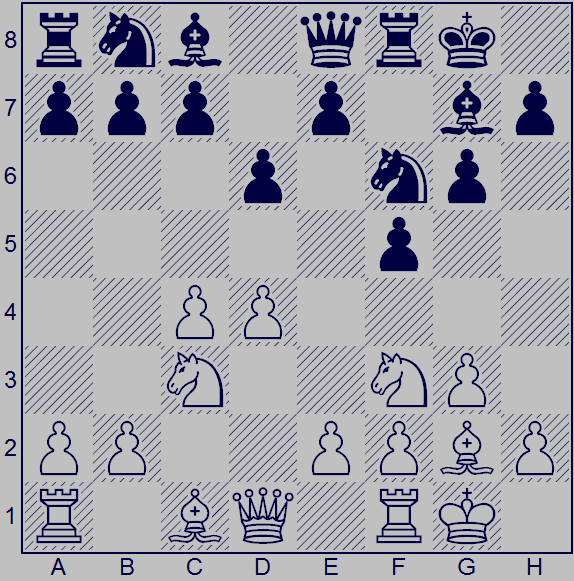
Classic position
When white does not fianchetto, we usually come to this position (see image) by this sequence :
1.d4 e6 2.c4 f5 3.Nc3 Nf6 4.Nf3 Be7 5.Bf4 O-O 6.e3 d6 7.h3 Qe8 8.Bd3
Has d’intentar fer e5 en bones condicions i tenir-ho preparat sobretot si el blanc et fa e4 en bones condicions
(ara encara no es facil perque te el alfil negre “penjant”).
No es aconsellable finachet en aquesta posicio un cop fet e6 perque un cavall a g5 combinat amb un d5 et pot fer molta pupa ...
A97 - Dutch, Ilyin-Genevsky
chessgames +
A97 opening,
explorer
Some A80-A99 games
Tahl vs. Reinemer :
1.d4 f5 2.Nf3 Nf6 3.Bg5 Ne4 4.h4 Nxg5 5.hxg5 g6
Classical Variation Karjakin, Sergey (2791) vs. Carlsen, Magnus (2914)
1.d4 f5 2.g3 Nf6 3.Bg2 e6 4.c4 d5 5.Nd2
(5.Nf3 Bd6 6.Nc3 c6 7.Bf4 Bxf4 8.gxf4 O-O 9.e3 Bd7 10.Qb3 Qc7 11.O-O Be8 12.Rfc1 Qe7 Eljanov,P (2755)-Carlsen,M (2840) Wijk aan Zee 2017)
5... Bd6 6.Nh3 O-O 7.O-O Nc6
(7... h6 8.Nf4 Bxf4 9.gxf4 Nc6 10.Nf3 dxc4 11.e3 Nd5 12.Bd2 b5 13.Qe2 Ba6 14.Rfc1 Rb8 Sachdev,T (2429) - L'Ami,E (2614) Reykjavik 2017)
8.e3 b6 9.b3 a5 10.Bb2 Ba6 11.Nf4 Bxf4 12.exf4 Ne4 13.Re1 Re8 14.Re3 Qd7 15.Nxe4 fxe4 16.f3 dxc4 17.fxe4 cxb3
18.d5 exd5 19.Qxb3 a4! A beautiful pawn sacrifice to weaken the light squares. 20.Qxa4 Bf1 21.Qd1 Bxg2 22.Kxg2 Na5
White's position alreadly looks strategically lost. 23.Rc3 d4 24.e5 Nc4 25.Rf3 c5 26.Bc1 Qd5 27.Kh3 Rad8
28.Rd3 Re6 29.Qf3 Qxf3 30.Rxf3 d3 31.Be3 d2 32.Rd1 Rd3 33.f5 Rxe5
Killer Dutch book (2015)
The Simon William’s book covers "Classical Dutch" (with pawns on f5-e6-d6 and Bishop on e7, as Figure #1),
as opposed to the Stonewall (with pawns on f5-e6-d5-c6 and Bishop on d6, as Figure #2)
or Leningrad (King-side fianchetto).
The opening itself is a recommended choice for those looking for excellent winning chances as black versus 1.d4 / 1.c4 / 1.Nf3
Ginger GM homepage, Simon Williams
Rules and variations
(rule 1/8) Black has to try to play ...e5 ; white has to try to play e4.
If black has no e5 available, it will lead to an inferior position because white will be able to open the e-file and attack our weak e6 pawn.
If white plays e4, black is forced to capture with ...fxe4 ; white will place a rook on e1 and place pressure against e6 pawn.
(rule 2/8) black's light-squared Bishop has to stay on c8 for a while,
as it is already reasonably placed for black’s purposes,
only moving it when it can come into the game with great effect perhaps on g4 or h3.
(rule 3/8) Black's queen has to try to reach h5 square.
(rule 4) If white does not fianchetto on short side, black has to play b6 and Bb7.
(rule 5) Rook lift via f8 and f6, then g6 or h6 - see G Abramovic vs Mikhail Botvinnik, 1924 :
1.d4 f5 2.Nf3 Nf6 3.c4 e6 4.Nc3 b6 5.Bg5 Be7 6.e3 Bb7 7.Bd3 O-O 8.O-O Ne4 9.Bxe7 Qxe7 10.Rc1 Na6
11.a3 Rf6 12.Qa4 (?) Nxc3 13.Rxc3 Bxf3 14.Qxa6 Rg6 15.g3 Qg5 16.Re1 Qh5 17.e4 Qxh2+ 0-1
(rule 6) Meet d5 with ...e5
This implies not to place a Knigth on c6, except if there a white Queen on c2 (and we have played a5, so we can play Nb4 in response to d5 and then we can play e5)
1.d4 f5 2.g3 e6 3.Bg2 Nf6 4.Nf3 Be7 5.0-0 0-0 6.c4 d6 7.Nc3 a5 8.Qc2 Nc6 9.d5 Nb4 10.Qb3 e5!
(rule 7) only attack when the time is right
10 variations
- 1. Ye Olde Faithful 7...a5 -
amongst its uses, ...a5 can help secure a Knight or Bishop on b4 and allow the quick transfer of the a8 Rook to the King-side via a6
- 2. the Most Popular Move 7...Qe8 -
initiating the Queen manoeuvre to h5.
Simon Williams says that,
although this is the most popular 7th move choice for black, he does not believe it to be the strongest option
- 3. the Modern 7...Ne4 -
freeing f6 for the Bishop and potentially grabbing space if white exchanges Knights
- 4. new, fresh and slightly dubious 7...Nc6 when white can respond with d5 and Nd4
- 5. white plays g3 and Bg2, early deviations
- 6. white avoids Fianchettoing - overview of both sides strategies if white decides upon a Colle or London system versus the Dutch
- 7. aggressive set-ups and early gambits - including the wild Korchnoi variation
- 8. early deviations: 2.Nc3 and 2.Bg5 - important lines to know how to face if you open 1...f5 (as opposed to 1...e6 and 2...f5)
- 9. white avoids d4 and adopts an English set-up
- 10. white avoids c4 and d4, including 2.d3 Nc6 and the dangerous Lisitsyn Gambit (1.Nf3 f5 2.e4!?)
[1] - Ye Olde Faithful 7...a5 or "Simagin variation"
GM Simon Williams video
Gallagher vs Williams 2001, pg 64 :
1.d4 f5 2.g3 Nf6 3.Bg2 e6 4.Nf3 Be7 5.O-O O-O 6.c4 d6 7.Nc3 a5 8.Re1 Ne4 9.Qc2 Nxc3 10.Qxc3 Nc6
11.e4 e5 12.exf5 Bxf5 13.Be3 Be4 14.Nd2 Bxg2 15.Kxg2 d5 16.a3 Bf6 17.Nf3 exd4 18.Nxd4 Qd7 19.Rad1 Ne5 20.c5 Nf3
21.Rf1 Qg4 ? {Ta6!} 22.Qd3 Bxd4 23.Bxd4 Nh4+ 24.Kh1 Nf3 25.Kg2 c6 26.h3 Qe6 27.Be3 g5 28.Bd4 Rae8 29.b4 axb4 30.axb4 Qd7
31.Ba1 Qe6 32.Rc1 d4 33.Rfd1 Rf7 34.Qc4 Qe4 35.Kf1 Nd2+ 0-1
Iskusnyh vs Williams 2005, pg 68 :
1.d4 e6 2.c4 f5 3.g3 Nf6 4.Bg2 Be7 5.Nf3 O-O 6.O-O d6 7.Nc3 a5 8.b3 Ne4 9.Bb2 Nxc3 10.Bxc3 Qe8
11.Re1 Qh5 12.e4 f4 13.e5 d5 14.Qd3 c6 15.Bd2 g5 16.gxf4 gxf4 17.Kh1 a4 18.c5 Bd7 19.Ng1 Qh4 20.b4 Na6
21.Ne2 Be8 22.Rg1 Bg6 23.Bf3 Kh8 24.Rxg6 hxg6 25.Qxg6 Rg8 26.Nxf4 Bg5 27.Qxe6 Nc7 28.Ng6+ Rxg6 29.Qxg6 Bxd2 30.Rg1 Qh6
31.Qf7 Rf8 32.Qxc7 Rxf3 33.e6 Qf6 34.e7 Re3 35.Qd8+ Kh7 36.Qg8+ 1-0
The refutation of 7...a5, pg 74 :
1.d4 f5 2.g3 Nf6 3.Bg2 e6 4.c4 Be7 5.Nf3 O-O 6.O-O d6 7.Nc3 a5 8.Re1 ! Ne4 9.Qd3 Nxc3 10.bxc3 ! Nc6
11.e4 !
e5 {pg 76} 12.dxe5 dxe5 13.Qd5+ {white wins the e5 pawn}
fxe4 12.Qxe4
[6] - 2.Bf4, London system versus Dutch
1.d4 f5 2.Bf4 e6 3.e3 Cf6 4.Cf3
White's strategy :
- Bf4 apreta d6 i c7
- molt perillós pel negre és g4 (després de Tg1)
Black's strategy :
- si el blanc juga 4.e3 jugarem g6, Ag7, d6, De7, Cc6 i e5 ! {pg 329}
- si el blanc juga 4.c4 jugarem g6 i Ag7
- si el blanc juga 4.c3 no juguen b6 i Ab7, sino que jugarem e5 ben d'aviat, després de d6, De7 i Cc6 {pg 341 i 348}
Jordi Bada video (gone 202003) holandesa vs London :
- fianchetto g6 + f5 + e6 + Bg7
- Cc6 si c3
- enroquem com el blanc ! No enroquem abans
- fem e5 a la primera oportunitat
En detall :
1.d4 f5 2.Bf4 Nf6 3.e3 e6 4.Nf3 g6 {inici de la novetat anti-London} 5.Be2 Bg7
6.Nb-e2 d6 {si ell no enroca, naltros tampoc} 7.c3 Nc6 8.Qc2 Qe7 {again no 0-0 - e5 is ready !} 9.0-0-0 Bd7 10.h3 0-0-0 11.e4 e5
6.0-0 0-0 7.Nb-e2 {fluixa} d6 8.c3 Nc6 9.Qb3 Kh8 10.h3 Qe7 11.Bh2 e5 !
7.c4 d6 8.Nc3 Qe7 {no podem Nc6 per d5} 9.h3 Nc6 10.d5 e5 11.
[8] - 2.Cc3
One of the most dangerous lines that black could face.
White intends to play e4 gaining space in the centre.
1.d4 f5 2.Cc3
d5 3.Ag5 c6 4.e4 dxe4 5.f3 Cf6
e6 4.e4 fxe4 5.Cxe4 Ae7 6.Axf6 Axf6 7.Cf3 {Dutch, Spielmann gambit (A80)}
3.Ag4 a6! {stoping Cb5 and preparing b5 and c5} 4.e3 Cf6 5.Cf3 e6 6.Ce5 Cb-d7
Cf6 3.Ag5
2.Ag5 {the spirit of the Trompowsky} h6 3.Ah4 g5 4.e4 Th7 5.Dh5+ Tf7 6.Cf3 Cf6 7.Dg6 Cc6
2.Cf3 e6 3.d5 exd5 4.Dxd5 d6 5.Cg5 De7 6.Cxh7 {si Txh7, Dxg8} c6 7.Db3 Txh7 8.Dxg8 Th4
[8] - 2.Ag5
1.d4 f5 2.Ag5 h6 3.Ah4 g5 4.Ag3 f4 ? 5.e3 ! h5 6.Ad3 Th6 ? 7.Dxh5
Cg6
1.d4 f5 2.Ag5 h6 3.Ah4 g5 4.e4 ! Ag7 5.
video celada
Simon plays Dutch against London
The idea is to play g6, but we need d6 first to prevent Ne5 :
1.d4 e6 2.Nf3 f5 3.Bf4 Nf6 4.e3 d6 5.c3 g6
if h4 then h6 so to h5 we play g5
6.h3 Bg7 7.Nb-d2 O-O 8.Bc4 Qe7 9.O-O Nc6 10.b4 a5 11.b5 Nd8
Simon video, 42 min -
Longer Chess Games #32 Climbing the 2500 mountain (slowly...) Dutch vs London System
Holandesa a l'estil Jordi Bada, 20160225
The Killer Dutch, by Simon Williams :
video.
Tenim 3 línies principals :
- línia clàssica (d6 i e6 - hem de jugar e5 tard o d'hora)
- Stonewall (peons a c6, d5, e6 i f5)
- Leningrado (3... g6 4... Bg7 5... Cf6)
Línia clàssica
En diversos ordres les peces van aixi:
1.d4 f5 ; impedeix e4
2.g3 e6 ;
3.Ag2 Cf6 ; white prevents black from fianchetto'ing on queen's side
4.Cf3 Ae7 ;
5.0-0 0-0 ;
6.c4 d6 ; linia classica
7.Cc3 De8 ; cap a h5
Conceptes :
- fem d6 per fer e5 quan estiguem preparats
- després farem f4 (sense prendre) per obrir pas a l'alfil de caselles blanques
- si ens fan d5 hem de poder fer e5 (per la rao anterior) [video, minut 6:29]
- atac contra fianchetto blanc : Dh5 + Ah3 + Cg4
- si el blanc no fa fianchetto i nosaltres si, compte que e6 queda desprotegit !
Haurem d'endarrerir d6 una estoneta
- si el blanc juga e4, mai agafarem fxe4 doncs e6 queda atacat per sempre {contradiccio amb llibre, pagina 35}
Blanc vol enroc llarg
Si el rival d'inici no dona cap senyal d'enroc curt, es a dir, juga Cc3 rapid despres Ag5 etc,
el millor es jugar mes activament amb Ab4 en comptes de Ae7
i amb b6 per fianchettar el teu alfil a b7 si el blanc no te intencio de fianchettar el seu a g2.
Mes tard si enroca llarg es pot començar amb c5 per trencar i obrir una bona columna per a tu,
aixi con la maniobra de la dama a a5 en comptes de e8.
Tambe a tenir en compte que si tenim el nostre alfil a b4 clavant el seu cavall,
ja no es tan facil per les blanques treure peces i enrocar llarg si abans no vigilen el posible AxCc3
que doblaria peons i trencaria la estructura de peons del enroc llarg.
Blanc fa enroc llarg
1.d4 f5 2.Nc3 Nf6 3.Bg5 e6 4.Qd3 Be7 5.O-O-O O-O
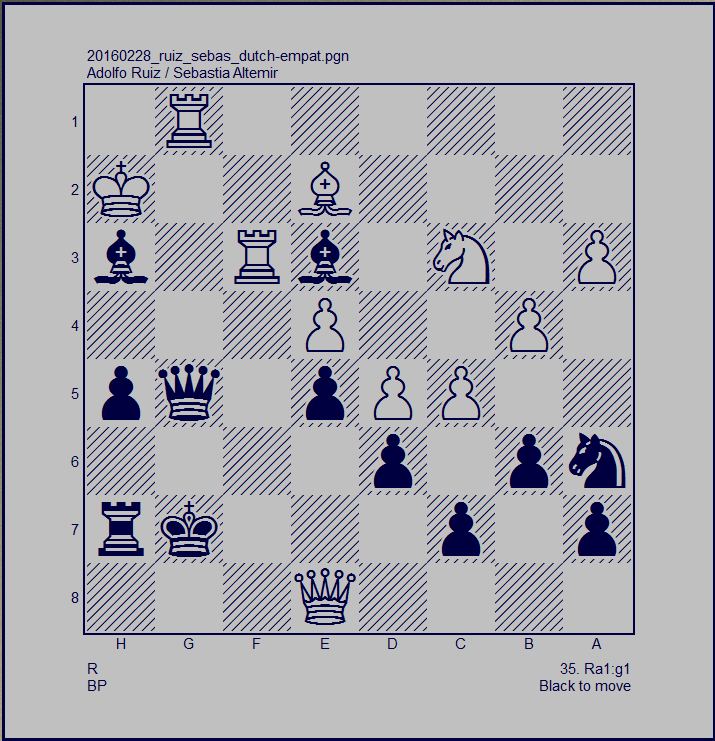
SAG 2016 : mat en 2
|
|
I did not see it, but maybe you will : black to move and mates in 2 moves !
Full PGN
here - it is quite a nice attack, IMHO
Or you can paste
1.d4 f5 2.c4 Nf6 3.Nc3 e6 4.Bg5 Be7 5.Nf3 0-0 6.e3 d6 7.Bd3 b6 8.0-0 Bb7
9.Re1 Qe8 10.Nb5 Na6 11.a3 Qh5 12.Bxf6 Rxf6 13.e4 f4 14.d5 e5 15.h3 g5 16.Nh2 Qg6
17.Ng4 Rf7 18.Nc3 Raf8 19.b4 Bc8 20.Be2 h5 21.Nh2 Rh7 22.Qa4 g4 23.h4 Bxh4 24.g3 fxg3
25.fxg3 Bxg3 26.Rf1 Bf4 27.c5 g3 28.Nf3 Bh3 29.Nh4 Qg5 30.Nf3 Be3+ 31.Kh1 Rxf3 32.Qe8+ Kg7
33.Rxf3 g2+ 34.Kh2 g1=Q+ 35.Rxg1 {position}
{me} Qxg1+ 36.Kxh3 Qg4+ 37.Kh2 Qg1+
{you} Bxg1 36.Kxh3 Qg4++
into
online pgn player
or
analysis editor
or
lichess analysis (Stockfish)
|
chatGPT : Dutch against London
Example of a typical Dutch defense setup against the London system:
- 1. d4 f5
- 2. Nf3 Nf6
- 3. Bf4 e6
- 4. e3 Be7
- 5. h3 O-O
- 6. Nbd2 Nc6 - supports d4 and e5 squares, and prepares ...c5 or ...a6 depending on how White proceeds.
- 7. Bd3 b6
Stonewall
Magnus Carlsen plays the Dutch Stonewall Defence against Fabiano Caruana :
video,
chessgames
White's plans : remove black's black square bishop, by b3 and Ba3
"Learning the Dutch Defense.doc" by Michael Aigner
Get it here skdps - w500
The Dutch system works for black against most opening moves except 1.e4
You can be checkmated fast
Mind your king :
1.d4 f5 2.g4 fxg4 3.h3 Nf6 4.hxg4 Nxg4 5.Qd3 Nf6 6.Rxh7 Rxh7 7.Qg6#
Section 1 : main line of the Stonewall variation (with Bd6)
You may play this normal setup if white starts with 1.d4 and on move 2 plays one of the following: c4, Nf3, g3, Bf4, or e3.
Black's preferred move order is: f5, Nf6, e6, d5, c6, Bd6, Nbd7, and O-O.
White can play several moves in a variety of orders, but usually they include: d4, c4, Nc3, g3, Bg2, Nf3, O-O, and Bg5 or Bf4.
Three sample continuations :
1.d4 f5 2.c4 Nf6 3.Nc3 e6 4.g3 d5 5.Bg2 c6 6.Nf3 Bd6 7.O-O Nbd7 8.Qc2 Ne4 9.b3 O-O
1.d4 f5 2.g3 Nf6 3.Bg2 e6 4.Nf3 d5 5.O-O c6 6.c4 Bd6 7.Bf4 Bxf4 8.gxf4 Nbd7 9.e3 O-O
1.d4 f5 2.c3 Nf6 3.Bg5 e6 4.Nf3 d5 5.e3 Bd6 6.Bd3 Nbd7 7.O-O O-O 8.Nbd2 Qe8
Questions to ponder:
- What are the most important squares?
Black wants to control e4, and white wants to control e5.
Both players would love to post knights on these central squares.
If you can get a knight to e4 and at the same time prevent white from playing Ne5, you're doing great!
- What is black's most common middlegame plan in the stonewall Dutch?
Black wants to start a kingside attack, using the pawns in front of the king.
Typical moves are Ne4 followed by g5 and h5.
The queen goes to e8 and h5, or sometimes to f6 and g7.
The queen's knight might go to f6 and g4, or just trade itself for white’s knight on e5.
Finally, don't forget a rook lift (Rf6 or Rf7).
- How does the bad light-squared bishop get out?
There are three strategies:
- play b6 and then Bb7 or Ba6
- go the long way via d7-e8-h5
- if white ever advances his c-pawn to c5 (so that it no longer attacks your d5 pawn),
then you can play e5 to open the e6 square for your bishop
- What should black do if white takes the d5 pawn with the c4 pawn?
You want to play exd5. However, sure your f5 pawn doesn't hang in the meantime.
A smart chess player will realize ahead of time that white is threatening the f5 pawn after white takes cxd5.
Watch out if white plays Bd3 or Qc2!
- When does the dark-squared bishop belong on e7 instead of d6?
This is really an advanced topic.
Here is a partial answer: always play Bd6 except if white plays Bg5 (pinning Nf6)
or if white tries Nh3 with the aggressive idea of advancing pawns to f3 and e4.
Section 2 : main line of the Leningrad variation (with Qe8)
White will typically play d4, c4, g3, Bg2, Nf3, O-O, and Nc3
Black’s preferred move order is : f5, Nf6, g6, Bg7, d6, O-O, and Qe8
Six sample variations, with reasonable moves for white and recommended moves for black.
1.d4 f5 2.c4 Nf6 3.g3 g6 4.Bg2 Bg7 5.Nf3 d6 6.O-O O-O 7.Nc3 Qe8 8.d5 Na6 9.Rb1 Bd7 10.b4 c5 11.dxc6 bxc6
1.d4 f5 2.c4 Nf6 3.g3 g6 4.Bg2 Bg7 5.Nf3 d6 6.O-O O-O 7.Nc3 Qe8 8.d5 Na6 9.Nd4 Bd7 10.Rb1 c6 11.b3 Nc7
1.d4 f5 2.g3 Nf6 3.Bg2 g6 4.c4 Bg7 5.Nc3 d6 6.Nf3 O-O 7.O-O Qe8 8.d5 Na6 9.Nd4 Bd7 10.e4 fxe4 11.Nxe4 Nxe4 12.Bxe4 c5 13.Ne6 Bxe6 14.dxe6 Nc7
1.d4 f5 2.g3 Nf6 3.Bg2 g6 4.c4 Bg7 5.Nc3 d6 6.Nf3 O-O 7.O-O Qe8 8.Re1 Qf7 9.b3 Ne4 10.Bb2 Nd7
1.d4 f5 2.Nf3 Nf6 3.g3 g6 4.Bg2 Bg7 5.O-O d6 6.c4 O-O 7.Nc3 Qe8 8.b3 e5 9.dxe5 dxe5 10.e4 Nc6 11.Ba3 Rf7 12.Re1 f4 13.Nd5 Bg4
1.d4 f5 2.c4 Nf6 3.Nc3 g6 4.g3 Bg7 5.Bg2 d6 6.Nh3 O-O 7.d5 Nbd7 8.O-O Ne5 9.b3 c5
Questions to ponder:
- How does black proceed after completing the first 10 to 12 moves?
He can choose from three major plans:
The first is more solid (safe and sane) involving queenside and center play.
The second is a direct kingside attack, which is far more aggressive yet also more risky.
- Explain the queenside positional plan.
Black wants to develop his pieces and connect his rooks before playing anything risky.
For example, from a6, the knight might go to c5 and e4, or to c7 (where it controls e6).
Typical moves are Bd7 and pawn to c6, Nc5 followed by pawn to a5 (to prevent white from kicking the knight with a4)
and Rb8 or Rc8 (to vacate the long diagonal, which frequently opens up).
- Explain the kingside attack plan.
One major purpose of Qe8 is to go to g6 or h5.
Naturally, black needs to play his g-pawn to g5, and perhaps support it with h6 first.
The king’s knight might go to g4 and, if attacked, retreat to e5.
If white ever plays e2-e4, black can consider advancing his f-pawn to f4.
In fact, pawn sacrifices on f4 are common, or black can choose to play Nh5 for support.
By moving the f-pawn, the light-squared bishop also comes to life.
- What other favorable tactics may arise?
Keep an eye out for tricks on the long diagonal (a1-h8).
White often plays b3 or b4, which leaves the c3 knight undefended.
This may result in discovered attacks when Nf6 moves.
Another common theme involves occupying e5 or d4 with minor pieces, generally the f6 knight or the g7 bishop.
Section 3 : anti-dutch variations (on move 2) : 2.e4 and 2.g4
The four anti-Dutch alternatives for white on move 2 are: e4, Nc3, Bg5, and g4.
The first, 2.e4, is called the Staunton gambit.
The next two moves are often played in tandem: 2.Nc3 and 3.Bg5 or 2.Bg5 and 3.Nc3.
Black may play a flexible hybrid Leningrad-stonewall system that works against both.
The Bayonet variation (2.g4) is a pawn sacrifice that can actually be accepted, but it is safer to decline it.
Complete video
Staunton gambit
Key idea is to capture on e4 and immediately develop both knights
1.d4 f5 2.e4 fxe4 3.Nc3 Nf6 4.Bg5 Nc6 5.d5 Ne5 6.Qd4 Nf7 7.Bxf6 exf6 8.Nxe4 f5 9.Ng3 g6 10.0–0–0 Bh6+ 11.f4 0–0 12.Nf3 Bg7
1.d4 f5 2.e4 fxe4 3.f3 Nf6 4.Nc3 Nc6 5.fxe4 e5 6.dxe5 Nxe5 7.Nf3 Bd6 8.Nb5 Nxf3+ 9.Qxf3 Be5 10.Bf4 Qe7 11.O-O-O O-O
Sample 3.Nc3, 4.f3
Nc3 {Raphael variation} and Bg5
Flexible approach to Nc3 and Bg5 using "hybrid Leningrad-Stonewall" system:
- 2.Nc3: key idea is to play d5 to discourage white’s e-pawn advance (stonewall structure) -
sample - inconvenient : peó a c2
- 2.Bg5: key idea is to fianchetto on the kingside (Leningrad structure)
2 samples :
1.d4 f5 2.Nc3 d5 3.Bg5 g6 4.e3 Bg7 5.Bd3 Nf6 6.Nf3 c6 7.0–0 Nbd7 8.Ne2 Ne4 9.Bf4 0–0 10.c4 e6
1.d4 f5 2.Bg5 g6 3.Nc3 d5 4.e3 Bg7 5.Bd3 c6 6.h4 Qb6 7.Rb1 Nd7 8.Nf3 Ngf6 9.h5 Ne4 10.hxg6 hxg6 11.Rxh8+ Bxh8
Bayonet variation
White plays 2.g4, sometimes 2.h3 and 3.g4
Key idea is to play d5, intending Bxf5
Sample :
1.d4 f5 2.g4 d5 3.gxf5 Bxf5 4.Nf3 Nf6 5.c3 e6 6.Rg1 g6 7.Bf4 Bd6 8.Bxd6 Qxd6 9.Nbd2 Nbd7 10.Qb3 0–0–0
Questions to ponder:
- What is the number one thing to think about when playing black against one of these tricky moves?
King safety! Remember that the main disadvantage of playing the Dutch defense is that you weaken your kingside on move 1.
Make sure that castling is your number one priority.
Your second concern should be the smooth development of all your pieces, ideally on active squares.
- Does black ever try to keep the pawn that white sacrifices?
There are exceptions to every rule, but almost always black should be content to give back the material
in order to finish his development.
As one saying goes: “The nice thing about being up a pawn is that you can give it back in a clever way and still be even material.”
Maybe the simple way to summarize this paragraph is to say: almost never capture a pawn on f3.
- Can white do something other than what is in this document?
Certainly he can! That means you must be alert for tactics and take extra time in the opening.
Don’t do anything stupid. If your opponent plays something unexpected, stop and think!
- What if white makes up his own anti-Dutch variation in an effort to confuse black?
Simply remember the opening rules.
They provide excellent guidelines to getting your pieces out on active squares, controlling the center, and getting your king safe.
Sometimes additional tactics may override these rules,
but your chances of surviving a surprise tactic are greater if you have developed and castled.
Section 4 : dutch defense against the english (1.c4) and Reti (1.Nf3)
Against the english 1.c4
Avoid the stonewall setup against the English opening - isolated e5 may come :
1.c4 f5 2.Nf3 Nf6 3.g3 e6 4.Bg2 d5 5.0–0 c6 6.d3 Bd6 7.Nbd2 Nbd7 8.Qc2 0–0 9.e4 fxe4 10.dxe4 dxe4 11.Nxe4 Nxe4 12.Qxe4 e5
Use the "anglo-dutch" system :
1.c4 f5 2.Nf3 Nf6 3.g3 d6 4.Bg2 e5 5.Nc3 g6 6.d3 Bg7 7.0–0 0–0 8.Rb1 Nc6 9.b4 h6 10.b5 Ne7 11.Nd2 c6 12.Qc2 g5
Against the Reti 1.Nf3
If black plays the Dutch defense after 1.Nf3, white can choose one of three approaches:
- play d4 early and transpose into a normal stonewall or Leningrad;
- play c4 early and avoid d4, thereby playing into the Anglo-Dutch system;
- throw caution to the wind by playing the pawn sacrifice 2.e4.
You should already be prepared to handle the first two options.
To face the so-called Lisitsin gambit, you merely need to memorize the first four moves (f5, fxe4, d5, and Qd6)
and then patiently calculate the tactics that arise.
Two samples :
1.Nf3 f5 2.e4 fxe4 3.Ng5 d5 4.d3 Qd6 5.Nc3 Nf6 6.dxe4 h6 7.Nb5 Qd8 8.e5 hxg5 9.exf6 gxf6 10.Qxd5 c6 11.Qxd8+ Kxd8 12.Nc3 Bf5
1.Nf3 f5 2.e4 fxe4 3.Ng5 d5 4.d3 Qd6 5.dxe4 h6 6.Qh5+ g6 7.Qh4 Bg7 8.Nf3 Bf6 9.e5 Bxe5 10.Bd3 Nc6 11.Na3 a6 12.0–0 Bd7 13.Re1 0–0–0
Questions to ponder:
- When do you know that you must play the Anglo-Dutch system rather than the stonewall or Leningrad variations?
First of all, remember that the Anglo-Dutch is very similar to the Leningrad where black plays the central e5 plan.
Hence, this question is more aimed at stonewall players.
Observe that f5 and Nf6 are the first two moves in both the Anglo-Dutch and the stonewall variation.
Therefore, you can wait to see if white plays d4 before your third move.
You would like to wait even longer, but on your third move, you must choose d6 or g6 (Anglo-Dutch and Leningrad) or e6 (stonewall).
To answer the question:
you know after white’s third move whether the game will be a normal queen pawn opening or a more flexible English opening.
- What are the typical plans in the Anglo-Dutch?
Black prefers to play on the kingside by advancing pawns to h6+g5+f4.
Furthermore, a bishop and queen battery on the light squares e6 and d7 will allow penetration with Bh3 (after the f5 pawn moves).
The king’s knight will go to g4 or occasionally h5.
The queen’s knight would love to end up on g6 but frequently needs to stay on e7 in order to defend weaknesses on c6 and d5.
White, on the other hand, has two plans at his disposal:
either push pawns on the queenside to create weaknesses on c6 and b7 or play for the central break e4.
- Should black try to keep the gambit pawn in the Lisitsin?
If your opponent plays well, then you should not try to keep the extra pawn.
Perhaps if you can develop a piece while defending the pawn, then that is worthwhile.
But never bend over backwards or go out of your way to save it.
Like in all gambits, the biggest key is finding good squares for all of your pieces and keeping your king safe (often by castling).
A80 - Krejik gambit
365chess,
chess.com
1.d4 f5 2.g4
El meu desastre
1.d4 f5 2.g4 fxg4 3.h3 gxh3 {d5 is far better}
4.Nxh3 d6 5.Ng5 h6 6.Qd3 Nf6 7.Qg6+ Kd7 8.Bh3+ Kc6 9.Nf7 Qe8 10.d5+ Kb6
11.Nxh8 Bxh3 12.Rxh3 Qxg6 13.Nxg6 Nbd7 14.Rb3+
Anti-holandesa : Pepe Cuenca
Mirem video (13:47) :
1.d4 f5 2.Nc3 Nf6 3.Bg5
e6 4.e4 fxe4 5.Nxe4 Be7 6.Bxf6 Bxf6 7.Nf3
Idees blanc : jugar c3 i Bd3 i Qd2
Idees negre : b6 o 0-0
d5
Anti-holandesa : London system
White plays 1.d4 f5, 2.Bf4, 3.Nf3, 4.e3 etc ... usually without playing c4
Basically the London is a set of solid lines where after 1.d4
White quickly develops his dark-squared bishop to f4
and normally bolsters (reforçar) his centre with pawns on c3 and e3 rather than expanding.
Alfonso Jerez : quan veiem Bf4, fem d6
Wiki on London System : D02, A46, and A48.
White goes for e4
1.d4 e6 2.c4 f5 3.Nf3 Nf6 4.e3 Be7 5.Bd3 O-O 6.O-O b6 7.Nc3 Bb7 8.Qe2 Ne4 9.Qc2 d5
Traps in Dutch
1,
Korchnoi gambit or trap
1.d4 f5 2.Bg5 h6 3.Bh4 g5 4.e4!
1.d4 f5 2.h3 Nf6 3.g4 fxg4 4.hxg4 Nxg4 5.Qd3 Nf6 6.Rxh7 Rxh7 7.Qg6++ Korchnoi
Dutch by GM's
From here :
By three methods we may learn wisdom.
First, by reflection, which is noblest.
Second, by imitation, which is easiest.
And third by experience, which is bitterest.
(Confucius)
B00 - Owen's defence
wiki,
Chessgames B00
1.e4 b6 2.d4 Ab7
3.Bd3 e6 4.Nf3 c5 5.c3 Nf6 6.Nbd2 Nc6 7.a3! d5 8.e5 Nfd7 9.b4 Be7 10.0-0 0-0 11.Re1
5...cxd4 6.cxd4 Bb4+ 7.Nc3 Nf6 8.Qe2 d5 9.e5 Ne4 10.0-0!? Bxc3 11.bxc3 Nxc3 12.Qe3 Nc6 13.Bb2 Ne4 14.Ba3
3.Nc3 e6 4.Nf3 Bb4 5.Bd3 Nf6 6.Bg5 h6 7.Bxf6 Bxc3+ 8.bxc3 Qxf6 9.0-0 d6 10.Nd2 e5 11.f4 Qe7 12.Qg4
Pedro vs Mario @ enroque corto :
1.e4 b6 2.Cc3 Ab7 3.c3 e6 4.f4 Ab4 5.Cf3 d5 6.Ad2 dxe4 7.Cxe4 Axd2 8.C4xd2 Cf6
9.Ae2 Cd5! {toca f4 pero vol anar a e3!} 10.0-0 Ce3 11.De1 Cxc2 12.Dg3 Cxa1 13.Dxg7 Tf8
14.Ce5 f6?? 15.Ah5+
Teoria vs Sebas :
ChT 1.e4 b6 2.d4 Ab7 3.Ad3 Cf6 4.Cc3 e6 5.a3 c5 6.Cf3
SAG 1.e4 b6 2.d4 Ab7 3.Cc3 Cf6 4.Ad3 e6 5.a3 c5 6.Ae3
Jordi Bada vs Mario lichess :
1. e4 b6 2. d4 Bb7 3. Bd3 f5 {?} 4. exf5 Bxg2 5. Qh5+ g6 6. fxg6 Bg7 7. gxh7+ Kf8 8. Nf3 Nf6
9. Qg6 Bxh1 10. Bh6 Rxh7 11. Ng5 Bxh6 12. Nxh7+ Nxh7 13. Qxh6+ Kg8 14. Bxh7+ Kf7 15. Qg6+ Kf8 16. Qg8# 1-0
It is the Matovinsky gambit -
wiki :
1. e4 b6 2. d4 Bb7 3. Bd3 f5? {black gravely weakens his kingside}
4. exf5! Bxg2 5. Qh5+ g6 6. fxg6 Nf6?? 7. gxh7+ Nxh5 8. Bg6# 1–0
SAG vs Mario, 20200322
lichess
1. e4 b6 2. d4 Bb7 3. Bd3 e6 4. Nf3 Nf6 5. e5 Ng8 6. O-O d6 7. Nc3 Nd7 8. d5 Nxe5 9. Nxe5 dxe5 10. Bb5+ c6 {error final}
11. dxc6 Qxd1 12. Rxd1 Bc8 13. c7+ Ke7 14. Rd8 Nf6 15. Bc6 Bd7 16. Rxd7+ Nxd7 17. Bxa8 g6 18. c8=Q Bg7
B01 - Scandinavian defence
An "improved" Caro-Kann ?
Maybe the best black's opening for large castling ...
Chessgames B01 ...
wiki
1.e4 d5
2.exd5
2... Qxd5
3.Nc3
3... Qa5
4.b4?!
3... Qd8
3... Qd6 i 4... g6
Pytel-Wade variation,
Bronstein variation
3... Qe5+ {Patzer variation}
3... Qe6+? ... 4...Qg6 : 5.Nf3 Qxg2 6.Rg1 Qh3 7.d4 = massive lead in development
3.d4 e4 !
3.Nf3 Bg4 (+ Nc6 +
0.0.0)
2... Nf6 {Marshall gambit}
3.d4 Nxd5 4.c4 Nb6/Nf6/Nb4
Bg4!? {portuguese variation} 4.f3 Bf5 5.Bb5+ Nbd7 6.c4
3.
c4 e6 {icelandic gambit}
uTube
c6 4.dxc6 Nxc6
4.d4 cxd5
3.Bb5+ Bd7 4.Bc4 b5 5.Bb3 Bg4
3.Bc4 Nxd5
3.Nc3 Nxd5
2... c6 3.dxc6
2.e5?! c5 + Bf5 o Bg4 + e6 : french defense
2.d4
Blackmar–Diemer gambit
2.Cc3 d4 3.Cce2 e5 {JB}
wiki
Idees pel blanc :
- juguem d4 i intentem d5 ... mentre el negre ho hagi enrocat !
- posar el alfil a f4 doncs la dama negra vol anar a c7 !
Escandinava - A06 Zukertort Opening, Tennison gambit
1.e4 d5 2.Nf3 {A06 Zukertort Opening: Tennison gambit} dxe4 3.Ng5 Nf6 4.d3 exd3 5.Bxd3
h6 {error} 6.Nxf7 Kxf7 7.Bg6+ Kg8 8.Qxd8 {Black resigns} 1-0
Nc6
Escandinava -> Portuguesa
No agafem amb la dama sino ataquem amb el cavall
1.e4 d5 2.exd5 Nf6
1.e4 d5 2.exd5 Cf6 3.d4 Ag4 4.Cf3 Dxd5
Portuguese games
Pytel-Wade variation - Qd6
No posem la dama a a5 sino a d6
1.e4 d5 2.exd5 Qxd5 3.Nc3 Qd6
Black goes a6, b5 and Bb7 ; also Tiviakov : {4...Cf6 5...c6}
White : com perseguim la dama en aquesta variant ?
365chess,
partides a
RedHotPawn
Chess Openings Explained, minut 40:16 :
1.e4 d5 2.exd5 Qxd5 3.Nc3 Qd6 4.d4 Nf6 5.Nf3 a6 {to prevent Nb5}
6.g3 b5 7.Bg2 Bb7 8.0-0 e6 9.Ne5 Bxg2 10.Kxg2 Nd7 11.Qf3 Rc8 12.Bf4 Qb6 13.Nxd7 Nxd7 14.d5
6.g3 Bg4 7.Bg2 Nc6 {presio a d4} 8.0-0 0-0-0 9.d5 {or h3} Ne5
Nb4 {sharp} 10.h3 Bh5 11.Bf4 Qc5 12.Be3 Qd6
Game Piotr Dobrowolski - Jacek Tomczak, European Rapid Championship (2010), white bishop vs black knight, ideal for black :
chessgames (0-1)
wiki :
1.e4 d5 2.exd5 Qxd5 3.Nc3 Qd6 4.d4 Nf6 5.Nf3
a6 6.g3 (prepara Af4 y hace Ab7 menos interesante) 6...Ag4 7.Ag2 Cc6 8.0-0 0-0-0 9.d5
g6
c6 - Tiviakov
Una miniatura
1895, Jacques Mieses vs Johannes Wilhelm Ohquist -
chessgames :
1.e4 d5 2.exd5 Qxd5 3.Nc3 Qd8 4.d4 Nc6 5.Nf3 Bg4 6.d5 Ne5 7.Nxe5 Bxd1 8.Bb5+ c6 9.dxc6 Qc7 10.cxb7+ Kd8 11.Nxf7# 1-0
Video complert
Video castigando la Defensa Escandinava
by Luis Fernandez Siles :
Dd8 {m6:48},
Dd6 {m7:53},
Da5 {m9:56} :
1.e4 d5 2.exd5 Qxd5 3.Nc3 Qa5 4.g3 Nf6 5.Bg2 c6 6.Nge2 Bf5 7.b4 Qc7 8.O-O e6 9.Rb1 Be7
Icelandic gambit from scandinavian defence
1.e4 d5 2.exd5 Nf6 3.c4 e6
4.dxe6 Bxe6 {main line}
5.d4 Bb4+ 6.Nc3 Ne4 7.Qc2 Qxd4
7.Bd2 Qxd4
7.Ng-e2 Bxc4
6.Bd2 Bxd2 7.Qxd2 Qe7
6.Nd2 Qxd4
5.Nf3 Qe7 6.Qe2 Nc6 7.d3 0-0-0
7.d4 Bf5 8.d5? Nb4
5.Nc3 Bb4 6.d4 Ne4
6.Nf3 Qe7
5.b3 Bc5 {attack f2 via Qd4 or Ne4}
1.e4 d5 2.e5 c5 3.f4 e6 - sicilian defense, McDonnel attack
The full modern Scandinavian gambit
Tricks & traps {Cxd5, 3.c4 Cb4 ***}
1.e4 d5 2.exd5 Nf6
3.Bb5+
3.c4
3.d4 Nxd5 4.c4
Nf6
Nb6
Nb4 ! 5.Qa4+ Nb8-c6 6.d5 b5 !! 7.cxb5 Bf5 8.dxc6 ? Bc2 !!
8.Na3 Qcd5 9.bxc6 ? Qe4 !!
10.Be2 Nd3+ {drops the queen}
10.Ne2 Nd3+
10.Be3 ! Nd3
10.Kd1 Rd8+ 11.Bd2 Rxd2 ! 12.Kxd2 Qd4+ 13.Ke1 Nd3+
13.Kc1 g6
13.Ke2 Qxb2+
7.Qb3 Nd4 !
7.Qa3
7.Qxb5 Nxc2+ 8.Kd1 Bd7
7.Qd1 Nd4 8.Na3 d5
5.a3 N4c6 6.Be3 e5 7.d5 Ne7 8.Nf3 Nf5 9.Nc3 Nxe3 10.fxe3 Nd7
Video The Icelandic Gambit 3.c4 e6-Part1
Few links
(B02-B05) Alekhine defence
Chessgames B02,
B02-B05
Main variations :
B02: 1.e4 Nf6
B02: 1.e4 Nf6 2.e5 Nd5 3.c4 Nb6 4.Nc3 d6 5.d4 dxe5 6.dxe5 Qxd1+ 7.Nxd1 Nc6 8.Bf4 Be6 9.Ne3 0-0-0 - m'agrada l'enroc llarg !
c5 5.Nf3 Nc6 6.d3 d6 7.Bf4 Bg4 8.exd6 e5 9.Be3 Bxd6 10.Ne4 Nd4 11.Bxd4 exd4 12.Be2 0-0
B03: 1.e4 Nf6 2.e5 Nd5 3.d4 (this includes the Exchange Variation and Four Pawns Attack)
B04: 1.e4 Nf6 2.e5 Nd5 3.d4 d6 4.Nf3 (Modern Variation without 4...Bg4)
B05: 1.e4 Nf6 2.e5 Nd5 3.d4 d6 4.Nf3 Bg4 (Modern Variation with 4...Bg4)
d6 missing
1. e4 Nf6 2. e5 Nd5 3. d4 Nc6 {d6 es obligatori o Nb6}
4. c4 Nb6 5. d5 Nxe5 6. c5 Nbc4 7. Qd4 b5 8. cxb6 Ba6 9. Nd2 Nxd2 10. Bxa6 axb6
11. Qxe5 Rxa6 12. Bxd2 d6 13. Qc3
anti-Alekine (by Jordi Bada, 201604)
1.e4 Nf6 2.e5 Nd5 3.Nc3
URLs
1.e4 Nf6 2.e5 Nd5 3.d4 d6 4.c4 Nb6 5.f4 dxe5 6.fxe5 Nc6 7.Be3 Bf5 8.Nc3 e6 9.Nf3
Planinc variation :
1.e4 Nf6 2.e5 Nd5 3.d4 d6 4.c4 Nb6 5.f4 g5 6.fxg5? dxe5
Luleerik vs SAG :
1.e4 Nf6 2.e5 Nd5 3.d4 d6 4.c4 Nb6 5.f4 g5 6.exd6 Qxd6 7.Nc3 Bg7
Luleerik vs FM (2200+) :
1.e4 Nf6 2.e5 Nd5 3.d4 d6 4.Nf3 Bg4 5.Be2 c6 6.Ng5 Bf5 7.e6 fxe6 8.Bg4?
(B07-B09) Pirc defence
The Pirc Defense is a hypermodern opening.
This means that black does not try to control the center early on with his pawns,
but spends some time fianchettoing his dark-squared bishop and only later attacks the center.
Black first leaves the center to white and then tries to conquer it back, taking advantage of his better development.
Generally speaking, black’s plan is to attack white’s center with either c7-c5 or e7-e5, and perhaps also advance his queenside pawns.
1.d4 d6 2.e4 Nf6 3.Nc3 g6
wiki,
chessgames B07,
Yasser Seirawan (Saint Louis Chess Club),
ChessOpenings (negritu calb),
iChess {concepts, video 27 min GM Damian Lemos},
chess.com {variants}
Pirc defence decision tree :
1.e4 d6 2.d4 Nf6 3.Nc3 - Pirc
c6 + Qa5 + e5 o b5 - defensa txeca o sistema Pribyl -
Ufimtsev-Pytel
1.e4 d6 2.d4 Nf6 3.Nc3 g6
4.Be3 c6 5.Qd2 - 150 attack
4.f3 Bg7 5.Be3 c6 6.Qd2 b5 - argentine (150) attack
0-0 6.Qd2 e5 ! - Zaichik
4.g3 + Bg2 + Nge2 - solid line, Karpov -
Sveshnikov system
4.Bc4 Bg7 5.Qe2 Nc6 6.e5 Ng4 7.e6 Nxd4 - sharp -
Holmov system
4.Bg5 Bg7 -
Byrne variation
4.Be2
Bg7 5.g4 -
chinese variation
5.h4 -
bayonet Mariotti attack
4.f4 Bg7 5.Nf3 - austrian attack
0-0
c5
4.Cf3 Bg7 5.Be2 0-0 6. 0-0 - classical system, 2 knights system
4.Be3 Bg7 5.Qd2 0-0 6.0-0-0 c6 (or Nc6) 7.f3 b5 8.h4 - viable !
d6 4.c3 - Geller's system
e5
4.dxe5 dxe5 5.Qxd8+ Kxd8 6.Bc4 Be6 7.Bxe6 fxe6
4.Nf3 - defensa Philidor
NM Robert Ramirez
3 Pirc lines
Hints
- the dark-square bishops for both sides are the critical piece in the Pirc
- white doesn't have many attacking chances if you get rid of his dark-square bishop
- Pirc vs KID
chess.com, part 10, Bg5
Annoying lines for black
- 1.e4 d6 2.d4 Nf6 3.Bd3!?
- 1.e4 d6 2.d4 Nf6 3.Nc3 g6 4.h4!?
Some games
Kasparov - Seirawan :
1.e4 d6 2.d4 Nf6 3.f3 g6 4.c4 => King's Indian Defence !
Candidates jewel; bishop sacrifice.
Fischer vs. Viktor Korchnoi, Curaçao 1962 [0-1]
1.e4 d6 2.d4 Nf6 3.Nc3 g6 4.f4 Bg7 5.Nf3 0-0 6.Be2 c5 7.dxc5 Qa5 8.0-0 Qxc5+ 9.Kh1 Nc6 10.Nd2 a5
11.Nb3 Qb6 12.a4 Nb4 13.g4? Bxg4! 14.Bxg4 Nxg4 15.Qxg4 Nxc2 16.Nb5 Nxa1 17.Nxa1 Qc6 18.f5 Qc4 19.Qf3 Qxa4 20.Nc7 Qxa1
21.Nd5 Rae8 22.Bg5 Qxb2 23.Bxe7 Be5 24.Rf2 Qc1+ 25.Rf1 Qh6 26.h3 gxf5 27.Bxf8 Rxf8 28.Ne7+ Kh8 29.Nxf5 Qe6 30.Rg1 a4
31.Rg4 Qb3 32.Qf1 a3 33.Rg3 Qxg3 0–1
Capablanca vs Marshall - play it !
Tbilisi 1967, David Bronstein vs Yuri V Nikolaevsky :
chessgames,
video
Pirc plans for black
On his fourth move, white choses a plan rather than merely a move
1.e4 d6 2.d4 Nf6 3.Nc3 g6
4.f4, 4.Bc4, 4.Bg5 - white intends to play an early e4-e5
4.Be3, 4.f3, 4.Qd2 - white focuses on the kingside, keeping the center strong
4.Nf3, 4.g3 - white maintains his strong center
Pirc 150 attack
1.e4 d6 2.d4 Nf6 3.Nc3 g6 4.Be3
c6 5.Qd2 b5 5.Bd3 Nb-d7
365chess.com
Pirc austrian atack
1.e4 d6 2.d4 Nf6 3.Nc3 g6 4.f4 Bg7
austrian attack
Anand wins an "Austrian Attack" : chessgames
Fischer vs Korchnoi, 1962 ;
chessgames
Spassky vs Fischer, 1972
uTube,
game 17 (1/2-1/2)
Czech Pirc
After 1.e4 d6 2.d4 Nf6 3.Nc3, black has an alternative to 3...g6 (Main line) known as the Pribyl system or Czech defence, beginning 3...c6 -
wiki
1.e4 d6 2.d4 Nf6 3.Nc3 c6 4.f4 Qa5
5.Bd2
5.Bd3
e5 6.Nf6
5.e5
1.e4 d6 2.d4 Nf6 3.Nc3 c6 4.Nf3 Qa5 - NM Robert Ramirez
czech Pirc
Paragua v Akobian, 2008 Chicago Open
Pirc books
- "The Pirc Defence", Mihail Marin, Quality Chess de 2017 {gracies, Bosco !} -
video
- Pirc Alert - a complete defence against 1.e4 [Lev Alburt, Alex Chernin, 2001].pdf -
{sagpdf}, 96 MB.
(B10-B19) Caro-Kann
Chessgames B10,
the chess website,
lichess Caro-Kann Defense. The Theory: Where to start?
The Caro-Kann starts with the moves
1.e4 c6 2.d4 d5
If you are a positional player, the Caro-Kann will definitely suit you well.
You will be able to handle Caro-Kann well when you understand the characteristics of the opening.
Maintaining a good pawn structure is one of the key points of the Caro-Kann system.
If you want to play the Caro-Kann, calculating ability is not as important as having good technical skills.
Tactical points
Often played by players who want to avoid long theoretical lines and still want to maintain complications.
White intends to castle queenside and wants to attack on the kingside and has already committed f3 preparing g4-h4.
Black has several choices here such as 3...e6, 3...g6 3...dxe4 and 3...Qb6.
All the mentioned choices are good and give black a very solid position.
Black has to try to :
- play c5 to undermine white's pawns structure
- play Rc8 to control the open column
Black's weaknesses or what white must do:
- the light squares are important for white to dominate. Avoid, if possible, exchanging your light square bishop.
- develop the b-knight to Nc3 to defend the light squares d5 and e4.
Video - structure explained.
The following is a list of positional concepts that you must know:
- the exchange of pieces favors black.
- the trade of the dark-squared color bishops also favors black - it is the main defender of d4 pawn.
- the main goal is to target the d4 pawn.
Black often doubles the rooks on the D file and brings his queen to b6 in order to exert big pressure against white’s center.
- an important idea seldom seen is the advance b7-b5.
With this pawn thrust, black seeks to weaken the white pawn on c4;
if white plays c5 then black obtains the d5 square for a knight and the white pawn on d4 is a permanent backward pawn.
- the advance with c6-c5 is NOT ALWAYS an equalizer.
Although it brings some freedom for the black pieces,
the structure arising after dxc5 or cxd4 gives white a queenside majority in the endgame.
So before advancing c5, it is best to make sure that there are dynamic factors such as piece activity to keep the balance.
- keep an eye on the d4-d5 break.
Main lines
White can counter the Caro-Kann with four main lines :
1. Classical system
1.e4 c6 2.d4 d5 3.Nc3 dxe4 4.Nxe4
Bf5 5.Ng3 Bg6 6.Nf3 Nd7 7.h4 h6 8.h5 Bh7 9.Bd3 Bxd3 10.Qxd3 e6
Nd7
Nf6
2. Advance system
1.e4 c6 2.d4 d5 3.e5
Bf5 4.Nf3 e6 5.Be2 Nd7 6.0-0 h6 7.Nbd2 Ne7 8.Nb3 Nc8 9.a4 Be7 10.a5 a6
c5
3. Exchange or Panov-Botvinnik system
1.e4 c6 2.d4 d5 3.exd5 cxd5 4.c4 Nf6 5.Nc3 e6 6.Nf3 Bb4 7.cxd5 Nxd5 8.Qc2 Nc6 9.Bd3 h6
4. Fantasy or Tartakower variation
1.e4 c6 2.d4 d5 3.f3
Variants Caro-Kann
classical 1.e4 c6 2.d4 d5 3.Nc3 dxe4 4.Nxe4 Bf5 5.Ng3 Bg6 6.h4 h6 7.Nf3 Nd7 8.h5 Bh7 9.Bd3 Bxd3 10.Qxd3
Smyslov (B17) 1.e4 c6 2.d4 d5 3.Nc3 dxe4 4.Nxe4 Nd7 5.Ng5 (Igor Zaitsev 1980) Nd7-f6
Karpov variation 1.e4 c6 2.d4 d5 3.Nc3 dxe4 4.Nxe4 Nd7
Bronstein-Larsen (B16) 1.e4 c6 2.d4 d5 3.Nc3 dxe4 4.Nxe4 Nf6!? 5.Nxf6 gxf6
Advance 1.e4 c6 2.d4 d5 3.e5
Bf5
Ataque bayoneta 4.Nc3 e6 5.g4
Short / Kamsky 4.Nf3 e6 5.Be2 c5 6.Be3
Tahl variation 4.h5
url url
Variante del cambio 1.e4 c6 2.d4 d5 3.exd5 cxd5
Tartakower (fantasy) variation (B12) 1.e4 c6 2.d4 d5 3.f3 - variante
fantasia
Panov-Botvinnik, Gunderam attack (B13) 1.e4 c6 2.d4 d5 3.exd5 cxd5 4.c4 Nf6 5.c5 e6 6.b4
Panov-Botvinnik Attack (B14) 1.e4 c6 2.d4 d5 3.exd5 cxd5 4.c4 Nf6 5.Nc3 e6
Two knight attack (B11) 1.e4 c6 2.Nc3 d5 3.Nf3
1.e4 c6 2.Nc3 d5 3.Qf3
Wikipedia
See tons of Tahl-Botvinnik games,
Tahl as white,
Tal as black
B11 - 2 cavalls
Traps on Bg4
1 e4 c6 2 Nc3 d5 3 Nf3 Bg4
1.e4 c6 2.Nf3 d5 3.Nc3 Bg4
4.h3 Bxf3 5.Qxf3 e6
4.Be2 e6 5.0-0 Nf6
1.e4 c6 2.Cf3 d5 3.Cc3 dxe4 4.Cxe4 Af5 5.Cg3 Ag6 6.h4 h6 7.Ce5 Ah7 8.Qh5 g6 9.Qf3 Cf6 10.Qb3!
Ag4
B12 - Caro-Kann, Tartakower (fantasy) variation
1. e4 c6 2. d4 d5 3. f3
g6
e6
dxe4 4. fxe4 e5 ! 5. Nf3
Bg4 6. Bc4
Be6 6. c3 Nd7 7. Bd3 Bd6
exd4 !
B12 (advance) + Tahl variation
MVL versus Ding Liren :
1. e4 c6 2. d4 d5 3. e5 Bf5 4. h4 h6 5. g4 Be4 6. f3 Bh7
7. e6 Nf6 8. Bf4 Qb6 9. Nc3 Qxb2 10. Kd2 Qb6 11. Nge2 a6 12. Rb1 Qa7
The Kenilworthian :
Caro Kann advance with h4
Kramnik novelty :
1.e4 c6 2.d4 d5 3.e5 Bf5 4.h4 h5 5.Bg5 Qb6 6.Bd3 Bxd3 7.Qxd3 Qxb2? {es millor e6, by JB} 8.e6!! fxe6
9.Nf3 Nd7 10.0-0 Qxa1 11.Qb3 e5 12.Nc3 Qxf1 13.Kxf1 e4 14.Ne5! Nxc5 15.Qxb7!
B12 (advance) + ataque bayoneta
1.e4 c6 2.d4 d5 3.e5 Bf5 4.g4
Bg6 5.h4
5.f4
Be4 5.f3 Bg6 6.h4 h5
Bd7 5.f4 e6 6.Nf3 c5 7.c3 Nc3 8.Be3
B12 - un Carlsen molt agressiu vs Fedoseev
chessgames :
1. e4 c6 2. d4 d5 3. e5 Bf5 4. c4 e6 5. Nc3 Bb4 6. cxd5 Qxd5 7. Ne2 Qd8 8. a3 Ba5
9. Ng3 Ne7 10. Bc4 Bg6 11. h4 h6 12. h5 Bh7 13. Qg4 Kf8 14. O-O Nd7 15. Nce4 Bc7
16. Ba2 Nf5 17. Nxf5 Bxf5 18. Qf3 Qe7 19. Ng3 Bh7 20. Qg4 c5 21. Bd2 Rd8 22. f4 Nb6
23. Bc3 Nd5 24. f5 Ne3 25. Qf3 Nxf5 26. Nxf5 Bxf5 27. d5 Bb6 28. Bc4 Kg8 29. d6 Qh4
30. b3 Rd7 31. Qe2 Qg4 32. Rxf5 Qxf5 33. Rf1 Qg5 34. Bd2 Qd8 35. Qg4 a6
36. Rxf7 Kxf7 37. Qxe6+ Kf8 38. Qf5+ Ke8 39. Qg6+ Kf8 40. Qf5+ Ke8 41. Qg6+ Kf8
42. e6 Qf6 43. exd7 Qxg6 44. hxg6 Bd8 45. Be6 h5 46. Kf2 h4 47. Bg4 b5 48. Kf3 b4 49. axb4 cxb4 1-0
B13 - Panov-Botvinnik attack
Caro Kann,
Panov-Botvinnik attack :
1.e4 c6 2.d4 d5 3.exd5 cxd5 4.c4 Nf6 5.Nc3 e6 6.Nf3 Be7 7.cxd5 Nxd5 8.Bd3 0-0 9.0-0
White has accepted an isolated Queen pawn that will need support,
and he hopes to utilize his space and superior development to gain a King side attack.
lichess The Caro-Kann/Panov Attack in depth
B14 - Panov-Botvinnik attack
chessgames :
1 e4 c6 2 d4 d5 3 exd5 cxd5 4 c4 Nf6 5 Nc3 e6
B15 - Caro-Kann Defense, Tartakower variation
Jan-Krzysztof Duda vs Magnus Carlsen 2020 :
1. e4 c6 2. d4 d5 3. Nc3 dxe4 4. Nxe4 Nf6 5. Nxf6+ exf6 6. c3 Bd6
7. Bd3 O-O 8. Qc2 Re8+ 9. Ne2 h5 10. Be3 Nd7 11. O-O-O b5
12. d5 c5 13. Bxb5 Rb8 14. c4 a6 15. Ba4 Re7 16. Ng3 Ne5
17. Ne4 Reb7 18. b3 Rb4 19. Bd2 Rxa4 20. bxa4 Bf5 21. Rde1 h4
22. h3 Ng6 23. Re3 Nf4 24. g4 Bg6 25. Kd1 f5 26. Nxd6 Qxd6
27. gxf5 Bh5+ 28. f3 Qf6 29. Bc3 Qg5 30. Qe4 Qg2 31. Rhe1 Qxa2
32. Qc2 Qxc4 33. Re8+ Kh7 34. Rxb8 Qxd5+ 35. Qd2 Bxf3+ 36. Kc1 Qxf5
37. Re3 Ne2+ 38. Kb2 Nxc3 39. Qxc3 Qf4 40. Qd3+ f5
41. Rf8 Qb4+ 42. Kc1 Be4 43. Qb3 Qd4 44. Qc3 Qd6 45. Rf7 Qg6
46. Rd7 Qg1+ 47. Kb2 c4 48. Rxe4 fxe4 49. Rd4 Qf2+ 50. Qd2 c3+
51. Kxc3 Qg3+ 52. Kb2 Qxh3 53. Rxe4 Qg3 54. Qd4 Qg2+ 55. Kc3 Qf3+
56. Kb4 Qf8+ 57. Ka5 Qf5+ 58. Kxa6 g5 59. a5 h3 60. Re7+ Kg6
61. Qg7+ Kh5 62. Qh7+ Kg4 63. Re4+ 1-0
B17 - Karpov variation
Chessgames B17, Steinitz variation
1.e4 c6 2.d4 d5 3.Nc3 dxe4 4.Nxe4 Nd7
5.Ng5 Ngf6 6.Bd3 e6 7.N1f3 Bd6 8.Qe2 h6 9.Ne4 Nxe4 10.Qxe4 Nf6 11.Qh4 Ke7
h6 6.Ne6!
URL
See (ru)
B17 - Steinitz/Smyslov variation
1.e4 c6 2.d4 d5 3.Nc3 dxe4 4.Nxe4 Nd7
5.Nf3 Ng-f6
5.Bc4 Ng-f6 6.Ng5 e6 7.Qe2 Nb6
5.Bg5 Ng-f6 6.Bd3 e6
6.Bc4 e6
Few Caro-Kann games
Una coleccio a chessgames :
The Best of the Caro-Kann
Karpov shows how to put pressure on the d4 pawn and what pieces to trade.
The game is considered a positional masterpiece :
Karpov - Spassky candidates semifinal, Leningrad URSS, rd 6, Apr-24-1974
Hamburg, May 1885:
1.e4 c6 2.d4 d5 3.e5 Bf5 4.Bd3 Bxd3 5.Qxd3 e6
6.f4 c5 7.c3 Nc6 8.Nf3 Qb6 9.0-0 Nh6 10.b3 cxd4
11.cxd4 Nf5 12.Bb2 Rc8 13.a3 Ncxd4 14.Nxd4 Bc5 15.Rd1 Nxd4
16.Bxd4 Bxd4+ 17.Qxd4 Rc1 0-1
Korchnoi plays it like this :
1.e4 c6 2.d4 d5 3.e5 c5 {quite a surprise} 4.dxc5 e6 5.Be3 Nd7 6.Bb5 Qc7 7.Nf3 Bxc5
Reti vs Tartakower, Vienna 1910
1.e4 c6 2.d4 d5 3.Nc3 dxe4 4.Nxe4 Nf6 5.Qd3 e5 6.dxe5 Qa5+ 7.Bd2 Qxe5 8.0-0-0 Nxe4 9.Qd8+ Kxd8 10.Bg5+ Kc7 (10... Ke8 11. Rd8# ) 11.Bd8# a mate 2 ways.
Shirov contra la Caro-Kann :
pgn, 19 moves
Karina Ambarcumova vs Valentina Gunina,
B12 Moscu 2011, 0-1 - la blanca juga Cd2 i Cb3 per defensar c5 !
El italià :
1.e4 c6 2.c4 d5 3.exd5 cxd5 4.d4 Nf6
Aronian vs Yasser Seirawan (1-0)
2014.11.18 video :
1.e4 c6 2.c4 d5 3.exd5 cxd5 4.cxd5 Nf6 5.Nc3 Nxd5 6.Nf3 Nc6 7.Bb5 Nc7 8.Ba4 e6 {es tanca l'alfil blanc}
Shirov vs Ivanchuk (B17, Linares 1998, 0-1)
See (ru) or
play
Bada destrossa en Rafael Gonzalez (2332) :
1.e4 c6 2.d4 d5 3.e5 Bf5 4.h4 h5 5.Ne2 e6 6.Ng3 Bg6 7.Be2 Be7 8. Bxh5 Bxh5
9.Nxh5 g6 10.Nf4 Rxh4 11.Rxh4 Bxh4 12.Nd2 Bg5 13.Nf3 Bh6 14.Qd3 Qc7 15.Nxe6 Qa5+ 16. Ke2 Bxc1
17.Rxc1 Ke7 18.Nf4 Qa6 19.Rh1 Qxd3+ 20.Kxd3 Nd7 21.Rh7 Nf8 22.Rh8 Nd7 23.Ng5 Rf8 24. e6 Ngf6
25.Nxf7 Rxh8 26.Nxh8 Nf8 27.Nhxg6+ Nxg6 28.Nxg6+ Kxe6 29.f3 Ne8 30.g4 Nd6 31.b3 Ne8 32. c4 Nf6
33.Nf4+ Kd6 34.cxd5 cxd5 35.Ke3 Ne8 36.Nd3 Nc7 37.a4 a5 38.f4 b6 39.f5 Na6 40. g5 Nb8
41.Ne5 Na6 42.g6 *
En Jaume fa taules :
Ros Alonso,J (2119) - Heuser,P (2041) - Berlin 25.08.2017
1.e4 c6 2.d4 d5 3.Sc3 dxe4 4.Sxe4 Sd7 5.Sg5 Sgf6 6.Ld3 e6 7.S1f3 Ld6 8.De2 h6 9.Se4 Sxe4 10.Dxe4 Sf6
11.De2 Dc7 12.Ld2 b6 13.0-0-0 Lb7 14.Kb1 0-0-0 15.The1 c5 16.La6 Kb8 17.Lxb7 Kxb7 18.a4 c4 19.a5 Tc8 20.Se5 Lxe5
21.dxe5 Sd5 22.Df3 bxa5 23.Lc3 Thd8 24.Td2 Td7 25.Ted1 Tcd8 26.Ld4 Dc6 27.Da3 Db5 28.Lc5 Tc8 29.Ld6 c3 30.Td3 Dxb2+
31.Dxb2+ cxb2 32.Kxb2 Tc4 33.Td4 Txd4 34.Txd4 g6 35.c4 Sb4 36.Td2 Kc6 37.Kc3 h5 38.f4 Tb7 39.g3 Td7 40.Kb3 Sa6
41.Ta2 Sc5+ 42.Lxc5 Kxc5 43.Txa5+ Kb6 44.Tb5+ Kc6 45.Kc3 Tb7 46.Kb4 Td7 47.Tc5+ Kb7 48.Tb5+ Kc6 49.Tc5+ Kb7 50.Tb5+ ½-½
En Carlsen jugant
agressiu amb en Fedosseyev :
1. e4 c6 2. d4 d5 3. e5 Bf5 4. c4 e6 5. Nc3 Bb4 6. cxd5 Qxd5 7. Ne2 Qd8 8. a3 Ba5 9. Ng3 Ne7 10. Bc4 Bg6
11. h4 h6 12. h5 Bh7 13. Qg4 Kf8 14. O-O Nd7 15. Nce4 Bc7 16. Ba2 Nf5 17. Nxf5 Bxf5 18. Qf3 Qe7 19. Ng3 Bh7 20. Qg4 c5
21. Bd2 Rd8 22. f4 Nb6 23. Bc3 Nd5 24. f5 Ne3 25. Qf3 Nxf5 26. Nxf5 Bxf5 27. d5 Bb6 28. Bc4 Kg8 29. d6 Qh4 30. b3 Rd7
31. Qe2 Qg4 32. Rxf5 Qxf5 33. Rf1 Qg5 34. Bd2 Qd8 35. Qg4 a6 36. Rxf7 Kxf7 37. Qxe6+ Kf8 38. Qf5+ Ke8 39. Qg6+ Kf8 40. Qf5+ Ke8
41. Qg6+ Kf8 42. e6 Qf6 43. exd7 Qxg6 44. hxg6 Bd8 45. Be6 h5 46. Kf2 h4 47. Bg4 b5 48. Kf3 b4 49. axb4 cxb4 1-0
Caro-Kann traps
Chessplayer :
- fantasy
- must know
- trap :
1. e4 c6 2. Nc3 d5 3. Nf3 dxe4 4. Nxe4 Bg4 5. h3 Bh5
6. Ng3 Bg6 7.h4 h6 8.Ne5 Bh7 9.Qh5 g6 10.Bc4! e6
11.Qe2 with the threat of Nxf7, Qxe6
- desatre total :
1.e4 c6 2.Nf3 d5 3.Nc3 dxe4 4.Nxe4 Bf5 5.Ng3 Bg6 6.h4 h6 7.Ne5 Bh7 8.Qh5 g6 9.Bc4 Nf6 10.Bxf7+ *
Solució :
Nb8-d7 o Nf6
- fast classic trap :
1.e4 c6 2.d4 d5 3.Nd2 dxe4 4.Nxe4 Nd7 5.Qe2 Ngf6 6.Nd6++
1.e4 c6 2.Nf3 d5 3.Nc3 dxe4 4.Nxe4 Nd7 5.Qe2 Ngf6 6.Nd6# 1-0
- Rafa 2015 :
1.e4 c6 2.d4 d5 3.Nc3 dxe4 4.Nxe4 Bf5 5.Nc5 - mind b7
- mine
1.Nf3 c6 2.c4 d5 3.e3 Bg4 4.Nc3 e6 5.cxd cxd5 6.Qa4 Nc6 7.Qxg4
Caro-Kann links
(B20-B99) Siciliana
Chessgames B20
1.e4 c5
2.Cf3 i 3.d4 - open sicilian
2.Cf3 d6 3.d4 cxd4 4.Cxd4 Cf6 5.Cc3
a6 - Najdorf -
B90..B99
g6 - Dragon -
B70..B79
Cc6 - classical -
B56
e6 - Scheveningen -
B80..B89
Ad7 - Kupreichik variation
4.Dxd4 - Chekhover variation
Cc6 5.Ab5 Ad7 6.Axc6
2.Cc3 - closed sicilian - B23 i B24
Wiki (*** excelent ***)
Closed sicilian
1.e4 c5 2.Nc3
Nc6 3.Nf3 B30
3.g3 B24
1.e4 c5 2.Nc3 Nc6 3.g3 g6 4.Bg2 Bg7 5.d3 e6 6.Be3 Nd4 7.Nce2 -
variante Smyslov
3.f4 B23 + Grand Prix
1.e4 c5 2.Nc3 Nc6 3.f4 g6 4.Nf3 Bg7 5.Bc4 e6 6.f5 -
variante Schofman
e6
3.Nf3
3.g3
3.f4
d6
3.Nf3
3.g3
3.f4
a6
3.Nf3
3.g3
3.f4
g6
3.Nf3
3.g3
3.f4
Open sicilian variations
The open sicilian can be broken down into four basic systems
- in the Dragon, the black bishop is fianchettoed on g7
- in the Scheveningen, it is developed on e7 while black adopts a "little center" of pawns on d6 and e6.
- in a third, the black e-pawn is pushed to e5, leaving the d-pawn backwards ;
this encompasses the Boleslavsky variation, the Lowenthal/Kalashnikov, and Sveshnikov Sicilians.
- a final development pattern involves black playing ...e6
but leaving the dark bishop free to develop to a variety of squares such as b4, c5, or even d6.
The last scheme encompasses the Taimanov, Paulsen
url
Open sicilian roadmap
1.e4 c5 2.Nf3 d6 3.d4 cxd4 4.Nxd4 Nf6 5.Nc3
5. ... Nc6 = clásica (B56)
5. ... g6 = dragón (B70)
5. ... e6 = Scheveningen (B80) 6.g4 Keres attack (B81)
5. ... a6 = Najdorf (B90)
1.e4 c5 2.Nf3 e6 3.d4 d5 = Marshall variation (B40)
1.e4 c5 2.Nf3 e6 3.d4 cxd4 4.Nxd4 a6 5.Nc3 Qc7 {per evita e5 a Nf6} 6.Bd3 Nf6 7.O-O
1.e4 c5 2.Nf3 e6 3.b3 Nc6 4.Bb2 d5 5.exd5 exd5 6.Bb5 Nf6 7. 0.0 or Qe2
1.e4 c5 2.Nf3 Nf6 = Nimzowitsch variation (B29)
1.e4 c5 2.Nf3 d6 3.Bb5+ = Moscow Variation or the Canal-Sokolsky Attack (no
d4)
1.e4 c5 2.Nf3 Nc6 3.d4 cxd4 4.Nxd4 e5 5.Nb5 d6 =
Kalashnikov (B32)
1.e4 c5 2.Nf3 Nc6 3.d4 cxd4 4.Nxd4 Nf6 5.Nc3 e5 =
pelikan (B33), variante Sveshnikov, Lasker-Pelikan o variante Cheliabinsk
1.e4 c5 2.Nf3 d6 3.d4 cxd4 4.Nxd4 Nf6 5.Nc3 g6 6.Be3 Bg7 7.f3 0-0 8.Qd2 Nc6 9.Bc4 =
yugoslav attack (B77) - see
K vs K, 1974
1.e4 c5 2.Nf3 d6 3.c3 Nf6
1.e4 c5 2.Nf3 e6 3.d4 cxd4 4.Nxd4 a6 = Paulsen
1 +
2
1.e4 c5 2.Nf3 d6 3.d4 cxd4 4.Nxd4 Nf6 5.Nc3 e6 = Scheveningen (B80-B89)
1.e4 c5 2.Nf3 Nc6 3.d4 cxd4 4.Nxd4 e6 5.Nc3 d6 6.Be3 Nf6 7.f4 = Scheveningen (B80-B89)
1.e4 c5 2.Nf3 Nc6 3.d4 cxd4 4.Nxd4 e5 = Labourdonnais-Loewenthal variation (
B32)
1.e4 c5 2.Nf3 a6 = O'Kelly variation (B28)
Resum
Very complete analysis :
Caissa
5
nice
traps
What are the differences ?
url :
- Smith-Morra
- Alapin
- closed
- classical
- Sveshnikov
- dragon
- accelerated Dragon
- hyper-accelerated Dragon
- Scheveningen variation
- Najdorf variation
B56 - classical sicilian
Reached by moves
1.e4 c5 2.Nf3 d6 3.d4 cxd4 4.Nxd4 Nf6 5.Nc3 Nc6
It is one of the soundest lines of the Sicilian for black, if not always the most enterprising.
White has several options beginning on the sixth move, such as the Richter-Rauzer attack and the Sozin attack.
Sveshnikov variation
Marked by an early e5 thrust by black :
1.e4 c5 2.Nf3 Nc6 3.d4 cxd4 4.Nxd4 Nf6 5.Nc3 e5
B70 - Dragon variation
Named for the formation of pawns from h7 to d6, the Dragon Variation is one of the sharpest openings in chess.
1.e4 c5 2.Nf3 d6 3.d4 cxd4 4.Nxd4 Nf6 5.Nc3 g6
Perhaps the most challenging line for both sides is the Yugoslav Attack, where white plays 6.Be3 Bg7 7.f3 -
both sides typically launch fierce attacks: white on the kingside, black on the queenside.
JB :
1.e4 c5 2.Cf3 Cc6 3.d4 cxd4 4.Cxd4 g6 5.Ae3 Ag7 6.Dd2 Cf6 7.Cc3 d5 8.exd5 Cxd5 9.Cxd5 Dxd5 10.c3
Accelerated Dragon
La dragón acelerada es una defensa sólida que admite una lucha a largo plazo por el punto entero. Surge tras la sequencia
1.e4 c5 2.Cf3 Cc6 3.d4 cxd4 4.Cxd4 g6
5.c4 - variante Maroczy
The Accelerated Dragon features an early g6 by black.
An important difference between this line and the Dragon is that black avoids playing d7–d6, {2nd move is Nc6}
so that he can later play d7–d5 in one move, if possible.
The Accelerated Dragon allows black to adopt a Dragon setup avoiding the Yugoslav attack.
By playing g6 earlier (usually in line 1. e4 c5 2. Nf3 Nc6 3. d4 cxd4 4. Nxd4 g6),
black retains the ability to play d5 in just one move (rather than having previously played d6 in the standard Dragon), saving a tempo.
Com això impedeix el atac yugoslau ?
Conversely, since white has not been forced to play Nc3 yet,
this setup allows white to play 5.c4,
Maroczy Bind
(1.e4 c5 2. Cf3 Cc6 3.d4 cxd4 4. Cxd4 g6 5. c4),
making this opening a much more positional one than the standard Sicilian Dragon.
The Accelerated Dragon generally features a more positional style of play than many other variations of the Sicilian.
url
If black really wants to play g6 as soon as possible, an even faster way is the Hyper-Accelerated Dragon,
where black plays g6 on the second move (1. e4 c5 2. Nf3 g6)
B80 - Scheveningen variation
Reached by
1.e4 c5 2.Nf3 d6 3.d4 cxd4 4.Nxd4 Nf6 5.Nc3 e6
Allows black to have a solid but flexible position that offers plenty of chances for counterplay on the queenside.
Conversely, white has an obvious central space advantage and can choose from a variety of plans.
B81 - Keres attack
1.e4 c5 2.Nf3 d6 3.d4 cxd4 4.Nxd4 Nf6 5.Nc3 e6 6.g4 - Keres attack
h6 7.h4
a6 6.h3 e6 7.g4 - Adams attack
B84 - Scheveningen
Chessgames B84
1.e4 c5 2.Nf3 d6 3.d4 cxd4 4.Nxd4 Nf6 5.Nc3 e6 6.Be2 a6
B90 - Najdorf variation
The Najdorf Variation (marked by 5. ... a6) is today the most popular line in the Sicilian.
This system is designed to exert control over b5 and later put pressure on white's e4 pawn.
Dedicat a en JAMC : {1.e4 c5 2.Nf3 d6 3.d4 cxd4 4.Nxd4 Nf6 5.Nc3 a6}
1.e4 c5 2.Nf3 d6 3.d4 cxd4 4.Nxd4 Nf6 5.Nc3 a6
6.Bg5 e6 - classical main line
7.f4 Be7 8.Qf3 Qc7 9.0-0-0 Nbd7 10.g4 or Bd3 - old main line
h6 9.Bh4 g5 - goteborg variation
Qb6 8.Qd2 - poisoned pawn variation
8.Nb3
8.a3 - prevents 8...Qxb2 by 9.Na4!
b5
6.Be3 - english attack
e5 7.Nb3 Be6 8.f3 + Qd2
e6 7.f3 or g4
Ng4
6.Bc4 e6 7.Bb3 b5 - Sozin attack
6.Be2
6.f4 - Amsterdam variation
6.h3 Adams attack
Najdorf wiki
Najdorf variation, english attack
1.e4 c5 2.Nf3 d6 3.d4 cxd4 4.Nxd4 Nf6 5.Nc3 a6 6.Be3
e6 7.f3 b5 8.Qd2 Nbd7 9.g4 h6 10.0-0-0
e5 7.Nb3 Be6 8.f3 Be7 9.Qd2 0-0 10.0-0-0 Nbd7 11
Ng4 7.Bg5 h6 8.Bh4 g5 9.Bg3
B77 - Yugoslav attack or Rauzer system
wiki :
1.e4 c5 2.Nf3 d6 3.d4 cxd4 4.Nxd4 Nf6 5.Nc3 g6 6.Be3 Bg7 7.f3 O-O 8.Qd2 Nc6 9.Bc4
Wing gambit
1.e4 c5 2.b4 cxb4
3.a3 bxa3 4.Nxa3
d5!
3.d4 - Alekhine, Bronstein, Koltanowski
1.e4 c5 2.Nf3 e6 3.b4
1.e4 c5 2.Nf3 Nc6 3.b4 - Portsmouth gambit
wiki
See wing gambit victories
B20 - Mengarini variation
Or "delayed Wing gambit"
1.e4 c5 2.a3 g6
3.b4
3.Nc3 Bg7 4.Bc4 Nc6 5.d3
B21 - Smith-Morra
1.e4 c5 2.d4 cxd4 3.c3
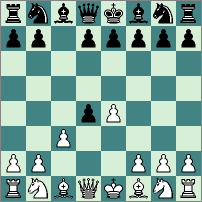
|
3 videos :
1,
1,
2, (ICC user name & password)
3.
T42:\Escacs\Siciliana\Smith_Morra\3videos
ideas & plans
El blanc ha de jugar e5 !
Quadres importants : c7 i f7;
h7 després de enrocar.
White playing e5 within the Smith Morra
is by far one off the most crucial elements of the gambit.
I find that e5 generally removes a lot of the space black attains
and can result a large amount of tactical opportunities.
Miniature :
1.e4 c5 2.d4 cxd4 3.c3 dxc3 4.Nc3 d6 5.Bc4 Nf6 {a very tempting move for Open Sicilian players!}
6.e5! dxe5? and now 7.Bxf7+ Game over : black loses Queen
from
ChessVille (why),
ChessVille (how), etc
Declined.
|
A) The Morra Gambit Accepted: 3...dxc3 4.Nxc3
Classical mainline: 4...Nc6 5.Nf3 d6 6.Bc4 e6 7.0-0 Nf6 8.Qe2 Be7 9.Rd1 e5 10.h3 or 10.Be3
Scheveningen setup: 4...Nc6 5.Nf3 d6 6.Bc4 e6 7.0-0 Nf6 (or Be7) 8.Qe2 a6 9.Rd1 Qc7 10.Bf4 (10.Bg5) Be7
Siberian variation: 4...Nc6 5.Nf3 e6 6.Bc4 Nf6 and 7...Qc7
Nge7 variations: 4...Nc6 (or 4...e6) 5.Nf3 e6 6.Bc4 a6 (Nge7) 7.0-0 Nge7 (d6 8.Qe2 Nge7 9.Bg5 h6) 8.Bg5 f6 9.Be3
6...a6 defence: 4...Nc6 5.Nf3 d6 6.Bc4 a6 eventually 7...Bg4
Fianchetto: 4...g6 (4...Nc6 5.Nf3 g6 allows 6.h4!?) 5.Nf3 Bg7 6.Bc4 Nc6
Chicago defence: 4...e6 5.Bc4 a6 6.Nf3 b5 7.Bb3 d6 8.0-0 and black plays ...Ra7 at some stage
Early queenside fianchetto: 4...e6 5.Bc4 a6 6.Nf3 b5 7.Bb3 Bb7
Wiki
Estudi detallat :
1.e4 c5 2.Nf3 d6 3.d4 cxd4 4.c3 dxc3 5.Nxc3 Nc6 6.Bc4
1.e4 c5 2.d4 cxd4 3.c3 dxc3 4.Nxc3 Nc6 5.Nf3 d6 6.Bc4
6. .. Bf6 ? 7.e5!
url.
7...Nxe5?
url.
8.Nxe5 dxe5 9.Bxf7+ Kxf7 10.Qxd8
7...dxe5?
url.
8.Qxd8+ Nxd8 (8...Kxd8) 9.Nb5 Kd7? (9...Rb8, Ne6, Be6) 10.Nxe5+ Ke8 11.Nc7++
7...Ng4?
url.
8.e6! f6 (8...Bxe6, 8...fe) 9.0-0 (9.Bf4) 9...Nge5 10.Nxe5 11.Bd5
7...d5
url.
8.Bb3(Nxd5) Nd7 9.Qxd5 e6 10.Qb5 a6 11.Qe2 Qc7 12.Bf4
6. .. a6 -> 2-on video, minut 00:03:40 de 00:46:47
url.
7. e5 dxe5 8. Qxd8+ Kxd8 9. Ng5 Nh6 10. Bxf7
Nxd8 9. Nd5 Ne6 10. Nb6 Rb8 11. Nxe5 Nf6 12. Nxf7
!!!
Kxf7 13. Bf4 (get Rook)
Nd4 13. Nxh8
Rg8 13. Ne5
6. .. e6 -> 2-on video, minut 17:39 de 00:46:47
url.
7. Qe2 Nf6 8. Bf4 e5 9. Ng5 Nd4 10. Qd2 Ne6 11. Be3
Be7 9. Rd1
6. .. Nf6 7.e5 Nxe5
url.
6. .. Nf6 7.e5 Ng4 8.e6 f6 9.0-0
url.
6. .. Nf6 7.e5 Ng4 8.e6 f6 9.Bf4
url.
6. .. Nf6 7.e5 Ng4 8.e6 Bxe6
url.
6. .. Nf6 7.e5 Ng4 8.e6 fxe6
url.
6. .. Nf6 7.e5 dxe5 8.Qxd8 Nxd8 9.Nb5 Kd7
url.
6. .. Nf6 7.e5 dxe5 8.Qxd8 Nxd8 9.Nb5 Rb8 10.Nxe5 e6 11.Nxa7
url.
6. .. Nf6 7.e5 dxe5 8.Qxd8 Nxd8 9.Nb5 Rb8 10.Nxe5 e6 11.Nxc7+
url.
6. .. Nf6 7.e5 dxe5 8.Qxd8 Kxd8
url.
6. .. Nf6 7.e5 d5 8.Bb3
url.
6. .. Nf6 7.e5 d5 8.Nxd5
url.
url.
5. .. e6
1.e4 c5 2.d4 cxd4 3.c3 dxc3 4.Nxc3 Nc6 5.Nf3 e6 6.Bf4
6. .. d6 7. Bf4 d6 8. Bc4
6. .. a6 7. e5 (+Bd3)
6. .. Nf6 7. e5
6. .. Nf6 7. Bb4 !?
Trap :
6. Bf4 Nge7 7. Nb5!! Ng6 8. Nc7+ (o Nd6) Ke7 9. Qd6+ Kf6 10. Bg5++
7. ... d5 8. Bc7 Qd7 9. Nd6+ (wins Queen)
7. ... e5 8. Nd6++
7. ... Qa5+ 8. Bd2 Qb6 9. Nd6+ (+Nxf7)
1-er video, 21:37 de 29:00, 2-on video, 24:50 de 46:47
Smith Morra links :
Siberian trap
1.e4 c5 This is the Sicilian Defense.
2.d4 cxd4
3.c3 dxc3 white's 3.c3 introduces the Smith-Morra Gambit. black accepts the gambit pawn.
4.Nxc3 Nc6
5.Nf3 e6
6.Bc4 Qc7
7.0-0 Nf6
8.Qe2 white prepares e4-e5.
This move is playable if white is careful on the next move.
After 8.Re1 Bc5 black has a good game as white's f2 square is sensitive.
white also doesn't achieve much after 8.h3 a6.
Instead, NCO suggests 8.Nb5 Qb8 9.e5 Nxe 10.Nxe5 Qxe5 11.Re1
and white has some compensation for the sacrificed pawns.
8. ... Ng4!
9.h3??
9. ... Nd4! The black threat of 10...Nxf3+ followed by 11...Qh2# wins white's Queen.
If 10.Nxd4?, Qh2#.
url,
youTube
S-M declined
1.e4 c5 2.d4 d3 3.c4
1.e4 c5 2.d4 Nc6 3.cxd
1.e4 c5 2.d4 d5 3.exd Qxd5 4. cxd (+Nc3)
1.e4 c5 2.d4 Nf6 3.?
1.e4 c5 2.d4 cxd4 3.c3 d3 4.c4 Nc6 5.Bxd3 d6 6.h3 Nf6 7.Nc3 g6 8.Be3 Bg7 9.Qd2 Be6 10.b3 0-0
11. Nf3 Qa5 12. Rc1 Rac8 13. 0-0
1.e4 c5 2.d4 cxd4 3.c3 Nc6 4.cxd4 d5 5.exd5
B22 (anti-sicilian) Alapin
wiki,
chessgames B22 - 10.544 games
White goes mostly for a type of position, rather than a concrete line.
Safe, little theory, easy to learn, active - what else can one expect from an opening variation ?
White's intention is obvious - to play d4 and build a strong pawn-centre, with pawns on e4 and d4.
Black's most natural way to prevent it is to attack the e4-pawn, by 2...d5 or 2...Cf6 (much better)
White can choose some drawish lines, as B33121, or more ambitious as B21 {Dorian Rogozenko "Anti Sicilian Book"}
{sagpdf}, 6 MB.
1.e4 c5 2.c3
2... Nf6 3.e5 Nd5 4.Nf3 Nc6 5.Na3 (Heidenfeld variation)
2... Nf6 3.e5 Nd5 4.Nf3 Nc6 5.Bc4 Nb6 6.Bb3 c4 7.Bc2 Qc7 8.Qe2 g5 9.h3 or e6
d5 7.exd6 Qxd6
4.d4 cxd4 5.Nf3 (if dxc3, Qxd5) Nc6 6.cxd4
2... Nc6 3.Nf3 d5 4.exd5 Qxd5 5.c4
2... d5 3.exd5 Qxd5 4.d4 Nc6 Barmen defense
Nf6 5.Nf3 Nc6 6.Na3
2... e6 3.d4 d5 4.e5 - advance variation of french
4.Nd2 - sort of Tarrasch french
4.exd5 exd5 5.Be3
2... d6 3.d4 Nf6 4.Bd3
2... g6 3.Nf3 Nf6 4.e5
Bg7 4.d4
"Black has only two good replies (to 2.c3) – 2...d5 and 2...Nf6"
Alapin Barmen defense : 1.e4 c5 2.c3 d5
After 1.e4 c5 2.c3 d5 3.exd5 Qxd5 4.d4 Nf6 5.Nf3 Nc6 the continuation 6.dxc5 is one of white’s most challenging
6...Qxd1+ - not Qxc5 because of 7.Na3 e5 8.Be3 and 9.Nc4
The complete line is :
1.e4 c5 2.c3 d5 3.exd5 Qxd5 4.d4 Nc6 5.Nf3 Bg4 6.Be2 cxd4 7.cxd4 e6 8.Nc3 Qa5
Alapin : usual 1.e4 c5 2.c3 e5
1.e4 c5 2.c3 e5
3.Nf3
3.d4
3.Bc4
3.f4 exf4 4.Nf3
3.d3
Alapin ben jugat pel negre
1 e4 c5 2 c3 Nf6 3 e5 Nd5 4 d4 cxd4 5 Qxd4 e6
6 Nf3 Nc6 7 Qe4 f5 8 Qe2 a6 9 Nbd2 b5 10 g3 Bb7
11 Bg2 Be7 12 O-O O-O 13 a4 bxa4 14 Rxa4 a5 15 Rd1 Nb6 16 Ra1 a4
A mi m'agrada pel negre :
1.e4 c5 2.c3 Nc6 3.d4 cxd4 4.cxd4 d5 5.exd5 Qxd5 6.Nf3 Bg4 7.Nc3 Axf3 8.Nxd5 Bxd1 9.Nc7+ Kd7 10.Nxa8 Bh5 (equal)
si Qd7 8.d5 guanya
Some Alapin games and links
Stevic (2607) - Topalov (2803), Khanty Mansiysk (ol) 2010
1.e4 c5 2.c3 d5 3.exd5 Qxd5 4.d4 cxd4 5.cxd4 Nc6 6.Nf3 Bg4 7.Nc3 Bxf3 8.gxf3 Qxd4 9.Qxd4 Nxd4 10.Nb5 e5
11.Nc7+ Kd7 12.Nxa8 Bb4+ 13.Kd1 Ne7 14.f4! Rxa8 15.fxe5 Rd8 16.Bh3+ Ke8 17.Be3 Nd5 18.Bxd4 Nf4 19.Kc2 Rxd4 20.Bf1 Ne6
21.Rd1 Rf4 22.Kb1 Ke7 23.Bg2 b6 24.Rhf1 Bc5 25.Rd2 h5 26.Bd5 g5 27.f3 a5 28.Rfd1 Rf5 29.Be4 Rxe5 30.Rd5 Rxd5
31.Rxd5 f6 32.Kc2 Bd6 33.Rd2 Bf4 34.Rf2 f5 35.Bd5 Nc5 36.Re2+ Kf6 37.Kc3 b5 38.Kd4 Bd6 39.Bg8 g4 40.fxg4 hxg4
41.Kd5 Ne4 42.a4 bxa4 43.Rxe4 fxe4 44.Kxd6 Kf5 45.Bc4 Kf4 46.Be2 g3 47.hxg3+ Kxg3 48.Kc5 Kf2 49.Bh5 Ke1 50.Kb5 Kd2
51.Kxa4 Kc2 52.Ka3 e3 53.Be2 a4 54.Ba6 Kc1 55.Ka2 Kc2 56.Bc4 Kc1 57.Bb5 Kd2 58.Kb1 e2 59.Bxe2 Kxe2 60.Kc2 Ke1
61.Kc3 Kd1 62.Kb4 Kc2 63.Kxa4 Kxb2 ½–½.
1 video with 3 games of Alisa Melekhina.
Ideas por Luis Fernandez Siles
B23 (anti-sicilian) 2.Cc3
PGN amb 9 partides magistrals - gracies, Lucas !
1.e4 c5 2.Nc3 Nc6 3.Bb5 e6 4.BxNc6 bxc 5.f4
1.e4 c5 2.Nc3 Nc6 3.Bb5 Nd4 4.Bc4 e6 5.Nf3 Nf6 6.0-0 a6
1.e4 c5 2.Nc3 d6 3.f4
1.e4 c5 2.Nc3 e6 3.Nf3
B23 closed sicilian
La jugo sota ensenyament de'n Ramon !
Usual start :
1.e4 c5 2.Nc3 Nc6 3.g3 g6 4.Bg2 Bg7 5.Nge2 e6 6.d3 Nge7 7.O-O d6 8.Be3 O-O 9.Qd2 Rb8 10.f4 b5
11.g4 b4 12.Nd1 Bb7 13.f5 ... and an attack via pawn storm ensues
URL :
- main idea(s) for white: build up position slowly,
possibly attack on the kingside with a slow pawn storm;
possibly open the center later with a d4 break.
- main idea(s) for black: pawn storm on the queenside;
depending on the position, black could possibly break in the center too.
URL :
- White’s e4-pawn, knight, and bishop on g2 will work together
to control the central light squares and make it difficult for black to break in the center with …d5.
- Black's : queenside expansion
Dedicat a la família Ros !
1.e4 c5 2.Nc3 Nc6 3.g3 g6 4.Bg2 Bg7 5.d3 d6
white's main options are 6.Be3 followed by Qd2 and possibly 0-0-0
or 6.f4 followed by Nf3 and 0-0
Some realy nice Dirty Chess Tricks against Sicilian - 10 (Closed Sicilian)
Anti-closed sicilian
Korchnoi defense :
1.e4 c5 2.Nc3 e6 3.g3 d5
Caruana vs Kasparov
Les idees pel blanc son
- f4 + f5
- h3 prevenint Cg4, Ae3 + Dd2 + Ah6
- d4
ronda 12
St Louis blitz 2017 [all pgns]
B23 - Grand Prix attack
1.e4 c5 2.f4 is the Grand Prix Attack or McDonnell Attack:
the latter name stems from the 14th match game played in London in 1834
between Alexander McDonnell and Charles Louis Mahé de La Bourdonnais, won by black.
According to Jeremy Silman and others,
black's best reply is 2...d5 3.exd5 Nf6!, the Tahl Gambit,
which has caused the immediate 2.f4 to decline in popularity.
1.e4 c5 2.f4 d5 3.Nc3, the Toilet Variation (named for its place of discovery) is one way of declining the gambit.
The modern main line runs 1.e4 c5 2.Nc3 Nc6 3.f4 g6 4.Nf3 Bg7.
Here white can play the positional 5.Bb5,
threatening to double black's pawns with Bxc6,
or the more aggressive 5.Bc4, aiming for a kingside attack.
Wiki Sicilian
White only needs to do 3 things to complete his development :
- find a place for the white-square bishop :
Bc4 is the most dynamic, but allows d5 ;
Bb5 has the idea of exchanging the bishop for the knight, as "Bb5 e6 + Bxc6 bxc6 + e5 d5 + exd6 Qxd6 + d3 Nf6"
- castle king-side
- push d-pawn 1 step to give black bishop some scope
Dereque Kelley
Then, white can proceed to move the queen to e1 and then g4 or h4, followed by e5 or f5.
f5 sacrifice opens the way for the black-square bishop.
Usually black shall play exf which is lots worse than the un-natural gxf.
Why is it worse ?
Because now the white-square bishop at c4 has become a monster and we have to keep it even playing a3.
Now white shall play (Q is on h4) Bh6, Ng7 and both h7 and f7 are under attack.
Gracies, Joan Bastida !
{Jordi Bada}
Quan el negre no juga d6, és dubtós colocar alfil a c4.
L'explicació és que llavors el negre juga e6-d5 molt comodament, molestant el desenvolupament de les peces blanques.
Si quan fas Ab5 et juguesin Db6,
compte que tenim un truc que convé recordar, que és Cd5, atacant la dama que no pot menjar el alfil pel doblet a c7 :
1.e4 c5 2.Nc3 d6 3.f4 Nc6 4.Bb5 Qb6 5.Nd5 !
Objectius
pel blanc
- hem de fer "f5" per obrir pas a l'alfil de caselles negres
- hem de moure la dama a e1 -> g3 o h4 (millor)
- hem de posar el alfil a "h6"
- hem de posar el cavall a "g5"
- si a6 hem de fer a4
pel negre
Si el negre pot jugar Bg4, el pla del blanc s'enfonsa
"f" pawn sacrifice
If exf then white-square bishop at c4 (or b3 or a2) becomes a monster
What if ... ?
1.e4 c5 2.Cc3 Cc6 3.f4 g6 4.Ab5 Cd4 5.0-0 a6 6.Ad3
5.Ac4
1.e4 c5 2.Cc3 d6 3.f4 g6 4.Cf3 Ag7 5.Bc4
as here
1.e4 c5 2.Cc3 e6 3.Cf3 abandonem GP
1.e4 c5 2.Cc3 g6 3.Ac4
1.e4 c5 2.Cc3 a6 (i b5) {JB, 20170112}
1.e4 c5 2.Cc3 Cc6 3.f4 e5 {interessant}
Per que abandonem GP en "2. ...e6 ?
Ens agafen el centre :
1.e4 c5 2.Nc3 e6 3.f4 Nc6 4.Nf3 d5 5.Bb5
Cge7 6.exd5 exd5
Cf6 6.e5 Cd7 7.Bxc6 bxc6
d4 6.Axc6+ bxc6 7.Ce2 Cf6
Apunts GPx
Ejemple siciliana JB
Jordi Bada Navarra vs. Daniel Mari Miguel, 9th Sant Boi Spain, Open,
2017.06.09
1. e4 c5 2. Nc3 Nc6 3. f4 g6 4. Nf3 Bg7 5. Bb5 Nd4 6. Bd3 e6 7. e5 d6 8. Ne4 Nxf3+ 9. Qxf3 dxe5 10. Bb5+ Kf8
11. fxe5 Bxe5 12. O-O f5 13. d3 Qc7 14. Kh1 a6 15. Bc4 b5 16. Ng5 Rb8 17. Nxe6+ Bxe6 18. Bxe6 Kg7 19. g4 Rf8 20. gxf5 Ne7
21. Qg2 h6 22. c3 Rf6 23. Be3 Rhf8 24. d4 Bd6 25. Rg1 Rxf5 26. Bxf5 Rxf5 27. Raf1 Rh5 28. h3 g5 29. Qg4 Qc6+ 30. Rg2 Kg6 31. Qe6+ 1-0
B27 - hyperaccelerated Dragon
1. e4 c5 2. Nf3 g6
B28 - O'Kelly variation
Chessgames B28
It starts like this :
1. e4 c5 2. Nf3 a6
The main idea is
1. e4 c5 2. Nf3 a6 3.d4 cxd4 4.Nxd4 Nf6 5.Nc3 {if 5.e5 Qa5+} e5 ... and Nd4 has no good square !
Important moves for black are : e6 and Qc7
Anand vs Morozevich, Calvia 2004.10.24 :
1. e4 c5 2. Nf3 a6 3. c4 e6 4. Nc3 Qc7 5. d4 cxd4 6. Nxd4 Nf6
7. a3 b6 8. Be3 Bb7 9. f3 Nc6 10. Be2 Ne5 11. Na4 Rb8 12. Rc1 Be7 13. b4 d6 14. O-O O-O
15. Qd2 Ba8 16. Nb3 Kh8 17. Rfd1 Rg8 18. Bd4 Ned7 19. Qe3 Qc6 20. Nb2 e5 21. Bc3 g5
22. h3 h5 23. Nd3 g4 24. hxg4 hxg4 25. c5 gxf3 26. Bxf3 bxc5 27. Na5 Qb5 28. a4 Qxa4 29. bxc5 Ng4
30. Qe2 Ndf6 31. Ra1 Qb5 32. Rd2 Rbc8 33. Rb2 Qd7 34. Nc4 Qe6 35. Nb6 dxc5 36. Nxc8 Rxc8
37. Nf4 Qd7 38. Rd2 Qa7 39. Rxa6 Qb7 40. Bxg4 Nxg4 41. Qxg4 Qxa6 42. Bxe5+ f6 43. Ng6+ Kh7 44. Nxe7 fxe5 45. Nxc8 1-0
B30 - Rossolimo attack
More or less it goes as
1.e4 c5 2.Nf3 Nc6 3.Bb5 e6 4.Bxc6 bxc6 5.d3
g6 4.Bxc6 bxc6 5.0-0
Veig que el blanc fa ... Qe2 ... e5 ... c4 ... Cg5 i f4 ... a3 i b4 ...
I el negre fa ... Ce7 i Cg6 ... Dc7 ...
El cavall de c6 ha de morir
Chessgames position and games
Que fem amb 3... Qc7 ?
As Marc a 20180420
1.e4 c5 2.Nf3 Nc6 3.Bb5 Qc7 4.0-0 e6 5.Bxc6 Qxc6 6.
4.Cc3
good video
B32 - Lowenthal variation
B32, posicio :
1.e4 c5 2.Nf3 Nc6 3.d4 cxd4 4.Nxd4 e5 6.Nb5 a6 7.Nd6+ Bxd6 8.Qxd6 Qf6 9.Qxf6 Nxf6 {minut 13 video} 10.Nc3 Nb4 11.Bd3 d6
11.Kd2
10.Bd3 d5!
9.Qa3 Ne7 10.Nc3 Rb8 (per b5)
9.Qd1 Qg6 10.Nc3 d5! 11.Nxd5 Qxe4!
Ne7 {
Kramnik-Vallejo, 26 jugades}
d6 - Kalachnikov
good video - ideas :
B40 - Marshall variation, also against GP
1.e4 c5 2.Nf3 e6 3.d4 d5
Amb en JA jugo
1.e4 c5 2.Nf3 e6 3.d4 cxd4 4.Nxd4 Nc6 5.c4 Nf6 6.Nc3 Bb4 7.Be3 Nxe4 8.Qc2 Nxc3 9.bxc3 Be7 10.g3 O-O
doraemon87 vs Perezsaurio, 20210409 :
1. e4 c5 2. Nf3 e6 3. Nc3 {classica} a6 4. g3 b5 5. Bg2 Bb7 6. d3 Qc7 7. O-O d6 8. Ng5 h6 9. Nh3 Nf6
10. f4 Nbd7 11. f5 e5 12. g4 Be7 13. a4 b4 14. Ne2 d5 15. Ng3 O-O-O 16. c3 dxe4 17. cxb4 exd3
18. Qxd3 Bxg2 19. Kxg2 cxb4 20. Qxa6+ Qb7+ 21. Qxb7+ Kxb7
(B41-46) - Paulsen
Usual lines :
1.P4R P4AD 2.C3AR P3D 3.P4D PxP 4.CxP P3TD
5.C3AD D2AD
5.C3AD P4CD
5.C3AD A4AD
5.A3D C3AR
5.A3D C3AD
5.A3D A4AD
5.A3D P3CR
5.P4AD -
Maroczy
5.C2D
1.P4R P4AD 2.C3AR P3D 3.P4D PxP 4.CxP C3AD
5.C5C P3D 6.P4AD
5.C5C P3D 6.A4AR
1.e4 c5 2.Nf3 e6 3.d4 cxd4 4.Nxd4 a6 = B41, Kan
1.e4 c5 2.Nf3 e6 3.d4 cxd4 4.Nxd4 a6 5.Bd3 = B42, Kan
1.e4 c5 2.Nf3 e6 3.d4 cxd4 4.Nxd4 a6 5.Nc3 = B43, Kan
1.e4 c5 2.Nf3 e6 3.d4 cxd4 4.Nxd4 Nc6 = B44
1.e4 c5 2.Nf3 e6 3.d4 cxd4 4.Nxd4 Nc6 5.Nc3 = B45, Taimanov
Kosteniuk - Polgar
Moskow 2009 blitz (1-0 en 78 mov per 1 peo),
Spassky - Fischer
1972 (0-1, Torre vs Alfil+pawn).
B43 - Kan
Chessgames B43 :
1.e4 c5 2.Nf3 e6 3.d4 cxd4 4.Nxd4 a6 5.Nc3 Qc7 {prevenint e5}
6.Bd3 Nf6 7.0-0 Bc5 8.Nb3 Na7
Bona intro :
1.e4 c5 2.Nf3 e6 3.d4 cxd4 4.Nxd4 a6
5.c4
5.Bd3
5.Nc3
B45 - Taimanov
Chessgames B45 :
1.e4 c5 2.Nf3 e6 3.d4 cxd4 4.Nxd4 Nc6 5.Nc3
Topalov vs Kasparov
(B51 - B52) Moscow variation - Canal Sokolsky variation - 2...d6 without 3.d4
After 1.e4 c5 2.Nf3 d6, white's most important alternative to 3.d4 is
3.Bb5+, known as the Moscow Variation or the Canal-Sokolsky attack.
Sicilian defense Moscow variation -
YouTube
365 chess
1.e4 c5 2.Nf3 d6 3.Bb5+ Bd7 4.Bxd7 Qxd7 5.0-0 Nf6 6.Re1 Nc6 7.c3
1992 Tahl vs Kasparov :
1.e4 c5 2.Nf3 d6 3.Bb5+ Nd7 4.d4 Nf6 5.O-O a6 6.Bxd7+ Nxd7 7.Nc3 e6 8.Bg5 Qc7 9.Re1 cxd4
10.Nxd4 Ne5 11.f4 h6 12.Bh4 g5 13.fxe5 gxh4 14.exd6 Bxd6 15.Nd5 exd5 16.exd5+ Kf8 17.Qf3 1-0 {on clock}
Variants
Jo veig 3 linies :
1.e4 c5 2.Nf3 d6 3.Bb5+
Nd7
Nc6
Bd7
B60-B69 - Richter–Rauzer Attack of the classical variation
We are under "classical variation" of sicilian :
1.e4 c5 2.Nf3 d6 3.d4 cxd4 4.Nxd4 Nf6 5.Nc3 Nc6
or
1.e4 c5 2.Nf3 Nc6 3.d4 cxd4 4.Nxd4 Nf6 5.Nc3 d6
White's most common reply is 6.Bg5, the Richter–Rauzer Attack,
threatening to double black's pawns after Bxf6 and forestalling the Dragon by rendering 6...g6 unplayable.
After 6...e6, Vsevolod Rauzer introduced the modern plan of Qd2 and 0-0-0 in the 1930s.
1.e4 c5 2.Nf3 d6 3.d4 cxd4 4.Nxd4 Nf6 5.Nc3 Nc6 6.Bg5
(B60)
1.e4 c5 2.Nf3 d6 3.d4 cxd4 4.Nxd4 Nf6 5.Nc3 Nc6 6.Bg5 Bd7 7.Qd2
(B61) Larsen Variation
1.e4 c5 2.Nf3 d6 3.d4 cxd4 4.Nxd4 Nf6 5.Nc3 Nc6 6.Bg5 e6
(B62)
1.e4 c5 2.Nf3 d6 3.d4 cxd4 4.Nxd4 Nf6 5.Nc3 Nc6 6.Bg5 e6 7.Qd2
(B63)
1.e4 c5 2.Nf3 d6 3.d4 cxd4 4.Nxd4 Nf6 5.Nc3 Nc6 6.Bg5 e6 7.Qd2 Be7 8.O-O-O O-O 9.f4
(B64)
1.e4 c5 2.Nf3 d6 3.d4 cxd4 4.Nxd4 Nf6 5.Nc3 Nc6 6.Bg5 e6 7.Qd2 Be7 8.O-O-O O-O 9.f4 Nxd4 10.Qxd4 (B65)
1.e4 c5 2.Nf3 d6 3.d4 cxd4 4.Nxd4 Nf6 5.Nc3 Nc6 6.Bg5 e6 7.Qd2 a6 (B66)
1.e4 c5 2.Nf3 d6 3.d4 cxd4 4.Nxd4 Nf6 5.Nc3 Nc6 6.Bg5 e6 7.Qd2 a6 8.O-O-O Bd7 (B67)
1.e4 c5 2.Nf3 d6 3.d4 cxd4 4.Nxd4 Nf6 5.Nc3 Nc6 6.Bg5 e6 7.Qd2 a6 8.O-O-O Bd7 9.f4 Be7 (B68)
1.e4 c5 2.Nf3 d6 3.d4 cxd4 4.Nxd4 Nf6 5.Nc3 Nc6 6.Bg5 e6 7.Qd2 a6 8.O-O-O Bd7 9.f4 Be7 10.Nf3 b5 11.Bxf6 (B69)
B67 - Richter-Rauzer, neo-modern Variation
Sergey Karjakin vs Fabiano Caruana, world championship candidates (2016) :
1.e4 c5 2.Nf3 Nc6 3.d4 cxd4 4.Nxd4 Nf6 5.Nc3 d6 6.Bg5 e6 7.Qd2 a6 8.O-O-O Bd7 9.f4 h6 10.Bh4 b5
11.Bxf6 gxf6 12.f5 Qb6 13.fxe6 fxe6 14.Nxc6 Qxc6 15.Bd3 h5 16.Kb1 b4 17.Ne2 Qc5 18.Rhf1 Bh6 19.Qe1 a5 20.b3 Rg8
21.g3 Ke7 22.Bc4 Be3 23.Rf3 Rg4 24.Qf1 Rf8 25.Nf4 Bxf4 26.Rxf4 a4 27.bxa4 Bxa4 28.Qd3 Bc6 29.Bb3 Rg5 30.e5 Rxe5
31.Rc4 Rd5 32.Qe2 Qb6 33.Rh4 Re5 34.Qd3 Bg2 35.Rd4 d5 36.Qd2 Re4 37.Rxd5 exd5 38.Qxd5 Qc7 39.Qf5 Rf7 40.Bxf7 Qe5 41.Rd7+ Kf8 42.Rd8+ 1-0
B71 - Levenfish variation
Chessgames B71 :
1.e4 c5 2.Nf3 d6 3.d4 cxd4 4.Nxd4 Nf6 5.Nc3 g6 6.f4
White prepares 7.e5 attacking black's f6-knight.
Therefore in the pre-computer era 6... Nc6 or 6... Nbd7 were considered mandatory to meet the Levenfish variation
Today, after 6... Bg7 7. e5 Nh5 8. Bb5+ Bd7 9. e6 fxe6 10. Nxe6 Bxc3+ 11. bxc3 Qc8 ... black might actually be better.
ChessGames B71 242 games
B76 - Drac
Chessgames B76, yugoslav attack
The Dragon Variation is one of the main lines of the Sicilian Defence and begins with the moves:
1.e4 c5 2.Nf3 d6 3.d4 cxd4 4.Nxd4 Nf6 5.Nc3 g6
Usual continuations are :
1.e4 c5 2.Nf3 d6 3.d4 cxd4 4.Nxd4 Nf6 5.Nc3 g6
1.P4R P4AD 2.C3AR P3D 3.P4D PxP 4.CxP C3AR 5.C3AD P3CR
6.P4A : f4 Ataque Levenfish, B71
6.A3R : 6.Be3 Bg7 7.f3 0-0 8.Qd2 Nc6 = Yugoslav Attack
ChessGames B76 1900 games
B80-B89 - sicilian, Scheveningen
Wiki
Basic moves are
1.e4 c5 2.Nf3 d6 3.d4 cxd4 4.Nxd4 Nf6 5.Nc3 e6 6.f4
Tahl vs Larsen play it like this in 1965 :
1.e4 c5 2.Nf3 Nc6 3.d4 cxd4 4.Nxd4 e6 5.Nc3 d6 6.Be3 Nf6 7.f4 Be7 8.Qf3 0-0 9.0-0-0 Qc7 10.Ndb5 Qb8
11.g4 a6 12.Nd4 Nxd4 13.Bxd4 b5 14.g5 Nd7 15.Bd3 b4 16.Nd5!! exd5 17.exd5
B81 - atac Keres a la variant Scheveningen
1.e4 c5 2.Nf3 d6 3.d4 cxd4 4.Nxd4 Nf6 5.Nc3 e6 6.g4 h6 7.h4 Nc6 (o a6)
20171227 - gracies, Joan Anton !
Read wiki
En Anand dona una lliço en Jiangchuan a Kuala Lumpur 1989
1.e4 c5 2.Nf3 e6 3.d4 cxd4 4.Nxd4 Nf6 5.Nc3 d6 6.g4 h6 7.Rg1 Nc6 8.h4 h5 9.gxh5 Nxh5 10.Bg5 Nf6
11.Be2 a6 12.h5 Bd7 13.Qd2 Be7 14.O-O-O Qc7 15.h6 gxh6 16.Bxf6 Bxf6
17.Nf5 Be7 {si exf5, 18.Nd5 Qd8 i 19.Qxh6!} 18.Nxe7 Kxe7 19.Rg3 b5 20.Qf4 Rad8 21.Qh4+ Ke8
22.Bxb5 Ne5 {si axb5, Nxb5 es mortal per l'escac a d6} 23.Be2 Qc5 24.Bh5 Rf8
25.f4 Nc6 26.e5 d5 27.Bxf7+ Rxf7 28.Rg8+ Qf8 29.Rxf8+ Rxf8 30.Qh5+ Ke7 31.Qxh6 1-0
Objectius pel blanc (si hi ha enroc curt) :
Objectius pel negre (si hi ha enroc llarg) :
- a7 + b5 + b4 (si hi ha cavall a c3)
2021 Tata Steel - Andrey Esipenko - Magnus Carlsen
chess24
pgns 8a ronda
1. e4 c5 2. Nf3 d6 3. d4 cxd4 4. Nxd4 Nf6 5. Nc3 a6 6. Be2 e6 7. Be3 Be7 8. g4 b5
9. g5 Nfd7 10. a3 Bxg5 11. Qd2 Bxe3 12. Qxe3 Qh4 13. Rg1 g6 14. O-O-O Qe7 15. f4 Bb7
16. Kb1 Nc6 17. Ncxb5 axb5 18. Nxc6 Bxc6 19. Qc3 O-O 20. Qxc6 d5 21. exd5 Rfc8
22. d6 Qd8 23. Qxb5 Rcb8 24. Qc4 Rxa3 25. Qc7 Qe8 26. Rg5 Ra4 27. Ra5 Rab4
28. b3 R4b7 29. Qc3 Qd8 30. Bf3 Rb4 31. Qc7 Qf6 32. Ra8 Rxa8 33. Bxa8 Qf5
34. Kb2 Rb5 35. Qxd7 Rc5 36. Rc1 Qxf4 37. Qe8+ Kg7 38. d7 1-0
B82 - beating Judit Polgar with Scheveningen 6.f4
Chessgames B82 865 games
Sicilian, Scheveningen (B82)
1 e4 c5 2 Nf3 d6 3 d4 cxd4 4 Nxd4 Nf6 5 Nc3 e6 6 f4
Un molt bon article by Ignacio Marin :
1.e4 c5 2.Nf3 d6 3.d4 cxd 4.Nxd4 Nf6 5.Nc3 a6 6.f4 e6 7.Df3!?
7... Db6 or Cbd7!?
8.Nb3 Qc7 9.g4 - fast avance of the g pawn
9... b5
10.g5 b4 11.Nb5 axb5 12.gxf6 : 12...Nd7 or 12...fg
10.Bd3
Stanford
B89 - Velimirovic attack
1.e4 c5 2.Nf3 d6 3.d4 cxd4 4.Nxd4 Nf6 5.Nc3 e6 6.Bc4 Nc6 7.Be3
Be7 8.Qe2 0-0 9.0-0-0 a6 10.Bb3 Qc7 11.g4
11.Rhg1
Bd7
Qa5
Qc7
Nxd4
d5
a6 8.Qe2 Qc7 9.0-0-0 Be7 10.Bb3 Na5 11.g4 b5 12.g5 Nxb3 13.axb3 Nd7 14.Nf5
14.h4
14.f4
14.Qh5
Very very nice sample :
Milan Matulovic vs Vladimir Simagin , Kislovodsk (1966)
B90 - Najdorf
Najdorf's intention with 5...a6 was to prepare ...e5 on the next move to gain space in the centre
The immediate 5...e5?! however is met by 6.Bb5+!, when black must either play 6...Bd7 or 6...Nbd7
The former allows white to exchange off black's light-squared bishop, after which the d5-square becomes very weak
The latter allows 7.Nf5, when black can only save the d-pawn by playing the awkward 7...a6 8.Bxd7+ Qxd7
In both cases, white's game is preferable
1.e4 c5 2.Nf3 d6 3.d4 cxd4 4.Nxd4 Nf6 5.Nc3 a6
6.A5CR
6.A4AD
6.P4AR
6.A2R
6.P3CR
6.P3TR
ChessGames B90,
Wikipedia
The oldest, sharpest response by white is an immediate 6.Bg5,
generally countered by 6...e6, followed by 7.f4,
hoping to exploit the pin on the knight.
The simplest response by black is 7...Be7,
when the main line continues
8.Qf3 Qc7 9.0-0-0 Nbd7 and now 10.g4 or 10.Bd3.
However, black's most popular choice at the master level is 7...Qb6!,
leading to the extremely complicated Poisoned Pawn Variation
(8. Qd2 Qxb2 9. Rb1 (or 9.Nb3) Qa3.
Currently, white's most popular weapon against the Najdorf is 6.Be3, called the English Attack.
Since the early 1990s,
the English Attack
(6.Be3 followed by f2-f3, g2-g4, Qd2 and 0-0-0 in some order)
has become extremely popular.
But black is extremely comfortable after 6.f3?! e5 7.Nb3 Be7
Wiki
B90 old variation
1.e4 c5 2.Nf3 d6 3.d4 cxd4 4.Nxd4 Nf6 5.Nc3 a6 6.Bc4 e6 7.a3
7.. Be7 8.Ba2 0-0 9.0-0 b5 10.f4 Bb7 11.f5 e5 12.Cde2 Cbd7
Polgar vs Kasparov
1.e4 c5 2.Nf3 d6 3.d4 cxd4 4.Nxd4 Nf6 5.Nc3 a6 6.Bg5 e6
If you play the main move 7.f4, you enter the Devil's Labyrinth.
Black can choose
- the Polugaevsky variation
- the Poisoned Pawn variation
- the Goetheborg variation and many other complicated lines
1.e4 c5 2.Nf3 d6 3.d4 cxd4 4.Nxd4 Nf6 5.Nc3 a6
6.Bg5 e6 7.f4 Qb6 8.Qd2 Qxb2 9.Rb1 Qa3
B96 - Polugayevsky
Chessgames B96
Polugaevsky was a noted theorist whose work on a number of openings has stood the test of time.
He is best remembered for a variation of the Sicilian Defense that bears his name:
1.e4 c5 2.Nf3 d6 3.d4 cxd4 4.Nxd4 Nf6 5.Nc3 a6 6.Bg5 e6 7.f4 b5!?
This "Polugaevsky Variation" of the Najdorf Sicilian leads to extraordinarily complicated play.
365chess Najdorf
B97 - poisoned pawn variation of the Najdorf sicilian
Chessgames B97 :
1.e4 c5 2.Nf3 d6 3.d4 cxd4 4.Nxd4 Nf6 5.Nc3 a6
6.Bg5 e6 7.f4 Qb6 8.Qd2 Qxb2 9.Rb1 Qa3
Selected games :
Spassky wins Fischer (1972),
Short loses to Kasparov (1993)
B98 sub-variants
B98 Sub-variants:
Sicilian, Najdorf, 7...Be7
1. e4 c5 2. Nf3 d6 3. d4 cxd4 4. Nxd4 Nf6 5. Nc3 a6 6. Bg5 e6 7. f4 Be7
Sicilian, Najdorf, Browne variation
1. e4 c5 2. Nf3 d6 3. d4 cxd4 4. Nxd4 Nf6 5. Nc3 a6 6. Bg5 e6 7. f4 Be7 8. Qf3 h6 9. Bh4 Qc7
Sicilian, Najdorf, Goteborg (Argentine) variation
1. e4 c5 2. Nf3 d6 3. d4 cxd4 4. Nxd4 Nf6 5. Nc3 a6 6. Bg5 e6 7. f4 Be7 8. Qf3 h6 9. Bh4 g5
Sicilian, Najdorf variation
1. e4 c5 2. Nf3 d6 3. d4 cxd4 4. Nxd4 Nf6 5. Nc3 a6 6. Bg5 e6 7. f4 Be7 8. Qf3 Qc7
Goteborg / Argentine variation
Moltes partides :
B98 @ chessUI
El meu enroc llarg més ràpid ...
... amb blanques
1.e4 c5 2.Nf3 d6 3.d4 cxd4 4.Nxd4 Nf6 5.Nc3 a6 6.Bg5 e6 7.Qd2 Nc6 8.0-0-0 Bd7 9.f3 Be7 10.g4 Rc8
Algunes partidetes sicilianes ...
- Atacs creuats ! (10...Rb8, 13...b5)
- Fischer vs Tahl, 0-1, B86 o B90 (Najdorf) al 1959 :
video,
chessgames
- guaita que fa en Nakamura :
Nakamura, Hikaru (2769) vs. Vachier-Lagrave, Maxime (2789) - Altibox Norway Chess | Stavanger | Round 6.3 | 3 Jun 2018 | 1/2-1/2
1. e4 c5 2. Nc3 d6 3. d4 cxd4 4. Qxd4 Nc6 5. Qd2 g6
6. b3 Bg7 7. Bb2 Nf6 8. O-O-O O-O 9. Kb1 Qa5 10. Nge2 e5
MVL wanted to prevent Nf4.
Sicilian traps
5 best opening traps in the sicilian defense :
1.e4 c5 2.Nf3 d6 3.d4 cxd4 4.Nxd4 Nf6 5.Nc3 a6 6.Bg5 e6 7.f4 Nd7 8.Qf3 {main line}
8.Bc4 {tricky} b5 {error} 9.Bxe6 fxe6 10.Nxe6 Qb6 11.Nd5! Nxd5 12.Qxd5 Bb7 13.Nc7! + Qe6
1.e4 c5 2.Nf3 Nc6 3.d4 cxd4 4.Nxd4 Nf6 5.Nc3 g6 {error}
6.Nxc6 bxc6 7.e5! Ne5 8.Nxe5 dxe5 9.Qxe5 Rb8 10.e6!! {Qe5 attacks both rooks}
1.e4 c5 2.Nf3 d6 3.d4 cxd4 4.Nxd4 Nf6 5.Nc3 g6 6.f4 Bg7 {mistake} 7.e5 dxe5 8.fxe5 Ng4 9.Bb5+ Kf8 10.Ne6+ {Qxd8 wins}
1.e4 c5 2.Nf3 a6! 3.d4 cxd4 4.Nxd4 Nf6 5.Nc3 e5! 6.Nb3 Bb4 7.Bd3 d5! 8.exd5 Nxd5 9.Bd7 Nxc3 10.bxc3 Bd6
1.e4 c5 2.Nf3 e6 3.d4 cxd4 4.Nxd4 a6 5.Nc3 Qc7 6.Be3 {error} Bb4 7.Qd2 Nf6 8.f3? d5 9.
He who has not tasted the bitter does not understand the sweet
(C00-C19) French defence
Wiki,
advance anatomy
The classical French main line :
1.e4 e6 2.d4 d5 3.Nc3 Nf6 4.Bg5 Be7 5.e5 Nfd7 6.Bxe7 Qxe7 7.f4 0-0 8.Nf3 c5 9.Bd3
White's light-square bishop eyes the weak h7-pawn,
which is usually defended by a knight on f6 but here it has been pushed away by e5.
A typical way for white to continue his attack is
9...cxd4 10.Bxh7+ Kxh7 11.Ng5+
... when black must give up his queen to avoid being mated, continuing with
11...Qxg5 12.fxg5 dxc3
Black has three minor pieces for the queen,
which gives him a slight material superiority,
but his king is vulnerable and white has good attacking chances.
Watch this game - Gaudersen s Faul, Melbourne 1928
1.e4 e6 2.d4 d5 3.e5 c5 4.c3 cxd4 5.cxd4 Bb4+
6.Nc3 Nc6 7.Nf3 Nge7 8.Bd3 0--0 9.Bxh7+ Kxh7 10.Ng5+ Kg6
11.h4 Nxd4 12.Qg4 f5 13.h5+ Kh6 14.Nxe6+ g5 15.hxg6#
An interesting variation:
1.e4 e6 2.d4 d5 3.c4 dxe4 4.Nc3 Nf6 5.f3 exf3 6.Nxf3 b6 7.Bd3 Bb7 8.0-0 Be7 9.Bc2 Nc6 10.Bg5 Qd7 11.a4
Pepe Cuenca's magistral comments on
So vs Akobian, USA 2016
A simple but nice trap
1.e4 e6 2.d4 d5 3.e5 c5 4.c3 Nc6 5.Nf3 Qb6 6.Bd3 cxd4 7.cxd4 Nxd4 8.Nxd4 Qxd4 9.Bb5+
Bd7 - jugada correcte ! 8.0-0 Nxd4 9.Nxd4 Qxd4 10.Nc3 Qxe5
Old style - Qg4
1.e4 e6 2.d4 d5 3.Nc3 Bb4 4.e5 c5 5.a3 Bxc3+ 6.bxc3 Qc7 7.Qg4
Ne7 7.Qg4 O-O
Qa5 7.Bd2 Qa4 8.Qb1 {intenta Bb5+} c4 9.h4 Nc6 10.h5 h6
Nc6 7.Qg4 g6
DDG - Diemer-Duhm gambit
DDG - e4 gambit !
1.e4 e6 2.d4 d5 3.c4
Winawer
Korchnoi-Spassky Candidates 1977 - french winawer
part 1,
part 2.
Petrosian variation (C16)
sample.
French theory
1.e4 e6 2.d4 d5 3.Nc3 - Paulsen variation (C10)
dxe4 - Rubinstein variation
Bb4 - Winawer variation (C18)
Nf6 - classical variation
c5 - "psychotic" Marshall gambit
1.e4 e6 2.d4 d5 3.Nc3 dxe4 4.Nxe4 Nd7 5.Nf3 Ngf6 6.Nxf6+ Nxf6 - black is ready for ...c5
Bd7 5.Nf3 Bc6 - Fort Knox variation - light-square bishop is active
Qd5
e5 - Ellis gambit
Nc6 5.Nf3 e5 - Ellis gambit delayed
1.e4 e6 2.d4 d5 3.Nc3 Bb4 4.e5 c5 5.a3 Bxc3+ 6.bxc3 Ne7 7.
Qg4 Qc7 8.Qxg7 Rg8 9.Qxh7 cxd4
0-0 8.Bd3 Nbc6
7.Nf3
7.a4 (Winawer Advance Variation) 7...Bd7 8.Bd3 c4 9.Be2 Ba4 10.0-0 Qa5 11.Bd2 Nbc6 12.Ng5 h6 13.Nh3 0-0-0
1.e4 e6 2.d4 d5 3.Nc3 Nf6 4.Bg5 dxe4 5.Nxe4 Be7 6.Bxf6 Bxf6 7.Nf3 Nd7 or 7...0-0
Be7 5.e5 Nfd7 6.Bxe7 Qxe7 7.f4 0-0 8.Nf3 c5
6.h4 (gambit) Bxg5 7.hxg5 Qxg5 8.Nh3 Qe7 9.Nf4 Nc6 10.Qg4 (the reason for 8.Nh3 rather than 8.Nf3)
c5 (declined)
Bb4 5.e5 h6 6.Bd2 Bxc3 7.bxc3 Ne4 8.Qg4
4.e5 (Steinitz variation) Nfd7 5.f4
5.Nce2 (Shirov-Anand variation)
1.e4 e6 2.d4 d5 3.e5 - advance variation
c5 4.c3 Nc6 5.Nf3 - main line
Qb6 - pressure on d4
6.a3
6.Be2
Bd7
1.e4 e6 2.d4 d5 3.Nd2 - Tarrasch variation
1.e4 e6 2.d4 d5 3.exd5 - exchange variation
exd5 4.c4 Bb4+ 5.Nc3
1.e4 e6 2.d4 d5 3.Bd3 c5 4.exd5 Qxd5 - [Schlechter variation] {JB, 20170112} 5.Nc3 Qxd4 6.Nb5 Qd8 7.Bf4 Na6 8.Qe2 Nf6 9.0-0-0
exd5 5.dxc5
5.Nf3 Nf6 6.0-0 c4 7.Re1+ Be7 8.Bf1
dxe4 4.Axe4 Cf6 5.Af3
Nf6 4.e5
1.e4 e6 2.Qe2 - Chigorin variation. Gracies, Lucas !
c5 3.Nf3
3.f4 -
interessant, as
here
3.g3
Be7 3.Nf3
Nc6 3.Nf3
e5 3.Nf3
d5 3.d3
Nf6 3.e5 Nd5 4.Nf3 i c4
b6 3.Nf3
c6 3.Nf3
Ne7 3.Nf3
g6 3.Nf3
See wikipedia for a list of "french" ECO codes :
1.e4 e6 2.d4 d5 3.exd5 exd5 4.Nc3 Nf6 5.Bg5 -
C01 - exchange
1.e4 e6 2.d4 d5 3.e5 -
C02 - advance
1.e4 e6 2.d4 d5 3.Nd2 - C03 - Tarasch
1.e4 e6 2.d4 d5 3.Nd2 Nc6 - C04 - Guimard variation
1.e4 e6 2.d4 d5 3.Nd2 Nf6 - C05
1.e4 e6 2.d4 d5 3.Nd2 Nf6 4.e5 Nfd7 5.Bd3 - C06
1.e4 e6 2.d4 d5 3.Nd2 c5 - C07
1.e4 e6 2.d4 d5 3.Nd2 c5 4.exd5 exd5 - C08
1.e4 e6 2.d4 d5 3.Nd2 c5 4.exd5 exd5 5.Ngf3 Nc6 - C09
6.Bb5 Bd6 7.dxc5
1.e4 e6 2.d4 d5 3.Nc3 dxe4 - C10 - Rubinstein variatiopn
1.e4 e6 2.d4 d5 3.Nc3 Nf6 -
C11
1.e4 e6 2.d4 d5 3.Nc3 Nf6 4.Bg5 Bb4 -
C12 - McCutcheon
1.e4 e6 2.d4 d5 3.Nc3 Nf6 4.Bg5 Be7 -
C13
5.e5 Nfd7 6.h4 - Alekhine-Chatard attack
1.e4 e6 2.d4 d5 3.Nc3 Nf6 4.Bg5 Be7 5.e5 Nfd7 6.Bxe7 Qxe7 -
C14 - classical
1.e4 e6 2.d4 d5 3.Nc3 Bb4 -
C15 - winawer
1.e4 e6 2.d4 d5 3.Nc3 Bb4 4.e5 -
C16 - winawer
1.e4 e6 2.d4 d5 3.Nc3 Bb4 4.e5 c5 -
C17 - winawer advance
1.e4 e6 2.d4 d5 3.Nc3 Bb4 4.e5 c5 5.a3 Bxc3+ 6.bxc3 -
C18 - winawer
1.e4 e6 2.d4 d5 3.Nc3 Bb4 4.e5 c5 5.a3 Bxc3+ 6.bxc3 Ne7 -
C19 - winawer
1.e4 e6 2.Nf3 d5 3.Nc3 Nf6 4.e5 Nfd7
C00 - Schlechter variation
1.e4 e6 2.d4 d5 3.Bd3
See 439 games at chesstempo
C00 - Horwitz attack, Papa-Ticulat gambit
See this video on Reti gambit
1.e4 e6 2.b3 d5 3.Bb2 dxe4 4.Nc3
Nf6 5.Qe2 Be7 6.Nxe4 0-0 7.Nf3
6.0-0-0 0-0 7.Kb1 a5 8.a4
Nc6 6.Nxe4 Be7 7.Nf3 0-0 8.0-0-0
f5 5.d3 exd3 6.Bxd3 Nc6 7.Qh5+ g6 8.Qe2
Qd4
Nc6 5.Nxe4
Be7 5.Nxe4
C00 - Chigorin variation
1.e4 e6 2.Qe2
c4 3.Nf3
3.f4
3.g3
Be7 3.Nf3
Nc6 3.Nf3
d5 3.d3
e5 {sorpresa}
See 1448 games at chesstempo
or
Chigorin's and lots more at 365 chess
Note that black still can play
1. ...e6 and 2. ...d5 (and c5 !) :
1.e4 e6 2.Qe2 d5 3.d3 Nf6 4.Nf3 c5 5.g3 Be7 6.Bg2 O-O 7.O-O Nc6 8.e5 Nd7 9.c4 d4 10.h4 Re8
11.Nbd2 Qc7 12.Re1 b6 13.Nf1 Bb7 14.Bf4 h6 15.h5 Bf8 16.N1h2 a6 17.Ng4 b5 18.b3 Kh8 19.Nd2 Ne7 20.Bxb7 Qxb7
21.Ne4 Nf5 22.Nh2 Be7 23.g4 Nh4 24.Bg3 f5 25.exf6 Bxf6 26.f4 Be7 27.Qf2 g5 28.fxg5 Rf8 29.Qd2 Nf3+ 30.Nxf3 Rxf3
31.g6 Kg7 32.Bf4 Rxf4 33.Qxf4 Rf8 34.Qg3 Bd8 35.Rf1 Bc7 36.Qh4 Bd8 37.Qh2 Bc7 38.Qd2 Rxf1+ 39.Rxf1 Ne5 40.Qf4 Qc8
41.Qf6+ Kg8 42.g7 Kh7 43.Qf8 1-0
White plays d3 and g3, as
here and h4
C02 - 3.e5 advance variation
Sveshnikov, E. (2541) vs. Komarov, D. (2582) - see it chessgames.com
1.e4 e6 2.d4 d5 3.e5 c5 4.Qg4 cxd4 5.Nf3 Nc6 6.Bd3 Nge7 7.0-0 Ng6 8.Re1 Be7 9.c3 dxc3 10.Nxc3 Bd7
11.Bd2 Nb4 12.Bb1 Rc8 13.a3 Nc6 14.Bd3 0-0 15.h4 f5 16.exf6 Rxf6 17.Bg5 Rxf3 18.Qxf3 Bxg5 19.Bxg6 Bxh4 20.Bf7+ Kh8
21.Rad1 Qb6 22.Bxe6 Bxe6 23.Rxe6 Nd4 24.Rxd4 Qxd4 25.g3 Bg5 26.Nb5 Qxb2 27.Nd6 Rb8 28.Re2 Qc1+ 29.Kh2 h6 30.Ne8 Qc5
31.Qf7 Qd4 32.f4 Bd8 33.Qf8+ Kh7 34.Qf5+ Kh8 35.Qf8+ Kh7 36.Kh3 b5 37.Qf5+ Kg8 38.Qe6+ Kh7 39.Qf5+ Kg8 40.Qg6 Bf6 41.Re6 Bd8 42.Nxg7 Qxg7 43.Re8#
Aron Nimzowitsch vs Arthur Hakansson
(C03-C09) Tarrasch variation
wiki:
1.e4 e6 2.d4 d5 3.Nd2
3... c5 4.exd5 {break open the centre}
4... exd5 ( 5.Ngf3 Nc6 6.Bb5 Bd6 7.0-0 Nge7 8.dxc5 Bxc5 9.Nb3 Bb6 )
( 5.Bb5+ Bd7 6.Qe2 Be7 7.dxc5 )
4... Qxd5 ( 5.Ngf3 cxd4 6.Bc4 Qd6 7.0-0 Nf6 (preventing 8.Ne4) 8.Nb3 Nc6 9.Nbxd4 Nxd4 10.Qxd4 )
4.Ngf3 Nc6 5.exd5 exd5 6.Bb5 - black has isolated "d" pawn
3... Nf6 {close the center} ( 4.e5 Nfd7 5.Bd3 c5 6.c3 Nc6 7.Ne2 cxd4 8.cxd4 f6 9.exf6 Nxf6 10.Nf3 Bd6 11.0-0 Qc7 12.Bg5 0-0 13.Bh4 i gB3)
0-0 12.Bf4
7.Nf3 {pawn sacrifice Qb6 8.0-0 cxd4 9.cxd4 Nxd4 10.Nxd4 Qxd4 11.Nf3 Qb6, Nedev vs Moskalenko}
3... Nc6 {Guimard variation} ( 4.Ngf3 Nf6 5.e5 Nd7 )
3... Be7 {Morozevich variation}
( 4.Ngf3 Nf6 5.e5 Nfd7 )
( 4.Bd3 c5 5.dxc5 Nf6 and 4.e5 c5 5. Qg4 Kf8!? )
En Ramón a Toulouse, desafiant els gabatxos :
1.e4 e6 2.d4 d5 3.Nd2 Nf6 4.e5 Nfd7 5.Bd3 c5
6.c3 Nc6 7.Ne2 cxd4 8.cxd4 f6 {fins aquí tot teòric de la Tarrasch}
9.Nf4 Ne7 10.Qh5+ g6 11.Bxg6+ Nxg6 12.Nxg6
En canvi un altre gabatxo juga, amb negres, així:
1.e4 e6 2.d4 d5 3.Nd2 Nf6 4.e5 Nfd7 5.Bd3 c5
6.c3 Nc6 7.Ne2 cxd4 8.cxd4 f6 {fins aquí tot teòric de la Tarrasch}
9.Nf4 Nxd4 10.Qh5+ Ke7 11.Ng6+ hxg6 12.exf6
També veig gent que juga "9...Qe7"
En Ramon Chalmeta, a Sant Boi, al
Chalmeta 2016 :
1.e4 e6 2.d4 d5 3.Nd2 Nf6 4.e5 Nfd7 5.Bd3 c5 6.c3 Nc6 7.Ne2 cxd4 8.cxd4 Nb6 9.0-0 Bd7 10.f4 Nb4 11.Nf3 Nxd3 12.Qxd3 Be7
(C11-C14) Classical Variation
1.e4 e6 2.d4 d5 3.Nc3 Nf6
C13 : french defense, Alekhine-Chatard attack, Albin-Chatard gambit
1.e4 e6 2.d4 d5 3.Nc3 Nf6 4.Bg5 Be7 5.e5 Nfd7 6.h4 Bxg5 7.hxg5 Qxg5 8.Nh3 Qe7
C14 : Spassky - Korchnoi
chess games :
1.e4 e6 2.d4 d5 3.Nc3 Nf6 4.Bg5 Be7 5.e5 Nfd7 6.Bxe7 Qxe7 7.f4 Nb6
8.Nf3 Bd7 9.Qd2 a6 10.a4 a5 11.Qe3 Qb4 12.b3 Nc8 13.h3 Ne7 14.g4 c5 15.Kf2 cxd4
16.Nxd4 0-0 17.Bd3 Nbc6 18.Nf3 f6 19.Na2 Qa3 20.Nc3 Qb4 21.Na2 Qa3 22.Nc3 Qb4
(C15-C19) Winawer Variation
1.e4 e6 2.d4 d5 3.Nc3 Bb4
Winawer (3.Bb4) Alessandro's "pet" French is 1.e4 e6 2.d4 d5 3.Nc3 Bb4 4.e5 Qd7 {5.Qg4}
C18 Spassky - Korchnoi - Winawer - poisoned pawn variation main line
Candidates final 1977 :
1.e4 e6 2.d4 d5 3.Nc3 Bb4 4.e5 c5 5.a3 Bxc3 6.bxc3 Ne7 7.Qg4
Jordi Bada juga Qg4
1.e4 e6 2.d4 Bb4+ 3.c3 Bd6 4.
Qg4 Nf6 5.Qxg7 Rg8 6.Qh6 Nxe4 7.Qxh7 Nf6 8.Qh4 Nd5 9.Qxd8+ Kxd8
Litebreck
1.e4 e6 2.d4 d5 3.e5 c5 4.c3 Qb6 5.
Qg4 Nc6 6.Nf3 cxd4 7.Bd3 f6 8.Qh5+ Ke7 9.O-O Qd8 10.cxd4 Qe8 11.Qh4 Qf7 12.Nc3 Nh6 13.exf6+
Boig88
1.e4 e6 2.d4 d5 3.e5 c5 4.c3 Nc6 5.
Qg4 Bd7 6.Nf3 Rc8 7.Bd3 cxd4 8.O-O dxc3 9.bxc3 h6 10.Re1 Qc7 11.Qg3 Na5
carlesdc96
C21 : Danish gambit
Rapporto di
apertura.
wiki :
1.e4 e5 2.d4 exd4 3.c3
d6
Qe7
d5
dxc3 (accepted)
4.Nxc3
d6 5.Bc4 Nc6 6.Nf3
Bc5 5.Bc4 Nc6 6.Nf3
Nc6 5.Bc4 6.Nf3
Bb4 5.Bc4
4.Bc4
d6 5.Nxc3
cxb2 5.Bxb2
Bb4+
d6 6.Qb3
d5 (return one of the pawns)
The Bishop at c4 (with Queen at b3) must be removed via pawns at c6 and b5.
C22 : center game, Paulsen attack
wiki,
365 : 47,5%-19,9%-32,6% ;
chessgames C22
Paulsen's attack - white castles queen's side : Cc3 + Bd2 + 0-0-0.
Bishop shall try to go to "c3", nice diagonal.
Then we attack on King's side : f4 + g4 + Cf3 + Ac4, h4 as fast as possible
If black goes Qf6, then white does Nd5 or Nb5 pointing at c7.
A la línia
principal,
els trets van així :
1.e4 e5 2.d4 exd4 3.Qxd4 Nc6 4.Qe3 Nf6 5.Nc3 Bb4 6.Bd2 0-0 7.0-0-0 Re8 8.Qg3
. . . . Rxe4 9.a3 Bxc3 10.Bxc3 d6 11.Bd3
. . . . Rg4 10.Qe3
. . . . Bd6 10.f4 Re8 11.Bd3
. . . . Nxe4 9.Nxe4 Rxe4 10.c3 Bf8 11.Bd3 Re8 12.Nf3 d5 13.Re1 Be6 14.Ng5 g6 15.Rxe6 fxe6 16.Nxh7 + Nf6+ + Qh3+
. . . . d6 9.f3
. . . . Ne5 10.h4 Nh5 11.Qh2
. . . . Be6 10.a3 Bc5 11.h4
. . . . Bxc3 9.Bc3 Rxe4 10.Bd3 Re8 11.Nf3
. . . . Ne5 9.f3 d6 10.h4
. . . . Qe7 9.f3 d6 10.Nge2
. . . . Bd6 9.f4 Nxe4 10.Nxe4 Rxe4 11.Bd3 Re8 12.Nf3
. . . . 8.Bc4 e6 9.Nf3
. . . . 9.Nh3 {Kupreichik variation}
. . . . Na5! 9.Be2 (not Bd3) d6 10.Qg3 Nc6 11.Bd3
. . . . Bxc3 9.Bxc3 Nxe4 10.Qf4
. . . . Rxe4 10.Bxf6
. . . . d5 7.exd5+ Ne7 8.0-0-0
. . . . d6 7.0.0.0
. . . Be7 6.Bc4 0-0 7.Bd2 e6 8.0-0-0 Be6 9.Bxe6 fxe6 10.Qh3 Qd7 11.Ng1-e2 e5
. . 5.Bd2 Bb4 6.Nc3 0-0 7.0-0-0 Re8 8.Qg3 Rxe4 9.a3 Bd6 10.f4 Re8 {main line}
. . 5.Bd2 Be7 6.c4 {M.M.}
. d6 5.Nc3 o Nf3
. g6 {ms Kostiuk} 5.h4! h5 6.Ac4 De7 7.Cc3
. Bb4+ 5.c3 Be7 {Charousek variation}
4.Qc4 {Hall variation}
3.f4 {Halasz gambit} Nc6 4.Nf3 Bc5 5.a3 a5 6.Bd3
Nf6 3.Nf3 Nxe4 4.Nxe5 d5 5.Nd2
4.Bd3 d5 5.Nxe5 Nd7 6.Nxd7 Bxd7
3.Nc3 Bb4
3.Bc4 Nxe4 4.dxe5
3.dxe5 Nxe4 4.Bc4
Qh4 3.Nc3 Bb4 4.Qd3
3.Bd3 exd4 4.Nf3 Qf6 5.0-0 Nc6 6.c3
5.e5 Qb6 6.0-0 Nc6 7.Re1
Qf6 3.Nf3 d6 4.Bc4
exd4 4.Nxd4
Nc6 4.Bg5
4.d5 Nd4 5.Nxd4
3.dxe5 Qxe5 4.Bd3
Gracies, Lucas !
Centre game at 365 :
1.e4 e5 2.d4 exd4 3.Qxd4 Nc6 --- Centre game
1.e4 e5 2.d4 exd4 3.Qxd4 Nc6 4.Qe3 --- Centre game, Paulsen attack
1.e4 e5 2.d4 exd4 3.Qxd4 Nc6 4.Qe3 Bb4+ 5.c3 Be7 --- Centre game, Charousek variation
1.e4 e5 2.d4 exd4 3.Qxd4 Nc6 4.Qe3 f5 --- Centre game, l'Hermet variation
1.e4 e5 2.d4 exd4 3.Qxd4 Nc6 4.Qe3 Nf6 --- Centre game, Berger variation
1.e4 e5 2.d4 exd4 3.Qxd4 Nc6 4.Qe3 Nf6 5.Nc3 Bb4 6.Bd2 O-O 7.O-O-O Re8 8.Bc4 d6 9.Nh3 --- Centre game, Kupreichik variation
1.e4 e5 2.d4 exd4 3.Qxd4 Nc6 4.Qc4 --- Centre game, Hall variation
Altres linies que he anat trobant :
1.e4 e5 2.d4 exd4 3.Qxd4 Nc6 4.Qe3 Qe7 5.Nc3 Qc5 6.Nd5 Nd4 7.Bd3 Nxc2+ 8.Bxc2 Qxc2 9.Bd2 Ne7 10.Rc1 Nxd5 11.exd5+
6.Qg3 Nb4 7.Bd3 + Ne2 + d4 o f4
Nf6 7.Be3 + 0-0-0
Amb g6 :
1.e4 e5 2.d4 exd4 3.Qxd4 Nc6 4.Qe3 g6 5.h4 h5 6.Bc4 Qe7 7.Nc3 Bh6 8.f4 Nf6 9.Nf3 d6 10.Bd2 a6
11.0-0-0 Ne5 12.Nd5 Nxd5 13.Bxd5 Nxf3 14.gxf3 0-0 15.Qg1 Kh7 16.f5 Bxd2+ 17.Rxd2 c6 18.Bc4 d5 19.Bd3 dxe4 20.fxe4 Bd7
21.Rg2 Rg8 22.Rg5 Be8 23.e5 Rd8 24.f6 1-0
Amb 2. ...Cf6 :
jo feia 1.e4 e5 2.d4 Cf6 3.dxe5 Cxe4 4.De2!? con idea de molestar al caballo
Después jugar tranquilo ;
si Cc5 jugar Cc3 ;
el alfil puede ir a e3 ;
jugar f4 i Cf3 enroque largo ;
reciclar la dama por f2 y sacar el alfil de casillas blancas.
El peón de e5 da mucha ventaja de espacio;
no hay que tener prisa, desarrollar tranquilamente y esperar que el negro rompa.
Sino, tirarle los peones del flanco de rey h3 g4
C22 tree
1.e4 e5 2.d4 exd4 3.Qxd4 Nc6 4.Qe3
d6 5.Nc3
5.Nc3 g6 6.Bd2 Bg7 7.0-0-0 Nge7 8.f4 Be6 9.Nf3 ; el alfil del fianchetto fa molta feina !
g6 5.Nc3
Ne7 5.Nc3
Nb4 5.Qb3 Qf6 6.Bd2
b6 5.Nc3 Bc5 6.Qg3 (if Qf6 then Nd5!)
Hall variation details
1.e4 e5 2.d4 exd4 3.Qxd4 Nc6 4.Qc4
Nf6 5.Nc3 Bb4 6.Bd2
0-0 7.0-0-0
d6 8.f3
Re8
Be6 9.Qe2
a5
Re8
d6
d6
g6
Bb4+
Some C22 games
3 videos
1 (4...g6 -
Almira Skripchenko vs Tatiana Kostiuk),
2 (4...Cf6 - Sanchez vs Hardarson),
3 (Nepomniachtchi vs Raetsky)
Partides :
O'mine :
1.e4 e5 2.d4 exd4 3.Qxd4 Nc6 4.Qe3 d6 5.Nc3 Nf6 6.Bd2 Be7 7.0-0-0 0-0 8.h3 d5 9.exd5 Nxd5 10.Qg3
1.e4 e5 2.d4 exd4 3.Qxd4 Nc6 4.Qe3 Nf6 5.Nc3 Bb4 6.Bd2 0-0 7.0-0-0 Re8 8.Qg3 Rxe4 9.a3 Bxc3 10.Bxc3 d6
11.Bd3 Rg4 12.Qf3 Rg5 13.h4 Bg4 14.hxg5 Bxf3 15.Nxf3 Ng4 16.Bxh7+ Kf8 17.Bf5 Nxf2 18.Rh8+ Ke7
19.Re1+ Ne5 20.Rxd8 Rxd8 21.Nxe5 dxe5 22.Bb4+ Ke8 23.Rxe5# 1-0
Nepo plays C22
Nepo amb blanques,
15 partides :
1 {h4 i h5}
1. e4 e5 2. d4 exd4 3. Qxd4 Nc6 4. Qe3 g6 5. Nc3 Bg7 6. Bd2 d6 7. O-O-O Nf6 8. h4 Be6 9. Nh3 Qe7 10. Nf4 h5 11. Bb5 O-O 12. f3 Ne5
2
1. e4 e5 2. d4 exd4 3. Qxd4 Nc6 4. Qe3 Nf6 5. Nc3 Bb4 6. Bd2 O-O 7. O-O-O Re8 8. Qg3 Rxe4 9. a3 Bd6 10. f4 Re8 11. Bd3 Bf8
3
1. e4 e5 2. d4 exd4 3. Qxd4 Nc6 4. Qe3 g6 5. Bd2 Bg7 6. Nc3 d6 7. O-O-O Nf6 8. h4 Ne5 9. Nh3 O-O 10. Be2 h5 11. Ng5 c6
4 {Vallejo, 0-1}
1. e4 e5 2. d4 exd4 3. Qxd4 Nc6 4. Qe3 Nf6 5. Nc3 Bb4 6. Bd2 O-O 7. O-O-O Re8 8. Qg3 Nxe4 9. Nxe4 Rxe4 10. Bf4 Qf6 11. Nh3 d6
5
1. e4 e5 2. d4 exd4 3. Qxd4 Nc6 4. Qe3 Nf6 5. Nc3 Bb4 6. Bd2 O-O 7. O-O-O Re8 8. Qg3 Rxe4 9. a3 Rg4 10. Qe3 Bf8 11. f3 Rg6
6
1. e4 e5 2. d4 exd4 3. Qxd4 Nc6 4. Qe3 Nf6 5. Nc3 Bb4 6. Bd2 O-O 7. O-O-O Re8 8. Qg3 d6 9. a3 Ba5 10. f3 Nh5 11. Qe1 Be6
7 {both 0-0-0}
1. e4 e5 2. d4 exd4 3. Qxd4 Nc6 4. Qe3 d6 5. Bd2 Nf6 6. Nc3 g6 7. O-O-O Bg7 8. h4 Be6 9. Nh3 Qd7 10. Nf4 O-O-O 11. Bb5 Rhe8
8 {g6 i h4}
1. e4 e5 2. d4 exd4 3. Qxd4 Nc6 4. Qe3 g6 5. Bd2 Bg7 6. Nc3 Nf6 7. O-O-O O-O 8. Qg3 Re8 9. f3 d6 10. Nge2 a6 11. Nf4 Ne5 12. h4 h5
9 {Carlsen, 0-1}
1. e4 e5 2. d4 exd4 3. Qxd4 Nc6 4. Qe3 Bb4+ 5. Nc3 Nf6 6. Bd2 O-O 7. O-O-O Re8 8. Qf4 Bxc3 9. Bxc3 Rxe4 10. Qg3 d5 11. f3 Re8
10
1. e4 e5 2. d4 exd4 3. Qxd4 Nc6 4. Qe3 Nf6 5. Nc3 Bb4 6. Bd2 O-O 7. O-O-O Re8 8. Qf4 Ne5 9. f3 Ng6 10. Qg3 Bd6
11 {Anand, 0-1}
1. e4 e5 2. d4 exd4 3. Qxd4 Nc6 4. Qe3 Nf6 5. Bd2 Bb4 6. Nc3 O-O 7. O-O-O Re8 8. Qf4 Bxc3 9. Bxc3 Rxe4 10. Qg3 d5 11. f3
12 {Karjakin, 1-0, g6 i h4+h5}
1. e4 e5 2. d4 exd4 3. Qxd4 Nc6 4. Qe3 Nf6 5. Nc3 g6 6. Bd2 Bg7 7. O-O-O O-O 8. Qe1 Re8 9. f3 d6 10. Kb1 a6 11. Nge2 b5 12. Nf4 Ne5 13. h4 c6 14. h5
13 {Karjakin, 1-0, h4 i h5 i h6}
1. e4 e5 2. d4 exd4 3. Qxd4 Nc6 4. Qe3 Nf6 5. Nc3 Bb4 6. Bd2 O-O 7. O-O-O Re8 8. Qg3 Rxe4 9. a3 Bxc3 10. Bxc3 d6 11. f3 Re8 12. h4 Qe7 13. h5 Ne5 14. h6 g6
14
1. e4 e5 2. d4 exd4 3. Qxd4 Nc6 4. Qe3 Nf6 5. Nc3 Bb4 6. Bd2 O-O 7. O-O-O Re8 8. Qf4 Bxc3 9. Bxc3 Rxe4 10. Qg3 d5 11. f3
15 {Aronian, 1-0}
1. e4 e5 2. d4 exd4 3. Qxd4 Nc6 4. Qe3 Nf6 5. Nc3 Bb4 6. Bd2 O-O 7. O-O-O Re8 8. Qf4 Bxc3 9. Bxc3 Rxe4 10. Qg3 d5 11. f3
Conclusió : si el negre fa g6, el blanc ha de fer h4 !
mr Miguel Muñoz en acció
En Miguel Muñoz Pantoja te moltes partides a
chesstempo, a
chessgames (173)
Videos
Ell sempre juga c4 quan el negre fa d6 - pregunta : com desenvolupa el alfil de f1 en aquestos casos ?
see c22.pgn !
[1/32] Hugo Soler Lopez
[4/32] Gustavo Barrenechea Bahamonte
[5/32] Josep Manuel Lopez Martinez
[17/32] Laura Martin Perez
[22/32] Jordi Comellas Blanchart {6.c3, 7.c4}
[27/32] Vicenc Canales Garcia {0-1}
[28/32] Fernando Gonzalez Martin {1822}
[29/32] Manuel Cabrera Marmol {6.c3, 7.c4}
[30/32] Karthik Venkataraman {6.c3, 7.c4, 1/2-1/2}
[31/32] Rodrigo Vasquez Schroeder {6.c3, 7.c4, 2.555}
[31/32] Jose Angel Guerra Mendez {5...g6, 6.c4, 0-1}
Africa quasi fa 0-0-0
1. e4 e5 2. d4 exd4 3. Qxd4 Nc6 4. Qe3 b6 5. Nc3 {sembla que vol enrocar llarg, oi ?}
5... Bb7 6. Bd2 {doble fianchetto ? extrany, com a minim}
6... g6 7. h4 Bc5 8. Qg3
Carlsen juga C22 amb negres
chessgames
[Event "PRO League KO Stage 2017"] [Date "2017.3.1"] [white "Kulkarni, Rakesh"] [black "Carlsen, Magnus"] [Result "0-1"]
1.e4 e5 2.d4 exd4 3.Qxd4 Nc6 4.Qe3 Nf6 5.Nc3 Bb4 6.Bd2 O-O 7.O-O-O Re8 8.Qg3 Rxe4
9.f3 Re8 10.Bd3 Ne5 11.Be2 d5 12.f4 Bxc3 13.Qxc3 Ne4 14.Qb3 Nxd2 15.Rxd2 Nc4 16.Rd1 Ne3 17.Rd2 c6
18.Nf3 Nxg2 19.Rg1 Nxf4 20.Bd1 Qf6 21.Rf2 Nh3 22.Rfg2 Nxg1 23.Rxg1 Qf4+ 24.Kb1 Re3 25.Re1 Rxe1 26.Nxe1 Qd2 27.Qd3 Qxe1 28.Qe2 Qxe2 0-1
Anand Viswanathan juga C22 amb negres
chessgames
1. e4 e5 2. d4 exd4 3. Dxd4 Cc6 4. De3 Cf6 5. Ad2 Ab4 6. Cc3 O-O 7. O-O-O Te8 8. Df4 Axc3
9. Axc3 Txe4 10. Dg3 d5 11. f3 Te6 12. Ce2 Td6 13. Df4 d4 14. Cxd4 Cd5 15. Cxc6 bxc6 16. Txd5 cxd5
17. Ae5 Te6 18. Dg3 Tg6 19. Df2 Aa6 20. f4 Axf1 21. Txf1 De7 22. Td1 Td8 23. a3 c5 24. h3 Te6
25. Rb1 d4 26. Df1 Rh8 27. Dc4 Te8 28. Db3 f6 29. Ab8 Tb6 0-1
Els meus errors en la C22
Si treu el cavall, em precipito :
1.e4 e5 2.d4 Cc6 3.d5 C6e7 4.f4 ? {negre juga Cg6 i Dh4}
5 traps in C22
[00:35] 1.e4 e5 2.d4 exd4 3.Qxd4 Nc6 4.Qa4 Nf6 5.Nc3 d5 6.Bg5 dxe4 7.Nxe4 Qe7 8.O-O-O Qxe4 9.Rd8+ ! Kxe8 10.Qxe4
[04:15] 1.e4 e5 2.d4 exd4 3.Qxd4 Nc6 4.Qe3 Bb4 5.c3 Ba5 6.Bc4 N8-e7 7.Qg3 0-0 8.h4 Ng6 9.h5 Ne5 10.Bg5 Qe8 11.Bf6 ! g6 12.hxg6 Nxg6 13.Qxg6 !
[09:16] 1.e4 e5 2.d4 exd4 3.Qxd4 Nc6 4.Qe3 Be7 5.Nc3 Nf6 6.Bd2 d5 7.exd5 Nb4 8.O-O-O Nfxd5 9.Nxd5 Nxa2+ 10.Kb1 Qxd5 11.b3 Nb4 12.Qxe7+ Kxe7 13.Bxb4 Ke6 14.Bc4
[13:56] 1.e4 e5 2.d4 exd4 3.Qxd4 Nc6 4.Qe3 Bb4 5.c3 Ba5 6.Bc4 Nf6 7.e5 ? O-O
[16:15] 1.e4 e5 2.d4 exd4 3.Qxd4 Nc6 4.Qe3 Nf6 5.Bc4 Ne5 6.Bc3 Bb4+ 7.c3 ? Bc5 ! 8.Qg3 Bxf2+ 9.Qxf2 Nd3+
video,
text & PGN
C24: Bishop's opening
Carlsen vs Caruana, Norway 2018 -
video
(C25-C28) Vienna game
Chessgames C29
See this "complete" video [****]
1.e4 e5 2.Nc3 Nf6
3.f4
d5 4.fxe5 Nxe4 5.Qf3 Nc6 6.Nxe4 Nd4
5.d3
5.Nf3
exf4 4.e5! Qe7 5.Qe2 Ng8 6.Nf3
3.Bc4 {Fischer's bishop, maybe on b3 or a2}
3.Nf3
Nc6
3.f4 exf 4.Nf6 g5 5.Bc4 (not h4) g4 6.0-0 gxf3 7.Qxf3
3.Bc4
Bc5? 4.Qg4 g6 {fianchetto without bishop ?} 5.Qd1
Qf6 5.Nd5! Qxf2 6.Kd1
Bc5
3.f4? d6
3.Nf3 d6!
Nc6? 4.Nxe5 Nxe5 5.d4!
The original idea behind 2.Nc3 was to play a kind of delayed King's Gambit with an eventual f4,
but in modern play white often plays more quietly, for example by fianchettoing his king bishop with g3 and Bg2.
chess arch [****],
wiki
En Jordi Bada la manega aixi per guanyar un 2308 amb blanques :
1. e4 e5 2. Nc3 Nf6 3. f4 d5 4. fxe5 Nxe4 5. Qf3 Nxc3 6. dxc3 Nc6 7. Bf4 g5 8. Bg3 h5
9. h4 g4 10. Qf2 Bh6 11. Bb5 Bd7 12. Ne2 Qe7 13. Bxc6 Bxc6 14. Nd4 Bd7 15. O-O c5 16. Nf5 Bxf5
17. Qxf5 Qe6 18. Qd3 Bg7 19. Qb5+ Qc6 20. Qa5 b6 21. Qa6 O-O 22. Rf5 Qg6 23. Raf1 f6 24. Qd3 Kh8
25. exf6 Bh6 26. Be5 c4 27. f7+ Kh7 28. Qd4 Rad8 29. Rf6 Qe4 30. Rxh6+ Kxh6 31. Rf6+ Qg6 32. Rxg6+ Kxg6 *
Partida standard :
1.e4 e5 2.Nc3 Nf6 3.f4 d6 4.Nf3 Nc6 5.Bc4 Bg4 6.0-0 Be7 7.h3 Bxf3 8.Qxf3 Nd4 9.Qd1
C27 - Frankenstein-Dracula variation
1. e4 e5 2. Nc3 Nf6 3. Bc4 Nxe4
4. Nxe4 d5
4. Bxf7+ Kxf7 5. Nxe4 - avoid Nc6 : d5 or Kg8
4. Qh5 Nd6 5. Bb3 Nc6
wiki
C29 - Gambit vienés
Chessgames C29,
365 C29 :
1.e4 e5 2.Nc3 Nf6 3.f4 d5 Vienna gambit
1.e4 e5 2.Nc3 Nf6 3.f4 d5 4.fxe5 Nxe4 5.Nf3 Bg4 6.Qe2 Vienna gambit, Kaufmann variation
1.e4 e5 2.Nc3 Nf6 3.f4 d5 4.fxe5 Nxe4 5.Nf3 Be7 Vienna gambit, Breyer variation
1.e4 e5 2.Nc3 Nf6 3.f4 d5 4.fxe5 Nxe4 5.Qf3 Vienna gambit, Paulsen attack
1.e4 e5 2.Nc3 Nf6 3.f4 d5 4.fxe5 Nxe4 5.Qf3 f5 Vienna gambit, Bardeleben variation
1.e4 e5 2.Nc3 Nf6 3.f4 d5 4.fxe5 Nxe4 5.Qf3 f5 6.d4 Vienna gambit, Heyde variation
1.e4 e5 2.Nc3 Nf6 3.f4 d5 4.fxe5 Nxe4 5.d3 Vienna gambit
1.e4 e5 2.Nc3 Nf6 3.f4 d5 4.fxe5 Nxe4 5.d3 Qh4+ 6.g3 Nxg3 7.Nf3 Qh5 8.Nxd5 Vienna gambit, Wurzburger trap
1.e4 e5 2.Nc3 Nf6 3.f4 d5 4.d3 Vienna gambit, Steinitz variation
S'hi pot arribar en rebre una Alekhine ...
Keres vs Rootare ! (1942, very nice game)
En Jordi Bada el juga aixi:
1.e4 e5 2.Nc3 Nf6 3.f4 d5 4.fxe5 Nxe4 5.Qf3 Nxc3 6.dxc3 Nc6 7.Bf4 g5 8.Bg3 h5
9.h4 g4 10.Qf2 Bh6 11.Bb5 Bd7 12.Ne2 Qe7 13.Bxc6 Bxc6 14.Nd4 Bd7 15.O-O c5 16.Nf5 Bxf5
17.Qxf5 Qe6 18.Qd3 Bg7 19.Qb5+ Qc6 20.Qa5 b6 21.Qa6 O-O 22.Rf5 Qg6 23.Raf1 f6 24.Qd3 Kh8
25.exf6 Bh6 26.Be5 c4 27.f7+ Kh7 28.Qd4 Rad8 29.Rf6 Qe4 30.Rxh6+ Kxh6 31.Rf6+ Qg6 32.Rxg6+ Kxg6 *
(C30-C39) King's Gambit - el gambit de rei
Gambito de rey, con razón llamado el rey de los gambitos.
Promete un juego agresivo y propenso a combinaciones.
El objetivo de las blancas es abrir la columna "f",
para situar su torre en f1 y atacar la casilla f7.
Farsalia,
GM Marian Petrov
Look for
Fischer's games and his
article,
again
The Modern Defense to the King's Gambit
1.e4 e5 2.f4 exf4 3.Cf3 d5
4.exd5 Cf6
Cc3
e5 ? g5 !
També trobo interessant jugar 1.P4R, 2.A4AD abans de P4AR ...
O també 1.P4R, 2.P4AR, 3.A4A ... (crec que D4T destrossa el blanc).
King's gambit
ideas ... [*** exeter chess club]
Detalls i BB.DD.
Kieseritzky gambit :
1.e4 e5 2.f4 exf4 3.Nf3 g5 4.h4 g4 5.Ne5
See Zukertort vs Anderssen, KGA, Muzio, Sarratt Defense (C34), Breslau (1865) :
23 jugades,
20 jugades
See Spassky vs Fischer, 29 ganivetades !
Un mat al centre facil de veure
1.e4 e5 2.f4 f6 3.Bc4 exf4 4.d4 g5 5.Qh5+ Ke7 6.Qf7+ Kd6 7.e5+ fxe5 8.Qd5+ Ke7 9.Qxe5++
Mine (20160122)
1.e4 e5 2.f4 exf4 3.Bc4 Qh4+ 4.Kf1 c6 5.Nf3 Qh5 6.d4 g5 7.h4 h6 8.Kg1 g4 9.Ne5 d5 10.exd5 cxd5
11.Bxd5 Rh7 12.Qe2 Ne7 13.Nc3 Bd7 14.Bxb7 Nbc6 15.Bxa8 Nxd4 16.Qe4 Ndf5 17.Nxd7 Kxd7 18.Bxf4 Rg7 19.Rd1+ Ke8 20.Bc6# 1-0
Una altra (derrota) :
1. e4 e5 2. f4 exf4 3. Nf3 Bc5 4. d4 Bb6 5. Bxf4 d6 6. Bc4 Nf6 7. Nc3 O-O
8. O-O Bg4 9. Kh1 Nbd7 10. h3 Bxf3 11. Rxf3 Nh5 12. Be3 g6 13. Qf1 c5 14. Bh6 Ng7
15. Bxf7+ Rxf7 16. Rxf7 Ne6 17. d5 Nd4 18. Rg7+ Kh8 19. Qf7 Qf8 20. Rxh7# 1-0
Els mestres moderns ho juguen aixi :
[white "Ivanchuk, Vassily"]
[Black "Karjakin, Sergey"]
[ECO "C33"]
[Eventdate "2015.03.07"]
1.e4 e5 2.f4 exf4 3.Bc4 Qh4+ 4.Kf1 d6 5.Nc3 Be6 6.Bb3 Nd7 7.d4 g5 8.Nf3 Qh5 9.h4 h6 10.Kg1 g4
11.Ne1 Bxb3 12.axb3 Ngf6 13.Nd3 g3 14.Qf3 Qxf3 15.gxf3 Nb8 16.Ne2 Nc6 17.c3 Rg8 18.Kg2 d5 19.e5 Nh5 20.Nexf4 Nxf4+
21.Nxf4 0-0-0 22.Nh5 b6 23.Nf6 Rh8 24.h5 Kb7 25.Kxg3 Na5 26.b4 Nb3 27.Rb1 a5 28.bxa5 bxa5 29.Be3 Kc6 30.Kf2 a4
31.Ke2 Na5 32.Ra1 Nc4 33.Rxa4 Nxb2 34.Ra6+ Kb7 35.Rha1 Nc4 36.Kd3 Nb6 37.Bf4 Rc8 38.Ng4 Bg7 39.Ne3 Bf8 40.Ra7+ Kc6
41.R1a6 Kb5 42.Nxd5 Rg8 43.c4+ Nxc4 44.Nc3+ 1-0
Existen muchas líneas para jugar el gambito de rey aceptándolo, (ECO C33-C39),
pero dos son las líneas principales : el Gambito de caballo y el Gambito de alfil.
wiki
C30 : KGR - King's Gambit Rejected
Les linies principals del KGR son :
1.e4 c6 2.f4 Ac5 3.Cf3 d6 4.Ac4 Cc6 - d4 square is important
4.c3 Cf6 5.d4
exf4 4.d4 Ab6 5.Axf4
1.e4 e5 2.f4 d6 3.Cf3 Ag4 d6
Cc6 4.Ac4 Ae6 5.Axe6 fxe6 6.0-0 Cf6 7.Cc3
1.e4 e5 2.f4 Ac5 3.Cf3 d6 4.c3 & d4
1.e4 e5 2.f4 f6?? 3.fxe5 fxe5 4.Dh5+ g6 5.Dxe5+ Ae7 6.Dxh8
Ke7 5.Qxe5+ Kf7 6.Ac4+ Rg6 7.Df5+ Rh6 8.d4+ Dg5 9.Dxg5#
Good video on Classical Defense
Caro-Kann style :
1.e4 c6 2.f4 d5 3.Nc3 dxe4 4.Nxe4 Nd7 5.Bc4 e6 6.d4 Ng-f6 7.Nxf6+ Nxf6 8.Nf3 Bd6
C31 : King's Gambit - contragambito Falkbeer
1.e4 e5 2.f4 d5 3.exd5 e4
Main line : 1.e4 e5 2.f4 d5 3.exd5 e4 4.d3 Cf6 5.dxe4 Cxe4 6.Cf3 Ac5 7.De2 Af5
Nimzowitsch : 1.e4 e5 2.f4 d5 3.exd5 c6
Wiki
Black can play 2...d5 (intending 3.exd5 e4!?, cramping white's position),
the aggressive Falkbeer Countergambit,
where black disdains the pawn and instead makes an all-out attempt to take advantage of white's kingside weakness.
A more modern interpretation of the Falkbeer is 2. ... d5 3 exd5 c6!?,
as advocated by Aron Nimzowitsch.
The Falkbeer is generally considered to slightly favor white,
however, and only if white plays 3.fxe5? would it be a mistake.
On this line, black can play 3...Qh4+, followed by 4.Ke2 Qxe4+ 5.Kf2 Bc5+,
and a heavy loss of material follows to avoid mate.
C35 : KGA, Cunningham
1.e4 e5 2.f4 exf4 3.Cf3 Be7
ChessGames C35.
C35 : gambit 3 peons
KG,
KGA + Cunningham +
gambit 3 peons,
365.
1.e4 e5 2.f4 exf4 3.Nf3 Be7 4.Bc4 Bh4 5.g3 fxg3 6.0-0 gxh2 7.Kh1
d5 8.Bxd5 Nf6 9.Bxf7+ Kxf7 10.Nxh4 Re8
Gracias, Luiso !
Una partida de 1842 :
1.e4 e5 2.f4 exf4 3.Nf3 Be7 4.Bc4 Bh4+ 5.g3 fxg3 6.0-0 gxh2+ 7.Kh1 Bf6 8.Ne5 Bxe5 9.Qh5 Qe7 10.Rxf7 Qc5
11.Rf8+ Ke7 12.d4 Qxc4 13.Qe8+ Kd6 14.Qxe5+ Kc6 15.Na3 d6 16.d5+ Kc5 17.Be3+ Kb4 18.c3+ Ka4 19.b3+ Kxa3 20.Bc1# 1-0
C37 : King's Gambit - gambito Muzio
1.e4 e5 2.f4 exf4 3.Cf3 g5 4.Ac4 g4 5.0-0 gxf3 6.Dxf3 Df6 7.e5 Dxe5 8.d3 Ah6 9.Cc3 Ce7 10.Ad2 Cbc6 11.Tae1
Doble Muzio
1.e4 e5 2.f4 exf4 3.Cf3 g5 4.Ac4 g4 5.0-0 gxf3 6.Dxf3 Df6 7.e5 Dxe5 8.Axf7+
Estudi variants a Ajedrez de Ataque :
1.e4 e5 2.f4 exf4 3.Cf3 g5 4.Ac4 g4
5.Axf7+ Rxf7 6.Ce5+ - variante de Lolli
5.d4 - variante de Ghulam Kassin
5.Cc3 - variante de McDonnell
5.Ce5 Dh4+ 6.Rf1 - gambito Salvio
6...Cf6 - defensa Santa María
6...Ch6 - variante de Silberschmidt
6...f3 - variante de Cochrane
6...Cc6 - variante de Herzfeld
5.0-0
5...d5 6.exd5 gxf3 - defensa Brentano
5...gxf3 6.Dxf3
6...De7 7.d4 - defensa de From
6...Df6 -----> defensa Sarratt
7.e5 Dxe5 8.Axf7+ Rxf7 9.d4 Dxd4+ Df5
8.d3 Ah6 9.Cc3 Ce7 10.Ad2 Cbc6 - Paulsen
King's gambit tree
1.e4 e5 2.f4 exf4 . . . . . . . . . . . . . . . . . . . . . . . . . . . . . . . . . . . . . . . . . . . . . . KGA
3.b3 Orsini
3.d4 Villemson
3.g3 Gaga
3.h4 Calvi
3.Ne2 Paris
3.Be2 Lesser Bishop
3.Bd3 Schurig
3.Kf2 Tumblweed
3.Qe2 Carrera
3.Qh5 Carrera gambit
3.Qf3 Breyer
3.Qg4 Dodo
3.Nc3 Mason
3.Nh3 Eisenberg
3.Bc4 . . . . . . . . . . . . . . . . . . . . . . . . . . . . . . . . . . . . . . . . . . . bishop's gambit
3.Bc4 b5 bishop's gambit / Lesser Bryan
3.Bc4 f5 bishop's gambit / Gianutio
3.Bc4 f5 4.Qe2 Qh4+ 5.Kd1 fxe4 6.Nc3 Kd8 bishop's gambit / Hein
3.Bc4 Nc6 bishop's gambit / Maurian
3.Bc4 c6 bishop's gambit / Lopez
3.Bc4 Ne7 bishop's gambit / Steinitz
3.Bc4 Qh4+ 4.Kf1 d6 5.Qf3 bishop's gambit / Lesser Cozio
3.Bc4 Qh4+ 4.Kf1 Bc5 bishop's gambit / Greco
3.Bc4 Qh4+ 4.Kf1 b5 bishop's gambit / Bryan
3.Bc4 Qh4+ 4.Kf1 Nc6 bishop's gambit / Boden
3.Bc4 Qh4+ 4.Kf1 g5 bishop's gambit / classical
3.Bc4 Qh4+ 4.Kf1 g5 5.Qf3 bishop's gambit / Cozio
3.Bc4 Qh4+ 4.Kf1 g5 5.Nc3 Bg7 6.g3 bishop's gambit / McDonnell Attack
3.Bc4 Qh4+ 4.Kf1 g5 5.Nc3 Bg7 6.g3 fxg3 7.Qf3 bishop's gambit / Fraser
3.Bc4 Qh4+ 4.Kf1 g5 5.Nc3 Bg7 6.d4 Ne7 bishop's gambit / McDonnell Defense
3.Bc4 Qh4+ 4.Kf1 g5 5.Nc3 Bg7 6.d4 d6 7.e5 bishop's gambit / Grimm
3.Bc4 d5 Bledow
3.Bc4 d5 4.Bxd5 c6 Bledow / Andersen
3.Bc4 d5 4.Bxd5 Qh4+ 5.Kf1 Bd6 Bledow / Boren-Svenonius
3.Bc4 d5 4.Bxd5 Qh4+ 5.Kf1 g5 6.g3 Bledow / Gifford
3.Bc4 d5 4.Bxd5 Nf6 Bledow / Morphy
3.Bc4 Nf6 Cozio
3.Bc4 Nf6 4.Nc3 Bb4 5.e5 Cozio / Paulsen
3.Bc4 Nf6 4.Nc3 c6 Cozio / Jaenisch
1.e4 e5 2.f4 exf4 3.Nf3 . . . . . . . . . . . . . . . . . . . . . . . . . . . . . . . . . . . . . . . . . . . KGA + knight's gambit (C34)
f5 Gianutio
f5 4.e5 Alapin
h6 Becker
Ne7 Bonsch-Osmolovsky
Nf6 Schallopp
Nf6 4.e5 Nh5 5.Qe2 Keres
d6
Fischer
1.e4 e5 2.f4 exf4 3.Nf3 Be7 KGA + Cunningham (C35)
4.Bc4 Bh4+ 5.g3 Cunningham / Bertin
4.Bc4 Bh4+ 5.g3 fxg3 6.0-0 gxh2+ 7.Kh1 Cunningham / three pawns
4.Bc4 Nf6 Cunningham / Euwe
1.e4 e5 2.f4 exf4 3.Nf3 d5 Abazzia (C36)
4.exd5 Nf6 Abazzia / Modern
4.exd5 Nf6 5.Bb5+ c6 6.dxc6 bxc6 7.Bc4 Abazzia / Botvinnink
1.e4 e5 2.f4 exf4 3.Nf3 g5 classical knight (C37)
4.Nc3 Quaade
4.h4 Paris attack (see classical knight)
4.d4 Rosentreter
4.d4 h6 5.h4 Bg7 Rosentreter / Becker
4.Ne5 Sorensen
4.Bc4 Nc6 Blanchly
4.Bc4 g4 5.d4 Ghulam Kassim
4.Bc4 g4 5.Ne5 Salvio
4.Bc4 g4 5.Ne5 Qh4+ 6.Kf1 f3 Salvio / Cochrane
4.Bc4 g4 5.Ne5 Qh4+ 6.Kf1 Nh6 7.d4 f3 Salvio / Silberschmidt
4.Bc4 g4 5.Ne5 Qh4+ 6.Kf1 Nh6 7.d4 d6 Salvio / Andersen
4.Bc4 g4 5.Ne5 Qh4+ 6.Kf1 Nc6 Salvio / Herzfeld
4.Bc4 g4 5.Nc3 McDonnell
4.Bc4 g4 5.Bxf7+ Lolli
4.Bc4 g4 5.Bxf7+ Kxf7 6.0-0 gxf3 7.Qxf3 Qf6 8.d4 Qxd4+ 9.Be3 Qf6 10.Nc3 Lolli / Young
4.Bc4 g4 5.0-0 Muzio
4.Bc4 g4 5.0-0 Qe7 Muzio / Kling & Horwitz
4.Bc4 g4 5.0-0 d5 Muzio / Brentano
4.Bc4 g4 5.0-0 gxf3 6.Qxf3 Nc6 Muzio / Holloway
4.Bc4 g4 5.0-0 gxf3 6.Qxf3 Qe7 Muzio / From
4.Bc4 g4 5.0-0 gxf3 6.Qxf3 Qf6 7.e5 Qxe5 8.Bxf7+ Muzio / double Muzio
4.Bc4 g4 5.0-0 gxf3 6.Qxf3 Qf6 7.e5 Qxe5 8.d3 Bh6 9.Nc3 Ne7 10.Bd2 Nbc6 11.Rae1 Muzio / Paulsen
1.e4 e5 2.f4 exf4 3.Nf3 g5 4.Bc4 Bg7 classical knight (C38)
5.d4 classical knight / Hanstein
5.h4 classical knight / Philidor
5.h4 h6 6.d4 d6 7.Nc3 c6 8.hxg5 hxg5 9.Rxh8 Bxh8 10.Ne5 classical knight / Philidor / Greco
5.h4 h6 6.d4 d6 7.Qd3 classical knight / Philidor / Schultz
5.0-0 classical knight / Hanstein
1.e4 e5 2.f4 exf4 3.Nf3 g5 4.h4 classical knight (C39)
4.h4 g4 5.Ng5 Allagier
4.h4 g4 5.Ng5 Nf6 Allagier / Schlechter
4.h4 g4 5.Ng5 h6 6.Nxf7 Kxf7 7.Bc4+ Allagier / Walker
4.h4 g4 5.Ng5 h6 6.Nxf7 Kxf7 7.Bc4+ d5 8.Bxd5+ Kg7 9.d4 Allagier / Urusov
4.h4 g4 5.Ng5 h6 6.Nxf7 Kxf7 7.Qxg4 Nf6 8.Qxf4 Bd6 Allagier / Horny
4.h4 g4 5.Ng5 h6 6.Nxf7 Kxf7 7.d4 Allagier / Thorold
4.h4 g4 5.Ng5 h6 6.Nxf7 Kxf7 7.d4 d5 8.Bxf4 dxe4 9.Bc4+ Kg7 10.Be5+ Allagier / Cook
4.h4 g4 5.Ng5 h6 6.Nxf7 Kxf7 7.Nc3 Allagier / Blackburne
4.h4 g4 5.Ne5 Kieseritzky
4.h4 g4 5.Ne5 d6 Kieseritzky / Kolisch
4.h4 g4 5.Ne5 d5 Kieseritzky / Campell
4.h4 g4 5.Ne5 d5 6.d4 Nf6 7.Bxf4 Kieseritzky / Brentano
4.h4 g4 5.Ne5 d5 6.d4 Nf6 7.Bxf4 Nxe4 8.Nd2 Kieseritzky / Caro
4.h4 g4 5.Ne5 d5 6.d4 Nf6 7.exd5 Qxd5 8.Nc3 Bb4 9.Kf2 Kieseritzky / Kaplanek
4.h4 g4 5.Ne5 Qe7 Kieseritzky / Salvio
4.h4 g4 5.Ne5 Qe7 6.d4 f5 7.Bc4 Kieseritzky / Cozio
4.h4 g4 5.Ne5 Nc6 Kieseritzky / Neumann
4.h4 g4 5.Ne5 h5 Kieseritzky / Stockwhip
4.h4 g4 5.Ne5 h5 6.Bc4 Rh7 7.d4 Bh6 8.Nc3 Kieseritzky / Jaenisch
4.h4 g4 5.Ne5 Bg7 Kieseritzky / Paulsen
4.h4 g4 5.Ne5 Be7 Kieseritzky / Polerio
4.h4 g4 5.Ne5 Nf6 Kieseritzky / Berlin
4.h4 g4 5.Ne5 Nf6 6.d4 Kieseritsky / Rubinstein (
Spassky vs Fischer, 1960)
4.h4 g4 5.Ne5 Nf6 6.Nxg4 d5 Kieseritzky / de Riviera
4.h4 g4 5.Ne5 Nf6 6.Bc4 d5 7.exd5 8.Bd6 8.0-0 Kieseritzky / Rice
King's gambit links
-
11 games
-
Spassky - Bronstein [C36], 1960.
-
"El gambito de Rey" de
Paul Keres.
-
Mira quina
llista
de variants més impresionant ... C33 thru C39
- un Gambit de Rei
posicional !
-
A Falkbeer game at ChessGames
-
Muzio by Shirov(2500) vs Lapinski(2200), 17 jugades only :
green point chess,
chessgames,
youtube
- destrossa el enroc blanc ... però el blanc guanya ...
1. e4 e5
2. f4 exf4
3. Nf3 Be7
4. Bc4 Bh4+
-
com es defensa això : (PxP+P4CR del negre) - h4 !
També ... senzillament 0-0 !!
1.e4 e5 2.f4 exf4 3.Nf3 g5 4.Bc4 g4 5.Bxf7+ Kxf7
6.Ne5+ Ke8 7.Qxg4 Nf6 8.Qxf4 d6 9.Nf3 Rg8 10.0-0 Rg4
11.Qe3 Rxe4 12.Qb3 Be6 13.Qxb7 Bd5 14.Qb5+ c6 15.Qb7 Re7
16.Qxa8 c5 17.Qxd5 Nxd5 18.d4 Qb6 19.Nc3 Nxc3 20.bxc3 Qa5
-
Partida
maca ! (baron Tassilo Heydebrand und der Lasa vs NN)
C40 : Gambito letón - Latvian gambit - Greco Counter gambit
What is required to play the Latvian Gambit with any degree of success
is a sharp eye for tactics and a mental attitude of total contempt (desprecio) for whatever theory has to say about it.
Paul van der Sterren, "Fundamental Chess Openings"
Theory table
1. e4 e5 2. Nf3 f5
3 4 5 6
1 d4 Nxe5 Be2 Ng4
fxe4 Nf6 d6 Be7 =
2 Bc4 Nxe5 d4 Qh5+
fxe4 Qg5 Qxg2 g6 =
3 Nc3 Nxe5 d4 Nxd3
fxe4 Qf6 exd3 c6 +/=
4 exf5 Ne5 Be2 Bh5+
e4 Nf6 d6 Ke7 +/=
Main Line
5 Nxe5 d4 Nc4 Nc3
Qf6 d6 fxe4 Qg6 +/=
Refutation : lichess.org
|
1.e4 e5 2.Cf3 f5 [C40] Contragambito Leton
1.e4 e5 2.Cf3 f5 3.Cxe5 Df6 4.d4 d6 5.Cc4 fxe4 6.Ce3 [C40] Leton, Variante Nimzowich
Cc3 Dg6
1.e4 e5 2.Cf3 f5 3.Cxe5 Cc6 [C40] Leton, Defensa Fraser
1.e4 e5 2.Cf3 f5 3.Ac4 [C40] Leton, 3.Ac4
1.e4 e5 2.Cf3 f5 3.Ac4 fxe4 4.Cxe5 Dg5 5.Cf7 Dxg2 6.Tf1 d5 7.Cxh8 Cf6 [C40] Leton, Variante Behting
1.e4 e5 2.Cf3 f5 3.Ac4 fxe4 4.Cxe5 d5 [C40] Leton, Variante Polerio
1.e4 e5 2.Cf3 f5 3.Ac4 fxe4 4.Cxe5 Cf6 [C40] Leton, Contragambito Corkscrew
Sergi
1.e4 e5 11.Bf1d3 Qe7xe4 21.Bf5e6 Nc7xe6
2.Ng1f3 f5 12.Bd3xe4 c6 22.Nf4xe6 Be7d8
3.Nf3xe5 Qd8f6 13.d5 c5 23.Ra1e1 Bd8a5
4.d4 d6 14.0-0 Ng8f6 24.Ne6g5 Kf7g7
5.Ne5d3 fxe4 15.c4 Nb8a6 25.Re3xe8 Ba5xe1
6.Qd1e2 Bc8f5 16.Rf1e1 Ke8f7 26.Re8xh8 Kg7xh8
7.Nb1c3 Qf6e6 17.Be4f5 Na6c7 1-0
8.Nd3f4 Qe6d7 18.b3 Ra8e8
9.Nc3xe4 Bf5xe4 19.Bc1b2 Bf8e7
10.Qe2xe4 Qd7e7 20.Re1e3 g6
Exemples
1.e4 e5 2.Nf3 f5 3.exf5 Bc5 4.Nxe5 Bxf2+ 5.Kxf2 Qh4+ 6.Ke3 Nf6
7.Bd3 Nd5+ 8.Ke2 Nc6 9.Nxc6 dxc6 10.Nc3 Nf4+ 11.Kf1 Nxd3 12.cxd3 0-0
13.g4 Bxf5 14.Kg2 Bxg4 15.Rf1 Bxd1 16.Rxd1 Rf2+ 17.Kg1 Qxh2# [0-1]
1.e4 e5 2.Nf3 f5 3.exf5 Bc5 4.Nxe5 Bxf2+ 5.Kxf2 Qh4+ 6.Kf3 b6
7.Ng4 Bb7+ 8.Ke3 Ne7 9.Qe2 0-0 10.Kd3 Nxf5 11.Rg1 h5 12.g3 Qg5
13.Bh3 hxg4 14.Bxg4 Nh6 15.Bh3 Rf3+ 16.Qxf3 Bxf3 17.Bg2 Qd5+ [0-1]
1.e4 e5 2.Nf3 f5 3.exf5 Nc6 4.d4 e4 5.Ne5 Nf6 6.Be2 d6
7.Bh5+ Ke7 8.Nf7 Qe8 9.Bg5 g6 10.fxg6 hxg6 11.Nxh8 gxh5 12.Nc3 [1-0]
ChessWorld
Més,
mes,
|

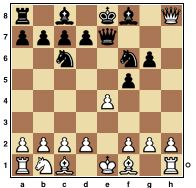
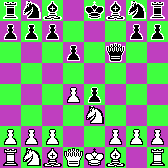
|
No s'ha de fer, però ... com es juga contra ...
Que fer contra 3.exf5 ?
1.e4 e5 2.Cf3 f5 3.exf5
3 ... e4 4.Ne5 Nf6 5.Be2 d6 6.Bh5+ Ke7 7.Nf7 {el blanc està molt millor}
4.Qe2
4.Nd4
4.Ng1!?
3 ... d6
3 ... Cc6
3 ... Cf6
3 ... Ac5 (***)
4.d4
4.Cc3 b5
3 ... Qf6
3 ... d5
Que fer contra 3.Cxe5 ?
1.e4 e5 2.Cf3 f5 3.Cxe5
3 ... Df6 (Nimzowich)
3 ... Cf6
4 Bc4 Qe7!! [Jorge]
3 ... Cc6
4.Qh5 g6 5.Cxg6 Cf6 6.Qh4 hxg6 !?!?
Que fer contra 3.d3 ?
1.e4 e5 2.Cf3 f5 3.d3
3 ... Cc6
3 ... d6
3 ... fxe 4.dxe
Cxe5
Que fer contra C3AD ?
1.e4 e5 2.Cf3 f5 3.Cc3
3 ... Cc6
3 ... fxe4
3 ... d6
3 ... Ac5 (***)
3 ... b5
Resum
1.e4 e5 2.Cf3 f5 3.exf5 .................... Cc6
e4 4.Ne5 Nf6 5.Be2
1.e4 e5 2.Cf3 f5 3.Cxe5 .................... Cf6
1.e4 e5 2.Cf3 f5 3.d3 ...................... Cc6
1.e4 e5 2.Cf3 f5 3.d4 ...................... fxe4 4.Nxe5 Nf6 5.Bg6 d6
1.e4 e5 2.Cf3 f5 3.Cc3 ..................... Cc6
1.e4 e5 2.Cf3 f5 3.Ac4 ..................... Cc6 o De7
En general, Cc6, luego Cf6, luego Ab4 ...
ChessVille (Clyde Nakamura)
Llibre de ruta gambit letó
1.e4 e5 2.Nf3 f5
3.Nxe5
Cf6
4.exf5
Qf6
4.d4 d6 5.Nc4 fxe4
4.Nc4
Nc6?!
3.exf5
e4
4.Ne5
Nf6 5.Be2
Qf6
4.Nd4
Nf6
Qf6
4.Qe2
Qe7
Nf6
d6
4.Bc4
4.d4
4.Nc3
Cc6
3.Bc4
Cc6
Qe7
fxe4 4.Nxe5 Qg5 5.d4 Qxg2 6.Qh5+ g6 7.Bf7+ Kd8 8.Bxg6! Qxh1 9.Ke2 Qxc1 ...
d5 5.Qh5+ g6 6.Nxg6 Nf6 7.Qh4
3.Nc3
Cc6
3.d4
d6
3.d3
Cc6
Wikipedia
(en)
(es)
No fewer than 11 responses for white have been analyzed :
3.Nxe5 ;
3.Bc4 ;
3.Nc3 ;
3.exf5 ;
3.d4
The responses not mentioned in this article are
3.d3,
3.b4?!,
3.c4!?,
3.Qe2!?,
3.b3?!,
and 3.g4?
None of those moves offer white any advantage.
3.Nxe5
White's 3.Nxe5 is the main line.
After the usual 3...Qf6, white chooses between 4.d4 d6 5.Nc4 fxe4 and the immediate 4.Nc4,
which has the advantage of allowing white to open the center with d3,
for example 4...fxe4 5.Nc3 Qg6?! 6.d3 exd3? 7.Bxd3 Qxg2?
and now white is winning after 8.Qh5+ Kd8 (or 8...g6 9.Qe5+ and 10.Be4) 9.Be4.
The main line continues 5...Qf7 6.Ne3!
Black usually responds with 6...c6!?,
when white can either accept the pawn sacrifice with 7.Nxe4 d5 8.Ng5 Qf6 9.Nf3,
or decline it with the more popular 7.d3 exd3 8.Bxd3 d5 9.0-0.
The latter variation has been deeply analyzed;
the British grandmaster Anthony Kosten analyzes one line to move 32.
One line discussed by International Master Jeremy Silman is 9...Bc5 10.Na4 Bd6 11.c4 d4 12.Nc2 c5 13.b4 Ne7 14.Nxc5 Bxc5 15.bxc5 Nbc6 16.Bb2 0–0 17.Nxd4 Nxd4 18.Bxd4 Bf5 19.Bxf5 Nxf5 20.Be3 Qxc4 21.Qb3 Nxe3!? 22.fxe3 Rxf1+ 23.Rxf1 Qxb3 24.axb3 Rc8 25.Rf5 and now 25...Rd8 or 25...Rc6 gives black excellent chances to draw the pawn-down endgame.
Silman later argued that 10.b4!! and now 10...Bxb4 11.Ncxd5 cxd5 12.Nxd5 or 10...Bd6 11.Re1! Ne7 12.Nexd5 cxd5 13.Nb5 is close to winning for white,
and that the "old, discredited" 9...Bd6 (rather than 9...Bc5) might be Black's best try, though still insufficient for equality.
Also possible is the eccentric 3...Nc6?!, against which John Nunn recommends 4.d4.
After 4.d4, Kosten analyzes 4...Qf6!? 5.Nc3 Bb4 6.exf5! Nxe5 7.Qe2.
Instead of 4.d4, Kosten says that white can accept the proffered rook with 4.Qh5+ g6 5.Nxg6 Nf6 6.Qh3 hxg6 7.Qxh8 Qe7 (7...fxe4? 8.d4! is strong) 8.d3!
(Stefan Bücker gives an alternative 8.Nc3! Nb4 9.d3 as also winning for white)
8...fxe4 9.Be3 Nc6 10.Bc5! Qxc5 11.Qxf6 Bf5 12.dxe4 Nd4 13.exf5! Nxc2+ 14.Kd1 Nxa1 15.Bd3 Qd6 16.Re1+ Kd7 17.Qf7+ Be7 18.Re6 winning.
3.Bc4
White's 3.Bc4 may lead to perhaps the most notorious and heavily analysed line of the Latvian,
which begins 3...fxe4 4.Nxe5 Qg5 5.d4 Qxg2 6.Qh5+ g6 7.Bf7+ Kd8 8.Bxg6! Qxh1+ 9.Ke2 Qxc1 (9...c6 is a major alternative) 10.Nf7+ Ke8 11.Nxh8+ hxg6 12.Qxg6+ Kd8 13.Nf7+ Ke7 14.Nc3!
However, instead of 4...Qg5, "nowadays players often give preference to 4. ... d5", the Svedenborg Variation.
According to Latvian Gambit experts Kon Grivainis and John Elburg, black wins more often than white in this line.
After 4...d5 5.Qh5+ g6 6.Nxg6, Black chooses between 6...Nf6 and 6...hxg6. 6...Nf6 usually leads, after 7.Qe5+ Be7 8.Bb5+! c6 9.Nxe7 Qxe7 10.Qxe7+ Kxe7 11.Be2 (11.Bf1!?), to an endgame where black is a pawn down but has considerable positional compensation.[17] Sharper is 6...hxg6, when 7.Qxh8 Kf7 9.Qd4 Be6 gives white a large material advantage,
but his "position is constantly on the edge of a precipice", and the line has accordingly fallen out of favor.
More often, white plays 7.Qxg6+ Kd7 8.Bxd5 Nf6, leading to sharp and unclear play.
3.Nc3
White's 3.Nc3 was originally analyzed by the American master Stasch Mlotkowski (1881–1943) in the 1916 British Chess Magazine.
Kosten gives as Black's two main responses 3...Nf6 4.Bc4 (4.exf5 is also possible) fxe4 5.Nxe5 d5 6.Nxd5! Nxd5 7.Qh5+ g6 8.Nxg6! hxg6! 9.Qxg6+ Kd7 10.Bxd5 Qe7 11.Qxe4 Rh4 12.Qxe7+ Bxe7, reaching an endgame where white has four pawns for a minor piece, and 4...fxe4 5.Nxe5 Qf6, when white can choose from 6.Nc4! (transposing to the main line 3.Nxe5 Qf6 4.Nc4 fxe4 6.Nc3), 6.d4, and 6.f4!?
Black can also play 3...d6, when 4.d4 transposes to the Philidor Counter-Attack (1.e4 e5 2.Nf3 d6 3.d4 f5!?) favored by Paul Morphy in the mid-19th century and still seen occasionally today.
3.exf5
white's 3.exf5 followed by e4 4.Ne5 Nf6 5.Be2 is recommended by John L. Watson and Eric Schiller.
4.Qe2, 4.Nd4, and even 4.Ng1!? (leading to a sort of King's Gambit with colours reversed) are also possible.
3.d4
white's 3.d4 followed by fxe4 4.Nxe5 Nf6 5.Bg5 d6 leads as usual to sharp play.
white often offers a piece sacrifice with either 6.Nc3!? or 6.Nd2!?, but black seems to have adequate resources against both.
1.e4 e5 2.Nf3 f5 3.Nxe5 Qf6 4.d4 d6
1.e4 e5 2.Nf3 f5 3.Nxe5 Qf6 4.d4 fxe4
1.e4 e5 2.Nf3 f5 3.Nxe5 Qf6 4.Nc4 fxe4 5.Nc3
1.e4 e5 2.Nf3 f5 3.Nxe5 Nc6 4.Nxc6 dxc6 5.d4
1.e4 e5 2.Nf3 f5 3.Nxe5 Nc6 4.Nxc6 dxc6 5.Nc3
1.e4 e5 2.Nf3 f5 3.exf5 e4 4.Ne5 Nf6 5.Be2
1.e4 e5 2.Nf3 f5 3.exf5 e4 4.Ne5 Nf6 5.d4
1.e4 e5 2.Nf3 f5 3.exf5 e4 4.Nd4 Nf6 5.d3
1.e4 e5 2.Nf3 f5 3.exf5 e4 4.Nd4 Nf6 5.Be2
1.e4 e5 2.Nf3 f5 3.exf5 e4 4.Nd4 Qf6 5.c3
1.e4 e5 2.Nf3 f5 3.exf5 e4 4.Nd4 Qf6 5.Qh5+
1.e4 e5 2.Nf3 f5 3.exf5 e4 4.Nd4 Qf6 5.Nb3
1.e4 e5 2.Nf3 f5 3.exf5 e4 4.Nd4 Qf6 5.Nb5
1.e4 e5 2.Nf3 f5 3.exf5 e4 4.Qe2 Qe7 5.Nd4
1.e4 e5 2.Nf3 f5 3.exf5 e4 4.Qe2 Nf6 5.d3
1.e4 e5 2.Nf3 f5 3.d4 fxe4 4.Nxe5 Nf6 5.Bg5
1.e4 e5 2.Nf3 f5 3.d4 fxe4 4.Nxe5 Nf6 5.Be2
1.e4 e5 2.Nf3 f5 3.d4 fxe4 4.Nxe5 Nf6 5.Bc4
1.e4 e5 2.Nf3 f5 3.d4 fxe4 4.Nxe5 Nf6 5.Nc3
1.e4 e5 2.Nf3 f5 3.d3 Nc6 4.Nc3 Nf6 5.Bg5
1.e4 e5 2.Nf3 f5 3.d3 Nc6 4.Nc3 Nf6 5.exf5
1.e4 e5 2.Nf3 f5 3.d3 d6 4.Nc3 Nf6 5.exf5
1.e4 e5 2.Nf3 f5 3.d3 d6 4.Nc3 Nf6 5.Bg5
1.e4 e5 2.Nf3 f5 3.d3 d6 4.exf5 Bxf5 5.Nc3
1.e4 e5 2.Nf3 f5 3.Bc4 fxe4 4.Nxe5 d5 5.Qh5+
1.e4 e5 2.Nf3 f5 3.Bc4 fxe4 4.Nxe5 Qg5 5.d4
1.e4 e5 2.Nf3 f5 3.Nc3 fxe4 4.Nxe4 d5 5.Ng3
1.e4 e5 2.Nf3 f5 3.Nc3 fxe4 4.Nxe5 Nf6 5.d4
Elephant gambit - Paulsen countergambit
We enter Elephant gambit with the moves
wiki
1. e4 e5 2. Nf3 d5
3.exd5 e4 (Paulsen countergambit)
Bd6 (proper Elephant gambit)
Qxd5 saves the pawn but 4.Nc3 gives white big lead
3.Nxe5 Bd6 4.d4 dxe4 5. Bc4 Bxe5 6.Qh5 Qf6 7.dxe5
1. e4 e5 2. Nf3 d5 3. exd5 e4 4. Qe2 Nf6
5.d3 Qxd5
5.d3 Be7
5.Nc3 Be7
f5 (Lutikov)
Mr Tal amb blanques :
Talin 1964
Jorge y yo - masacre en el ala del Rey
1.e4 e5 2.Nf3 f5 3.Nxe5 Nc6 4.Qh5+ g6 5.Nxg6 Nf6 6.Qh4 hxg6 7.Qh4xh8 *
Podem jugar ...
7. ... Qe7
... Kf7
... Ag7
... d5
Sin muertes [leov]
1. e4 e5 2. Nf3 f5 3. Bc4 Nc6 4. d3 Be7 5. Nc3 d6 6. 0-0 Bf6 7. Nd5
Analisi a la jugada 4 :
Si caballo f6, entonces caballo g5; estas dispuesto a continuar esa linea ?
Si alfil c5, la misma: caballo g5, con amenaza en f7, dama h5 luego de e por f5 etc
d6 reduce la accion del alfil de f8, se puede contestar la misma caballo a g5
La mejor creo que es alfil a e7 evitando caballo g5 que es la que considero peor amenaza del blanco.
1.e4 e5 2.Cf3 f5 3.Bc4 Cc6 4.d3 Ae7 5.Cc3 d6
Sin muertes [opal]
1.e4 e5 2.Nf3 f5 3.Nxe5 Nf6 4.Bc4 Qe7 5.d4
Analicemos 5. ... d6 :
Posibles respuestas :
- 1 alfil b5 ... c6
- 2 alfil f7 ... rey d8
- 3 caballo f7 ... la tipica d5 y cayo en una mini trampa o celada
Celada de la Torre, mr Trendle
1.e4 e5
2.Nf3 f5
3.Nxe5 Nf6
4.Bc4 Qe7
5.d4 d6
6.Nf7 d5
7.Nxh8 dxc4
8.Nc3 fxe4 Siempre c6 !
9.Bg5 Cd7 No "c6" por Bxf6 y luego Qh5+ y sale el caballo via f7.
anti-letó, by Jordi Bada, 201604
1.e4 e5 2.Nf3 f5 3.Nxe5 Qf6 4.d4 d6 5.Nc4 fxe4 6.Be2
Variacions
1430 partides
Part one :
- 1. Greco Variation 3.Nxe5 Qe7
- 2. Fraser Variation 3.Nxe5 Nc6!?
- 3. Main Line 3. Nxe5 Qf6 4.d4 d6 5.Nc4 fxe4
- 4. Leonhardt Variation 3.Ne5 Qf6 4.Nc4
Part two :
- 5. 3.exf5 Variation
- 6. 3.d4 Variation
- 7. Svedenborg Variation 3.Bc4 fxe4 4.Nxe5 d5
- 8. Mlotkowski Variation 3.Nc3
Readers who would like to play a Latvian game against
mr. Elburg can do so at
http://www.gambitchess.com, excelent place [*****] !!!
URLs
Hechiceros
Espectacular
+
visor.
Gran partida de
Richard Guerrero.
Cuba
6th World Championship Latvian Gambit.
4th.
Bon estudi - no es bo per les negres.
1.e4 e5 2.Nf3 f5 3.Nxe5 Qf6 4.Nc4 (Leonhardtïs variation)
C41 : Philidor defense
wiki,
chessgames C41
His original idea was to challenge white's centre by the pawn thrust f7–f5.
1.e4 e5 2.Nf3 d6 3.d4 exd4 4.Nxd4 Nf6 5.Nc3 black goes Be6 and 0-0 {relieve central tension}
Qxd4 Nc6 5.Bb5 Bd7 6.Bxc6 Bxc6 7.Nc3 Nf6 8.Bg5 followed by 0-0-0
Nf6 4.Nc3 Nbd7 5.Bc4 Be7 6.0-0 {keep e5 pawn}
f5 {Philidor counter gambit}
4.Bc4 exd4
4.Nc3 exd4
4.dxe5 fxe4
4.exf5 e4
3.Bc4 Nc6 {semi italian opening}
1.e4 e5 2.Nf3 d6 3.Bc4 Bg4?! 4.Nc3 g6? 5.Nxe5 Bxd1?? 6.Bxf7+ Ke7 7.Nd5#
Legal trap
Other :
1.e4 e5 2.Nf3 d6 3.d4 Nd7 4.Bc4 c6 5.0-0 Be7 6.dxe5 dxe5
Petrov defence, Cochrane gambit
Chessgames C42
web resources,
(7) interesting videos, etc
analysis, nice page
wiki
Everything about Petrov
+ "Table of Theory" ...
Chess Website
Analisi TOTAL !!!, by Uwe Bekemann - u/k
Few
games.
Zapata wins Anand in
6 moves, Biel 1988
Compilation at
chessgames (impressive)
Error clàssic (no 3...d6) :
1.e4 e5 2.Nf3 Nf6 3.Nxe5 Nxe4? 4.Qe2
Nf6?? 5.Nc6+ - wins black queen
d5 5.d3 Qe7 6.dxe4 Qxe5 7.exd5 - black loses a pawn
Qe7 5.Qxe4 d6 6.d4 f6 7.Nc3 dxe5 8.Nd5 Qd6 9.Bf4 Nd7 10.0-0-0 or dxe5
Bd6 5.Qxe4 Qe7 6.d4 f6 7.f4
C42 - other lines
1.e4 e5 2.Nf3 Nf6 3.Nxe5 d6 4.Nxf7!? Kxf7 5.Nc3 c5!? 6.Bc4+ Be6 7.Bxe6+ Kxe6 8.d4 Kf7 9.dxc5 Nc6 (1)
5.d4 Nxe4 6.Qh5+ g6 7.Qd5+ and Qxe4
c6 6.Bc4+ d5 7.Bb3
Be6 6.d4 g6 7.Bd3
Be7 6.Nc3 c6 7.Bc4+ d5 8.exd5 cxd5 9.Nxd5 Nxd5 10.Qh5+ Kf8 11.Bxd5 Qe8
g6 6.Nc3 Kg7 7.Be2 d5 8.e5 Ne4 9.Nxe4 dxe4 10.0-0 Nc6 11.Be3 h5 12.f3 exf3 13.Rxf3 Be6 14.c4
Qe8 6.Nc3 d5 7.e5 Bb4 8.Bd3
g6 7.Bd3 Kg7 8.0-0 Nc6 9.Be3 Nb4 10.h3 Nxd3 11.Qxd3 Rg8 12.e5 dxe5 13.dxe5
(no Qxe5 as 14.Bd4 and 15.Nd5) Nd7 14.Nd5 Nxe5 15.Nxc7 or Qc3 or Bd4
6.f3
C43 - classic line
Chessgames C43
1.e4 e5 2.Cf3 Cf6 3.d4 exd4 4.e5 Ne4 5.Qxd4
Kramnik as black:
[Event "Tahl Memorial"]
[Site "Moscow RUS"] [Date "2010.11.08"] [EventDate "2010.11.05"] [Round "4"] [Result "1/2-1/2"]
[White "Hikaru Nakamura"] [Black "Vladimir Kramnik"] [ECO "C42"] [WhiteElo "2741"] [BlackElo "2791"] [PlyCount "66"]
1. e4 e5 2. Nf3 Nf6 3. Nxe5 d6 4. Nf3 Nxe4 5. Nc3 Nxc3 6. dxc3 Be7 7. Be3 0-0 8. Qd2 Nd7 9. 0-0-0 Re8 10. h4 c6
11. Bd3 Nf6 12. Rde1 d5 13. Bd4 c5 14. Bxf6 Bxf6 15. Qf4 Be6 16. Ng5 g6 17. Bb5 Rf8 18. Nxe6 fxe6 19. Rxe6 Bxc3 20. Qg4 Bg7
21. h5 c4 22. hxg6 h6 23. Rd1 Qa5 24. Rxd5 Qxa2 25. Bxc4 Qxb2+ 26. Kd1 Kh8 27. f3 a5 28. Rd7 a4 29. Qh4 Qb1+ 30. Kd2 Qb4+
31. Kd1 Qb1+ 32. Kd2 Qb4+ 33. Kd1 Qb1+ 1/2-1/2
Versus Pallus:
1.e4 e5 2.Nf3 Nf6 3.Nxe5 d6 4.Nxf7 Kxf7 5.d4 Bg4 6.f3 Bd7 7.Nc3 Ke8 8.Bc4 Nc6 9.0-0 a6 10.Re1 b5
11.Bb3 Be7 12.e5 dxe5 13.dxe5 Ng8 14.Qd5 Bc5+ 15.Qxc5 Qe7 16.Be3 Qxc5 17.Bxc5 Nge7 18.e6 Bc8 19.Nd5 Nxd5 20.Bxd5 Bb7
21.Bxc6+ Bxc6 22.e7 h5 23.Re5 Kf7 24.Rf5+ Kg6 25.Rf8 Re8 26.Rd1 Kh7 27.Rd8 Rg8 28.b4 Kh8 29.Kf2 Kh7 30.f4 Kh8
31.h3 Kh7 32.g4 hxg4 33.hxg4 Kh8 34.g5 Kh7 35.g6+ Kxg6 36.Rxg8 Rxg8 37.Rxg8 Kf7 38.Rc8 Be8 39.Rxc7 Kg8 40.Rc8 Kf7
41.Kg3 g6 42.Kh4 Bd7 43.Rf8+ 1-0
Petrov tree:
1.e4 e5 2.Nf3 Nf6
3.Nxe5
d6
. 4.Nf3
. Nxe4
. 5.d4
. d5 lo millor
. Be7
. Bg4
. Nf6
. Qe7
. 5.Nc3
. Nxc3 6.dxc3 {white castles large!}
Carlsen vs Karpov
. Nf6
. 5.Qe2
. Qe7
. d5
. 5.d3
. Nf6
. Nc5
. 5.c4
. Be7
. Nc6
. 5.Bd3
. Nf6
. d5
. Nc5
. 5.Bc4
. d5
. Be7
. Bg4
. 5.Nc3 - negre perd
. 5.d3 Nc6
. 4.Nc4 Nxe4
. 5.Nc3
. Nxc3
. Nf6
. d5
. 5.Qe2
. Qe7
. d5
. 5.d4
. d5
. Be7
. 4.Nxf7 Kxf7 ; cochrane gambit
. 5.d4
. c5
. Be7
. g6
. Qe8
. c6
. Be6
. Qe7
. Bg4
. Nxe4
. Nc6
. 5.Nc3 Be7
. 5.Bc4+ d5
. 4.Nd3 Nxe4
. 5.Qe2 Qe7
. 5.Nc3 Nxc3
. 5.f3 Qh4+
Qe7
. 4.Nf3
. Nxe4
. 5.Be2
. d5
. d6
. Nc6
. 5.Qe2
. d5
. Nf6
. Nc6
. Qxe4+
. 5.Be2
. Be7
. Bb4
. d5
. 5.Qe2
. Qxe2+
. Bc5
. d5
. Nc6
. 4.d4
Nxe4
Nc6
Bd6
Bc5
d5
3.Nc3 {3 cavalls}
Ab4
Cc6 {4 cavalls}
3.d4
exd4
Cxe4 4.Ad3 d5 5.Cxe5 Ad6
3.Bc4
3.d3
3.Qe2
3.Bb5
3.Bd3
3.c3
Trap
1.e4 e5 2.Nf3 Nf6 3.Nxe5 Nxe4 ?? 4.Qe2 Nd6?? 5.Nc6+ wins the black queen
Few notable games
Topalov - Kramnik Linares 1999 [ (1) ½-½]
1.e4 e5 2.Nf3 Nf6 3.Ne5 d6 4.Nf7 Kf7 5.Nc3 c5 6.Bc4 Be6
Short - Shirov Dubai 2002 [0-1]
1. e4 e5 2. Nf3 Nf6 3. Ne5 d6 4. Nf7 Kf7 5. d4 c5 6. dc5 Nc6
2018.04.09, Vitiugov vs Nikita Caruana, Fabiano in Karlsruhe/Baden Baden GER 0-1
1.e4 e5 2.Nf3 Nf6 3.d4 Ne4 4.de5 d5 5.Nbd2 Qd7
6.Bd3 Nc5 7.Be2 g6 8.Nb3 Ne6 9.Be3 c5 10.Ng5 b6
11.Ne6 fe6 12.a4 Bb7 13.O-O Nc6 14.f4 Bh6 15.a5 Ne7
16.Bg4 d4 17.Bc1 O-O 18.Qd3 Bd5 19.Qh3 Bg7 20.Nd2 Nf5
All Linares 1991 , as
Ivanchuk - Karpov [1-0]
C44 - C45 : Scotch game
wiki :
1.e4 e5 2.Nf3 Nc6 3.d4 exd4 the most important continuations are :
4.Nxd4 (main line)
Bc5 (classical variation)
5.Be3 Qf6 (if Nf6 then Nxc6!) 5.c3 Nge7 7.Bc4 or 7.g3
5.Nxc6 Qf6 6.Qd2 dxc6 7.Nc3
5.Nb3 Bb6 6.a4 a6 7.Nc3 {Potter variation}
6.Nc3+Qe2+Be3+h4+0-0-0
5.Nf5
Nf6 (Schmidt variation)
5.Nxc6 {Mieres variation} bxc6 6.e5 Qe7 7.Qe2 Nd5 8.c4
5.Nc3 Bb4 6.Nxc6 bxc6 7.Bd3 d5 8.exd5 cxd5 9.0-0 0-0 10.Bg5 c6
Qh4!? (Steinitz Variation) 5.Nc3 Bb4 6.Be2 Qxe4 7.Nb5 Bxc3+ 8.bxc3 Kd8 9.0-0
Qf6
Nxd4?!
Bb4+?!
4.Bc4 (Scotch gambit)
Nf6 5.e5 Ng4 6.Qe2 Qe7
Bc5 5.c3 Nf6
4.c3 (Göring gambit)
4.Bb5
Kasparov's (12) games - 7 wins, 5 draws
C44 - Ponziani
1.e4 e5 2.Nf3 Nc6 3.c3
Nf6 4.d4 Nxe4 5.d5 Ne7 6.Nxe5 Ng6
d6? 7.Bb5+
Bc5 6.dxc6
exd4 5.e5 Nd5
Ne4 6.Qe2 Nc5 7.cxd Ne6 (fork?)
f5 7.exf d5 8.Nd2 Qf6 9.Nxe4 dxe4 10.Qxe4+ i Nxd4
d5? 7.exd6 Bf5
d5 (best) 4.Qa4 f6 5.Bb5 Nge7 6.exd5 Qxd5 7.d4
0-0 Bd7 8.d4
Bd7 5.exd5 Nd4 6.Qd1 Nxf3+ 7.Qxf3 Nf6 8.Bc4 e4 9.Qe2 Bd6 10.d4 h6 11.h3 0-0 12.0-0 Qe7
dxe4 5.Nxe5 Qd5
Bd7 6.Nxd7 Qxd7 7.Qxe4+ Be7 8.Bb5 Nf6 9.Qf3
d6
f5
Bc5 4.d4 exd4 5.cxd4 Bb4+ 6.Nc3 o Bd2
Sample games
Alekhine 1951, sacrifici de dama :
1.e4 e5 2.Nf3 Nc6 3.c3 Nf6 4.d4 Nxe4 5.d5 Ne7 6.Nxe5 Ng6 7.Bd3 Nxf2 8.Bxg6 Nxd1 9.Bxf7 Ke7 10.Bg5+ Kd6 11.Nc4+ Kc5 12.Nba3 Nxb2 13.Be3++ 1-0
Taylor & Emms
1.e4 e5 2.Nf3 Nc6 3.c3 d5 4.Bb5 dxe4 5.Nxe5 Qg5 6.Qa4 Qxg2 7.Bxc6 bxc6 8.Qxc6 Kd8 9.Rf1 Bh3 10.Qa8+ Ke7 11.Kd1 Qxf1 12.Kc2 Bf5 13.Na3
Taylor unfortunately only concentrates on the move 13...e3 again not aware of 13...f6!?
URLs
C46 : Three knights, Winawer defence (Gothic defence)
Wiki 3 knights + f5
1.e4 e5 2.Nf3 Nc6 3.Nc3 f5
4.d4 (50/20/30)
4.exf5 (33/22/44)
4.Bb5 (44/2/44)
Then 4.Bb5 transposes into the Schliemann variation of the Ruy Lopez with 4.Nc3.
365chess.com
(C50-C59) Obertura Italiana
Tree :
1.e4 e5 2.Nf3 Nc6 3.Bc4
1.e4 e5 2.Nf3 Nc6 3.Bc4 Bc5 C50 King's Pawn Game
1.e4 e5 2.Nf3 Nc6 3.Bc4 Bc5 4.b4 C51 Evans Gambit
1.e4 e5 2.Nf3 Nc6 3.Bc4 Bc5 4.b4 Bxb4 5.c3 Ba5 C52 Evans Gambit with 4...Bxb4 5.c3 Ba5
1.e4 e5 2.Nf3 Nc6 3.Bc4 Bc5 4.c3 C53 Giuoco Piano
1.e4 e5 2.Nf3 Nc6 3.Bc4 Bc5 4.c3 Nf6 5.d4 exd4 6.cxd4 C54 Giuoco Piano
1.e4 e5 2.Nf3 Nc6 3.Bc4 Nf6 C55 Two Knights Defence
1.e4 e5 2.Nf3 Nc6 3.Bc4 Nf6 4.d4 exd4 5.0-0 Nxe4 C56 Two Knights Defence, Max Lange attack
1.e4 e5 2.Nf3 Nc6 3.Bc4 Nf6 4.Ng5 C57 Two Knights Defence, including the Fried Liver Attack
1.e4 e5 2.Nf3 Nc6 3.Bc4 Nf6 4.Ng5 d5 5.exd5 Na5 C58 Two Knights Defence
1.e4 e5 2.Nf3 Nc6 3.Bc4 Nf6 4.Ng5 d5 5.exd5 Na5 6.Bb5+ c6 7.dxc6 bxc6 8.Be2 h6 C59 Two Knights Defence
Basic ideas:
- bring your Bishop onto the a2-g8 diagonal, eyeing up the tender f7 point
- play c2-c3 and d2-d4 to take over the centre
- bring your King's Rook to e1
- don't make time-wasting pawn moves, like h2-h3
The idea is to play c3, d4 ; and only after "...exd4, cxd4" you play Nc3.
1.e4 e5 2.Cg1-f3 Cb8-c6 3.Bf1-c4 Bf8-c5
4.c2-c3 Ng8-f6 5.d2-d4 exd4 (?)
6.cxd4 Bc5-b4 7.Bc1-d2 Nf6xe4 8.Bd2xb4 Nc6xb4 9.Bc4xf7 Ke8xf7
10.Qd1-b3+ d5-d5 11.Nf3-e5 Kf7-e6 12.Qb3xb4 Rh8-f8
Analisi :
1.e4 e5 2.Nf3 Nc6 3.Bc4
Nf6 4.Ng5 d5 5.exd5 Nxd5 6.d4 -
2 knights
Bc5 4.c3 Nf6 5.d3
4.b4 -
Evans gambit
4.0-0
4.d3
4.Nc3
4.d4 exd4 5.0-0 Nf6 6.e5 - Max-Lange attack
Be7 4.d4 exd4 -
defensa hongaresa
d6 4.c3 Bg4
Nd4 4.c3 Nxf3
f5 4.d3 Nf6
h6 - very passive and does not prevent f7 attacks
Top-5 Italian attacks! :
1. e4 e5 2. Nf3 Nc6 3. Bc4 Italian Game or Giuoco Piano Game
3... Bc5 4. c3 white starting a Center Attack
4... Nf6 5. d4 exd4 6. cxd4 Bb4+ 7. Nc3 Nxe4 8. O-O Bxc3 9. d5! Its Moeller or Moeller-Therkatz attack
C50 "King's Pawn Game" includes Blackburne Shilling Gambit, Hungarian Defence, Semi-Italian Opening, Italian Gambit, Légal Trap, Rousseau Gambit and Giuoco Pianissimo.
Una maravella d'atac lent i perillós :
1.e4 e5 2.Nf3 Nc6 3.Bc4 Bc5 4.d4 exd4 5.0-0 d6 6.e5 dxe5 7.Re1 f6 8.Nh4 Nge7 9.Qh5+ g6 10.Qh6 Nf5
11.Nxf5 Bxf5 12.Qg7 Rf8 13.Bh6 Bxc2 14.Qxh7 Qe7 15.Bg7 0-0-0 16.Qh3+ Kb8
Un atac ràpid i desastrós (Mario/ferna1411 vs Jordi Bada/jobana) :
1.e4 e5 2.Nf3 Nc6 3.Bc4 Nf6 4.Ng5 d5 5.exd5 Nd4 6.d6 Qxd6 7.Nxf7 Qc6 8.d3 Qxg2 9.Rf1 Nf3+ 10.Ke2 Bg4
11.Ke3 Bc5+ 12.d4 Bxd4+ 13.Kd3 e4+ 14.Ke2 Ng1+ 15.Kd2 Bxd1 0-1
Giuocco Pianissimo, 4.d3
Giuoco Pianissimo at Norway 2017, ronda 7
Kramnik vs Carlsen (1-0)
chessgames
1. e4 e5 2. Nf3 Nc6 3. Bc4 Bc5 4. c3 Nf6 5. d3 d6 6. O-O a6 7. Re1 Ba7 8. a4 O-O 9. h3 Ne7 10. d4 Ng6
11. Nbd2 c6 12. Bd3! Re8 13. Bc2 h6 14. Nf1 exd4 15. cxd4 c5 16. d5 b5 17. axb5 axb5 18. Ng3 Bd7 19. Be3 Bb6 20. Rxa8 Qxa8
21. b4 Qa7 22. Qa1! Qc7 23. Bxh6! cxb4 24. Bxg7 Qxc2 25. Qxf6 Qxf2 26. Kh2 Bd8 27. Qxd6 Nh4 28. Nxh4 Bxh4 29. Nh5 Bxh3 30. Rg1 Bg5
31. Bf6 Bg4 32. Bxg5 Bxh5 33. Qh6 Rxe4 34. Qxh5 Qf5 35. Qh6 b3 36. Bf6 Qf4 37. Qxf4 Rxf4 38. d6 Rxf6 39. Rd1 Rh6 40. Kg1
Karjakin vs Aronian (0-1)
Karjakin, Sergey (2781) vs. Aronian, Levon (2793) - Norway Chess 2017 | Stavanger | Round 7.5 | 14 Jun 2017 | ECO: C50 | 0-1
1. e4 e5 2. Nf3 Nc6 3. Bc4 Bc5 4. O-O Nf6 5. d3 O-O 6. a4 a5 7. Bg5 h6 8. Bh4 Be7 9. Bg3 d6 10. h3 Kh8
11. c3 Nh7 12. Qb3 f5 13. exf5 Bf6 14. Be6 Ne7 15. Nh4 Qe8 16. Bxc8 Rxc8 17. Ng6+ Nxg6 18. fxg6 Qxg6 19. Qxb7 Ng5
20. h4 Ne6 21. Qe4 Qh5 22. Nd2 Nf4
23. Bxf4 exf4 24. Qf3 Qxh4 25. Rfe1 Rb8 26. Nc4 g5 27. Re6
27... Bg7 28. Rg6 Rbe8 29. d4 Kh7 30. Qd3 Kg8 31. d5?
31... f3! 32. gxf3
32... Rf4 33. Kg2
33... Ref8 34. Nd2 g4 35. Kg1 R8f5 36. Ne4 Rxf3 37. Qd4 Re5 38. Ng3 Rxg3+ 39. fxg3 Qxg3+ 40. Kf1 Kh7 41. Rxg7+ Kxg7
Giuoco Piano by Anand vs Aronian (2016, 1-0)
Moscu 2016, ronda 9 :
World Chess
[Event "Candidates 2016"]
[Site "Moscow, Russia"]
[Date "2016.03.21"]
[Round "9.2"]
[white "Anand Viswanathan (IND)"]
[Black "Aronian Levon (ARM)"]
[Result "1-0"]
[ECO "C50"]
1.e4 e5 2.Nf3 Nc6 3.Bc4 Bc5 4.0-0 d6 5.d3 Nf6 6.c3 a6 7.a4 Ba7 8.Na3 Ne7 9.Nc2 Ng6 10.Be3 0-0
11.Bxa7 Rxa7 12.Ne3 Ng4 13.Qd2 a5 14.d4 Ra8 15.dxe5 N4xe5 16.Nxe5 Nxe5 17.Bb3 Nd7 18.Bc2 Re8 19.f3 b6 20.Rfd1 Nc5
21.b4 Nd7 22.Bb3 Nf6 23.Qd4 Qe7 24.Nd5 Nxd5 25.Bxd5 Ra7 26.b5 Bb7 27.c4 Qe5 28.Rac1 Qxd4+ 29.Rxd4 Kf8 30.Kf2 Ke7
31.f4 f6 32.Rc3 Kd7 33.Rh3 h6 34.Rg3 Re7 35.Rg6 Bxd5 36.cxd5 Ra8 37.Kf3 Rae8 38.Kg4 Rxe4 39.Rxg7+ Kc8 40.Rd2 Kb8
41.Rc2 Rc8 42.Ra2 Rd4 43.Kf5 Rxd5+ 44.Kxf6 Rf8+ 45.Rf7 Rxf7+ 46.Kxf7 Rf5+ 47.Kg6 Rxf4 48.g3 Rc4 49.Kxh6 d5 50.Kh5 d4
51.g4 d3 52.h4 Rd4 53.Rd2 Kc8 54.g5 Kd7 55.Kg6 Rxh4 56.Rxd3+ Ke8 57.Ra3 Rc4 58.Kg7 Kd7 59.g6 c6 60.Kf6 cxb5
61.g7 Rg4 62.axb5 Rg1 63.Rd3+ Ke8 64.Re3+ Kd7 65.Re5 Rxg7 66.Rd5+ 1-0
Giuoco Piano by Hou vs Carouana (0-1)
[Event "chess.com IoM Masters"]
[White "Hou, Yifan"]
[Black "Caruana, Fabiano"]
[Site "Douglas ENG"]
[Result "0-1"]
[Date "2016.10.06"]
[WhiteElo "2649"]
[BlackElo "2813"]
[PlyCount "78"]
[ECO "C50"]
1.e4 e5 2.Nf3 Nc6 3.Bc4 Bc5 4.0-0 Nf6 5.d3 d6 6.c3 a5 7.Re1 h6 8.a4 0-0 9.h3 Be6
10.Na3 Bxa3 11.Bxe6 Bxb2 12.Bxf7+ Rxf7 13.Bxb2 Qd7 14.c4 Raf8 15.Nh4 Kh7 16.f4 exf4 17.d4 Re8 18.Qb1 Kg8 19.Nf3 Rfe7
20.d5 Ne5 21.Bxe5 Rxe5 22.Nxe5 Rxe5 23.Qxb7 f3 24.Qb3 fxg2 25.Qf3 Qe8 26.Ra2 Nxe4 27.Rae2 Ng5 28.Qg4 Rxe2 29.Rxe2 Qxe2
30.Qxe2 Nxh3+ 31.Kh2 g1=Q+ 32.Kxh3 Kh7 33.Qd2 h5 34.Qxa5 Qh1+ 35.Kg3 h4+ 36.Kf4 Qh2+ 37.Kf5 Qe5+ 38.Kg4 Qg3+ 39.Kf5 h3 0-1
Carlsen vs Karjakin, 2016
1.e4 e5 2.Nf3 Nc6 3.Bc4 Bc5 4.0-0 Nf6 5.d3 0-0 6.a4 d6 7.c3 a6 8.b4 Ba7 9.Re1 Ne7 10.Nbd2 Ng6
11.d4 c6 12.h3 exd4 13.cxd4 Nxe4 14.Bxf7+ Rxf7 15.Nxe4 d5 16.Nc5 h6 17.Ra3 Bf5 18.Ne5 Nxe5 19.dxe5 Qh4 20.Rf3
C54 - Greco's attack
In the main line, Greco Variation, white plays 4.c3 in preparation for the central advance d2–d4.
1.e4 e5 2.Nf3 Nc6 3.Bc4 Bc5 4.c3 Nf6 5.d4 exd4 6.cxd4 Bb4+ 7.Bd2 Bxd2+ 8.Nbxd2 d5 9.exd5 Nxd5 10.0-0 0-0
11.Rc1 Nb6 12.Bb3 Ne7 13.Ne4 c6 14.Nc5 Ned5 15.Re1 Rb8 16.Ne5 Bf5 17.Qf3 Be6 18.Qg3 Nc7 19.Nxe6 fxe6 20.Re4 Nbd5
21.Rh4 Nf6 22.Bc2 Qe7 23.Qh3 g5 24.Rh6 Qg7 25.Bxh7+ Nxh7 26.Rg6 Rbd8 27.Qh6 1-0
C55 - 2 knights defense, Max Lange attack
1.e4 e5 2.Nf3 Nc6 3.Bc4 Nf6 4.d4 exd4 5.0-0 Bc5 6.e5
Ng4
d5 7.exf6 dxc4 8.Re1+ Be6 9.Ng5 Qd5 10.Nc3 Qf5 11.Nce4 0-0-0
wiki
Jordi Bada guanya en "trispios" (1er del campionat), 20200329 @
lichess :
1. e4 e5 2. Nf3 Nc6 3. Bc4 Nf6 4. d3 Be7 5. O-O O-O 6. c3 d6 7. Re1 Na5 8. Nbd2 Nxc4
9. Nxc4 h6 10. h3 Be6 11. Ne3 Nh7 12. Nf5 Bf6 13. d4 Ng5 14. Bxg5 hxg5 15. dxe5 dxe5 16. Qa4 g6
17. Ne3 c6 18. Rad1 Qc7 19. Ng4 Bxg4 20. hxg4 Kg7 21. g3 Qc8 22. Kg2 Qxg4 23. Rh1 b5 24. Qb4 a5
25. Qd6 Qxe4 26. Rde1 Qd5 27. Rh7+ Kxh7 28. Qxf6 1-0
C57 - 2 knights defense - Fried Liver attack
Video,
video
1.e4 e5 2.Nf3 Nc6 3.Bc4 Nf6 4.Ng5 d5 5.exd5 Nxd5 6.Nxf7 Kxf7
7.Qf3+ Ke6 8.Nc3
Nb4
9.a3 Nxc2 10.Kd1 Nxa1 11.Nxd5 Kd6 12.d4
Nd4 11.Bxd5+ Kd6 12.Qg3 + d3
Ne7 9.O-O c6 10.O-O + d4
wiki
Contraataque Traxler
YouTube:
1.e4 e5 2.Nf3 Nc6 3.Bc4 Nf6 4.Ng5 Bc5 5.Nxf7 Bxf2+ 6.Kf1 Qe7 7.Nxh8 d5 8.exd5 Nd4 9.c3 Bg4 10.Qa4+
1.e4 e5 2.Nf3 Nc6 3.Bc4 Nf6 4.Ng5 Bc5 5.Nxf7 Bxf2+ 6.Kxf2 Nxe4+ 7.Ke3 Qh4 8.Nxh8 Qf4+ 9.Ke2 Qf2+ 10.Kd3 Nxb4+ 11.Kxe4 Qf4# 0-1
Here are
some ideas
and the
wiki
(C51-C52) - Evans gambit :4.b4
The main lines start with :
1.e4 e5 2.Nf3 Nc6 3.Bc4 Bc5
C51 : 4.b4
C52 : 4.b4 Bxb4 5.c3 Ba5 6.d4 exd4 7.0-0 Nge7 8.cxd4 d5 9.exd5 Nxd5 10.Bg5 f6
4... Bxb4 5.c3 Ba5 6.d4 d6 7.0-0 Bb6 8.dxe5 dxe5 9.Qxd8+ Nxd8 10.Nxe5 Be6 - Lasker's line
9.Qb3 Qf6 10.Bg5 Qg6 11.Bd5 Nge7 12.Bxe7 Kxe7 13.Bxc6 Qxc6 14.Nxe5 Qe6 - Chigorin
6... exd4 7.Qb3 - Nigel Short
7.0-0 Nge7
Bb6 5.a4 a6 6.Nc3 Nf6 7.Nd5 Nxd5 8.exd5 Nd4 9.a5 Ba7 10.d6
1.e4 e5 2.Nf3 Nc6 3.Bc4 Bc5 4.b4 Bxb4 5.c3 Ba5 6.d4 exd4 7.Qb3 Qe7 8.0-0 Nf6 9.Ba3 d6 10.e5 Ne4 11.exd6 cxd6 12.Re1 0-0
url
1.e4 e5 2.Nf3 Nc6 3.Bc4 Bc5 4.b4 Bxb4 5.c3 Ba5 6.d4 exd4 7.Qb3 Qf6 8.0-0 Bb6 9.e5 Qg6 10.cxd4 Na5 11.Qc3 Nxc4 12.Qxc4 Ne7
13.Ba3 d6 14.exd6 cxd6 15.Re1 Be6 16.d5 Bh3 17.Rxe7 Kxe7 18.Qh4 Qf6 19.Qxf6 Kxf6 20.gxh3
url
wiki,
Evergreen game.
70 games collection
Main squares :
- Bc4 and Qb3 pointing to f7
- Ba3 and Re1 pointing to e7
Italian game traps
... proposed by black
Kostic trap :
1.e4 e5 2.Nf3 Nc6 3.Bc4 Nd4 4.Nxe5 taking the poisoned pawn
4... Qg5 forking the knight and g2 but leaving white the possibility of Nxf7 (the trap itself)
5.Nxf7 falling for it
5... Qxg2 6.Rf1 rook to safety
6... Qxe4+ if white blocks the check by playing Be2 then Nf3 smothered mate
7.Qe2 Nxe2 8.Bxe2 Kxf7
(C60-C99) Ruy Lopez
1.e4 e5 2.Nf3 Nc6 3.Bb5
Other than 3...a6
Classical Defence (or Cordel) C64 1.e4 e5 2.Nf3 Nc6 3.Bb5 Bc5 4.c3 f5 = Cordel Gambit
Cozio Defence 1.e4 e5 2.Nf3 Nc6 3.Bb5 Nge7
Berlin Defence C65-C67 1.e4 e5 2.Nf3 Nc6 3.Bb5 Nf6
Bird's Defence C61 1.e4 e5 2.Nf3 Nc6 3.Bb5 Nd4
Steinitz Defence C62 1.e4 e5 2.Nf3 Nc6 3.Bb5 d6
Schliemann Defence C63 1.e4 e5 2.Nf3 Nc6 3.Bb5 f5!?
Smyslov Defence 1.e4 e5 2.Nf3 Nc6 3.Bb5 g6
Morphy Defence, 3...a6
Exchange Variation 1.e4 e5 2.Nf3 Nc6 3.Bb5 a6 4.Bxc6
Norwegian Defence 1.e4 e5 2.Nf3 Nc6 3.Bb5 a6 4.Ba4 b5 5.Bb3 Na5
Graz Defence 1.e4 e5 2.Nf3 Nc6 3.Bb5 a6 4.Ba4 b5 5.Bb3 Bc5
Classical Defence Deferred 1.e4 e5 2.Nf3 Nc6 3.Bb5 a6 4.Ba4 Bc5
Steinitz Defence Deferred 1.e4 e5 2.Nf3 Nc6 3.Bb5 a6 4.Ba4 d6
Schliemann Defence Deferred 1.e4 e5 2.Nf3 Nc6 3.Bb5 a6 4.Ba4 f5
Arkhangelsk Defence C78 1.e4 e5 2.Nf3 Nc6 3.Bb5 a6 4.Ba4 Nf6 5.0-0 b5 6 Bb3 Bb7
Modern Arkhangelsk Defence 1.e4 e5 2.Nf3 Nc6 3.Bb5 a6 4.Ba4 Nf6 5.0-0 b5 6 Bb3 Bc5
Moler Defence 1.e4 e5 2.Nf3 Nc6 3.Bb5 a6 4.Ba4 Nf6 5.0-0 Bc5
Russian Defence C79 1.e4 e5 2.Nf3 Nc6 3.Bb5 a6 4.Ba4 Nf6 5.0-0 d6
Open Defence 1.e4 e5 2.Nf3 Nc6 3.Bb5 a6 4.Ba4 Nf6 5.0-0 Nxe4
Closed Defence, 3. ... a6 4.Ba4 Nf6 5.0-0 Be7 : alternatives to the main line
Delayed Exchange Variation Deferred 1.e4 e5 2.Nf3 Nc6 3.Bb5 a6 4.Ba4 Nf6 5.0-0 Be7 6 Bxc6
Centre Attack C69 1.e4 e5 2.Nf3 Nc6 3.Bb5 a6 4.Ba4 Nf6 5.0-0 Be7 6 d4
Worral Attack C86 1.e4 e5 2.Nf3 Nc6 3.Bb5 a6 4.Ba4 Nf6 5.0-0 Be7 6 Qe2
Averbakh Variation C87 1.e4 e5 2.Nf3 Nc6 3.Bb5 a6 4.Ba4 Nf6 5.0-0 Be7 6 Re1 d6
Trajkovic Variation 1.e4 e5 2.Nf3 Nc6 3.Bb5 a6 4.Ba4 Nf6 5.0-0 Be7 6 Re1 b5 7 Bb3 Bb7 (8 c3 d5 9 exd5 Nxd5 10 Nxe5 Nxe5 11 Rxe5 Nf4)
Marshall Attack 1.e4 e5 2 Nf3 Nc6 3 Bb5 a6 4.Ba4 Nf6 5.0-0 Be7 6 Re1 b5 7 Bb3 0-0 8 c3 d5 (gambit!)
(white anti-Marshall : 8.a4 or 8.h3 instead of 8.c3)
Closed Defence, main line : 3. ... a6 4.Ba4 Nf6 5.0-0 Be7 6.Re1 b5 7.Bb3 d6 8.c3 0-0
Pilnik Variation 1.e4 e5 2.Nf3 Nc6 3.Bb5 a6 4.Ba4 Nf6 5.0-0 Be7 6.Re1 b5 7.Bb3 d6 8.c3 0-0 9.d3
Bogoljubow Variation 1.e4 e5 2.Nf3 Nc6 3.Bb5 a6 4.Ba4 Nf6 5.0-0 Be7 6.Re1 b5 7.Bb3 d6 8.c3 0-0 9.d4 Bg4
Chigorin Variation 1.e4 e5 2.Nf3 Nc6 3.Bb5 a6 4.Ba4 Nf6 5.0-0 Be7 6.Re1 b5 7.Bb3 d6 8.c3 0-0 9.h3 Na5
Breyer Variation 1.e4 e5 2.Nf3 Nc6 3.Bb5 a6 4.Ba4 Nf6 5.0-0 Be7 6.Re1 b5 7.Bb3 d6 8.c3 0-0 9.h3 Nb8
Zaitsev Variation 1.e4 e5 2.Nf3 Nc6 3.Bb5 a6 4.Ba4 Nf6 5.0-0 Be7 6.Re1 b5 7.Bb3 d6 8.c3 0-0 9.h3 Bb7
Karpov Variation 1.e4 e5 2.Nf3 Nc6 3.Bb5 a6 4.Ba4 Nf6 5.0-0 Be7 6.Re1 b5 7.Bb3 d6 8.c3 0-0 9.h3 Nd7
Kholmov Variation 1.e4 e5 2.Nf3 Nc6 3.Bb5 a6 4.Ba4 Nf6 5.0-0 Be7 6.Re1 b5 7.Bb3 d6 8.c3 0-0 9.h3 Be6
Smyslov Variation C93 1.e4 e5 2.Nf3 Nc6 3.Bb5 a6 4.Ba4 Nf6 5.0-0 Be7 6.Re1 b5 7.Bb3 d6 8.c3 0-0 9.h3 h6
Wiki - bona intro i discusió variants.
PDf
C60 + g6 : spanish fianchetto or Smyslov defence
1.e4 e5 2.Nf3 Nc6 3.Bb5 g6
Depending on white’s reaction, black comes out fighting with ...Nf6 or a quick ...f5.
See
Zsofia Polgar vs Vasily Smyslov, 1996, 0-1;
Karjakin vs Carlsen, Tata Steel 2016
C63 : Ruy Lopez, Schliemann Defence
I think that the Schliemann, 1.e4 e5 2.Nf3 Nc6 3.Bb5 f5,
is not only viable but constitutes a dynamic winning try.
It is a particularly nice choice because it is reached already on the third move.
Marshall Gambit specialists,
who so rarely have the opportunity to play their line because white almost always deviates early, should take note of this.
After white's stronger responses, positional considerations more or less vanish and tactics becomes everything.
The better prepared player will most likely win.
There are those who think that 4. d3 is an easy way to get a slight advantage against the Schliemann,
but I disagree.
After 4...fxe4 5. dxe4 Nf6 the half-open f-file
(which sometimes becomes a half-open g-file when Black is forced, after white's Bg5, Nc3-d5 and Nxf6, to recapture ...gxf6)
compensates for white's somewhat more efficient development.
But black must be ready to gambit his e-pawn after 6. 0-0 Bc5!
The best Schliemann reference, by far, is V. L. Ivanov's and A. Kulagin's Play the Schliemann Defense, Olbrich 1994.
The line 4. Nc3! fxe4 5. Nxe4 Nf6?! has lately been called into question,
so that Black, if he plays the Schliemann, should go in for 5...d5! 6. Nxe5 dxe4 7. Nxc6 Qg5!
-- a complicated line treated at great length by Ivanov and Kulagin.
1.e4 e5 2.Nf3 Nc6 3.Bb5 f5 {40%/29%/31%}
4.d3 fxe4 5.dxe4 Nf6 6.0-0 Bc5!
4.Nc3! fxe4 5.Nxe4 Nf6?!
d5! 6.Nxe5 dxe4 7.Nxc6 Qg5!
4.exf5 e4 5.Qe2 Qe7
4.Bxc6 dxc6
Chessgames C63 1434 partides.
Explore & statistics [*****]
Wiki
C64 : Ruy Lopez, classical defence
The best reference is Mikhail Krasenkov's The Open Spanish, Cadogan 1995
The Classical Defense is unsophisticated, requiring no very deep understanding of positional themes.
It merely opposes the Spanish bishop with an Italian one and asks white the question,
How much can you hurt me if I just put my pieces on good squares and then play actively?
On the other hand, a fairly high degree of sophistication is demanded of white
if he is to make use of the advantage he obtains, with best play, against this defense.
The Classical Defense begins with the moves
1.e4 e5 2.Nf3 Nc6 3.Bb5 Nf6 4.0-0 Bc5
5.Nxe5
5...Nxe5 6.d4 a6!
5.Nc3 0-0 6.Nxe5
6...Nxe5
5.c3 0-0 6.d4 Bb6 7.dxe5
7...Nxe4 8.Qd5 Nc5
5.c3 0-0 6.d4 Bb6 7.Bg5 h6 8.Bh4 d6
9.Bxc6 bxc6
9.a4
Chessgames C64,
video
tutorial
Cordel gambit:
1.e4 e5 2.Nf3 Nc6 3.Bb5 Bc5 4.c3 f5
Nice
game, pure attack & sacrifice :
1.e4 e5 2.Nf3 Nc6 3.Bb5 Bc5 (classical or Cordel Defense)
4.0-0 Nge7 5.c3 f5 6.Bxc6 dxc6 7.Nxe5 fxe4 8.Qh5+ g6 9.Nxg6 Nxg6 10.Qxc5 Qd3
Black's king is in the center, but white has no center. Black has compensation for a pawn.
11.f3 Bh3 12.Qe3 Rg8 13.Qxd3 exd3 14.gxh3 Nf4+ 15.Kf2 0-0-0 16.Ke3 Ng2+ 17.Ke4 Rge8+ 18.Kf5 Rd5+ 19.Kf6 Nf4 20.Rg1 Re6+
21.Kg7 Rd7+ 22.Kh8 Re8+ 23.Rg8 Ng6#
(C65-C67) Ruy Lopez, Berlin defence
Theory
1.e4 e5 2.Nf3 Nc6 3.Bb5 Nf6 4.0-0
4. ... Bc5 C65 - the Berlin Classical Variation
4. ... Nxe4 C67 - Open variation
4. ... d6 C66 - Steinitz, pasive
wiki.
Judit vs Kasparov (Spanish Berlin)
A sample :
[Date "2011.07.27"] [White "Ponomariov, Ruslan"] [Black "Kramnik, Vladimir"] [Opening "Ruy Lopez"] [Variation "Berlin defence"]
1.e4 e5 2.Nf3 Nc6 3.Bb5 Nf6 4.d3 Bc5 5.0-0 Nd4 6.Nxd4 Bxd4 7.Nd2 c6 8.Ba4 d6 9.c3 Bb6 10.Nc4 Bc7
11.Bb3 0-0 12.Bg5 h6 13.Bh4 g5 14.Bg3 Bg4 15.f3 Be6 16.Re1 Nh5 17.Bf2 Nf4 18.d4 exd4 19.cxd4 d5 20.exd5 Bxd5
21.Qc2 g4 22.Nd2 Qg5 23.Ne4 Qg6 24.Bxd5 Nxd5 25.Qb3 Rae8 26.Ng3 h5 27.fxg4 hxg4 28.Rxe8 Rxe8 29.Qxb7 Rb8 30.Qxa7 Rxb2
31.Rf1 Qc2 32.Qc5 Rxa2 33.Qxc2 Rxc2 34.Nf5 Kh7 35.g3 Bb6 36.Re1 Bd8 37.Ne3 Nxe3 38.Rxe3 Kg6 39.Re4 Bg5 40.Kf1 f6
41.d5 cxd5 42.Rxg4 Kf5 43.Rd4 Ke5 44.Rd1 Ke4 45.Rd4+ Kf3 46.Rd3+ Ke4 47.Rd4+ Ke5 48.Rd1 Ke4 49.Rd4+ Kf3 50.Rd3+ Ke4
Another :
[Site "Mukachevo UKR"] [Date "2010.08.13"] [White "Naiditsch,A"] [Black "Efimenko,Z"] [Result "1-0"] [ECO "C67"]
1.e4 e5 2.Nf3 Nc6 3.Bb5 Nf6 4.0-0 Nxe4 5.d4 Nd6 6.Bxc6 dxc6 7.dxe5 Nf5 8.Qxd8+ Kxd8 9.Nc3 Ke8 10.Bf4 Be6
11.Rfd1 h6 12.g4 Ne7 13.h3 Nd5 14.Bd2 Nxc3 15.Bxc3 c5 16.Kg2 Be7 17.Ng1 h5 18.f3 Rd8 19.Ne2 Rxd1 20.Rxd1 hxg4
21.hxg4 Bg5 22.a3 Ke7 23.Bd2 Bxd2 24.Rxd2 b5 25.Nc3 Rb8 26.Ne4 c4 27.Kg3 a5 28.f4 g6 29.Kh4 b4 30.axb4 axb4
31.Kg5 Rb5 32.Nf6 c3 33.bxc3 bxc3 34.Rh2 Bd5 35.Rh3 Bc6 36.Rxc3 Rb6 37.Rc5 Ra6 38.Kh6 Kf8 39.c4 Rb6 40.Nd5 Bxd5
41.cxd5 Rb7 42.d6 cxd6 43.exd6 ; 1-0
(C68-C69) Ruy Lopez, exchange variation
1 e4 e5 2 Nf3 Nc6 3 Bb5 a6 4 Bxc6 dxc6 5 d4 exd4 6 Qxd4 Qxd4 7 Nxd4 Bd7 variante Alekhine
5 Nc3 variante Keres
f6 6 d3 variante Romanovsky
Preciosa Lasker - Capablanca -
atenció a 10.f4 i 12.f5, sense preocupar-se de la debilitat a "e4"
C76 : Ruy Lopez, modern Steinitz defence, fianchetto variation
1 e4 e5 2 Nf3 Nc6 3 Bb5 g6
Posición &
partides.
C82 - Dilworth variation
365chess :
The Dilworth is a fun line. It occurs in the Open Ruy Lopez:
1. e4 e5 2. Nf3 Nc6 3. Bb5 a6 4. Ba4 Nf6 5. 0-0 Nxe4 6. d4 b5 7. Bb3 d5 8. dxe5 Be6 9. c3 Bc5 10. Nbd2 0-0 11. Bc2 Nxf2!? 12. Rxf2 f6
C84 - spanish closed games
1. e4 e5 2. Nf3 Nc6 3. Bb5 a6 4. Ba4 Nf6 5. O-O Be7 6. Re1 b5 7. Bb3 d6 8. c3 Na5 9. Bc2 c5 10. d4 Qc7
C88 - Ruy Lopez closed -> Zaitzev
En la Española la compleja Variante Zaitsev merece atención.
El intento más agresivo de las blancas sin duda es
1.e4 e5 2.Cf3 Cc6 3.Ab5 a6 4.Aa4 Cf6 5.0-0 Ae7 6.Te1 b5 7.Ab3 d6 8.c3 0-0 9.h3 Ab7 10.d4 Te8 11.Cbd2 Af8 12.a4!?
Ahora el juego continúa normalmente con
12... h6 13.Ac2 exd4 14.cxd4 Cb4 15.Ab1 c5 16.d5 Cd7 17.Ta3 c4
Ahora sigue 18.Cd4, el intento más importante de las blancas.
Otra variante interesante 18.Tee3!?.
C89 : Ruy Lopez, Marshall counterattack
1.e4 e5 2.Nf3 Nc6 3.Bb5 a6 4.Ba4 Nf6 5.0-0 Be7 6.Re1 b5 7.Bb3 0-0 8.c3 d5
9.exd5
Nxd5
e4
9.d4
exd4
Nxe4
dxe4
9.d3
dxe4
h6
Qd6
Bg4
wiki RL,
wiki MA
Important novelty in the Marshall Attack -
play It !
[esc_marshall.htm]
Mortimer trick
1.e4 e5 2.Nf3 Nc6 3.Bb5 Nf6 4.d3 Ne7 {trick}
5.Nxe5 ? c6
6.Ba4 Qa5
6.Bc4 Qa5
6.Nc4 {mate in d6} d6 7.Ba4 b5 !
Stonewall formation
The idea can be played either as black (Stonewall Attack) or as black (Stonewall Defence variation of the Dutch Defence)
The Stonewall Attack is characterized by white playing 1.d4, 2.e3, 3.f4 and 4.c3,
usually playing 5.Bd3 as well,
even though the moves are not always played in that order.
The Stonewall is a system white sets up, rather than a specific variation.
If white puts up the Stonewall formation
it is called a Stonewall regardless of how Black chooses to defend against it.
When Black sets up a Stonewall formation,
with pawns on c6, d5, e6 and f5, it is a variation of the
Dutch Defense.
If Black fails to react energetically to the Stonewall setup,
white may launch a lethal attack on the Black king,
typically by playing the knight from f3 to e5,
advancing the g-pawn to drive away the defending Black Knight,
and making a well timed bishop sacrifice at h7
when white can bring one of the major pieces (Queen and/or Rook) to the h-file.
Often this attack is so powerful that white does not need to develop the knight and bishop on b1 and c1.
Black has several ways to meet the Stonewall:
- one choice which must be made is whether to fianchetto one or both bishops
Black can meet the Stonewall with a ...b6 and ...Ba6 aiming to trade off the dangerous white bishop on d3,
and a kingside fianchetto with g7-g6 takes away white's idea of attacking h7
- an early development of Black's light-squared Bishop to f5 also cuts across white's plans
Wiki Stonewall Attack
Sample Stonewall games
1.d4 d5 2.f4 Nf6 3.e3 e6 4.Nf3 c5 5.c3 Nc6 6.Bd3 Bd6 7.0-0 0-0 8.Nbd2 b6
9.Ne5 Bb7 10.g4 Qc7 11.g5 Nd7 12.Bxh7+ Kxh7 13.Qh5+ Kg8 14.Rf3 f6 15.Rh3 fxe5 16.g6 1-0
Stonewall defence from Semi-Slav :
1.d4 d5 2.c4 c6 3.Nf3 e6 4.e3 Bd6 5.Bd3 f5 6.0-0 Nf6 7.b3 Qe7 8.Bb2 0-0
Trading black's dark-squared bishop becomes a very important factor for both sides in this opening
since it gives a lot of weak squares to be dealt with.
Understanding such nuances bridges the gap between an amateur and a strong professional chess player.
Carlsen plays Stonewall as black and wins 4 times
Carlsen versus Wesley
So, Wesley (2791) vs. Carlsen, Magnus (2914) - Norway Chess Blitz 2017 | Stavanger | Round 9.1 | 5 Jun 2017 | ECO: A04 | 0-1
1.Nf3 e6 2.d4 f5 3.g3 Nf6 4.Bg2 d5 5.c4 Bd6 6.Nc3 c6 7.Bf4 Bxf4 8.gxf4 O-O
9.e3 Nbd7 10.Qb3 b6 11.Ng5 Nb8 12.O-O-O Kh8 13.Kb1 Qe7 14.Rc1 h6 15.Nf3 Nbd7 16.cxd5 cxd5 17.Ne5
(17. Nb5 Ba6 18.Rc7)
17... Nxe5 18.fxe5 Ne4 19.Rc2 Ba6 20.Bf1 Bxf1 21.Rxf1 Rac8 22.f4 (22. Ne2)
22... Nxc3+ 23.Rxc3 Rxc3 24.Qxc3 Qh4 25.Qa3 (25. Qc2)
25... Rc8 26.Qxa7 Qxh2 27.a3 (27. Rc1)
27... Qg2 28.Re1 Qf2 29.Rh1 Qxe3 30.Ka2 Qxd4 31.Qd7 Qc4+ 32.Ka1 d4 33.Rg1 Rg8 34.Rd1 d3 35.Rxd3 Qxf4
36.Qd6 Qc1+ 37.Ka2 Qc4+ 38.Ka1 f4 39.Rc3 Qd5 40.Qxb6 Qxe5 41.a4 Rf8 42.Qb4 Kg8 43.Rf3 Qf5 44.Qc4 Kh7
Viswanathan Anand vs Magnus Carlsen
Dutch Defense: Stonewall. Modern Variation (A90),
video :
1.d4 f5 2.g3 Nf6 3.Bg2 e6 4.c4 c6 5.Nf3 d5 6.O-O Bd6 7.b3 Qe7 8.Ne5 O-O 9.Nd2 a5 10.Bb2 Nbd7 11.Qc2 a4
12.Ndf3 Ne4 13.e3 a3 14.Bc3 Nxe5 15.Nxe5 Bd7 16.Nxd7 Qxd7 17.c5 Bc7 18.b4 h5 19.Be1 e5 20.dxe5 Bxe5 21.Rd1 Qe6
22.f3 Nf6 23.Bh3 g6 24.e4 dxe4 25.fxe4 Bb2 26.exf5 Qxa2 27.Bf2 g5 28.Rfe1 Qf7 29.Re6 Ng4 30.Bxg4 hxg4 31.Rg6+ Kh7
32.Rd7 Qxd7 33.f6 Qd1+ 34.Qxd1 Kxg6 35.Qd3+ Kh6 36.h4 gxh3 0-1
Caruana, A90, 2015, Gashimov Memorial
Anand 2015
Interesting points for black :
- f8 bishop is the key defender of the dark squares - never trade it (except if you are Carlsen playing versus Wesley)
- c8 bishop shall move to d7, e8 and then h5
- black will try a king-side attack, as controls e4 square
London system
The London System is a chess opening that begins with 1.d4 and 2.Bf4 or 2.Nf3 & 3.Bf4.
It is a "system" opening that can be used against virtually any black defense
and thus comprises a smaller body of opening theory than many other openings.
The London System is one of the "Queen's Pawn Game",
where white opens with 1.d4 but doesn't play the Queen's Gambit via c4.
Wiki
If black plays slowly, c4 is better that c3.
Description :
How to beat it ?
The goal for Black in breaking the London System is to remove white's dark bishop from the game.
To break the London, trap / trade the dark bishop.
The London system is refuted by
1.d4 d5 2.Nf3 Nf6 3.Bf4 c5! 4.e3 Nc6 5.c3? (system move but it's very dubious) 5...Qb6 a la francesa
... and Black is at least slightly better.
Eric Rosen plays London against GM Benjamin Gledura,
very intense
1.d4 d5 2.Bf4 c5 3.e3 Nc6 4.Nf3 Bg4 5.Nb-d2
En Pepe Cuenca a chess24 canvia el ordre per arribar al mateix lloc :
1.d4 Nf6 2.Bf4 d5 3.e3 e6 4.Nf3 c5!
Play the (white's) right order
If white is going to play the London System, it is now thought to
be more accurate to play 1.d4 ... 2.Bf4
instead of 1.d4 ... 2.Nf3 ... 3.Bf4
Why ?
See "Sverre Johnsen; Vlatko Kovacevic (2005). Win with the London System. Gambit. ISBN 1-904600-35-2"
For example, after 1.d4 d5 who would have thought 2.Bf4 is the most precise move to enter the London System?
The idea is that after 2.Nf3 c5 then 3.c3 is more or less forced to be able to meet ...Qb6.
Whereas after 1.d4 d5 2. Bf4 c5 3.e3 Qb6
white can try the aggressive 4.Nc3
when 4...e6 5.Bxb8 Rxb8 6.Bb5+ Bd7 7.Bxd7+ Kxd7 8.dxc5 Bxc5 9.Qd2 Qxb2 10.Rb1 Qa3 11.Rb3 Qa6 12.Nge2 Nf6 13.0-0
leads to a position where the authors feel white has more than enough compensation for the pawn.
Delaying the development of white’s King Knight can lead to quite a number of original positions.
For example 1.d4 d5 2.Nf3 e6 3.Bf4 Bd6 has a good reputation as a equalizing weapon,
but 2.Bf4 e6 3.e3 is something different as after 3...Bd6 white can try the novel 4. Bxd6 Qxd6 5.Qg4!?
Likewise, another attempt to better use the tempo spent on Nf3 is seen
in the line 1.d4 d5 2.Bf4 Nf6 3.e3 c5 4.c3 Nc6 5.Nd2,
rather than 5.Nf3 Qb6 6.Qb3 c4 7.Qc2 Bf5 8.Qc1 e6 which was advocated for black in "How to Beat 1.d4" by James Rizzitano,
and which Johnsen and Kovacevic agree is harmless for black.
There are two really nice lines against the London System, one for the more positionally minded, one for more of an attacker:
1.d4 d5 2.Bf4 e6 3.e3 Nf6 4.Nf3 Bd6 5.Bg3 b6!
Black delays c5, not giving white any tricks, fianchettos his Queen's Bishop, and moves the Knight to e4.
It is a super-solid line for Black
1.d4 Nf6 2.Bf4 g6 3.e3 Bg7 4.Nf3 b6 intending 5...Bb7, 6...d6, and 7...Nbd7 with possibilites of ...Qe8 and ...e5.
Might require an ...a6 first if white puts his Knight on c3 to avoid issues on c7.
Benko Volga move order
King's indian against London
Indian Game: London System · 1-0
(A48)
1.d4 Cf6 2.Cf3 g6 3.Af4 Ag7 4.e3 d6
Vassily Ivanchuk vs Alexey Shirov
Few "London System" games
Carlsen vs Wesley So {I like black's position after move 7}
Carlsen vs Wang Hao {empat}
Eric Rosen plays London ...
Amb en GM Evgeny Sveshnikov :
chessgames,
youtube
Amb en GM Miezis Normunds :
youtube
Mario vs Africa
Get PGN
1.d4 Nf6 2.Nf3 d6 3.Bf4 Bf5 4.Nc3 Nbd7 5.Nh4 Bg6 6.Nxg6 hxg6 7.e4 e5 8.dxe5 dxe5
9.Bg5 Bb4 10.a3 Ba5 11.b4 Bb6 12.Nd5 Bxf2+ 13.Ke2 Bb6 14.Nxb6 Nxb6 15.Qxd8+ Rxd8 16.Bxf6 gxf6
17.Rd1 Nc4 18.Rxd8+ Kxd8 19.Kd3 Nxa3 20.c4 b5 21.Kc3 Nxc4 22.Bxc4 bxc4 23.Kxc4 Kc8 24.Kc5 Rh4
25.Rf1 Rxe4 26.Rxf6 Rf4 27.Ra6 Kb7 28.Ra5 a6 29.b5 axb5 30.Rxb5+ Kc8 31.Kc6 Rf6+ 32.Kd5 c6+ *
Few "London System" URLs
(D00-D69) Queen's pawn game - Gambito de Dama
Queen's gambit @ Wikipedia
1. d4 d5
2. c4
A mi m'agrada
1.d4 Nf6 2.c4 e6 3.e3 c5 4.Nc3
Que segueix
1.d4 Nf6 2.c4 e6 3.e3 c5 4.Nc3 cxd4 5.exd4 d5 6.Nf3 Bb4 7.Bd3 dxc4 8.Bxc4 0-0 9.a3 Bxc3+ 10.bxc3 b6
11.Bb2 Bb7 12.0-0 Nbd7 13.Re1 Qc7 14.Bd3 Bd5 15.Qe2 Rac8 16.a4 Bc4 17.Bxc4 Qxc4 18.a5 Qxe2 19.Rxe2 b5 20.a6 Rc6
O també
1.d4 Nf6 2.c4 c5 3.d5 e6 4.Nc3 exd5 5.cxd5 d6 6.e4 g6 7.Nf3 Bg7 8.Be2 0-0 9.0-0 a6 10.a4 Bg4
11.Bf4 Bxf3 12.Bxf3 Qe7 13.Re1 Nbd7 14.Qd2 Ne5 15.Be2 Rab8 16.Bg5 Rfe8 17.f4 Ned7 18.Bg4 Qf8 19.Bh3 h5 20.Qd1 c4
Main variations
- 2. .. dxc4 (Queen's Gambit Accepted, QGA, D20-D29) -
url
- 2. .. Nc6 (Chigorin Defense, D07) -
url
- 2. .. c5 (Symmetrical Defense, D06) -
url
- 2. .. c6 (Slav Defense & semi-slav, D10-D17) -
url
- 2. .. e5 (Albin Countergambit, D08-D09) -
url
- 2. .. e6 (Queen's Gambit Declined) (QGD) -
url
- 2. .. Bf5 (Baltic Defense, D06) -
url
- 2. .. Nf6 (Marshall Defense, D06) -
url
Kramnik-Anand play it like this :
1.d4 d5 2.c4 c6 3.Nf3 Nf6 4.Nc3 e6 5.e3 Nbd7 6.Bd3 dxc4 7.Bxc4 b5 8.Bd3 a6
Old-style:
1.e4 e6 2.d4 d5 3.Nc3 Bb4 4.e5 c5 5.a3 Bxc3+ 6.bxc3 Ne7 7.Qg4 {S.}
D06 : defensa Baltica
Book : Giovanni Falchetta - 1.d4 d5 2.c4 Bf5 - Keres Defence.pdf
1.d4 d5 2.c4 Bf5
3.Qb3
3.cxd5
3.Cc3 e6
3.Cf3 e6 4.Cc3 c6 5.Qb3 Qb6 6.c5 Qc7 7.Bf4 Qc8 8.Ch4
wiki
D06 : defensa Marshall
1.d4 d5
2.c4 Nf6
3.cxd5 Nxd5
4.e4 (72%, 12%, 16%)
4.Nf3 (81%, 5%, 14%)
3.Nc3
wiki
D07 : Main variations to the Chigorin Defense
After 1.d4 d5 2.c4 Nc6
* 3.Nc3
o 3...Nf6 4.cxd5 Nxd5 5.e4 Nxc3 6.bxc3 e5 7.d5 Nb8 or 7.Nf3 exd4.
o 3...dxc4 4.Nf3 Nf6 5.e4 Bg4 6.Be3 e6 7.Bxc4 Bb4 is a position that occurs very frequently in current practice.
* 3.cxd5 Qxd5 4.e3 e5 5.Nc3 Bb4 6.Bd2 Bxc3
o 7.bxc3 and now black's main moves are 7...Nf6 and 7...Qd6.
o 7.Bxc3 has received considerable attention in recent years
and 7...exd4 8.Ne2 Nf6 9.Nxd4 0-0 seems to be considered Black's most reliable choice,
but the sharper 8...Bg4 is also sometimes played.
* 3.Nf3 Bg4 4.cxd5 Bxf3
o 5.gxf3 Qxd5 6.e3 and now Black has two very different,
but proven ways of playing 6...e5 7.Nc3 Bb4 and 6...e6 7.Nc3 Qh5.
o 5.dxc6 Bxc6 6.Nc3 and Black has now two well established options 6...Nf6 and 6...e6.
The most important continuations to the Slav defense are
After 1.d4 d5 2.c4 c6
3.Nc3 e5 (Winawer Countergambit)
3.Nc3 e6 (Semi-Slav Defense)
3.cxd5 cxd5 (Slav Exchange Variation)
3.Nf3 e6 (Semi-Slav Defense)
3.Nf3 Nf6 4.Nc3 (main line)
4... a6
4... dxc4 (Slav Accepted)
5.a4 (Alapin Variation)
5... Na6 (Smyslov Variation)
5... e6 (Soultanbéieff Variation)
5... Bf5 (Czech Variation)
6.e3 (Dutch Variation)
6.Ne5 (Krause Attack)
6.Nh4
5... Bg4 (Steiner Variation)
5.e3 (Alekhine Variation)
5.e4 (Slav Gambit)
4... e6 (Semi-Slav Defense)
4... g6 (Schlechter Variation)
3.Nf3 Nf6 4.e3 (Slav Declined)
(D20-D29) QGA
Nice page on QGA
D20 - 1.d4 d5 2.c4 dxc4
Queen's Gambit Accepted: Accelerated Mannheim Variation 1.d4 d5 2.c4 dxc4 3.Qa4+
Queen's Gambit Accepted: Central Variation, Alekhine System 1.d4 d5 2.c4 dxc4 3.e4 Nf6
Queen's Gambit Accepted: Central Variation, Greco Variation 1.d4 d5 2.c4 dxc4 3.e4 b5
Queen's Gambit Accepted: Central Variation, McDonnel Defense Somov Gambit 1.d4 d5 2.c4 dxc4 3.e4 e5 4.Bxc4
Queen's Gambit Accepted: Central Variation, McDonnell Defense 1.d4 d5 2.c4 dxc4 3.e4 e5
Queen's Gambit Accepted: Central Variation, Modern Defense 1.d4 d5 2.c4 dxc4 3.e4 Nc6
Queen's Gambit Accepted: Central Variation, Rubinstein Defense 1.d4 d5 2.c4 dxc4 3.e4 c5
Queen's Gambit Accepted: Central Variation, Rubinstein Defense Yefimov Gambit 1.d4 d5 2.c4 dxc4 3.e4 c5 4.d5 b5
Queen's Gambit Accepted 1.d4 d5 2.c4 dxc4
Queen's Gambit Accepted: Linares Variation 1.d4 d5 2.c4 dxc4 3.e4 c5 4.d5 Nf6 5.Nc3 b5
Queen's Gambit Accepted: Old Variation 1.d4 d5 2.c4 dxc4 3.e3
Queen's Gambit Accepted: Old Variation, Billinger Gambit 1.d4 d5 2.c4 dxc4 3.e3 e5 4.Bc4 exd4 5.Qb3 Qe7 6.a3
Queen's Gambit Accepted: Old Variation, Christensen Gambit 1.d4 d5 2.c4 dxc4 3.e3 e5 4.Bc4 exd4 5.Qb3 Qe7 6.Nf3
Queen's Gambit Accepted: Old Variation, Korchnoi Gambit 1.d4 d5 2.c4 dxc4 3.e3 e5 4.Bc4 exd4 5.Qb3 Qe7 6.Kf1
Queen's Gambit Accepted: Old Variation, Novikov Gambit 1.d4 d5 2.c4 dxc4 3.e3 e5 4.Bc4 exd4 5.Qb3 Qe7 6.Nd2
Queen's Gambit Accepted: Saduleto Variation 1.d4 d5 2.c4 dxc4 3.e4
Queen's Gambit Accepted: Schwartz Defense 1.d4 d5 2.c4 dxc4 3.e4 f5
D21 - 1.d4 d5 2.c4 dxc4 3.Nf3
Queen's Gambit Accepted: Alekhine Defense, Borisenko-Furman Variation 1.d4 d5 2.c4 dxc4 3.Nf3 a6 4.e4
Queen's Gambit Accepted: Godes Variation 1.d4 d5 2.c4 dxc4 3.Nf3 Nd7
Queen's Gambit Accepted: Gunsberg Defense 1.d4 d5 2.c4 dxc4 3.Nf3 c5
Queen's Gambit Accepted: Normal Variation 1.d4 d5 2.c4 dxc4 3.Nf3
Queen's Gambit Accepted: Rosenthal Variation 1.d4 d5 2.c4 dxc4 3.Nf3 e6
Queen's Gambit Accepted: Slav Gambit 1.d4 d5 2.c4 dxc4 3.Nf3 b5
D22 - Alekhine Defence - 1.d4 d5 2.c4 dxc4 3.Nf3 a6
Queen's Gambit Accepted: Alekhine Defense 1.d4 d5 2.c4 dxc4 3.Nf3 a6
Queen's Gambit Accepted: Alekhine Defense, Haberditz Variation 1.d4 d5 2.c4 dxc4 3.Nf3 a6 4.e3 b5
Queen's Gambit Accepted: Alekhine Defense: Alatortsev Variation 1.d4 d5 2.c4 dxc4 3.Nf3 a6 4.e3 Bg4 5.Bxc4 e6 6.d5
D23 - 1.d4 d5 2.c4 dxc4 3.Nf3 Nf6 4.Qa4+
Queen's Gambit Accepted 1.d4 d5 2.c4 dxc4 3.Nf3 Nf6
Queen's Gambit Accepted: Mannheim Variation 1.d4 d5 2.c4 dxc4 3.Nf3 Nf6 4.Qa4+
D24 - 1.d4 d5 2.c4 dxc4 3.Nf3 Nf6 4.Nc3
Queen's Gambit Accepted: Bogoljubow Defense 1.d4 d5 2.c4 dxc4 3.Nf3 Nf6 4.Nc3 a6 5.e4
Queen's Gambit Accepted: Gunsberg Defense, Prianishenmo Gambit 1.d4 d5 2.c4 dxc4 3.Nc3 c5 4.d5 Nf6 5.Nf3 e6 6.e4 exd5 7.e5
Queen's Gambit Accepted: Showalter Variation 1.d4 d5 2.c4 dxc4 3.Nf3 Nf6 4.Nc3
D25 - 1.d4 d5 2.c4 dxc4 3.Nf3 Nf6 4.e3 Bg4
Queen's Gambit Accepted: Deferred 1.d4 d5 2.Nf3 Nf6 3.c4 dxc4
Queen's Gambit Accepted: Janowski-Larsen Variation 1.d4 d5 2.c4 dxc4 3.Nf3 Nf6 4.e3 Bg4
Queen's Gambit Accepted: Normal Variation 1.d4 d5 2.c4 dxc4 3.Nf3 Nf6 4.e3
Queen's Gambit Accepted: Smyslov Variation 1.d4 d5 2.c4 dxc4 3.Nf3 Nf6 4.e3 g6
Queen's Gambit Accepted: Winawer Defense 1.d4 d5 2.c4 dxc4 3.Nf3 Nf6 4.e3 Be6
D26 - 1.d4 d5 2.c4 dxc4 3.Nf3 Nf6 4.e3 e6
Queen's Gambit Accepted: Classical Defense, Normal Lines 1.d4 d5 2.c4 dxc4 3.Nf3 Nf6 4.e3 e6 5.Bxc4 c5 6.0-0
Queen's Gambit Accepted: Classical Defense, Steinitz Variation Development Variation 1.d4 d5 2.c4 dxc4 3.Nf3 Nf6 4.e3 e6 5.Bxc4 c5 6.0-0 Nc6
Queen's Gambit Accepted: Classical Defense, Steinitz Variation Exchange Variation 1.d4 d5 2.c4 dxc4 3.Nf3 Nf6 4.e3 e6 5.Bxc4 c5 6.0-0 cxd4
Queen's Gambit Accepted: Normal Variation, Traditional System 1.d4 d5 2.c4 dxc4 3.Nf3 Nf6 4.e3 e6
Queen's Gambit Accepted: Classical, Furman Variation 1.d4 d5 2.c4 dxc4 3.Nf3 Nf6 4.e3 e6 5.Bxc4 c5 6.Qe2 a6 7.dxc5 Bxc5 8.0-0 Nc6 9.e4 b5 10.e5
D27 - 1.d4 d5 2.c4 dxc4 3.Nf3 Nf6 4.e3 e6 5.Bxc4 c5 6.0-0
Queen's Gambit Accepted: Classical Defense, Main Lines 1.d4 d5 2.c4 dxc4 3.Nf3 Nf6 4.e3 e6 5.Bxc4 c5 6.0-0 a6
Queen's Gambit Accepted: Classical Defense, Rubinstein Variation 1.d4 d5 2.c4 dxc4 3.Nf3 Nf6 4.e3 e6 5.Bxc4 c5 6.0-0 a6 7.a4
Queen's Gambit Accepted: Classical Defense, Russian Gambit 1.d4 d5 2.c4 dxc4 3.Nf3 Nf6 4.e3 e6 5.Bxc4 c5 6.0-0 a6 7.e4
Queen's Gambit Accepted: Furman Variation 1.d4 d5 2.c4 dxc4 3.Nf3 Nf6 4.e3 e6 5.Bxc4 c5 6.0-0 a6 7.dxc5 Bxc5
D28 - 1.d4 d5 2.c4 dxc4 3.Nf3 Nf6 4.e3 e6 5.Bxc4 c5 6.0-0 a6 7.Qe2
Queen's Gambit Accepted: Classical Defense, Alekhine System 1.d4 d5 2.c4 dxc4 3.Nf3 Nf6 4.e3 e6 5.Bxc4 c5 6.0-0 a6 7.Qe2
Queen's Gambit Accepted: Classical Defense, Alekhine System Except Main Line 1.d4 d5 2.c4 dxc4 3.Nf3 Nf6 4.e3 e6 5.Bxc4 c5 6.0-0 a6 7.Qe2 b5
Queen's Gambit Accepted: Classical, Flohr Variation 1.d4 d5 2.c4 dxc4 3.Nf3 Nf6 4.e3 e6 5.Bxc4 c5 6.0-0 a6 7.Qe2 b5 8.Bb3 Nc6 9.Rd1 c4 10.Bc2 Nb4 11.Nc3 Nxc2 12.Qxc2 Bb7 13.d5 Qc7
D29 - 1.d4 d5 2.c4 dxc4 3.Nf3 Nf6 4.e3 e6 5.Bxc4 c5 6.0-0 a6 7.Qe2 b5
Queen's Gambit Accepted: Classical Defense, Alekhine System Main Line 1.d4 d5 2.c4 dxc4 3.Nf3 Nf6 4.e3 e6 5.Bxc4 c5 6.0-0 a6 7.Qe2 b5 8.Bb3 Bb7
Queen's Gambit Accepted: Classical Defense, Alekhine System Smyslov Variation 1.d4 d5 2.c4 dxc4 3.Nf3 Nf6 4.e3 e6 5.Bxc4 c5 6.0-0 a6 7.Qe2 b5 8.Bb3 Bb7 9.Rd1 Nbd7 10.Nc3 Bd6
D27 : QGA, classical defense, Russian gambit
1.d4 d5 2.c4 dxc4 3.Cf3 Cf6 4.e3 e6 5.Axc4 c5 6.0-0 a6 7.e4
7... b5 32%/45%/22%
7... Nxe4 37%/48%/14%
7... cxd4 77%/16%
(D32-D34) Tarrasch Defense
url
D37 by Jan Gustafsson
1.d4 Nf6 2.c4 e6 3.Nf3 d5 4.Nc3 dxc4
(D43-D49) Semi Slav
After 1.d4 d5 2.c4 c6 3.Nc3 e6 or 1.d4 d5 2.c4 e6 3.Nc3 Nf6 4.Nf3 c6
wiki
D44 : Gambito de Dama rehusado, semi eslava
The Anti-Meran gambit (ECO code D44) comes after 5.Bg5
This line is also extremely complicated.
White refuses to shut in the dark-squared bishop,
instead developing it to an active square where it pins the black knight,
but black can now win a pawn by 5...dxc4.
White takes charge of the centre with 6.e4
and black proceeds to defend his booty with 6...b5
Usually the game now continues with 7.e5 h6 8.Bh4 g5 9.Nxg5 hxg5 10.Bxg5 Nbd7.
White will get his piece back,
along with two pawns, meaning he will be a pawn up,
but black will soon complete his development while white will be lagging behind.
This is frequently referred to as the
Botvinnik system.
White will fianchetto his king's bishop and castle kingside,
while black will play ...c5, ...Qb6, castle long,
and can carry an attack on either flank leading to absurdly complex play.
Ruben Dario
1.d4 d5 2.c4 c6 3.Ng1f3 Ng8f6 4.Nb1c3 e6 5.Bc1g5 dxc4
6.e4 b5 7.Bf1e2 Bf8e7 8.0-0 0-0 9.e5 Nf6d5 10.Bg5xe7 Qd8xe7
11.Nc3e4 a5 12.Ne4d6 a4 13.a3 Nb8d7 14.Qd1d2 f6 *
chessGames D44,
wt harvey puzzles on D44
Magnus Carlsen – Jan Smeets, Corus A Wijk aan Zee NED (2), 17.01.2010
Topalov-Anand game :
1.d4 Nf6 2.c4 e6 3.Nf3 d5 4.Nc3 Be7
5.Bg5 h6 6.Bh4 0-0 7.e3 Ne4 8.Bxe7 Qxe7
9.cxd5 { previously Topalov chose Rc1 here } 9...Nxc3 10.bxc3 exd5 11.Qb3 Rd8 12.c4
D45 - Chebanenko Slav
Aronian beats Carlsen -
Altibox Norway Chess | Round 4.2 | 10 Jun 2017 | ECO: D45
1.d4 d5 2.c4 c6 3.Nf3 Nf6 4.Nc3 e6 5.e3 a6 6.b3 Bb4 7.Bd2 Nbd7 8.Bd3 O-O 9.O-O Qe7 10.Bc2 Rd8 11.a3 Bxa3
12.Rxa3! Qxa3 13.c5 b6 14.b4!? Ne4 15.Nxe4 dxe4 16.Bxe4 Rb8!
17.Bxh7+! Kxh7 18.Ng5+ Kg8 19.Qh5 Nf6! 20.Qxf7+ Kh8 21.Qc7 Bd7 22.Nf7+ Kh7
23.Nxd8 Rc8 24.Qxb6 Nd5 25.Qa7 Rxd8 26.e4 Qd3 27.exd5 Qxd2 28.Qc7 Qg5 29.dxc6 Bc8
30.h3 Qd5 31.Rd1 e5 32.Rd3 exd4 33.Qe7 Bf5? 34.Rg3 Bg6 35.Qh4+ *
[!!!]
Moscow and anti-Moscow
From Alexey Dreev book "The Moscow and anti-Moscow variations - an insider's view"
Moscow variation
1.d4 d5 2.c4 c6 3.Nf3 Nf6 4.Nc3 e6 5.Bg5 h6 6.Bxf6 Qxf6
Continuations
1 7.e4 dxe4 8.Nxe4 Bb4+
2 7.a3
3 7.Qb3
4 7.Qc2
5 7.g3 Nd7 8.Bg2 dxc4
6 7.e3 Nd7 8a3
7 7.e3 Nd7 8.Bd3 dxc4 9.Bxc4 Bd6
8 7.e3 Nd7 8.Bd3 dxc4 9.Bxc4 g6
9 7.e3 g6
Anti-Moscow variation
1.d4 d5 2.c4 c6 3.Nf3 Nf6 4.Nc3 e6 5.Bg5 h6 6.Bh4 dxc4 7.e4 g5 8.Bg3 b5
Continuations
1 9.Ne5
2 9.B2 Bb4; 9 ...b4 ; 9 ...Nbd7
3 9.Be2 Bb7 10.e5
4 9.Be2 Bb7 10.h4 b4
5 9.Be2 Bb7 10.h4 g4 11.Ne5 h5
6 9.Be2 Bb7 10.h4 g4 11.Ne5 Rg8; 11 ... Nbd7
7 9.Be2 Bb7 10.0-0 Nbd7 11.Ne5
D52 : queen's gambit declined, Cambridge Spring variation
Main line
1.d4 d5 2.c4 e6 3.Nc3 Nf6 4.Bg5 Nbd7 5.Nf3 c6 6.e3 Qa5
The line remains popular among amateurs because there are several traps White must avoid. For example,
7.Nd2 Bb4 8.Qc2 0-0 9.Bd3?? dxc4! (threatening ...Qxg5) 10.Bxf6 cxd3! (a zwischenzug) 11.Qxd3 Nxf6 and Black has won a piece.
Also, the
Elephant Trap {gràcies, Ramón!}
White has several choices on his seventh move. The most common are:
7.Nd2 (the main line) immediately breaks the pin on the c3 knight and defends e4; 7...Bb4 is answered by 8.Qc2, defending the c3 knight and covering e4.
7.cxd5 avoids complications by clarifying the situation in the center. Black's strongest is the recapture 7...Nxd5, continuing the attack on c3.
7.Bxf6 avoids tactics involving discovered attacks on the g5-bishop.
url
D59 : QGD + Tartakower's
365chess :
1.d4 d5 2.c4 e6 3.Nc3 Nf6 4.Bg5 Be7 5.e3 0-0 6.Nf3 h6 7.Bh4 b6 8.cxd5 Nxd5 9.Bxe7 Qxe7 10.Nxd5 exd5 11.Rc1 Be6
Fischer vs Spassky game 6 :
1.c4 e6 2.Nf3 d5 3.d4 Nf6 4.Nc3 Be7 5.Bg5 0-0 6.e3 h6 7.Bh4 b6 8.cxd5 Nxd5 9.Bxe7 Qxe7 10.Nxd5 exd5
11.Rc1 Be6 12.Qa4 c5 13.Qa3 Rc8 14.Bb5 a6 15.dxc5 bxc5 16.0-0 Ra7 17.Be2 Nd7 18.Nd4 Qf8 19.Nxe6 fxe6 20.e4 d4
21.f4 Qe7 22.e5 Rb8 23.Bc4 Kh8 24.Qh3 Nf8 25.b3 a5 26.f5 exf5 27.Rxf5 Nh7 28.Rcf1 Qd8 29.Qg3 Re7 30.h4 Rbb7
31.e6 Rbc7 32.Qe5 Qe8 33.a4 Qd8 34.R1f2 Qe8 35.R2f3 Qd8 36.Bd3 Qe8 37.Qe4 Nf6 38.Rxf6 gxf6 39.Rxf6 Kg8 40.Bc4 Kh8 41.Qf4 1–0
D70+
Grunfeld Defense is a hypermodern chess opening.
This means that Black does not try to control the center early on with his pawns,
but spends some time on fianchettoing his dark-squared bishop and only then attacks the center with his pieces.
Therefore, it is essential to know that Black needs to rely on several pawn breaks
against White’s center.
With White’s pawn on d4, typical pawn breaks to destroy the center are …e5, …c5.
If White has no pawn breaks against the d4-pawn, the move …f5 can be considered.
The Grunfeld Defense is a tactical and sharp opening in its nature.
Many lines lead to very concrete play.
For this reason, Black can not only enjoy all the rich possibilities
but also needs to be familiar with several critical ideas, tactical themes and strategic plans for both sides.
The Grunfeld Defense is separated into numerous important sub-variations that can arise including
- the Exchange Variation
- the Taimanov Variation (4.Nf3 Bg7 5.Bg5)
- the Russian System (4.Nf3 Bg7 5.Qb3)
- the lines with 4.Bf4
- the 5.Bd2 Variation
- the variations with g3
- and the Anti-Grunfeld with 3.f3
Most important variations :
Exchange Variation 1.d4 Nf6 2.c4 g6 3.Nc3 d5 4.cxd5 Nxd5 5.e4 Nxc3 6.bxc3
Taimanov’s Variation 1.d4 Nf6 2.c4 g6 3.Nc3 d5 4.Nf3 Bg7 5.Bg5
4.Bf4-Variation 1.d4 Nf6 2.c4 g6 3.Nc3 d5 4.Bf4
Russian System 1.d4 Nf6 2.c4 g6 3.Nc3 d5 4.Nf3 Bg7 5.Qb3
5.Bd2 Variation 1.d4 Nf6 2.c4 g6 3.Nc3 d5 4.cxd5 Nxd5 5.Bd2
Variations with g3 1.d4 Nf6 2.c4 g6 3.g3
Anti Grunfeld :
1.d4 Nf6 2.c4 g6 3.f3
d5 {true Grunfeld Defense} 4.cxd5 Nxd5 5.e4 Nb6 6.Nc3 Bg7 7.Be3 O-O [D70]
c5 4.d5 b5 5.cxb5 a6 6.4 {Benko gambit}
Bg7 4.e4 0-0 5.Nc3 {Saemisch variation of the Kings Indian Defense}
url
D70 Neo-Grunfeld Defense - Goglidze Attack
Opening
ChessGames,
Chess-db,
chesstempo
1.d4 Nf6 2.c4 g6 3.f3 d5
Carlsen vs Chao B Li, 2015 Qatar.
Mamedyarov vs Kurnosov (2009, 0-1).
Viktor Arsentievich Goglidze - 110 games.
D80 Grunfeld defense
As Joana (2003, FIDE id 32013426, Cat 26910) and Jaume !
365 :
1.d4 Nf6 2.Nf3 g6 3.c4 Bg7 4.g3 0-0 5.Bg2 d5
6.cxd5 Nxd5
6.0-0
c6
dxc4
6.Nc3 dxc4
6.Nbd2 c6
Grunfeld greatest games
(E00-E09) Obertura Catalana
# E00 Queen's Pawn Game
# E01 Catalan, closed
# E02 Catalan, Open, 5.Qa4
# E03 Catalan, Open, Alekhine variation
#
E04 Catalan, Open, 5.Nf3
# E05 Catalan, Open, Classical line 1.d4 Nf6 2.c4 e6 3.g3 d5 4.Bg2 dxc4 5.Nf3 Be7
# E06 Catalan, Closed, 5.Nf3 1.d4 Nf6 2.c4 e6 3.g3 d5 4.Bg2 Be7 5.Nf3
# E07 Catalan, Closed, 6...Nbd7 1.d4 Nf6 2.c4 e6 3.g3 d5 4.Bg2 Be7 5.Nf3 0-0 6.0-0 Nbd7
# E08 Catalan, Closed, 7.Qc2
#
E09 Catalan, Closed, Main line 1.d4 Nf6 2.c4 e6 3.g3 d5 4.Bg2 Be7 5.Nf3 0-0 6.0-0 Nbd7 7.Qc2 c6 8.Nbd2
1.d4 d5 2.c4 e6 3.g3 Nf6
WiKi
Tartakower originated the Catalan Opening at Barcelona 1929.
This system starts with 1.d4 d5 2.c4 e6 3.g3
Notable partida de dos GM de la élite
Blancas: Leko, Negras: Anand
1.d4 Cf6 2.c4 e6 3.g3 (la abertura catalana se instauró en el Torneo Internacional de Barcelona 1929)
3...d5 4.Cf3 dxc4 (acelera el dinamismo de la posición) 5.g2 a6 6.0-0 Cc6 7.e3 Ad7 8.Cc3 b5 (arriesgado y propio) de Anand) 9.Ce5 Cxe5 l0.dxe5
(si 10.Axa5 Dxa8 11.dxe5 Cd5 y los peones del flanco dama compensan la calidad)
10...Cd5 11.Cxd5 exd5 12.Dxd5 Tb8 13.a4 Ab4 14.Td1 De7 15.Ad2 Ac5 16.axb5 axb5
17.Aa5 c6 18.Dd2 Tc8 19.Tac1 h5 20.b4 (se consigue clara superioridad con 20.b3)
20...Aa7 21.Ta1 Th6 22.Dc3 Af5 23.e6 (complica la lucha, pero 23.Td6 crea mayores problemas)
23...Txe6 (Anand no se da cuenta que cae en posición perdedora. Es preciso 23. ..fxe6);
24.Dxg7 Ag4 25.Td2 (dejando escapar un brillante triunfo con 25.Axc6+ Te6xc6 26.Ad8 Df8 27.De5+ Ae6 28.Dxb5 ganando);
25...Ab8; 26.h3 Ae5 (Anand pasa al contraataque con eficacia);
27.Dg8+ Df8 28.Dxf8+ Rxf8 29.Tcl Af5 30.e4 Ah7 31.Ab6 Af6 32.h4 (es mejor 32.Ac5+)
32..Axe4 33.Ah3 Ad5 34.Axe6 fxe6 35.Ac5+ Ae7 36.Axe7+ Rxe7 37.Tb2 Rd6 (pese la calidad de menos de los peones del flanco dama deciden)
38.Rf1 c5 39.Rf1c1 cxb4 40.Txb4 Rc5 41.Tcb1 Ac6; 42.Rinden
E09 - Shirov en Kemer
Turquia, 5/10/2007 - blancas: A.Shirov, negras: S.Azarov
1.d4 Cf6 2.c4 e6 3.Cf3 d5 4.g3 Ae7 5.Ag2 0-0
6.0-0 c6 7.Dc2 Cbd7 8.Cbd2 b6 9.e4 Aa6 10.Te1 Tc8
11.e5 Ce8 12.b3 c5 13.Ab2 Cc7 14.Tad1 b5 15.dxc5 Axc5
16.cxd5 Cxd5 17.Db1 Ab4 18.Te4 Ae7 19.Tg4! Dc7 20.Ce4 Dc2
(E20-E59) Nimzo Indian defence
Las ideas básicas para el negro
son :
- enroque corto
- alfil casilla blancas en fianchetto : b6 + Bb7
- cambiar en c3 y presionar en c4 incluso con Ba6, Nc6 y Na5
1.d4 Cf6 2.c4 e6 3.Nc3 Bb4
1.d4 Cf6 2.c4 e6 3.Nc3 Bb4 4.e3 = Rubinstein system
1.d4 Cf6 2.c4 e6 3.Nc3 Bb4 4.e3 c5
1.d4 Cf6 2.c4 e6 3.Nc3 Bb4 4.e3 b6
1.d4 Cf6 2.c4 e6 3.Nc3 Bb4 4.e3 0-0 5.Bd3 d5 6.Nf3 c5 7.0-0 = main line
1.d4 Cf6 2.c4 e6 3.Nc3 Bb4 4.e3 0-0 5.Bd3 d5 6.Nf3 c5 7.0-0 dxc4 8.Bxc4 Nbd7 = Parma variation
1.d4 Cf6 2.c4 e6 3.Nc3 Bb4 4.e3 0-0 5.Bd3 d5 6.Nf3 c5 7.0-0 dxc4 8.Bxc4 cxd4 9.exd4 b6 = Karpov variation
1.d4 Cf6 2.c4 e6 3.Nc3 Bb4 4.e3 0-0 5.Bd3 d5 6.Nf3 c5 7.0-0 dxc4 8.Bxc4 Nc6 9.a3 Ba5 = Larsen variation
1.d4 Cf6 2.c4 e6 3.Nc3 Bb4 4.e3 0-0 5.Bd3 d5 6.Nf3 c5 7.0-0 Nc6 8.a3 Bxc3 9.bxc3 dxc4 10.Bxc4 Qc7 = main variation
1.d4 Cf6 2.c4 e6 3.Nc3 Bb4 4.e3 0-0 5.Bd3 d5 6.Nf3 c5 7.0-0 Nc6 8.a3 Bxc3 9.bxc3 Qc7 = Khasin variation
1.d4 Cf6 2.c4 e6 3.Nc3 Bb4 4.e3 0-0 5.Bd3 d5 6.Nf3 c5 7.0-0 Nbd7 = Averbakh variation
1.d4 Cf6 2.c4 e6 3.Nc3 Bb4 4.e3 0-0 5.Ne2 = Reshevsky variation
1.d4 Cf6 2.c4 e6 3.Nc3 Bb4 4.e3 0-0 5.Bd3 d5 6.Ne2 = modern variation
1.d4 Cf6 2.c4 e6 3.Nc3 Bb4 4.e3 c5
1.d4 Cf6 2.c4 e6 3.Nc3 Bb4 4.e3 c5 5.Bd3 Nc6 6.Nf3 Bxc3+ 7.bxc3 d6 = Hubner variation
1.d4 Cf6 2.c4 e6 3.Nc3 Bb4 4.e3 c5 5.Ne2 = Rubinstein variation
1.d4 Cf6 2.c4 e6 3.Nc3 Bb4 4.e3 b6
1.d4 Cf6 2.c4 e6 3.Nc3 Bb4 4.e3 b6 5.Ne2 Ba6 = Fischer variation
1.d4 Cf6 2.c4 e6 3.Nc3 Bb4 4.e3 b6 5.Ne2 c5 = Romanishin-Psakhis variation
1.d4 Cf6 2.c4 e6 3.Nc3 Bb4 4.e3 b6 5.Ne2 Ne4 = american variation
1.d4 Cf6 2.c4 e6 3.Nc3 Bb4 4.e3 b6 5.Bd3 Bb7 6.Nf3 0-0 7.0-0 d5 = Tahl variation
1.d4 Cf6 2.c4 e6 3.Nc3 Bb4 4.e3 b6 5.Bd3 Bb7 6.Nf3 0-0 7.0-0 c5 = Keres variation
1.d4 Cf6 2.c4 e6 3.Nc3 Bb4 4.e3 b6 5.Bd3 Bb7 6.Nf3 Ne4 = Dutch variation
1.d4 Cf6 2.c4 e6 3.Nc3 Bb4 4.Qc2 = Capablanca variation
1.d4 Cf6 2.c4 e6 3.Nc3 Bb4 4.Nf3 = Kasparov variation
Wiki
videos de Tyrone Ferrara
Keres - Botvinnik play E34, 1941
Botvinnik wins in 12 moves without Keres error !
Play the
game,
comentaris
1.d4 Nf6 2.c4 e6 3.Nc3 Bb4 4.Qc2 d5 5.cxd5 exd5 6.Bg5 h6 7.Bh4 c5
8.0-0-0 Bxc3 9.Qxc3 g5 10.Bg3 cxd4 11.Qxd4 Nc6 12.Qa4 Bf5
13.e3 Rc8 14.Bd3 Qd7 15.Kb1 Bxd3+ 16.Rxd3 Qf5 17.e4 Nxe4 18.Ka1 0-0
19.Rd1 b5 20.Qxb5 Nd4 21.Qd3 Nc2+ 22.Kb1 Nb4 0-1
(E60-E99) King's Indian defense
Wiki's details are
excellent !
1.d4 Cf6 2.c4 g6
3.Nc3 Bg7 4.e4 d6 5.Nf3 0-0 6.Be2 e5 - variación clásica
7.0-0 Nc6 8.d5 Ne7 - Mar del Plata
7.0-0 Nbd7
7.0-0 exd4 8.Nxd4
7.dxe5 dxe5 8.Qxd8 Rxd8 - variante del cambio
3.Nc3 Bg7 4.e4 d6 5.f3 - variacion Samisch
3.Nc3 Bg7 4.e4 d6 5.Be2 0-0 6.Bg5 - variacion Averbakh
3.Nc3 Bg7 4.e4 d6 5.f4 - ataque de los 4 peones
3.Nc3 Bg7 4.g3 0-0 5.Bg2 d6 6.Nc3 - variacion fianchetto
"Mona Lisa", Bagirov-Gufeld, USSR championship 1973 (0-1) :
1.d4 g6 2.c4 Bg7 3.Nc3 d6 4.e4 Nf6 5.f3 0-0
6.Be3 Nc6 7.Nge2 Rb8 8.Qd2 a6 9.Bh6 b5 10.h4 e5
11.Bxg7 Kxg7 12.h5 Kh8 13.Nd5 bxc4 14.hxg6 fxg6 15.Qh6 Nh5
16.g4 Rxb2 17.gxh5 g5 18.Rg1 g4 19.0-0-0 Rxa2 20.Nef4 exf4
21.Nxf4 Rxf4 22.Qxf4 c3 23.Bc4 Ra3 24.fxg4 Nb4 25.Kb1 Be6
26.Bxe6 Nd3 27.Qf7 Qb8+ 28.Bb3 Rxb3+ 29.Kc2 Nb4+ 30.Kxb3 Nd5+
31.Kc2 Qb2+ 32.Kd3 Qb5+ 0-1 as mate follows : Kc2 Qe2+; Kb3 Qb2+; if Kc4 then Qb5++; if Ka4 then Qb4++;
Mark Taimanov vs Miguel Najdorf,
1953, Orthodox Variation., Classical System Neo-Classsical Line (E99)
Few concepts for white by Varuzhan Akobian,
from his game against
Igor Foygel,
using Smyslov-Petrosian system :
- no white pawn in e4
- keep black squares bishop to weaken black's castling
- white pawn to c5 (and b4) and knigh to d6
- queen on c2, rooks on c1 and d1
- play positional, closed
- castle short-side, as black
Pirc vs KID
A difference between the Pirc and the KID is that the Pirc is played against open systems 1.e4.
This means that white will often be attacking on the King side with either an e5 or f5 thrust,
while black often looks for counter play in the center and Queen side.
The KID defense is played against closed systems 1.d4.
This means that white will often be attacking on the Queen side with d5 and c5 while black will be storming the Kingside with his pawns.
E76 - 4 pawn's attack
Play this beautiful
game : Yuri Zimmerman vs Zombor Erdelyi (1-0) !
1. d4 (one) Nf6 2. c4 (two) g6 3. Nc3 Bg7 4. e4 (three) d6 5. f4 (four) O-O 6. Nf3
(E80-E89) King's Indian, Sämisch variation
wiki :
the classical plan for White is to castle queenside and initiate an attack on the kingside involving advances of the g- and h- pawns.
After 6...e5, if White chooses to close the centre with 7.d5,
White's typical plan is to castle queenside,
and then launch an assault on the kingside with moves like g4 and/or h4.
1.d4 Nf6 2.c4 g6 3.Nc3 Bg7 4.e4 d6 5.f3
0.0 6.Be3 e5 7.d5 {Tahl game}
How Tahl destroys King's Indian
E93 - King's Indian, Petrosian system
All at chessgames E93,
fantastic Tahl vs Fischer, 1-0
En atac d'en Mario des un London System
1. d4 Nf6 2. Nf3 g6 3. Bf4 Bg7 4. Qd2 O-O 5. Bh6 d6 6. h4 Nc6 7. h5 Bf5 8. Bxg7 Kxg7
9. hxg6 h5 10. gxf7 Kxf7 11. Nc3 Qd7 12. e4 Bg4 13. Ng5+ Ke8 14. f3 Rg8 15. O-O-O a6 16. Bc4 Na5
17. Bxg8 Nxg8 18. fxg4 Qxg4 19. Nf3 Nc4 20. Qg5 Qe6 21. d5 Qf7 22. Qxh5 Qxh5 23. Rxh5 Kd7 24. Rh8 Ne3
Obertures habituals
| Benko Gambit | 1.d4 Nf6 2.c4 c5 3.d5 b5
|
| Caro-Kann | 1.e4 c6 2.d4 d5
|
| Clarendon Court Defence | 1.d4 c5 2.d5 f5
|
| English | 1.c4 e5
|
| Evans Gambit | 1.e4 e5 2.Nf3 Nc6 3.Bc4 Bc5 4.b4 Bxb4
|
| French defense | 1.e4 e6 2.d4 d5
|
| French Winawer | 1.e4 e6 2.d4 d5 3.Nc3 Bb4 4.e5 c5
|
| French: Tarrasch, Closed Variation | 1. e4 e6 2. d4 d5 3. Nd2 Nf6
|
| French: Tarrasch, Open Variation | 1. e4 e6 2. d4 d5 3. Nd2 c5
|
| King's Gambit | 1.e4 e5 2.f4
|
| King's Indian | 1.d4 Nf6 2.c4 g6 3.Nc3 Bg7
|
| Modern Benoni | 1.d4 Nf6 2.c4 c5 3.d5 e6
|
| Nimzo-Indian | 1.d4 Nf6 2.c4 e6 3.Nc3 Bb4
|
| Queen's Gambit Declined | 1. d4 d5 2. c4 e6 3. Nc3 Nf6
|
| Ruy Lopez | 1.e4 e5 2.Nf3 Nc6 3.Bb5
|
| Ruy Lopez: Exchange Variation | 1.e4 e5 2.Nf3 Nc6 3.Bb5 a6 4.Bxc6 dxc6
|
| Ruy Lopez: Schliemann Defense | 1.e4 e5 2.Nf3 Nc6 3.Bb5 f5
|
| Scotch Game | 1.e4 e5 2.Nf3 Nc6 3.d4
|
| Sicilian: Dragon | 1.e4 c5 2.Nf3 d6 3.d4 cxd4 4.Nxd4 Nf6 5.Nc3 g6
|
| Sicilian: Grand Prix attack | 1.e4 c5 2.f4
|
| Sicilian: Najdorf | 1.e4 c5 2.Nf3 d6 3.d4 cxd4 4.Nxd4 Nf6 5.Nc3 a6
|
| Sicilian: Smith-Morra gambit | 1.e4 c5 2.d4 cxd4 3.c3
|
| Trompowsky attack | 1.d4 Nf6 2.Bg5
|
Fritz 9
Alekhine's defence
1.e2-e4 Ng8-f6
Benoni defence
1.d2-d4 Ng8-f6 2.c2-c4 c7-c5 3.d4-d5 e7-e6
Bird's opening
1.f2-f4
Bishop's opening
1.e2-e4 e7-e5 2.Bf1-c4
Blumenfeld conter gambit
1.d2-d4 Ng8-f6 2.c2-c4 e7-e6 3.Ng1-f3 c7-c5 4.d4-d5 b7-b5
Bofo Indian defence
1.d2-d4 Ng8-f6 2.c2-c4 e7-e6 3.Ng1-f3 Bf8-f4+
Budapest defence
1.d2-d4 Ng8-f6 2.c2-c4 e7-e5
Caro-Kann
1.e2-e4 c7-c6
Catalan gambit
1.d2-d4 Ng8-f6 2.c2-c4 e7-e6 3.g2-g3 d7-d5
Center gambit
1.e2-e4 e7-e5 2.d2-d4
Dutch defence
1.d2-d4 f7-f5
English opening
1.c2-c4
Four Knight's game
1.e2-e4 e7-e5 2.Ng1-f3 Nb8-c6 3.Nb1-c3 Ng8-f6
French defence
Giucco Piano
1.e2-e4 e7-e5 2.Ng1-f3 Nb8-c6 3.Bf1-c4 Bf8-c5
Grunfeld defence
1.d2-d4 Ng8-f6 2.c2-c4 g7-g6 3.Nb1-c3 d7-d5
Hungarian defence
1.e2-e4 e7-e5 2.Ng1-f3 Nb8-c6 3.Bf1-c4 Bf8-e7
King's gambit
1.e2-e4 e7-e5 2.f2-f4
King's Indian defence
1.d2-d4 Ng8-f6 2.c2-c4 g7-g6 3.Nb1-c3 Bf8-g7
Latvian gambit
1.e2-e4 e7-e5 2.Ng1-f3 f7-f5
Nimzo Indian defence
1.d2-d4 Ng8-f6 2.c2-c4 e7-e6 3.Nb1-c3 Bf8-b4
Old Indian defence
1.d2-d4 Ng8-f6 2.c2-c4 d7-d6
Philidor's defence
1.e2-e4 e7-e5 2.Ng1-f3 d7-d6
Pirc Robatsch defence
1.e2-e4 d7-d6
Ponziani's opening
1.e2-e4 e7-e5 2.Ng1-f3 Nb8-c6 3.c2-c3
Queen's gambit
1.d2-d4 d7-d5 2.c2-c4
Queen's Indian defence
1.d2-d4 Ng8-f6 2.c2-c4 e7-e6 3.Ng1-f3 b7-b6
Reti opening
1.Ng1-f3 d7-d5 2.c2-c4
Russin defence
1.e2-e4 e7-e5 2.Ng1-f3 Ng8-f6
Ruy Lopez
1.e2-e4 e7-e5 2.Ng1-f3 Nb8-c6 3.Bf1-b5
Scandinavian defence
1.e2-e4 d7-d5
Scotch game
1.e2-e4 e7-e5 2.Ng1-f3 Nb8-c6 3.d2-d4
Sicilian defence
1.e2-e4 c7-c5
Three Knight's game
1.e2-e4 e7-e5 2.Ng1-f3 Nb8-c6 3.Nb1-c3
Trompovski's opening
1.d2-d4 Ng8-f6 2.Bc1-g5
Two Knight's defence
1.e2-e4 e7-e5 2.Ng1-f3 Nb8-c6 3.Bf1-c4 Ng8-f6
Vienna game
1.e2-e4 e7-e5 2.Nb1-c3
Volga gambit
1.d2-d4 Ng8-f6 2.c2-c4 c7-c5 3.d4-d5 b7-b5
Vulture
1.d2-d4 Ng8-f6 2.c2-c4 c7-c5 3.d4-d5 Nf6-e4
wiki
Wiki basic openings :
# 2 King's Pawn Openings
* 2.1 Spanish Opening (aka Ruy Lopez) 1.e4 e5 2.Nf3 Nc6 3.Bb5
* 2.2 Italian Game 1.e4 e5 2.Nf3 Nc6 3.Bc4
* 2.3 Russian Game (aka Petroff's Defence) 1.e4 e5 2.Nf3 Nf6
* 2.4 Philidor Defence 1.e4 e5 2.Nf3 d6
* 2.5 Danish Gambit 1.e4 e5 2.d4 exd4 3.c3
* 2.6 Sicilian Defence 1.e4 c5 2.Nf3
* 2.7 French Defence 1.e4 e6
* 2.8 Pirc Defence 1.e4 d6
* 2.9 Modern Defence 1.e4 g6
* 2.10 Alekhine's Defence 1.e4 Nf6
* 2.11 Scandinavian Defence 1.e4 d5
# 3 Queen's Pawn Openings
* 3.1 Queen's Gambit 1.d4 d5 2.c4
* 3.2 King's Indian Defence 1.d4 Nf6 2.c4 g6 ... 3...Bg7 ... 4...d6
* 3.3 Grünfeld Defence 1.d4 Nf6 2.c4 g6 3.Nc3 d5
* 3.4 Nimzo-Indian Defence 1.d4 Nf6 2.c4 e6 3.Nc3 Bb4
* 3.5 Queen's Indian Defence 1.d4 Nf6 2.c4 e6 3.Nf3 b6
* 3.6 Modern Benoni 1.d4 Nf6 2.c4 c5 3.d5 e6
* 3.7 Benko Gambit 1.d4 Nf6 2.c4 c5 3.d5 b5
# 4 Other openings
* 4.1 English Opening 1.c4
* 4.2 Reti Opening 1.Nf3 d5 2.c4
* 4.3 King's Indian Attack white plays (any order) e4, d3, Nf3, Nd2, g3, Bg2, 0-0
iChess
best opening moves
for white and
for black
Gambits
Some gambits :
- King's Gambit: 1.e4 e5 2.f4
- Queen's Gambit : 1.d4 d5 2.c4 [1]
- Evans Gambit: 1.e4 e5 2.Nf3 Nc6 3.Bc4 Bc5 4.b4
- Rousseau Gambit 1.e4 e5 2.Nf3 Nc6 3.Bc4 f5
- Smith-Morra Gambit: 1.e4 c5 2.d4 intending 2. ..cxd4 3.c3 dxc3 4.Nxc3
- Two Knights Defence: 1.e4 e5 2.Nf3 Nc6 3.Bc4 Nf6 4.Ng5 d5 with 5.exd5 Na5 6.Bb5+ c6 7.dxc6 bxc6 likely to follow
- Blackmar-Diemer Gambit (BDG): 1.d4 d5 2.e4 dxe4 3.Nc3 followed by 4.f3
- From's Gambit: 1.f4 e5
- Staunton Gambit: 1.d4 f5 2.e4
- Budapest Gambit: 1.d4 Nf6 2.c4 e5
- Scotch Gambit: 1.e4 e5 2.Nf3 Nc6 3.d4 exd4 4.Bc4
- Latvian Gambit: 1.e4 e5 2.Nf3 f5
- Blackburne Shilling Gambit: 1.e4 e5 2.Nf3 Nc6 3.Bc4 Nd4?! [2]
- Elephant Gambit: 1.e4 e5 2.Nf3 d5
- Englund Gambit : 1.d4 e5?!
- Italian Gambit: 1.e4 e5 2.Nf3 Nc6 3.Bc4 Bc5 4.d4
[1]
This is the most played "gambit",
but it is technically not a gambit
since white can guarantee the recovery of his pawn
(most simply 2. ..dxc4 3. Qa4+, but usually more subtle lines).
[2]
This is not a true gambit by Black,
since after 4.Nxe5!? Qg5! Black wins material.
White can (and from this position should)
play a gambit himself with
5.Bxf7+! Ke7 6.0-0! Qxe5 7.Bxg8 Rxg8 8.c3 Nc6 9.d4,
when White's two pawns and rolling pawn center,
combined with Black's misplaced king,
give White strong compensation for the sacrificed bishop.
Llista complerta.
Staford gambit in Petrov opening
Stafford gambit -
study at lichess -
7 traps in one :
1.e4 e5 2.Nf3 Nf6 3.Nxe5 Nc6!? 4.Nxc6 dxc6 # setup
Trap #1
1.e4 e5 2.Nf3 Nf6 3.Nxe5 Nc6 4.Nxc6 dxc6 5.d3 Bc5 6.Bg5?
6…Nxe4!
Trap #2
1.e4 e5 2.Nf3 Nf6 3.Nxe5 Nc6 4.Nxc6 dxc6 5.d3 Bc5 6.Nc3?
6…Ng4! 7.Be3 Nxe3 8.fxe3 Bxe3
Trap #3
1.e4 e5 2.Nf3 Nf6 3.Nxe5 Nc6 4.Nxc6 dxc6 5.d3 Bc5 6.h3?!
6…Bxf2+!? 7.Kxf2 Nxe4+ 8.Kf3 O-O
Trap #4
1.e4 e5 2 Nf3 Nf6 3. Nxe5 Nc6 4.Nxc6 dxc6 5.d3 Bc5 6.Be2
6…h5 7.O-O?
Trap #5
1.e4 e5 2.Nf3 Nf6 3.Nxe5 Nc6 4.Nxc6 dxc6 5.Nc3 Bc5 6.Bc4?
6…Ng4 7.O-O? Qh4 8.h3 Nxf2 9.Qf3 10.Kh2 Nf2+ 11.Kg1 Qh1#
Trap #6
1.e4 e5 2.Nf3 Nf6 3.Nxe5 Nc6 4.Nxc6 dxc6 5.Nc3 Bc5 6.Be2 h5 7.h3?
7…Qd4! 8.O-O? Ng4! 9.hxg4 hxg4 10.g3 Qe5 11.Kg2 Bxf2! 12.Rxf2 Qh5 13.Rf4 Qh2+ 14.Kf1 Qxg3
Trap #7
1.e4 e5 2.Nf3 Nf6 3.Nxe5 Nc6 4.Nxc6 dxc6 5.e5 Ne4!? 6.d3?
6…Bc5! 7.dxe4 Bxf2 8.Kxf2 Qxd1 winning
8.Ke2 loses to Bg4+
7.Be3 Bxe3 8.fxe3 Qh4+ 9.g3 Nxg3 10.Rg1 Ne4+ 11.Rg3 Qxh2 winning.
Gambits after e4
- Evans gambit (1.e4 e5 2.Nf3 Nc6 3.Bc4 Bc5 4.b4)
- King’s gambit (1.e4 e5 2.f4)
- Scotch gambit (1.e4 e5 2.Nf3 Nc6 3.d4 exd4 4.Bc4)
- Danish gambit (1.e4 e5 2.d4 exd4 3.c3)
- Göring gambit (1.e4 e5 2.Nf3 Nc6 3.d4 exd4 4.c3)
- Wing gambit (1.e4 c5 2.b4)
- Morra gambit (1.e4 c5 2.d4)
- Milner-Barry gambit (1.e4 e6 2.d4 d5 3.e5 c5 4.c3 Nc6 5.Nf3 Qb6 6.Bd3 cxd4 7.cxd4 Bd7 8.Nc3 Nxd4 9.Nxd4 Qxd4)
- Blackmar-Diemer gambit (1.e4 d5 2.d4 dxe4 3.Nc3 followed by 4.f3 against the Caro-Kann, Scandinavian and French)
C40 - Elephant gambit
wiki starts with
1.e4 e5 2.Nf3 d5
3.exd5 e4 4.Qe2 Nf6 5.Nc3 Be7 6.dxe4 0-0 7.Nc3 Re8 8.Bd2 Bb4 9.0-0-0
6.Nxe4 Nxd5 7.d3 0-0 8.Qd1 Bg4 9.Be2 f5 10.Ng3 Nc6 11.c3
0-0 7.Nxf6+ Bxf6 8.d4 Re8 9.Be3
5.d3 Qxd5 6.Nbd2 Be7 7.dxe4 Qe6
f5 5.d3 Nf6 6.dxe4 fxe4 7.Nc3 Bb4 8.Qb5+c6 9.Qxb4 exf3 10.Bg5 cxd5 11.0-0-0 Nc6 {Tal-Lutikov, 1964}
c6
Bd6 {the Elephant Gambit proper} 4.Nc3 Nf6 5.d3 h
4.d4 e4 5.Ne5 Nf6 6.Nc3 0-0 7.Bc4
Qxd5 ? 4.Nc3
3.Nxe5 Bd6 4.d4 dxe4 5.Nc4 Nf6 6.Be2 o Bg5 0.0
5.Bc4 Bxe5 6.Qh5 Qf6 7.dxe5
dxe4 4.Bc4 Qg5 5.Bxf7+ Ke7 6.d4 Qxg2 7.Rf1 Bh3 8.Bc4 Nf6 9.Bf4
Qe7 ? 4.d4 f6 5.Nd3 dxe4 6.Nf4 Qf7 7.Nd2
Tahl vs Lutikov
by Yasser Seirawan
Theory table
wiki book
After 1. e4 e5 2. Nf3 d5 ...
3 4 5 6
exd5 Qe2 d3 Nbd2 +/=
e4 Nf6 Qxd5 Nc6 +/=
... Nc3 Bc4 d3 +/=
Bd6 Nf6 Nbd7 a6 +/=
d4 dxe5 =
Nf6 Nxe4 =
Nxe5 d4 Bc4 =
Bd6 dxe4 Bxe5 =
Nc3 Nd5 ∞
d4 c6 ∞
Eines tàctiques, motius de combinació o desenvolupament / chess tactical tools
Puc fabricar una forquilla ?
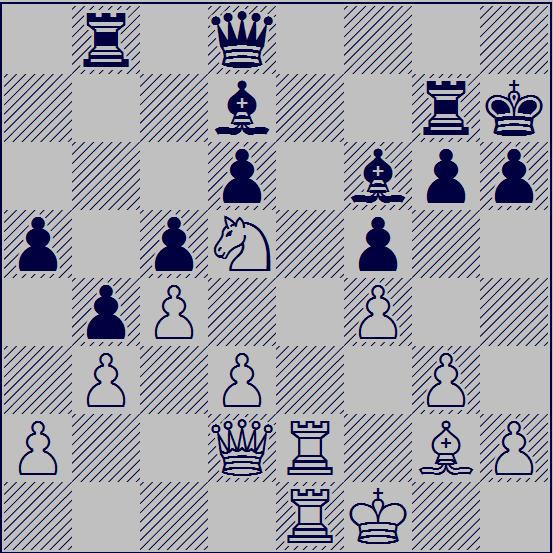
2 tipus de mat a 8va
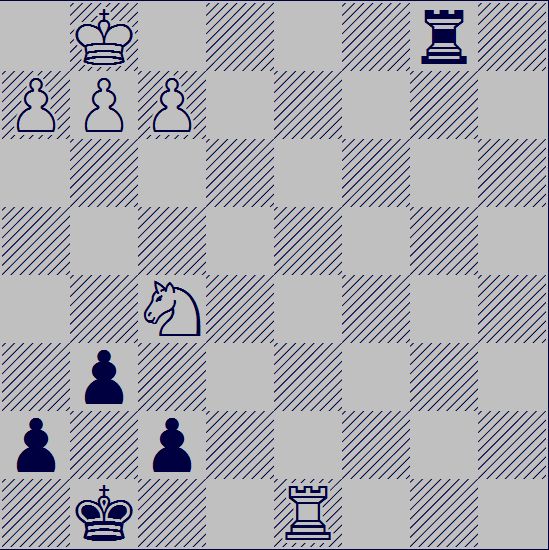
- King & Queen on same column (by Rook)
- King & Queen on same colour (by Bishop)
- atacar una pieza desprotegida
- pieza sobre-cargada, que defiende 2 piezas simultaneamente
- atacar la seva dama amb una peça menor
- atac "en descoberta"
- doble escac
- torres en septima linea doblarás y la partida ganarás
- mat a la 8-va fila
- fork - fer una "forquilla :
fer escac amb l'alfil/cavall a la vegada que s'ataca (amb el mateix alfil/cavall o una peça destapada) una torre
- pin (clavada)
- com crear un peo passat ? Per exemple ... 3 enfront 3
- atac al enroc - atac al fiancheto
- si juguem contra una Caro-Kann o una escandinava, i el rival ha fet "c6", el nostre alfil de caselles negres s'ha convertit en monstre
Curs molt complert a chess.com - Introduction to tactics
- learn to play chess
- from beginner to winner
- think like a chess player
- make the most of your pieces
- understanding endgames
- winning with tactics
- forcing moves
- reading the board
- advanced chess concepts
- key openings
- choosing the best move
- activating your pieces
- advanced endgames
- attacking the king
- advanced tactics
- endgame patterns
- mastery
- openings
- strategy
- tactics
- endgames
- attacking
- mastergames
- misc
curs chess.com
7 de las mejores trampas de apertura, GM Igor Shirov
Trampas que no descomponen nuestra posicion si el rival no cae en la trampa
- siciliana, 4...Cf6
- siciliana, 4.c3
- (5:30) Caro-Kann :
url
On-line tactic tools & puzzles
(60) tactical tools at ChessTempo
Advanced Pawn, Attraction, Avoiding Perpetual, Avoiding Stalemate, Blocking, Capturing Defender, Clearance, Coercion, Counting,
Defensive Move, Desperado, Discovered Attack, Distraction, Double Check, Exposed King, Fork/Double Attack, Hanging Piece, Interference,
Mate - Anastasia's, Mate - Arabian, Mate - Back Rank, Mate - Balestra, Mate - Blackburne's, Mate - Boden's, Mate - Damiano's Bishop,
Mate - Damiano's, Mate - Double Bishop, Mate - Dovetail, Mate - Dovetail - Bishop, Mate - Escalator, Mate - Epaulette, Mate - Greco's,
Mate - Hook, Mate - Kill Box, Mate - Lawnmower, Mate - Lolli's, Mate - Morphy's, Mate - Opera, Mate - Pawn, Mate - Pillsbury's, Mate - Railroad,
Mate - Smother, Mate - Suffocation, Mate - Swallow's Tail, Mate - Triangle, Mate - Vukovic,
Mate Threat, Overloading, Pin, Quiet Move, Sacrifice, Simplification, Skewer, Trapped Piece, Unpinning, Unsound Sacrifice
Weak Back Rank, X-Ray Attack, Zugzwang, Zwischenzug
url !
Els 7 elements del sistema d'en Aron Nimzowich - "My System"
He regards the following as the elements of chess strategy:
- the center - el centre
- play on the open files - les columnes obertes
Shirov-Anand, 2000
- play on the 7th and 8th ranks - la 7a i 8a fila
- the passed pawns - el peo passat
- the pin - la clavada
- discovered checks - escac a la descoberta
- exchanging - els canvis
- the pawn-chain - la cadena de peons
wiki
El joc posicional d'en Aron Nimzowich
- el joc posicional i el centre
- el peo doblat
- el peo aillat
- els 2 alfils
- sobreprotecció
- mainobrant contra un punt feble
Bones posicions, combinacions conegudes
Greek Gift - extracció del rei enrocat
Quan no hi ha el cavall a f6, ens poden atacar h7 :
alfil agafa h7, as
1. Bxh7+
Kh8
Kxh7 2.Ng5+ ... Qh5
Compte amb Bf5 !
Doblar torres a la 7a fila
Si el rei te 3 caselles també el podem matar :
Peo clavat
|
Hem de veure de seguida que podem agafar g4 amb el cavall
|
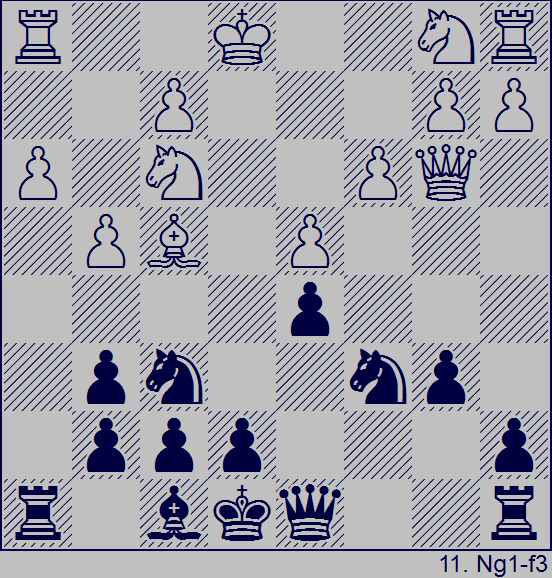
|
Queen trap on b2
|
dama agafa b2 - trap
|

|
Preparació de la forquilla
- posem el cavall (segurament al centre) en un lloc on poguem atacar la seva dama en un sol salt, primera casella de la forquilla - d5
- regalem la torre (amb escac) per a portar el rei a la segona casella de la forquilla - a8
- fem la forquilla, guanyant material - c7
|
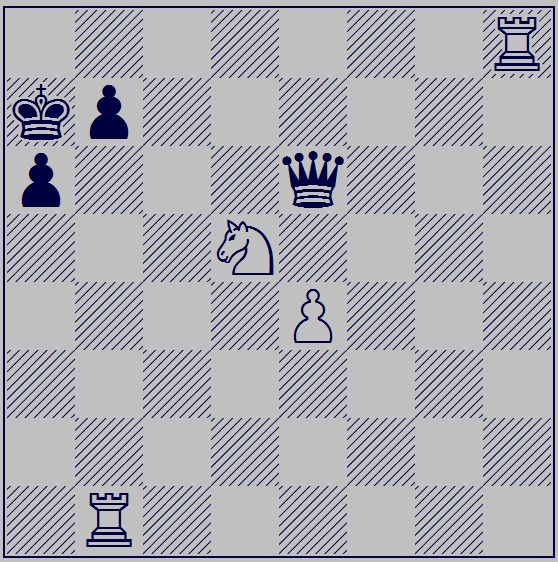
|

| La forquilla és a d5, guanyant el alfil de c5 amb l'escac,
que cobreix el cavall que és a punt de desapareixer : TxC !
|
h6 i g5 contra alfil i cavall
Normalment jugariem Cxg6, hxg6 i Axg6
Pero aqui hi ha un truc : Cxg6, Cxd5 i ara el alfil està clavat,
o si Cf3 llavors Cf6 i el negre guanya cavall per peó.
Dubtes tàctics
- si h6 i g5 (contra cavall i alfil), quan puc agafar 2 peons per peça i amb què (alfil o cavall) ?
- si estic en fianchetto i m'ataquen l'alfil, agafo i faig baixar la dama a h6, o espero a que m'el matin i agafo amb el rei a g7 ?
- si estem 3 peons contra 3 peons (exbiaixats), amb quin ataco ?
- posar el cavall darrere els seus peons, en un quadre de color diferent del seu alfil
- en la banda on tinc majoria, quin peó he de avançar ?
El que te la columna lliure (la majoria de vegades)
Preguntes a fer-se abans de moure
- quines jugades puc fer ?
- en que ha cambiat la posició amb la seva darrera jugada ? video
(a) qué ataca
(b) que no defensa
- quines intencions te la seva jugada ?
- per què ha fet aquest moviment el contrari ? Quin plan te al cap ?
- la seva jugada ha deixat algun unt feble en la seva posició ?
- mira els punts febles de la seva posició i de la teva
- mira les peces desprotegides de la seva posició i de la teva
Una peça pot estar desprotegida i estar darrere una altra peça (que podem treure o que fa doble feina)
- quines peces no tinc protegides ?
- tinc peces en posició de rebre una "forquilla" ?
- puc amenaçar mat en 1 ?
- puc fer-li escac a la descoberta ?
- puc fer-li una "forquilla" ?
- després de fer jo la meva jugada, quines bones jugades te ell ?
- fes un pla - estavia molt de temps
- si no tens atac, millora la posició de les teves peces
- pensa les "forquilles" de cavall i clavades de alfil (o de torre) que et puguin fer
- mira on apunten els "tandem" Alfil+Dama o Torre+Torre
- hi ha alguna peça "sobrecarregada", es a dir, que fa 2 feines a la vegada ?
- procura moure deixant les peces protegides
- es millor si mous la teva peça a una casella que ja està defensada
- quan ja hem decidit quin moviment fem, pensem quins moviments pot fer el rival llavors
Quan fem un canvi ?
Només farem canvis si
- guanyem un temps
- segueix desenvolupament o alliberació
Deciding what to move
So its your turn to move, what do you do first?
Most players tend to look at moves they can play,
ie he's moved there so I can now move here and so on.
I wont go as far to say that this is wrong
but from personal experience and talking to most players
I do believe it can be improved on.
The first thing you need to do before making any moves is weight up the position, understand it,
you need to look for key features.
The way you look at the position will determine what you need to do and how,
and then you can decide on what moves you need to play.
I will talk through my own personal check list
1. Define areas of control
This is basicly something that iv learned
from IM Bangievs square strategy training.
The first thing I do on each move
is to look at the area I control and the area the other player controls.
This helps show yours and their general strong and weak points of the board,
just to get an over all feel for the game.
2. Define direction of attacks
So you know the area that you control - where your pieces are coordinated.
Now you need to find in which direction you want to attack.
Pieces can normally only work well when working together on one part of the board,
so you need to group them and coordinate them there.
3. Square complex/colour weaknesses (maybe the most important)
A lot of the middle game of chess is all about square colour.
You can only attack one colour at a time,
if you try to play on black and white,
then your pieces automaticly become uncoordinated,
however once you define which colour you want to play on
and get all your pieces controling squares of that colour,
you will find a flow to the game
and the other player will find it very hard to stop you
from moving around on the colour you control.
Try to limit your colour weaknesses and if you have one,
trade off the other players pieces that can control the weak squares.
Google search under Bangiev squares
4. Enemy pieces to be challenged (traded)
I expect everyone knows what the pieces are worth,
pawns = 1 knights = 3 bishops = 3, rooks = 5 and queen = 9.
Well thats a good lie.
The piece values are never static,
for example at the start of the game the rooks in the corners are basicly pointless
and after 1.Nf3 the knight is better than the rooks
(at least for that move)
since it is doing something and the rooks arent.
You have to make pieces work for you in the most effective way,
which normally means centralisation,
a cental piece will control more squares.
If a bishop can control more squares than a rook,
or more important squares then the bishop
is worth maybe 5 and the limited rook is worth 3.5 etc,
its all about your judgement.
You have to look at each piece and give it a value, a rating,
how good is this piece etc.
Once you have worked out how good each piece is
you then know which one of your pieces you need to keep on
and which of the enemy pieces you need to trade,
if you can trade your bad pieces for their good pieces
you will find yourself winning effortlessly.
5. Own pieces to use and how
Pretty much like the last one,
you are aiming for max amount of control with your pieces,
finding good squares for them or exchanging them for better enemy pieces.
6. Enemy plan
Work it out!
7. Your plan
Get one!! ie, short term improving piece position,
controling a colour, challenging the other players good pieces.
Maybe move a pawn to take away a good square from an enemy piece
(mainly knight),
but also have a long term plan, like
kingside attack, on central breakthrough.
8. Look for tactical chances
Weak king,
undefended piece,
weak pawns,
overloaded piece,
etc
If they have only one weakness dont attack it,
ie if a piece is undefended DONT attack it,
leave it undefended because the only way tactics
or combinations happen is the rule of two weaknesses.
You need to hit two weaknesses at once
for a tactic to work,
so dont help the other player and pointless attack things
forcing them to strengthen their position.
9. Positional moves
If theres no tactical tries
then its time to use everything you looked at
and judged in the position and start to list candidate moves.
Once you have the moves, caculate and find the best one for you.
Improving the position of your pieces.
Trading good enemy pieces.
Taking away good squares from their pieces.
Trying to control a colour complex.
Gain space.
Controling center.
Controling open files.
Prophylaxis moves
(ie taking care of your own weaknesses,
undefended pieces, exposed king etc etc)
Arbre de analisi
Level One – Checks and Checkmate Threats
- Find all of your checks. Examine each one. If you see a sequence that leads to a forced win, play it.
- If you don’t see a sequence that leads to a forced win, then examine all of the opponent’s checks. If you see a sequence that leads to a forced loss, prevent it.
- Find all of your moves that threaten to checkmate on the following move. If your opponent can’t stop the mate, play the threatening move.
- If you don’t see an unstoppable checkmate threat for you, then examine your opponent’s options. If he can threaten to checkmate you, prevent it.
- If there are no dangerous check or checkmate threats, examine all of the possible captures.
Level Two – Captures
- Find all your captures. If any of these win material, find the one that wins the most.
- Find all your opponent’s captures. If any of these win material, find the one that wins the most.
- Compare. If your best capture wins more material than his best capture, play your capture. If his best capture wins more material than your best capture, prevent his capture.
- In capturing sequences, watch out for in-between moves where the opponent plays something other than the expected recapture.
- If there are no checks or captures that win material, look for threatening moves.
Level Three – Threats
Find the biggest threat for each side. If yours is the biggest, play it. If his is the biggest, avoid it.
Examples of Threats
- Simple Attacks (For example a pawn move that attacks a knight.)
- Forks (One piece attacking two pieces in different directions. All pieces can fork.)
- Skewers (A bishop, rook, or queen attacks two pieces on the same line. A line is a rank, file, or diagonal. If the attacked piece moves, the one behind it can be captured.)
- Double Checks (One piece moves with check, while a piece behind it also gives check.)
- Discovered and Double Attacks (Your piece moves, exposing an attack by another one of your pieces against an opponent’s piece. If the moving piece also makes a threat it is called a double attack.)
- Pins (A pinned piece can often be successfully attacked by a pawn. It also loses control over squares it would normally control so those squares can be used by the attacker.)
- Trapped Pieces (Pieces that have nowhere to move when attacked by pawns. Bishops are often trapped by pawns.)
- Pawn Promotion (Safely getting a pawn through to the eighth rank is a common winning idea.)
- Overloaded Pieces (A piece may be tied down to guarding more than one square. Moving a piece to one of those squares forces the defender to give up the defense of the other square.
- Clearance sacrifices. A piece moves, often as a sacrifice, to let another piece occupy its previous square and create powerful threats.
Level Four – Positional Ideas
If there are no checks, captures or threats, look for ways to strengthen your position, or weaken the opponent’s. There are many positional ideas to choose from. Here are some key ideas.
Opponent’s Plan
Ask yourself, “What does my opponent want to do?” If it is dangerous, stop it.
Piece Placement
Identify your most inactive piece and try to find a better square for it.
- Pieces that can make many moves are stronger than those with fewer choices.
- Pieces that are blocked by your own pawns or pieces are poorly placed.
- Pieces that threaten to capture the opponent’s pieces or pawns are well placed.
Pawns and Squares
- Pawns are strongest when they are side by side.
- Pawns that are doubled, backward, or isolated are weaker.
- It is often a good idea to push the rook pawn in front of your castled king to avoid back row checkmates. However, this makes it easier for your opponent to trade off the pawns in front of your king.
- If you are behind in development it is usually a bad idea to make pawn moves.
- If there are no pawns on the central files it is usually a bad idea to move pawns until the ending is reached.
- A strong square is one on which your piece can not be attacked by enemy pawns. Usually it is in the center or in the enemy’s half of the board.
- A weak square is one that needs to be guarded by a piece.
- The squares in front of weak pawns are often weak because enemy pieces can sit there safely.
King Safety
- If a king lacks pawn cover, or if an attacker has more pieces than the defender in the king’s vicinity, the king is vulnerable to attack.
- With the center files blocked by pawns a king is often safer in the middle than being castled.
- If one or more of the center files are open, the kings are safer being castled.
- If kings castle on opposite sides, the player whose pawns attack the enemy king fastest usually wins.
- If the enemy has a queen, or two rooks, keep the king in a safe place.
- When several pieces have been exchanged, the king is usually safe from checkmate and should be used actively.
Material and Exchanges
If you are ahead in material by a piece or more, you do not need to win more material. Play it safe.
- The first rule is always “Don’t allow counterplay.”
- Aim for even trades to try and reach a winning ending.
- Protect your king!
- Do not trade off all of the pawns.
If you are behind in material the ending is lost so avoid even trades.
- Your best chance is to try to checkmate your opponent.
- Try to make exchanges which unbalance the material: knight for bishop, rook and pawn for two minor pieces, and so on. Unbalancing the pieces makes it harder for the opponent to trade down into a won ending.
General Concepts
- If your opponent has a bad piece, limited in its movements, do not exchange it.
- If your opponent has a piece which can move to many squares or is performing a vital task, try to trade for it.
- If your opponent has two pieces that need to occupy the same square to be effective, avoid exchanging them.
- After the opening stage, if your opponent lacks space for his pieces, avoid piece trades.
- The exchange of even one pair of pieces is often enough to relieve a cramped position.
Mike Splane, 2008
4 important chess principles
- recognize when the nature of a position has changed and adjust your mind
- try to make as difficult as possible for your opponent to execute his plan
- be on the lookout for opportunities to take advantage of your opponents complacency
- create situations in which your opponent must make decisions
In other words
- mentally adapt to a change in the position
- resist by preventing your opponent from executing their only winning plan
- take advantage of complacency
- make your opponent make decisions
FM Alisa Melekhina
Coses que ells saben i jo no
"punts tematics" en una obertura
- si faig Caro-Kann, segurament acabaré enrocant llarg
- si faig Siciliana, he de fer a6 i b5 per atacar en el flanc de dama
- si faig Siciliana amb c5xd4, he de posar la torre a c8
- si faig London, no he de canviar el alfil blanc de quadres negres (jugar h3)
- si faig defensa india, he de fer "f5" en algun moment
- si jugo holandesa, he de fer e5 en algun moment
Sacrificis tematics
- Siciliana contra enroc llarg : Tc8xCc3
- Grand Prix : f5
Typical positions
simplify chess :
As you must know by now, there are 17 essential pawn structures in chess, and they are the very foundation of each chess position -
complete guide to pawn structures
Molt interessant : cursos y teoria :
Finales de alfil contra caballo
- cuando hay peones en ambos lados, cuanto más desequilibrada está la cantidad de peones, más favorece al alfil.
- la existencia de peones pasados, especialmente si están alejados, también resulta favorable al alfil
- cuando la posición de peones está bloqueada, es fundamental ver que bando tiene sus peones en las casillas por donde juega el alfil
Si es el poseedor del alfil (alfil malo) la ventaja del caballo suele ser muy grande.
En cambio, si el bando del caballo tiene sus peones en casillas donde pueden ser atacados por el alfil, a menudo se encuentra en clara inferioridad.
leccion 32
See "Saidy vs Fischer, 1963" and "Karpov vs Kasparov, Moscú, 1984"
Finales de alfiles del mismo color
Aquí son importantes varios factores :
- la mejor estructura de peones, especialmente si hay peones débiles o peones pasados
- la presencia de un alfil malo
- la mayor actividad del rey
leccion 34
Mireu Smyslov vs Keres, Moscú, 1951
Finales de alfiles de distinto color
La regla de oro es, para el bando fuerte, colocar los peones en casillas diferentes a su alfil,
mientras que el bando defensor debe colocarlos en las casillas de su propio alfil.
El primer factor para desequilibrar un final con alfiles de diferente color es la creación de peones pasados.
Pero en general, un solo peón pasado puede ser detenido por el rey o el alfil defensor, y es necesario buscar la creación de otro, preferiblemente alejado del primero.
leccion 35
El nudo de Maroczy
La característica principal es la posición de los peones en e4 y c4 con la columna «d» semiabierta,
contra los peones negros en d6 y e7, siendo la columna semiabierta de las negras la «c».
Ello hace que la ruptura …d6-d5 sea muy difícil de realizar y que el punto d5 se convierta en una excelente casilla para un caballo,
puesto que si es desalojado con …e6, el peón d6 perderá su principal defensor y podría ser atacado por la columna semiabierta.
Nudo Maroczy
ajedrez castellón {***},
simplify chess {+++},
wikipedia
La lucha contra la formación Maroczy principalmente intenta la eliminación de alguno de los peones que forman el nudo.
Para ello se utiliza la ruptura …f5 o …b5.
Hedgehog setup :
black’s main idea in this system is to breakthrough rapidly and under good conditions, with either b7-b5, supported with a7-a6, or d7-d5, supported with e7-e6.
A basic concept of chess strategy is that when you have less space,
you must exchange pieces in order to have more room for those that are left on the board. This is precisely what black must try to do.
In addition to this, endgames can be good for black, because White’s advanced pawns have left weak squares behind them.
How to reach this position
Common opening lines :
- The Moscow variation of the Sicilian defence: 1.e4 c5 2.Nf3 d6 3.Bb5+ Bd7 4.Bxd7 Qxd7 5.c4 Nc6 6.d4 cxd4 7.Nxd4
- English opening
Sample games
Attacking a fianchetto
If the Bishop is removed, all that will be left is a network of holes.
user's guide (Exeter),
Smirnov
Two short samples to
paste
Lee,R - Holmes,D [E82]
1.d4 Nf6 2.c4 g6 3.Nc3 Bg7 4.e4 d6 5.f3 0-0 6.Be3 b6 7.Qd2 c5 8.d5 Na6 9.0-0-0 Nc7 10.Bh6 a6
11.g4 b5 12.h4 bxc4 13.Bxc4 Nb5 14.Nge2 Nxc3 15.Nxc3 Bd7 16.h5 Qe8 17.hxg6 fxg6 18.Bxg7 Kxg7 19.Qh6+ Kh8 20.e5 dxe5
21.d6 exd6 22.Rxd6 Qe7 23.Rxf6 Rxf6 24.Nd5 Qg7 25.Nxf6 1-0
Homer,S - Wilde,T [B07]
1.e4 d6 2.d4 Nf6 3.Nc3 g6 4.Be2 Bg7 5.h4 h6 6.Be3 0-0 7.h5 Kh7 8.hxg6+ fxg6 9.Qd2 Ng8 10.0-0-0 Nc6
11.Nf3 Qe8 12.Rh4 h5 13.g4 Nf6 14.gxh5 gxh5 15.Rdh1 Rh8 16.Nd5 Nxd5 17.Rxh5+ Kg8 18.Rxh8+ Bxh8 19.Rg1+ Bg7 20.exd5 Nd8
21.Bh6 1-0
Attacking a castled king
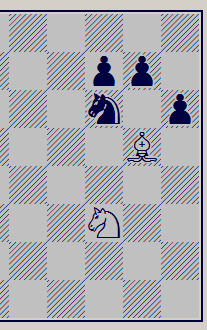
|
Black has played the pawn to h6.
If white Bishop goes to h4 and black pawn moves to g5,
when is it correct to sacrifice a piece for 2 pawns ?
No sacrificar mai si
te alfil negre que pugui tapar inmediatamnet la diagonal
o
te un cavall a d7 que apoya el de f6
Do we always sacrifice the Knight and keep the Bishop ?
Yes, to keep the Knight pin to the Queen.
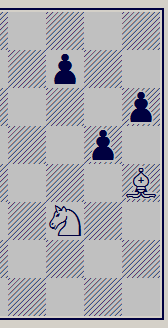
| |
Traps
Opening traps
7 in this video
Situacions conegudes
Anem a veure si podem resumir que cal fer en posicions conegudes
Standard games for known openings
Known sacrifices
Greek gift
Atac al pió 7TR, as {use load FEN} :
rnbq1rk1/pp3ppp/1n2p3/4P3/2Pp4/P1PB1N2/6PP/R1BQK2R w KQ - 0 12
Also known as greek gift
Read about bishop sacrifice on h7 (video)
Vladimir Vuković, Art of Attack in Chess – chapter 6 is dedicated to the classical bishop sacrifice
{sagpdf}
What if Kh8 ?
video Jonathan Schrantz, St Louis Chess Club, 46 min
Lasker sacrifice or Double bishop sacrifice
url
chjess.com
1,
2
Finals elementals
Endgame frequency table
Estudiar finals, com
- rei contra rei i
peó (nice wiki article, *****)
Key squares :
a key square is a square such that if White's king occupies it,
White can force the pawn to promotion,
regardless of where the Black king is and regardless of which side is to move,
and against any defense.
Opposition :
the player not having to move is said to "have the opposition"
- Torre i pió versus Torre; acaben en Lucena position
o Philidor position,
The side with the pawn will try to reach the Lucena position to win;
the other side will try to reach the Philidor position to draw.
Philidor : the basic idea for the defender is
to keep his rook on his third rank until the pawn advances to that rank,
then check the opposing king from behind.
La torre ha de atacar el peo pel darrere, o, si no es pot, pel davant. Mai pel costat {Chalmeta, 20160207}
- Reina contra peó.
- Dama contra Torre ! {***}
Finals amb peons
Rei i peo contra rei - com empatar
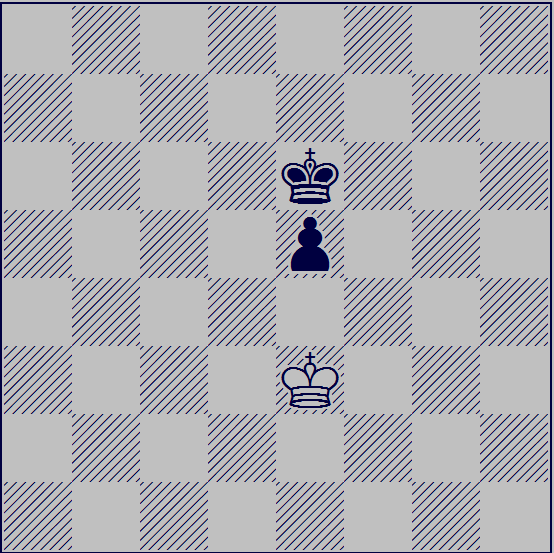
|
(1) quan el rei negre avançi a la fila 5,
el rei blanc s'hi ha de posar enfront.
|
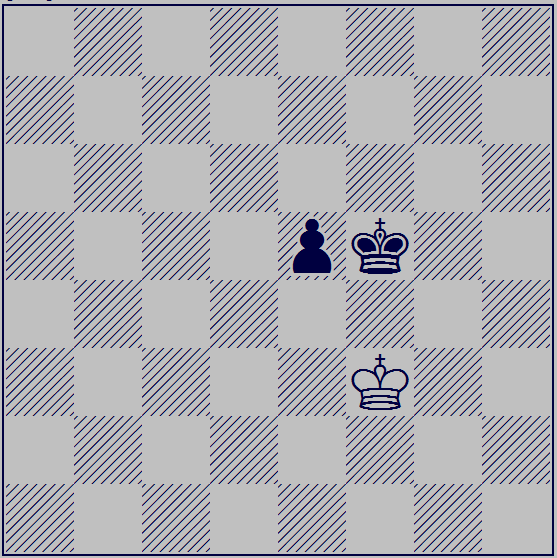
| (2) d'una altra manera, quan el rei surt del darrere el seu peó,
i es posa al seu costat,
el rei blanc s'ha de posar al davant del rei contrari.
|
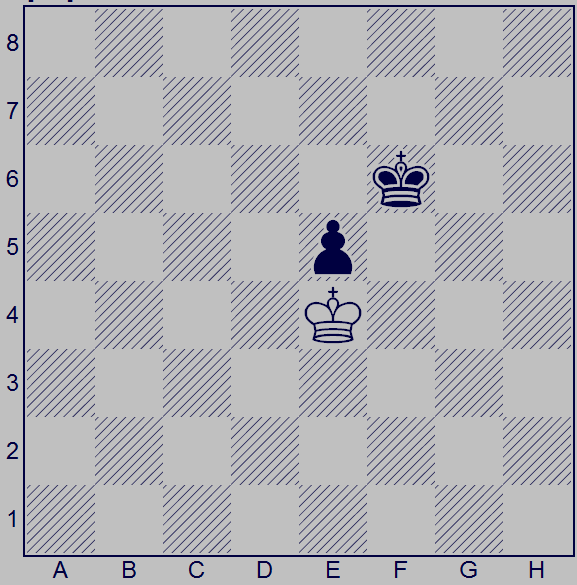
| (3) si no es posa al seu costat directe, sino en diagonal, anem al davant del peo i estem en bucle :
quan el rei torni a e6, el nostre rei anirà a e3
|
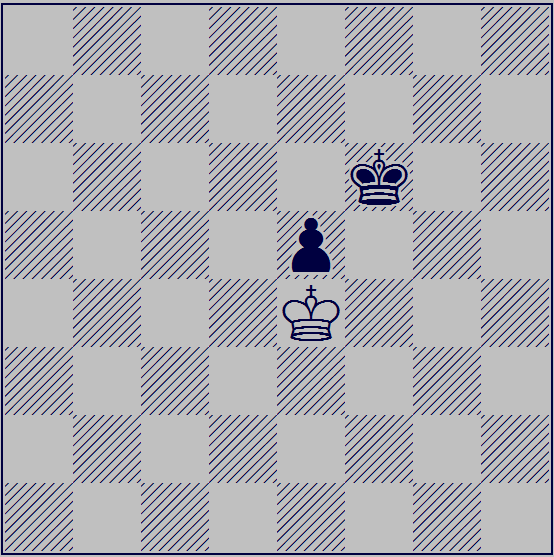
| (4) si Rf6, llavors Re4
|
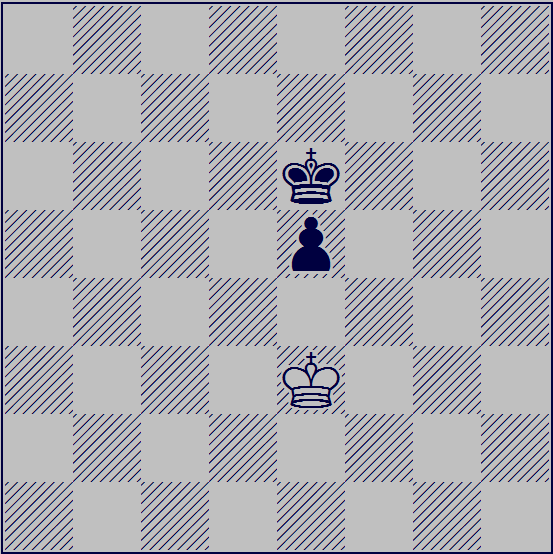
| (5) si Re6, llavors Re3
|
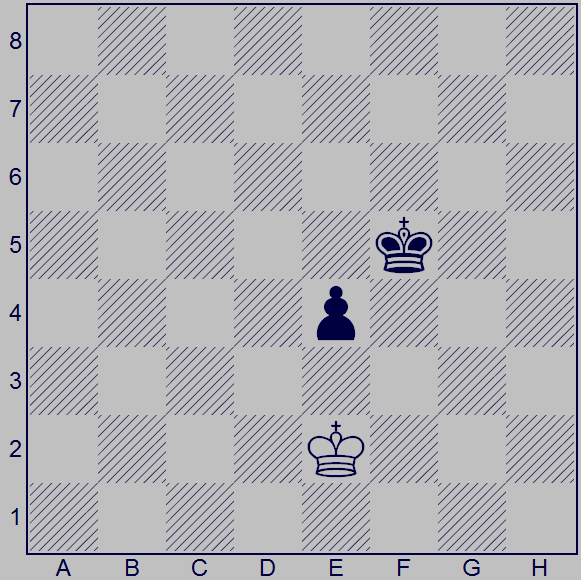
| (6) si e4+, llavors Re2
Això ens porta a un rei ofegat en arribar a (1) amb el rei blanc a e1 i que toqui moure al negre.
|
Torre i peo contra torre - empat mitjançant "Philidor position"
S'empata si es juga be. Requisits :
- saber empatar amb rei contra rei i peo (veure secció anterior)
- tenir el rei abans del peo
Anem per parts
Comencem aixi :
el peo negre no ha arribat a la fila 3
La torre blanca s'ha d trobar al cantó llarg del peó, es a dir, al cantó on hi ha mes caselles,
per a que el rei no la pugui tocar.
|
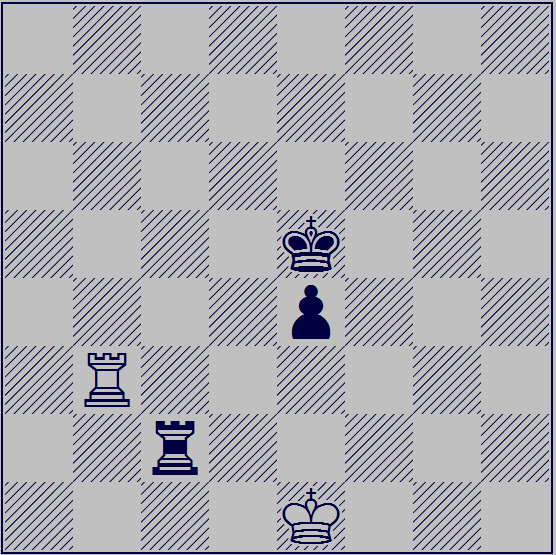
| La torre blanca es manté a la fila 3 per impedir que s'hi posi el rei negre.
Si la torre negre es posa a la fila 1 tocant el nostre rei blanc, el rei blanc pot anar a la fila 2.
Tard o d'hora, el rei negre anirà a la fila 4 i el peó avançarà a la fila 3.
O be, ens proposarà un canvi de torres, que acceptarem ràpidament.
|
Fase 2 :
el peo negre ha arribat a la fila 3
| 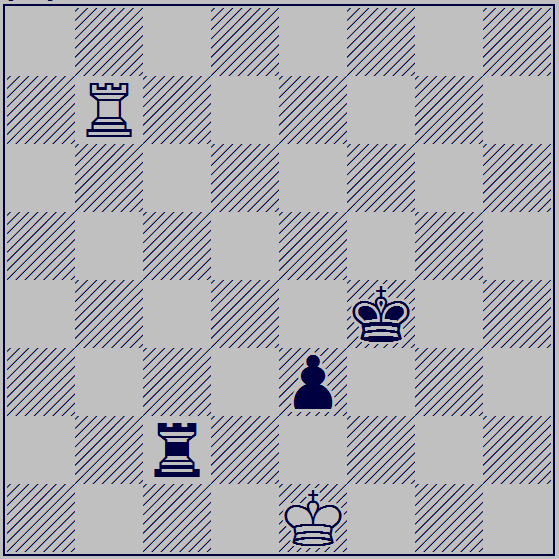
| La torre blanca es posa mes enrere del peo i dona escac al rei negre quan es posi a la fila 3 obligant-lo a ficar-se darrere el peó.
|
The defender should keep his king in front of the opposing pawn
and keep his rook on the third rank until the pawn advances to that rank.
Then go to the far end of the board (the seventh or eighth rank) and check the king from behind.
If the attacker tries to get his king to his sixth rank by moving his rook to that rank first to block the checks,
the defender simply exchanges rooks and has a drawn king and pawn versus king endgame.
Philidor position
Finals sense peons
- dama contra torre
- 2 alfils - es pot guanyar
- 2 cavalls - es pot empatar
- 1 alfil i un cavall
Pawnless endgame
Dama contra torre
"T'has de quedar al mig i donar voltes a la torre" - Ramón
Mat amb 2 alfils
- pensem que dos alfils juntets son com una torre, però en diagonal
- el rei, al igual que quan te una torre, ha de tapar el forat d'escapament del rei contrari quan movem el alfil per arreconar el rei
- hem de aconseguir la posició indicada al esquema, on un sol alfil i el rei tenen retingut el rei contrari en 2 caselles
- el altre alfil és el que dona el penultim "escac" - serà el alfil del quadre del racó el que doni el "mat"
wiki
Mat amb 1 alfil i un cavall
- el esquema anterior també aplica en aquest cas
- el mat només es produirà al racó del color del alfil - the checkmate can be forced only in a corner that the bishop controls
- per arribar-hi, el cavall ha de fer un moviment en forma de "W"
- si sembla que el rei s'escapa, fem 2 moviment anti-naturals i el tanquem de nou
wiki
metode super facil - GM Carlos Matamoros
Alfil i Torre contra Torre
- el bandol "fort" (que te alfil i torre) ha de portar el rei contrari cap a una banda,
és a dir, que el rei quedi en la darrera fila o columna "tallat" per la torre.
- el bandol "fliux" pot escollir cap a on anar, i ha de anar a
- una casella de cavall.
Compte que n'hi ha 8 en el tauler -
les 4 on hi ha cavall de veritat (b1, g1, b8 i g8)
i les 4 corresponents "verticals", es a dir a2, a7, h2 i h7.
- del color que NO sigui el del alfil del bandol "fort"
- tot i aixi, per poc que s'equivoqui el "fluix", li fan mat o li roben la torre,
mentre el "fort" només ha de vigilar de no ofegar el rei contrari.
- compte que s'ha de fer "mat" en
menys de 50 jugades !
Xarxa :
Biblio
See
Llibres section, "Los 100 finales que hay que saber"
Partides maques
|
Byrne (2530) - Fischer (2460), [D97], 1956, comentada !
The game of the century : 17 ... Be6 !!
|
 Byrne-Fischer
Jugala !
|
|
1. Nf3 Nf6 2. c4 g6 3. Nc3 Bg7 4. d4 0-0 5. Bf4 d5
6. Qb3!? dxc4 7. Qxc4 c6 8. e4 Nbd7!? 9. Rd1 Nb6 10. Qc5!? Bg4!?
11. Bg5?! Na4!!! 12. Qa3 Nxc3 13. bxc3 Nxe4! 14. Bxe7 Qb6! 15. Bc4 Nxc3!
16. Bc5 Rfe8+ 17. Kf1 Be6!! 18. Bxb6 Bxc4+ 19. Kg1 Ne2+ 20. Kf1 Nxd4+
21. Kg1 Ne2+ 22. Kf1 Nc3+ 23. Kg1 axb6! 24. Qb4 Ra4! 25. Qxb6 Nxd1
26. h3 Rxa2 27. Kh2 Nxf2 28. Re1 Rxe1 29. Qd8+ Bf8 30. Nxe1 Bd5!
31. Nf3 Ne4 32. Qb8 b5 33. h4 h5!? 34. Ne5 Kg7 35. Kg1 Bc5+
36. Kf1 Ng3+ 37. Ke1 Bb4+!? 38. Kd1 Bb3+ 39. Kc1 Ne2+ 40. Kb1 Nc3+
41. Kc1 Rc2++ 0-1
|
|
|
Anderssen - Kieseritzky (London 1851) - The Immortal Game
|
|
|
|
1 e4 e5 2 f4 exf4 3 Bc4 Qh4+ 4 Kf1 b5
5 Bxb5 Nf6 6 Nf3 Qh6 7 d3 Nh5 8 Nh4 Qg5
9 Nf5 c6 10 Rg1 cxb5 11 g4 Nf6 12 h4 Qg6
13 h5 Qg5 14 Qf3 Ng8 15 Bxf4 Qf6 16 Nc3 Bc5
17 Nd5 Qxb2 18 Bd6 Qxa1+ 19 Ke2 Bxg1 20 e5 Na6
21 Nxg7+ Kd8 22 Qf6+ Nxf6 23 Be7 ++
|
|
|
Inmortal Letona. Morillo - Ortiz, 1970 (C40) - visor
|
|
|
|
1. e4 e5 2. Nf3 f5 3. Bc4 fxe4 4. Nxe5 Nf6 5. Nf7 Qe7 6. Nxh8 d5
7. Be2 Nc6 8. Bh5+ g6 9. Nxg6 hxg6 10. Bxg6+ Kd8 11. Bh5 Ne5 12. 0-0 Qh7
13. Be2 Bd6 14. g3 Qh3 15. f3 Neg4 16. fxg4 Bxg3 17. Rf2 Bxf2+ 18. Kxf2 Qxh2+
19. Ke3 Qg3+ 20. Kd4 c5+ 21. Kxc5 Nd7+ 22. Kd4 Qe5+ 23. Ke3 d4+ 24. Kf2 Qh2+
25. Kf1 Ne5 26. Nc3 d3 27. cxd3 Bxg4 28. Bxg4 Ke7 29. Nd5+ Kd6 30. Ne3 Rf8+
31. Nf5+ Rxf5+ 32. Bxf5 Qh1+ 33. Ke2 Qf3+ 34. Ke1 Nxd3# 0-1
|
|
|
3 partides maques i desconegudes i una de coneguda
|
|
|
|
Les meves partides ...
|
Amb en Sergi, primera :
1. e4 c6 2. d4 d5 3. e5 Bc8f5 4. Ng1f3 e6 5. Bf1d3 Bf5xd3
6. Qd1xd3 Nb8d7 7. 0-0 Qd8c7 8. Bc1g5 h6 9. Bg5e3 c5 10. b3 cxd4
11. Be3xd4 Ng8e7 12. Nb1d2 Ne7c6 13. c4 dxc4 14. Nd2xc4 Nc6xd4 15. Qd3xd4 Qc7c5
16. Qd4e4 Ra8b8 17. Ra1c1 Qc5b4 18. Rf1d1 Bf8e7 19. Rd1xd7 Ke8xd7 20. Qe4d3 * (perd la dama)
|
|
Amb en Sergi, segona : (lenta pero segura)
1. d4 d5 2. e3 e6 3. Bf1d3 Bf8d6 4. Ng1f3 Ng8f6 5. Nb1d2 Nb8d7
6. 0-0 0-0 7. b3 e5 8. dxe5 Nd7xe5 9. Bc1b2 Ne5xd3 10. cxd3 Bc8g4
11. Rf1e1 c6 12. Qd1c2 Rf8e8 13. Bb2xf6 Qd8xf6 14. d4 Re8e6 15. h4 Qf6h6
16. g3 Qh6h5 17. Kg1g2 Ra8e8 18. Nf3h2 Bg4f5 19. Qc2d1 Qh5g6 20. Nd2f1 Bd6b4
21. Nf1d2 Bb4xd2 22. Qd1xd2 Bf5e4 23. Kg2g1 Qg6f5 24. Qd2e2 Re6g6 25. Qe2f1 h5
26. Ra1d1 Re8e6 27. Rd1d2 Re6f6 28. a3 Qf5d7 29. Re1e2 Rg6xg3 30. fxg3 Rf6xf1
31. Nh2xf1 a5 *
|
|
2 Rooks vs 1 Queen
Fischer vs Matthai [1/2-1/2]
Portisch vs Fischer [0-1, queen is better]
Kramnik vs Grigory [1-0, queen is better]
|
|
Siciliana, Zizou & MgBal
Zizou [pgn]
MgBal [pgn]
|
|
India de Rei
Robert Angler [pgn]
La pitjor
1.e4 d5 2.exd5 g6 3.c4 c6 4.dxc6 Nxc6 5.Nc3 e5 6.b3 Bf5 7.Bb2 Bg7 8.Nge2 Nb4 9.Rc1 Nd3# 0-1
|
Blitz games
Carlsen loses to Morozevich, World
Blitz Championship 2012, (3'+2'')
Another :
1. e2-e4 e7-e5 2. Ng1-f3 Nb8-c6 3. Bf1-b5 a7-a6 4. Bb5-a4 Ng8-f6 5. 0-0 Bf8-e7
6. c2-c3 d7-d6 7. Rf1-e1 Bc8-g4 8. h2-h3 Bg4-h5 9. d2-d4 b7-b5 10. Ba4-b3 0-0
11. g2-g4 Bh5-g6 12. Bb3-c2 h7-h6 13. Nb1-d2 e5xd4 14. c3xd4 Nc6-b4 15. a2-a3 Nb4xc2
16. Qd1xc2 h-h5 17. g4-g5 Nf6-h7 18. h3-h4 f7-f6 19. d4-d5 Qd8-d7 20. Kg1-h2 f6xg5
21. h4xg5 Be7xg5 22. Re1-g1 Bg5-f4 [0-1, Fedor]
GameKnot : monkeyballz !
1. e4 g5 2. d4 Bg7 3. c3 h6 4. Be3 Nf6 5. Bd3 d6
6. Qb3 b6 7. Nd2 Be6 8. Bc4 d5 9. exd5 Nxd5 10. 0-0-0 c5
11. Bb5+ Nd7 12. Qa4 a6 13. Bxd7+ Qxd7 14. Qxd7+ Kxd7 15. c4 cxd4
16. cxd5 Rac8+ 17. Kb1 Bf5+ 18. Ka1 dxe3 19. fxe3 Rc2 20. Ngf3 Bxb2+
21. Kb1 Rxd2+ 22. e4 Bxe4# [-1, jcasazza, 2031]
|
|
|
gnuchess at T60
Homepage,
manuals, man chess, info chess, ...
File gnuchess.ini allows seting config options.
The file is looked in three places according to the following precedence:
- the directory where the program was started
- environment variable GNUCHESS_PKGDATADIR
- the package data directory stated at configure time
*** always plays black ***
Fritz & chessbase
Homepage,
Q&A,
filenames,
news
Get
CB14 (iso+patch+keygen)
Add Stockfish 13 :
- "Crear modulo UCI" - find the ".exe"
- "Añadir apuntador" - set "default engine"
Or use "File + Options + Modules" -
url
Base de dades
Joaquim 2026.06.26 : Mega Database per ChessBase versio 14
Els fitxers essencials - Mega Database 2026.cbh
Idioma
Extras
Optionen
Sprache !
Analisi
FILE + NEW + POSITION SETUP ("S")
<setup>
GAME + INFINITE ANALISYS (yep !)
or "Tools" + "Analysis" + "Deep Position Analysis" (nop !)
Fritz 8 can Save a game as
Configuració
Base de Datos de Referencia :
- Kayak : c:\D&S\user\My Documents\ChessBase\Bases\database.cbh
- T42 : c:\D&S\user\My Documents\ChessBase\Bases\fritz10\database.cbh
[+/-] : number of lines that are calculated in parallel.
Engine
Change Engine
Hash Table := 1024 MB ;
Panes
To restablish standard layout:
- windows
- standard layots
- big board
Arrows
- move just made - Tools, Options, Game : "Mark Move" checkbox
- long-term plans - Tools, Options, Engine : "Show Plans" checkbox
Engine
Get Fritz 9.eng from Emule ! @
Get it
here ! [446.464 bytes, DVD still required to Load]
and place it in
c:\Program Files\ChessBase\Engines.
Openings Book(s)
Fritz8.ctg [166.105.088]
WMV files
- Window
- Panes
- Chess Media System (CTRL+ALT+"V")
Play a lecture :
- start Fritz in Classical Offline mode ("Play Chess" in the start dialog)
- Open - Chess Media File
- Select "filename.wmv"
A Chess Media System for Fritz
Para poder usar el sistema Chess Media debe :
- Archivo
- Abrir
- Archivo de Chess Media
Import PGN into Rybka
- create a new database or access and old one to add games to it
"database" icon (last group on the right) + "application" (up-left) + "new" : sag-cat.cbh {c:\Users\bisc\Documents\ChessBase\Database\Work}
- access the PGN file to import
"application" + "open" + FileType := "PGN" + navigate to PGN directory {D:\escacs\StBoi\2016-campionat-1a-catalana}
- doble-click on the game to open it into Rybka
- goto "Recent Databases" + select "sag-cat" + "application" + "Save"
url
Delete a PGN from database
- "database" icon + "application" (up-left) + double-click "sag-cat.cbh" to display all games in database
- select any game + "delete" key : the game is in gray now
- click "Database" icon, then select "Database" tab (between Home and View) + click "Database Functions" icon
- select "Remove Deleted Games" from drop-down menu
Export PGN into CBV, chessbase backup
- import a PGN game
- create a New Database (empty)
- "Save" game
- "backup" database into CBV file
Fritz & My Computers
Fritz Chess Benchmark.exe says :
| Computer | Processors found | Relative Speed | K nodes/sec
|
| T42 {1} | 1 | 2,28 | 1.100
|
| RAP {1} | 4 | 7,47 | 3585
|
| HP {3} | | |
|
{1} : Performance relative to P3 1,0 GHz (480 Knodes/sec)
Dubtes de Fritz
- que passa amb (no catalogat a ChessGame.Com)
- 1. ... b5 !?
- 1. ... g5 !?
- per què el Fritz 8 amb Engine del 9 per avaluar una posició i arribar a la mateixa fondaria triga més si hi ha mes variacions "visibles" ?
Vull dir, escollides amb el botó "+" ...
rn2k2r/ppq2ppp/2p1p3/3n4/2BP4/P1P2Q1P/2PB1PP1/R4RK1 w kq - 1 13
Si tanquem a nomes estudiar 2 variacions, llavors aquesta posició
8/1p6/5B2/b6p/2k2K2/8/8/8 w - - 2 55
| Fondaria | Veure 2 | Veure 15
|
| 12 | 00:05 | 00:22
|
| 13 | 00:10 | 00:51
|
| 14 | 00:38 | 02:00
|
| 15 | 01:28 | 04:45
|
| 16 | 03:44 |
|
- que son les extensions ...
- CBB
- CBG
- CBH = DataBase's
- CBJ
- CTG = "Openings Book" Tab ; Rybka : Turk Book.ctg
51.910.034 database.cbh
58.680.908 database.cbb
83.507.404 database.cbj
93.124.307 database.cbg
Fritz 10 System requirements
120 €
Minimum :
Pentium II 300 MHz,
64 MB RAM,
Windows 2000 SP4, XP SP2,
DVD-ROM drive,
Windows Media Player 9
Recommended:
Pentium IV 2,2 GHz or better,
256 MB RAM, Windows XP,
GeForce5 graphics card (or comparable) with 128 MB memory or better,
100%DirectX compatible,
sound card,
Windows Media Player 9,
DVD-ROM-drive
Network installation => "Please insert Fritz 10 DVD" message.
Engines @ d:\P F\ChessBase\Engines
118.784 Comet B68.eng
147.456 Fritz 5-32.eng
548.864 Fritz 960.eng
15.867.904 Fritz Giveaway.eng
77.824 Mate210.eng
Fritz 9
SVCHOST.EXE @ T42
Get serial (10 a day)
Fritz 9 S/N:
H8LXU-JWEKG-YWFUM-Y69DM-YSRAJ
QCEGE-KVDA2-I5SJ5-9A8KR-BEMFQ
IKLX5-N3AMD-7O72G-SPD2K-D2OH6
VDE4A-KHSTB-2QL36-LVXXL-LXL78
ERRRF-KTNFC-PFGAG-BODQH-PH8E8
ZNPFC-LXPL3-H28CA-SPXFI-9SNJ5
NE6E8-UTL3M-ODACC-5CWN9-CQXVH
K9CQT-EAW5C-AIP3W-R9AC4-MJ5SN
GR5KP-LVPHK-R7KTJ-IVXR5-4I36W
BHUJJ-B2S5G-G84G6-9KNRV-XBE82
J4EQR-RRB4W-VP5WB-KXPHM-PL9KH < Fritz 10 @ Kayak & T42.
N86JU DZF37 81B3X VQJTE 1A2PJ (AMS)
T42 : KGF.exe
Kayak : Keygen.
I6QVT-2SBS3-9EAEW-WTRPP-XXPXV
RAP : Keygen v9
X6WDA-5O34Q-NHGAM-LNHKV-EW7AG
Rybka 4 :
98DLW-MK784-M2RL8-R986K-1J29X-RY4
Serial: 98dlw-mk784-m2rl8-r986k-1j29x-ry4j
Fritz is Blind !
|
Fritz does not see a winning move in this position ... But there is one. Gràcies, Javier !
Use FEN here :
4r3/4q1r1/P2p2Pk/2p1pQ1P/2P2p2/1P5R/6RK/8 w - - 0 1
|

|
chess X
The future is here - UCI engine(s)
Which ones are available ? Penguin PGN editor requires one ...
engine list
TCEC
Top Chess Engine Championship
Protocol
Read this :
Gràcies, Ramón !
Houdini
201505 :
Houdini,
wiki
StockFish
201408:
StockFish,
homepage (Open Source)
What interface does it need ?
using stockfish
download it and run "stockfish-6-64.exe", then GUI as Arena or SCID or Tarrash-UI
How to evaluate a PGN position
Stockfish 13 NNUE on Lichess
molt interessant !
Nalimov table bases
6-men tablebases : 161 GB vs 1.2 TB - (Syzygybases vs Nalimov's)
Android
DroidFish
1.40,
1.61 - Stockfish chess engine
- top-left : Edit board, File, Select opening book, Manage chess engines, Set color theme, Settings, About/help.
- middle-of-board : Tools = Clipboard, File, Share game Share as text, Share as image, Retrieve position
- bottom (off-the-board) : Edit Game = edit headers, edit comments, truncate game tree, move variation down
- 6 icons under the board : (?), Hint, Select action, Menu (as top-left or Analysis Mode, Edit/replay game, play white/black), Go Back, Go Forward
FEN
What is a FEN ?
FEN stands for "Forsyth-Edwards Notation",
and the similar EPD for "Extended Position Description".
A FEN is a representation of a single position in a game of chess.
Here is the FEN of the position after white makes the first move of the game - PK4.
rnbqkbnr/pppppppp/8/8/4P3/8/PPPP1PPP/RNBQKBNR b KQkq e3 0 1
The first part of the FEN gives the position of the pieces on the board.
Lower case letters indicate black pieces,
upper case letters indicate white pieces
and numbers represent the number of empty squares between pieces.
The FEN reads
from the top-left of the board
to the bottom-right of the board.
- The b indicates that it is black's turn to move.
- The KQkq indicates that both sides have queen-side and king-side castling still available.
- e3 indicates that square e3 is open to an en passant capture.
- The 0 shows that no moves have been made since the last pawn move or piece capture.
- If this reaches 50, the game is drawn (except in certain, defined, end-games).
The final 1 shows that this is the first move of the game.
This number is incremented directly after each of black's moves.
FEN viewer, paste a FEN
FEN from an image
Few items :
FEN in a Javascript page
<span>
<script language="javascript">RenderBoard(0,'r1bqkb1r/pp1n1ppp/2p1pn2/3p4/2PP4/4PN2/PP1N1PPP/R1BQKB1R w KQkq - 0 6');
</script>
</span>
url
RHP
Rating is calculated as the average of all the games you have played.
Each game is scored as being your opponent's rating (for a draw),
your opponent's rating plus 400 (for a win),
or your opponent's rating minus 400 (for a loss).
If your opponent is also on a provisional rating,
then the 400s above become 200s.
Classificació inversa de les obertures
Classificació de les obertures segons
el tipus de jugador que tenim enfrente
i
el joc que volguem obtenir.
Si el jugador és ... agresiu però no defensor
llavors li jugarem
- amb blanques - Anglesa ?
- amb negres - Caro Kann ?
Si el jugador és ... estàtic i defensor
llavors li jugarem
- amb blanques - Gambit de Rei
- amb negres - contra P4R : Gambit Letó
- amb negres - contra P4D : Old Benoni
Obertures-sorpresa :
- 1-a jugada de Blanques : g4 = 59,8% vs 29,5% de 234 partides.
Grob's attack,
g4 o b4.
- 1-a jugada de Negres : e4 - g5 = 40% vs 46,2% de 65 partides.
- 1-a jugada de Negres : d4 - f5 Holandesa, Dutch [Sergi].
wiki
- 2-a jugada de Blanques : Cc3, g6. 2. h4
- 2-a jugada de Blanques : d4 i després c3 :
Gambit Danès (C21)
- contra d4 : c5 -
Old Benoni
Grob : 1.g4
White can lead Black into dangerous traps.
Many of these traps rely on Black's replying with 1...d5, attacking the pawn with his queen's bishop.
After 2.Bg2 Bxg4!?, White has an attack after 3.c4 and eventually Qb3,
aiming at the weakened squares d5 and b7, an attack that may well be worth a pawn.
1.g4 d5 2.Bg2 Bxg4 3.c4 c6 4.Qb3 Qd7 5.Nc3 e6 6.d4 Ne7 7.Nf3 Bxf3 8.Bxf3 dxc4 9.Qxc4
A key element of the Grob is deploying the king's bishop on g2 and having it rule the diagonal.
In order to further this goal white must keep the center clear of pawns.
This leads to frequent "tearing at the center" with c4 often being white's third move.
Wiki,
5.000 games PGN
Some
tactics advice
Reverse Grob : 1.e4 g5
365chess
A. Karpov
Defensa Siciliana, variante del Dragón
1.- Karpov - Gik, 1969
Defensa Siciliana, variante Paulsen
3.- Smejkal - Karpov, 1973
Defensa Siciliana, variante Najdorf
4.- Karpov - Polugarevsky, 1974
Defensa Siciliana, variante Scheveninger
Play It !
5.- Karpov - Spassky, 1974
Defensa Siciliana, variante del Dragón
6.- Karpov - Korchnoi, 1974 (2)
Defensa Francesa, variante Tarrasch
7.- Karpov - Vaganian, 1976
Apertura inglesa
8.- Tatai - Karpov, 1977
Apertura Española, variante Abierta
9.- Karpov - Korchnoi, 1978
Defensa Pirc
10.- Karpov - Korchnoi, 1978
Apertura inglesa, Cuatro Caballos
11.- Timman - Karpov, 1979
Gambito de Dama, Defensa Ortodoxa
12.- Korchnoi - Karpov, 1981
Apertura Española, variante Abierta
13.- Karpov - Korchnoi, 1981
Apertura Española, variante Abierta
14.- Karpov - Yusupov, 1983
Gambito de Dama, Defensa Tarrasch
15.- Karpov - Kasparov, 1984/85
Gambito de Dama, Defensa Ortodoxa
16.- Karpov - Kasparov, 1984/85
Gambito de Dama, Defensa Ortodoxa
17.- Karpov - Kasparov, 1985
Apertura Española, Variante Zaitsev
18.- Kasparov - Karpov, 1985
Gambito de Dama, Variante del Cambio
19.- Karpov - Kasparov, 1985
Gambito de Dama, Defensa Ortodoxa
20.- Karpov - Beliavski, 1986
Defensa Grünfeld
21.- Karpov - Kasparov, 1986 (5)
Defensa Grünfeld
22.- Karpov - Kasparov, 1986 (17)
Defensa Grünfeld
23.- Karpov - Kasparov, 1986 (19)
Defensa Siciliana, variante del Dragón
24.- Karpov - Sznapik, 1986
Defensa India de Dama
25.- Karpov - A. Sokolov, 1987
Apertura inglesa, Cuatro Caballos
26.- Kasparov - Karpov, 1987 (2)
Defensa Francesa, variante Winawer
27.- Karpov - Farago, 1988
Gambito de Dama Aceptado
28.- Karpov - Timman, 1988
Defensa Grünfeld
29.- Karpov - Kasparov, 1988
Defensa India de Dama
30.- Karpov - M. Gurevich, 1988
Gambito de Dama, Variante del Cambio
31.- Karpov - Yusupov, 1988
Defensa Holandesa
32.- Karpov - Malaniuk, 1988
Gambito de Dama, Defensa Eslava
33.- Karpov - Hjartarson, 1988
Apertura Española, Variante Zaitsev
34.- Hjartarson - Karpov, 1989 (3)
Defensa Bogo-India
35.- Karpov - P. Nicolic, 1989
Gambito de Dama, Variante Lasker
36.- Kasparov - Yusupov, 1989 (8)
Defensa Grünfeld
37.- Karpov - Timman, 1990 (4)
Gambito de Dama, Defensa semi-Eslava
38.- Karpov - Anand, 1991 (4)
Gambito de Dama, Variante Tartakower
39.- Karpov - Short, 1992
Defensa Grünfeld
40.- Karpov - Kamsky, 1992
Defensa Caro-Kann
41.- Kamsky - Karpov, 1993
Gambito de Dama, Defensa semi-Eslava
Play It !
42.- Karpov - Kramnik, 1994
Apertura Catalana
43.- Karpov - Beliavsky, 1994
Gary Kasparov
Makogonov,
also a Baku native, helped influence Kasparov toward a more "universal" style of chess.
Likewise, he influenced Kasparov'’s early opening repertoire,
since Garry then played the solid
Caro-Kann defense and
the Tartakover-Makogonov Variation of the Queen’s Gambit Declined defense.
E71 : King's Indian, Makagonov system (1 d4 Nf6 2 c4 g6 3 Nc3 Bg7 4 e4 d6 5 h3)
|
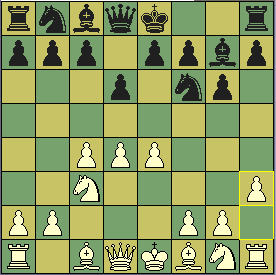
|
Consells
10 consells de'n Miguel Illescas
- controla tus nervios
- manten la concentracion
- gestiona bien el tiempo
- evita errores graves
El factor mas decisivo son los errores graves, no las aperturas ni la estrategia ni los finales.
- jaques y capturas
Repasa TODOS los jaques y capturas disponibles, tanto tuyos como del contrario.
- anticipate al rival
Antes de mover, trata de adivinar la respuesta del rival.
- juega de forma natural
Coloca tus piezas en posiciones activas, ocupa el centro, enroca rapido.
No inicies un ataque si no lo tienes claro. Haz las jugadas mas logicas.
- habla con tus piezas
Pregunta a cada pieza qué le gustaria hacer, a qué casilla querría ir.
Si no tienes un plan claro, mejora tu peor pieza o ataca la pieza mas avanzada del rival.
Haz que tus piezas trabajem en equipo.
- respeta al oponente
Levántate de la silla y mira el tablero con los ojos de tu rival.
Refuerza tus puntos vulnerables.
- disfruta de la partida
Intenta aprender de tus errores. Sé humilde pero optimista.
How to eliminare blunders
- warm up before the fame : tactical puzzles (simple ones), visualization (openings, your winning games)
- focus on chess, not on ELO or other : visualization
- avoid tactical openings (sharp positions) when your oponent is better prepared
- keep track of your opponent's plans - what's the last opponent's move and what's its idea ?
What is he going to do next ?
- anti-blunder check : before playing the chosen move, think "which forcing reply can my opponent play" ?
- grasp the initiative - defenders blunder more often
- when you are short of time, simplify the position and avoid tactical complications
- training : solve tactical puzzles from the other side - find your opponent's plan
part 1,
part 2
4 tips :
- be fresh - sleep well
- keep developing your pieces
- if you attack your opponent's queen, there is always a possibility for intermediate moves
- remove pieces from active positions only if they are threatened directly
- on the long run, giving up king's safe is always a bad idea
url
Els bons jugadors ...
- posen sempre les fitxes en quadres protegits per les seves peces - mai deixen una peça desprotegida
- milloren la seva posició amb petites amenaces directes
- mai canvien fitxes - aprofiten que l'altre ho fa per millorar la seva posició -
"To take is a mistake" (min 1:50)
- mai regalen ni un peó - si te'l ofereixen, és una trampa {dedicat a en Ramón}
Vocabulari internacional
- the word "gambit" was originally applied to chess openings
in 1561 by Spanish priest Rúy López de Segura,
from the Italian expression
dare il gambetto (to put a leg forward, i. e., to trip someone).
- fianchetto = Italian "little flanking"
- "j'adoube" per "composo"
- "en passant" o "en pris" pel "matar al pas"
- discovered check = jaque a la descubierta
- glossary of chess :
Zwischenzug - in between move.
Zugzwang - compulsion to move - squeeze, Trébuchet.
- Vocabulari, glossari :
french
5 idiomes.
Alfil : originàriament era un elefant, de fet el nom català prové de l'àrab "al fil", الفيل, «l'elefant»
in English of course it is a bishop, in Russian it is an elephant, in French a joker, in German a runner, and in Czech – an archer.
knight (vocabulari) - steed - corcel
La Dama simbolitza el primer ministre o un alt funcionari, per això és anomenada «emir» en el món àrab,
però convertit aquí en la dona del rei.
La figura representa una persona estilitzada, d'alçada gran, normalment amb diadema. Antigament rebia el nom d'«alferza».
wiki
- Rus :
- "greek gift" sacrifice with 14.Bxh7!
- Stalem o stalemate = ofegat !
Stalemate = пат
- Pin = "clavada"
- Skewer or thrust = clavada inversa
- Fork = forquilla o "doble"
- smothered mate
- a pawn on the sixth rank, with an opposing pawn in front of it is called a "thorn pawn", "fawn pawn", or "nail pawn".
Acudits
What is the worst chess joke of all time?
Garry Kasparov's Russian joke
In a park people come across a man playing chess against a dog.
They are astonished and say: "What a clever dog!"
But the man protests: "No, no, he isn't that clever. I'm leading by three games to one!"
Early traps
Fried Liver Attack in the Two Knights Defense.
The logical moves (1.e4 e5 2. Nf3 Nc6 3. Bc4 Nf6),
then my opponent jumped 4.Ng5 and I played 4...d5.
He captured and so did I (5.exd5 Nxd5),
then out of the blue came a thunderbolt (6.Nxf7!).
I don't remember the rest of the game, but my King got checkmated very quickly.
Solution : 5... Na5
Openings
Checklist: How To Learn Chess Openings
- ❑ Evaluate Your Playing Style
- ❑ Find Positions Which Suit You
- ❑ Play Sound Chess Openings
- ❑ Get An Overview
- ❑ Collect The Relevant Material
- ❑ Understand The Key Concepts
- ❑ Don't Play Too Many Openings
- ❑ Follow Opening Experts
- ❑ Check Critical Lines
- ❑ Test Your Openings
- ❑ Play Opening Tournaments
- ❑ Work With A Second
- ❑ Repair Your Lines
- ❑ Check For Opening Traps
- ❑ Don't Trust Chess Books Blindly
- ❑ Watch Chess videos
Finals
Lucena.
Patterns
- centralize your king
- create an outside passed pawn
- place rooks behind passed pawns
- whenever your opponent has a weak pawn, make it unmovable
Partides notables
- Kotov - Botvinnik : game
- Tal - Botvinnik, final 1960,
21 partides :
- Boris Gelfand squeezes Wang Yue into dust :
- Garry Kasparov vs Boris Gelfand 1993 Linares - Najdorf defense, Fischer attack :
- Tal es sempre espectacular :
Typical chess mistakes
Submitted by WGM Natalia_Pogonina
- playing without a plan
- underestimating opponent’s threats
- failing to convert a winning position due to loss of concentration
- giving up (or starting to play the game out without any interest) too early
- poor time management
The Theory of Steinitz
- at the beginning of the game the forces stand in equilibrium
- correct play on both sides maintains this equilibrium and leads to a drawn game
- therefore a player can win only as a consequence of an error made by the opponent - there is no such thing as a winning move
- as long as the equilibrium is maintained, an attack, however skillful, cannot succeed against correct defence - such a defence will eventually necessitate the withdrawal and regrouping of the attacking pieces and the attacker will then inevitably suffer disadvantage
- therefore a player should not attack until he already has an advantage, caused by the opponent's error, that justifies the decision to attack
- so, at the beginning of the game a player should not at once seek to attack.
Instead, he should seek to disturb the equilibrium in his favour by inducing the opponent to make an error - a preliminary before attacking
- when a sufficient advantage has been obtained, a player must attack or the advantage will be dissipated
From
Steinitz' Theory, British Chess Magazine Vol. 104, p.370 Sept 1984
Repertori consistent de obertures
From Jordi Bada channel :
- {minut 13} Pirc contra e4 i India de Rey contra d4
- {minut 14} Francesa contra e4 i Holandesa contra d4
Pero encara que les estructures de peces siguin similars, els plans i/o objectius de cada obertura son ben diferents.
Així, també ens cal un estudi dels plans de cada obertura.
Conceptes diferents
Explicitar diferencies :
- entre sicilianes :
- Najdorf Sicilian
- Sicilian Scheveningen
- Sicilian Paulsen
- Sicilian Taimanov
- Sicilian Richter Rauzer
- Sicilian Kan
- entre francesa i Caro-Kann - com recolzar d5
- francesa 1.e4 e6 2.d4 d5 - el peo de d5 es recolza amb e6
- Caro-Kann 1.e4 c6 2.d4 d5 - el peo de d5 es recolza amb c6
Sicilianes
Bronstein : "I tried to not make my position worse or, more importantly, tried not to make it better"
Llibres
Got :
- "My system", by Nimzowich.
{sagpdf}, 48 MB.
[es],
{sagpdf}, 8 MB.
djvu
- Watson
los secretos de la estrategia moderna (1998) {sagpdf}
- Reuben Fine (1949), "The Ideas Behind the Chess Openings" -
{sagpdf}, 9 MB
- Yasser Seirawan, "Winning Chess Openings" -
{sagpdf}, 9 MB
- Staunton, "The Blue Book of Chess" - here
or
{sagpdf}, 350 KB
- Capablanca, "Chess Fundamentals" - here
or
{sagpdf}, 12 MB
qualificat per Mikhaïl Botvínnik com "el millor llibre d'escacs mai escrit"
- Edward Lasker, "Chess Strategy" :
{sagpdf}
- Petrosian system against QID
- Modern Chess Openings - tinc el del 39 !!!
- Jesús de la Villa - 100 Endgames You Must Know -
{sagpdf},
[es] Los 100 finales que hay que saber -
{sagpdf}
- The Seeds of Tactical Destruction - Dan Heisman
- "The Art of Attack in Chess" by Vukovic (a classic!) -
here
or
my gDrive
or
{sagpdf}
- táctica : Kurt Richter, "Combinaciones en ajedrez"
{sagpdf}
+ gDrive -
Un tratado de la táctica del medio juego con 404 ejemplos prácticos
- Reuben Fine : "Basic Chess Endings" (1941) -
{sagpdf}, 29 MB
- "The Method in Chess", by Iossif Dorfman -
the real talent is the hability to work hard
- Part 1: The elements
- Part 2: King safety
- Part 3: Material correlation I
- Part 4: Material correlation II
- Part 5: Outposts
- Part 6: The static balance
- Part 7: Playing according to the balance
- Part 8: Which pawn structure to play for?
- Part 9: Static vs. dynamic play
- "Zurich 53" by Bronstein -
210 games -
got "david-bronstein-zurich-international-chess-tournament-1953.pdf".
La final Botvinnik - Smyslov (24 games)
- Entrenamiento de elite II - Yusupov i Dvoretsky
See my gDrive {j*ume.p*re.puny*tes@g*.com}
Llibres Jordi Bada
- Alekhine - mis mejores partidas
{sagpdf}
- Botvinnik - "estrategia I (1923-1941) II (1942-1956) i III (1957-1970)" - ISBN 978-84-92517-16-9
- Capablanca - lecciones elementales de ajedrez
{sagpdf} - iniciación al ajedrez
- Capablanca - fundamentos del ajedrez
{sagpdf}
- Nimzowich - mi sistema
{sagpdf}
- Mikhail Shereshevsky, "Endgame Strategy", 1985, ISBN = 0-08-029746-3
From
ch warez,
1 i
2 -
got it here, 5,75 GB
- 2 llibres JB - modern interpretation of 2 systems
- New Sicilian Dragon, The - Williams, Simon
- New Old Indian - Cherniaev, Alexander & Prokuronov, Eduard
- 20200127 : Ajedrez bajo la superficie, Jan Markos
- 20220215 : la idea en ajedrez, Sharjan Guliev {see c. Francisco Giner, 42. Lunes a Viernes 16-20 h.} - 20220331, SAG
Best ones
- easily the best reference is Mikhail Krasenkov's The Open Spanish, Cadogan 1995
{sagpdf}, 16 MB
- the best Schliemann reference, by far, is
V. L. Ivanov's and A. Kulagin's Play the Schliemann Defense, Olbrich 1994 {pend}
- best books on practical endgames ever written -- "Endgame Strategy" by Mikhail Shereshevsky
42 games {pend}
- if you wish to study openings in greater depth
- "Chess Openings For Juniors" by J. N. Walker is a very good introduction to opening play
- more advanced : Gabor Kallai's "Basic Chess Openings" and "More Basic Chess Openings"
- Caro Kann : "Práctica de ajedrez magistral", match Botvinnik- Tal, 1960, by Tal -
{sagpdf}
21 partides, pgn
Coneguts :
- M. Blokh, Combinational Motifs, ISBN 5900965325.
Exercicis :
{sagpdf} : 1 a 102 {20140815}
- "Manual de jugadores avanzados" de Miguel Suetin.
- "Winning Chess Tactics" by Seirawan & Silman
- Nigel Povah's "How to Play the English Opening" -
(pathtochessmastery)
- "Starting Out: The Caro-Kann" by Joe Gallagher -
(pathtochessmastery)
- Peter Romanovsky, "Middlegame Planning"
- Mihai Suba’s excellent book, "Dynamic Chess Strategy"
- otro libro interesante : "Chess: 5334 Problems, Combinations, and Games", 1994 ( ISBN 1884822312)
Laszlo Polgar.
Llibres
gratix (chesszone, DJVU format).
If you want more detailed works, you should check out:
- Dvoretsky’s endgame manual
- "Fundamental chess endings" by Muller and Lamprecht
- "Practical endgame play – beyond the basics" by Flear
- "Basic chess endings" by Fine
A couple of old but very fun easy to read endgame books are:
- "Practical endgame play" by Reinfeld
- "Capablanca’s best chess endings" by Chernev
If you are after a more thinking man’s approach to the endgame:
- The classic "Endgame strategy" by Mikhail Shereshevsky is highly recommended.
- "Chess endgame lessons" (books 1 & 2) by Benko are great, but very hard to find.
- "Technique for the tournament player" by Dvoretsky and Yusupov is excellent, but advanced.
If you want to study specific areas of the endgame:
Any from the old (but wonderful) Averbakh series are great
(ROOK v. MINOR PIECE ENDINGS, PAWN ENDINGS, QUEEN AND PAWN ENDINGS, BISHOP ENDINGS, QUEEN v. ROOK/MINOR PIECE ENDINGS, KNIGHT ENDINGS, etc.),
and John Emms’ the SURVIVAL GUIDE TO ROOK ENDINGS is also high on every list.
Finally we come to "The final countdown" by Hajenius and Van Riemskijk.
I love the title, but I think it was a bad marketing ploy since most people likely thought it was an end of the world thriller.
In reality, it’s all about King and pawn endgames.
For the most part it’s quite advanced, and the many tiny numbers and symbols on various squares (key squares) can be quite daunting.
However, it’s a delight to read and is one of my favorite books.
Russian system for training children.
I would highly recommend Lev Alburt's series, The Comprehensive Chess Course series.
The first two volumes, Comprehensive Chess Course Vol 1 and Volume 2, deal with the basics.
ICC
Every Russian Schoolboy Knows (video),
as Alex Yermolinsky learned
Willy Hendriks
- cómo he podido hacer semejante jugada ?
- no evaluamos primero la posición y después buscamos jugadas - todo sucede al mismo tiempo
- Capablanca : si usted ve una buena jugada, hágala !
If you see a good move, sit on your hands: you'll find a better one - E. Lasker
- somos en gran medida dependientes de alguna suerte de generador de jugadas que claramente no forma parte de nuestro proceso de pensamiento consciente
Videos
106 Seirewan at Saint Louis Chess Club
Mark Dvoretsky said "if you see no clear plan, try at least to improve the worst piece you have"
Temes pendents
Lliçons d'escacs
- como crear un peon pasado
- ataque al enroque
- como hacer "mate"
- 13 mates que debes
conocer
- 2 piezas mayores en el ultimo rango
- 2 peones
- octava fila
- en diagonal (alfil i dama)
- rey inmovilizado
- alfil y caballo contra fianchetto
- Anastasia (caballo y torre)
- dos alfiles
- alfil y dama en clavada
- alfil y dama contra fianchetto
- torre y dama en columna abierta
- rey y dama
- torre y alfil (mate de Morphy)
Drills
Creating a passed pawn
Keres:
prepare for the possible assault of your opponent the best way you can,
and then do nothing since you cannot possibly improve the best defensive formation that you've already created
Frases
- Chess, like love and music, has the power to make people happy - Tarrasch
- When you don't see good moves, you start playing bad moves
- "Yet to calculate is not in itself to analyze.
A chess-player, for example, does the one without effort at the other.
It follows that the game of chess, in its effects upon mental character, is greatly misunderstood.
I am not now writing a treatise, but simply prefacing a somewhat peculiar narrative by observations very much at random;
I will, therefore, take occasion to assert that the higher powers of the reflective intellect are more decidedly
and more usefully tasked by the unostentatious game of draughts
than by all the elaborate frivolity of chess.
In this latter, where the pieces have different and bizarre motions, with various and variable values,
what is only complex is mistaken (a not unusual error) for what is profound.
The attention is here called powerfully into play.
If it flag for an instant, an oversight is committed, resulting in injury or defeat.
The possible moves being not only manifold but involute, the chances of such oversights are multiplied;
and in nine cases out of ten it is the more concentrative rather than the more acute player who conquers."
An excerpt from "Murders in the Rue Morgue" by Edgar Allan Poe.
ThinkChess (soft)
- patzer - a poor or amateurish chess player
- Els escacs son un joc per la seva forma, un art pel seu contingut i una ciència per la seva dificultat - T. Petrosian
- Winning isn't everything; a good game is. [TRP40@RHP]
- "Chess is a sea in which a gnats may drink and an elephants may bathe" - indian proverb, from mr
Zug - (gnat = mosquit, mosca petita)
- el talento tiene una ventaja: el derecho a trabajar más duro que los demás
- Never meet a threat with a threat = nunca respondas a una amenaza con una amenaza
- cuidado despues de cometer un error : estas a punto de cometer otro
How the team would celebrate: there will probably be some imbibing of liquids at some point.
Tools
PGN - format, viewers, etc
Per poder fer "Paste" en un viewer on-line, la partida ha de estar escrita en anglès !
Full PGN headers :
[Event "Open de Sants"]
[EventDate "2016.08.19"]
[Site "Cotxeres de Sants"]
[Date "2016.08.19"]
[Round "1"]
[White "Enric Menendez Cabrera"]
[Black "Sebastia Altemir"]
[Result "1/2-1/2"]
[ECO "A85"]
[WhiteElo "1801"]
[BlackElo "1687"]
[PlyCount "14"]
1. e4 e6 2. d4 d5 3. Nd2 Nf6 4. e5 Nfd7 5. Ngf3 {un comentari
en dues linies, referit a la jugada seguent} c5 6. c3 Nc6 7. Be2 cxd4
PGN viewers :
PGN tools
guidous PGN tools
at C:\sebas\miscosas\escacs\eines\pgn-extract we have :
PGN
extractor :
pgn-extract.exe -r JB_326_partides.pgn - verificar fitxer
pgn-extract.exe -ttags.txt JB_326_partides.pgn -o a90.pgn - extract ECO "A90" games into A90.pgn file
"tags.txt" conte
ECO "A90"
pgn-extract.exe -ttags.txt JB_326_partides.pgn -o jba90blk.pgn - extract ECO "A90" games with JB jugant amb negres
"tags.txt" conte
ECO "A90"
Black "Jordi Bada"
pgn-extract.exe -ttags.txt JB_326_partides.pgn -o jb-all.pgn - extract all JB games into jb-all.pgn file
"tags.txt" conte
Player "Jordi Bada"
pgn-extract.exe -#1 JB_326_partides.pgn - split file into individual games
%myPROG% %IFN% -Tp"Travesset Ribera, Joaquim" -o .\F2.pgn -L%LOG% - get Joaquim's games into F2
Linux PGN tools
PGN player on line
Tactics trainer / puzzles
GMs personal pages
Tahl's 10 best sacrifices
youtube
7 +
3
Fa un enroc llarg super-rapid,
Tahl vs Koblents 1957 :
1.e4 c5 2.Nf3 d6 3.d4 cxd4 4.Nxd4 Nf6 5.Nc3 Nc6 6.Bg5 e6 7.Qd2 Be7 8.O-O-O O-O 9.Nb3 Qb6
10.f3 a6 11.g4 Rd8 12.Be3 Qc7 13.h4 b5 14.g5 Nd7 15.g6 hxg6 16.h5 gxh5 17.Rxh5 Nf6 18.Rh1 d5 19.e5 Nxe5
20.Bf4 Bd6 21.Qh2 Kf8 22.Qh8+ Ng8 23.Rh7 f5 24.Bh6 Rd7 25.Bxb5 Rf7 26.Rg1 Ra7 27.Nd4 Ng4 28.fxg4 Be5 29.Nc6 Bxc3
30.Be3 d4 31.Rgh1 Rd7 32.Bg5 axb5 33.R1h6 d3 34.bxc3 d2+ 35.Kd1 Qxc6 36.Rf6+ Rf7 37.Qxg7+ 1-0
Tambe a Tahl vs Koblents 1961 :
1.e4 c5 2.Nf3 d6 3.d4 cxd4 4.Nxd4 Nf6 5.Nc3 a6 6.Bg5 e6 7.f4 Be7 8.Qf3 Qc7 9.O-O-O Nbd7
10.Be2 h6 11.Bh4 b5 12.e5 Bb7 13.exf6 Bxf3 14.Bxf3 d5 15.Nxe6 fxe6 16.Bh5+ g6 17.Bxg6+ Kf8 18.fxe7+ Kg7 19.Bg3 Nf6
20.Rhe1 b4 21.Rxe6 bxc3 22.f5 Qb7 23.b3 Qd7 24.Be5 Qxe6 25.fxe6 Kxg6 26.Rf1 Nh7 27.Bxh8 Rxh8 28.Rf8 Rxf8 29.exf8=Q Nxf8
30.e7 Kf7 31.exf8=Q+ Kxf8 32.Kd1 1-0
Remembering Vugar Gashimov, 1986 – 2014. By Elisabeth W.
Vugar is among the most wonderful people I ever had the pleasure to meet.
The strong emotional bond we developed transformed quickly into a deep love, we were not only a couple, but also best friends.
To this day all I know about chess are the basic rules, and I haven't yet played in a proper game of chess.
Chess never played a preeminent role in our relationship, yet Vugar's successes and his Elo rating bear testimony to his outstanding talent for the game.
Being a layperson in this area myself, I could neither assess the course of chess tournaments, nor their results, like a professional player might have been able to.
I was always very proud of Vugar's talent and abilities in this field, but more than that I saw his other positive traits, which were even greater than every single brilliant chess game he played.
Vugar was a level-headed person who always put more emphasis on the well-being of others than his own.
He was a person with a great sense of beauty and aesthetics, a person, who could find joy in the simple things of life – always with a smile on his face.
For him, happiness meant making other people happy.
Vugar was a thoughtful person with a lot of interests: he was a person with an affinity for everything cultural, he composed poems and loved philosophizing about life, listening to music for hours on end, interpreting song lyrics, telling anecdotes, and playing tennis and FIFA on his computer.
A few weeks before he was diagnosed with having a "recurrent, malignant brain tumor" he made a dream of his come true: he learned to play the piano.
Since then he played the piece "River flows in you", which he was able to learn in this short amount of time, for me on several occasions.
My joy and enthusiasm turned into a state of shock very quickly after learning about his diagnose, and only Vugar's fighting spirit and optimism could alleviate this.
Even at times when Vugar was burdened mentally or physically he offered me a shoulder to lean on.
I remember well when he was about to go into surgery at the hospital in Bonn: he had a smile on his face.
Two days later, when he returned from the ICU to his room, same thing: he had a smile on his face.
One can very well describe Vugar's nature with words like humor, vitality and openness, and that is exactly how he will remain in my memory.
Vugar, I have never loved a man as much as I have loved you.
Thank you for the countless, wonderful moments, that I had the honor to share with you.
You will always be with me in my heart, accompanying me every step of the way, and my memories of you will brighten my days and give me courage.
Vugar, you were an amazing person! Thank you.
url
Articles, llibres, revistes, clubs, etc
Saps que el rellotge va ... a la dreta del jugador amb fitxes negres ?
Llocs on jugar o mirar
- ChessTempo : dedicated to helping chess players improve their game.
Exercicis
tactics,
finals !
u(dimoni/sag$5)
- chess 24 - site with nice
videos,
by
Lawrence Trent, good comentarist.
Watch few
games (1h)
Carlsen Giri,
o
Caruana Carlsen;
RSS;
Pepe Cuenca i el peó "facundo";
neveres
Pepe Cuenca en la Copa Dicharachera 2018 :
un francesa amb enroc llarg {minut 6}
It uses
HTML5 canvas fingerprinting
instead of cookies to identify users
- Chess.com [535.505 users, 03/09] :
Explorer
+
Openings
+
delete account.
[/]
En
Dretch
destrossa en
GM
Joey {*** partides increibles ***} -
També en
MinhGTrAn (VietNam)
Un altre vietnamita :
Minh Le
i en
Hiraku
En
Anton Demchenko guanya en Minh.
Blitz Meister apallissa
Genghis Khan.
Eric
Hansen és apallissat per en Joey !
LexySexy es en
Baadur Jobava,
and this is what he does against a "boring"
CaroKann :
1. e4 c6 2. d4 d5 3. Nd2 de4 4. Ne4 Bf5 5. Ng3 Bg6 6. h4 h6 7. Nf3 Nd7 8. h5 Bh7 9. Bd3 Bd3 10. Qd3 Ngf6
11. Bd2 e6 12. 0-0-0 Be7 13. Qe2 0-0 14. Kb1 c5 15. d5 ed5 16. Bh6 gh6 17. Nf5 Re8 18. Nh6 Kf8 19. Ng5 Qb6 20. Qf3 Ne5
21. Qg3 Bd6 22. Nf5 Qb2 23. Kb2 Nc4 24. Kb3 Bg3 25. h6 Na5 26. Ka4 b5 27. Ka5 Bc7 28. Kb5 Rab8 29. Ka4 Ne4 30. Rd5 Nc3
31. Ka3 Nb5 32. Kb2 Nd4 33. Kc3 Nb5 34. Kd3
Lukasz Licznerski,
gran lluita amb en
Tamir Nabaty, gran fera atacant !
La
bestia tambe te nivell.
El Lovlas es un mestre, i tambe destrossa en Joey.
Nakamura,
David Smerdon,
GM Francisco Vallejo Pons
Timur
Gareev.
Yaacovn,
homepage.
Titas Stremavicius,
- Red Hot Pawn [185.680 jugadors (31/12/2006)]
Flag index.
Blitz requires "Port 1935 must be open".
- GameKnot [861.992 users, 03/09]
{opening display}
- ChessColony ! [671.000 registered players]
Bon programa per jugar
Man vs Computer ...
- Play Chess.de {rakitik},
- Chess live {m.edra},
- Chess Corner ! [62.384 members]
- Lets Play Chess [450.000 members, mal lloc]
- Chess World ! [ IE only ]
lichess
lichess homepage,
uTube channel
- API with NJS sample !
bot
oAuth token for personal API
- hacked source code ->
github :
Lichess is written in Scala 2.13, and relies on the Play 2.8 framework.
scalatags is used for templating.
Pure chess logic is contained in the scalachess submodule.
The server is fully asynchronous, making heavy use of Scala Futures and Akka streams.
WebSocket connections are handled by a separate server that communicates using redis.
Lichess talks to Stockfish deployed in an AI cluster of donated servers.
It uses MongoDB to store more than 1.7 billion games, which are indexed by elasticsearch.
HTTP requests and WebSocket connections can be proxied by nginx.
The web client is written in TypeScript and snabbdom, using Sass to generate CSS.
The blog uses a free open content plan from prismic.io.
All rated games are published in a free PGN database.
Browser testing done with Browserstack.
Proxy detection done with IP2Proxy database.
April fools! Lichess wasn't "hacked" but we do make all our source code available for everyone, and we always have.
- companys de SB :
- GM Joey {closed 202205},
wiki ,
chessgames (341 games)
- Magnus Carlsen
- Svidler
- Andrew Tang
- Minh Le,
Brandon Jacobson,
Dmitry Andreikin
- Eric Rosen,
Knight and Bishop and Pawn better that Queen
- Igor Kovalenko ,
111 del mon
Play against computer
Candidats i campions
El mag de Riga
Tal had the congenital deformity of ectrodactyly in his right hand. Despite this, he was a skilled piano player.
From BCN 1992
all 1992 games, as winning Kasparov (by time) !
La seva darrera partida -
visor :
Tahl, Mikhail - Lautier, Joel ; Barcelona, 1992
1.d4 Cf6 2.Cf3 e6 3.g3 b5 4.Ag2 Ab7 5.0–0 c5 6.Ag5 Db6 7.a4 a6 8.Cc3 Ce4 9.Cxe4 Axe4 10.axb5 Dxb5
11.Dd2 f6 12.Af4 Db7 13.c4 cxd4 14.Dxd4 e5 15.Axe5 fxe5 16.Dxe5+ Ae7 17.Cd4 Axg2 18.Cf5 Db4 19.Rxg2 Cc6 20.Dxg7 0–0–0
21.Txa6 Db7 22.Tfa1 Cb4+ 23.Rg1 Cxa6 24.Dxe7 Db6 25.Da3 Thf8
26.Cd6+ Rc7 27.Dxa6 Ta8 28.Dxb6+ Rxb6 29.Td1 Ta2 30.Td2 Rc6
31.f3 Tfa8 32.Cb5 T8a4 33.Tc2 Rc5 34.Cc3 Ta1+ 35.Rf2 Txc4 36.Td2 Ta7 37.e4 Rc6 38.Re3 Tb7 39.Tc2 d6 40.Rd3 Tc5
41.f4 Tb4 42.g4 Rd7 43.g5 Re6 44.h4 d5 45.Cxd5 Txc2 46.Cxb4 Txb2 47.Cc2 Tb3+ 48.Rc4 Th3 49.Cd4+ Rf7 50.f5 Txh4
51.Rd5 Tg4 52.Cf3 Tg3 53.Ce5+ Rg8 54.f6 Txg5 55.Re6 Tg1 56.f7+ Rg7 57.Cd7 Tf1 58.f8=D+ Txf8 59.Cxf8 h6 60.Cd7 h5
61.Ce5 h4 62.Cf3 1–0
En rus, Barcelona 92 :
Михаил ТАЛЬ - Владимир АКОПЯН - Барселона, 1992 - Сицилианская защита
1.e4 c5 Ну естественно. Не играть же 1...е5 отказавшись от ничьей.
2.Nf3 Nc6 3.Bb5 d6 4.0–0 Bd7 5.Re1 Nf6 6.c3 a6
7.Ba4 c4
Сейчас это продолжение переживает не лучшие времена из-за 8.Bc2 c последующим b3, но тогда это ещё не было достоянием общественности.
8.d4 cxd3
9.Bg5 e6
В третьей партии финального матча в Лас-Вегасе, 1999 Халифман избрал со мной 9...Ne5 10.Nbd2! Bxa4 11.Qxa4+ b5 12.Qd4,
и белые завладели инициативой, но возможно простое 10...е6.
10.Qxd3 Be7 11.Bxf6
В Вейк-ан–Зее, 1993 Нийбоер продолжал 11.Nbd2, и здесь вместо 11...Ne5 12.Nxe5 Bxa4 13.Nec4!,
после чего я столкнулся с трудностями, следовало ответить незатейливо 11...Qc7. Ход в тексте более прямолинеен.
11...gxf6 12.Bxc6 Bxc6 13.c4 0–0 14.Nc3 Kh8
Приступая к фланговой диверсии.
Объективно, возможно, на стороне белых некоторый перевес, но я был доволен своей позицией и уповал на силу слонов.
15.Rad1 Rg8 16.Qe3 Qf8 17.Nd4
В этот момент Таль сказал: "Моё предложение остается в силе", но хотя на доске сложное положение,
я получил то, что хотел - игровую позицию со взаимными шансами, и потому ответил отказом.
17...Rc8 18.f4?
Видимо, мой отказ подействовал на Таля,
иначе вместо этого азартного хода он бы избрал простое 18.Nxc6 Rxc6 19.b3 c прекрасной игрой.
18...Bd7 19.b3 Bd8!
Постепенно слоны становятся активными, и белым надо проявлять осторожность.
20.Nf3?
После этого позиция белых начинает быстро деградировать. Следовало продолжать 20.Kh1, кое-как поддерживая равновесие.
20...b5! 21.Qa7
Это вторжение абсолютно безвредно, но и при 21.е5 fxe5 22.fxe5 bxc4 слоны вскрывались, и белым становилось туго.
21...Bc7?!
Сложный ход. Куда проще было, как я и собирался вначале продолжать 21... Ba5
22.Qxd7
(сразу проигрывает 22.Rd3 Qd8 23.Qxa6 Bb6+ 24.Kh1 Ra8 25.Qb7 Ra7 с ловлей ферзя)
22...Bxc3 23.Re3 (плохо 23.Re2 d5!, и нельзя брать пешку из-за 24...Qc5+ и 25...Rc7, снова пленяя заблудшего ферзя)
23...Bb4 с огромным перевесом.
22.Qxa6 Видимо, Таль махнул рукой на партию.
На самом деле после моей неточности на предыдущем ходу профилактическое 22.Kh1! оставляло ситуацию на доске далеко неясной.
22...bxc4
23.b4 Это легко критиковать, но и после 23.bхc4 Qh6 белым дорог хороший совет.
После хода в тексте у меня от выигрывающих продолжений разбежались глаза.
Действительно, и 23...d5, и 23...f5, и 23...Qh6 оставляют позицию белых в руинах,
но и прямолинейный ход в партии отнюдь не плох.
23...Qg7 24.g3 d5 25.exd5 Bxf4 26.Kf2
26...f5?? Ума не приложу, как такой ход пришёл мне в голову.
Явное нарушение правил шахматного движения - отдать чернопольного слона, попутно ослабив чёрные поля.
На деле всё очень просто: мне показалось взятие слона невозможным из-за мата на g2.
Иначе трудно не пойти 26...exd5 27.Nxd5
(теперь 27.gxf3 действительно ведёт к разгрому после 27...Qg2+ 28.Ke3 Rge8+)
27...Bxg3+ 28.hxg3 Qxg3+ 29.Ke3 Rc6, и занавес.
Сильно и 26...Bxg3+ 27.hxg3 Qxg3+ 28.Ke3 Ra8 29.Qxc4 Rgc8, а также 26...e5 - везде со страшной атакой.
Уверен, что сам Михаил Нехемьевич разобрался бы с позицией белых в несколько ходов.
27.gxf4 Qxc3 28.Qd6! Чего-чего, а находчивости Михаилу Нехемьевичу не занимать!
Мгновенно оценив обстановку, он возвращает в игру ферзя, и возвращается сам.
28...Ba4 29.Rd4! Rg7?
Чувствуя, что поплыл ("мат на g2!"), сделав этот ход, я предложил ничью.
Вам легко разобраться, уважаемый читатель, что позиция чёрных сейчас проиграна?
Она действительно проиграна после сделанного хода, но мне лично это стало ясно только после 32-го хода Таля.
Я считал, что 30.dxe6 невозможно из-за продолжения в партии, а если так, то ситуация по меньшей мере неясна.
Следовало поставить ладью на клетку дальше - 29...Rg6!, и партия могла завершиться такой красивой ничьей:
30.dxe6 Rcg8 31.Ng5 f6 32.Nf7+ Kg7 33.Ng5! (единственное; проигрывает 33.Re3 Rg2+ 34.Kxg2 Qxe3)
33...Kh8! (тоже единственное, ибо нельзя 33...fxg5 34.Qe5+ Kh6 35.fxg5+ Kh5 36.Rh4+! с выигрышем ферзя как в партии)
34.Nf7+ c повторением ходов.
Недурно было и 29...Qb2+ 30.Rd2 Qf6 со сложной позицией динамического равновесия.
Таким образом, явное передёргивание в реплике Сосонко очевидно.
30.dxe6! Со словами: "А теперь я хочу поиграть!"
30...Bc6 31.Ng5
Разумеется, не 31.Re3 Rg2+ 32.Kxg2 Qxe3 33.Qe5+ Qxe5 34.fxe5 fxe6, но Таль уже все посчитал.
31...Rxg5 Здесь уже всё плохо, но я считал, что Таль просто зевнул мат...
32.Qe5+! Конечно, не 32.fxg5 Qf3+. Теперь всё ясно.
Здесь уже нужно было сдаться, но ошарашенный такой быстрой переменой, я сделал ещё несколько необязательных ходов.
32...Rg7 33.Rd8+ Rxd8 34.Qxc3 f6 35.e7 Ra8 36.Qxf6 Be4 37.Rg1 Rxa2+ 38.Ke1. Чёрные сдались.
You can watch it here
notable games
- Tal vs. Alexander Tolush, USSR Championship, Moscow 1957, King's Indian Defence, Sämisch Variation (E81)
- Boris Spassky vs. Tal, USSR Championship, Riga 1958, Nimzo-Indian Defence, Sämisch Variation (E26)
- Tal vs. Vasily Smyslov, Yugoslavia Candidates' Tournament 1959, Caro–Kann Defence (B10)
- Robert James Fischer vs. Tal, Belgrade, Candidates' Tournament 1959, Sicilian Defence, Fischer–Sozin Attack (B87)
- Mikhail Botvinnik vs. Tal, World Championship Match, Moscow 1960, 6th game, King's Indian Defence, Fianchetto Variation, Classical Main line (E69)
- István Bilek vs. Tal, Moscow 1967, King's Indian Attack, Spassky Variation (A05)
- Boris Spassky vs. Tal, Tallinn tt 1973, Nimzo-Indian Defence, Leningrad Variation (E30)
- Tal vs. Tigran Petrosian, 8th Soviet Team Cup, Moscow 1974, rd 5, Pirc Defence, Classical System, (B08)
K vs K
1984-85,
WCC index - notable games :
2013
In 2013 the candidates were :

Magnus Carlsen
|
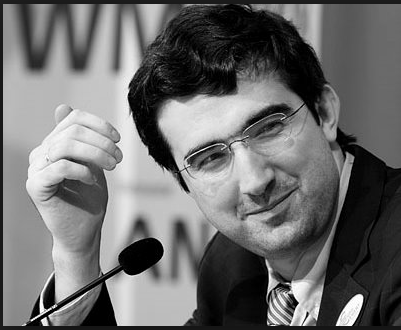
Vladimir Kramnik
|
Levon Aronian
|
Teimour Radjabov
|
Alexander Grischuk
|
Vasily Ivanchuk
|
Peter Svidler
|
Boris Gelfand
|
Carlsen vs Anand, del 9 al 22 de Novembre de 2013
wikipedia : 6 ½ / 3 ½
chesspro.ru
Carlsen vs Anand, del 7 al 28 de Novembre de 2014
wikipedia : 6 ½ / 4 ½
chesspro.ru
Carlsen vs Karjakin, del 11 al 30 de noviembre de 2016
wikipedia : 6/6 with 1 win each, then 1/3 on rapid chess
chesspro.ru
Read ajedrez21 blog,
read chessgames :
see 16 games+,
go wiki
Victories :
- C-K, 0-1 - D05 Rubinstein opening
- C-K, 1-0 - C65 spanish game, Berlin defense, "Turkey Grinder"
- K-C, 0-1 - rapides, C78 spanish game, Martinez variation
- C-K, 1-0 - rapides, B54 Sicilian defense, Prins variation, "Navigating the Rapids", 50.Dh6+ !!
Candidats Berlin 2018
Here is what they got :
(1)
GM Kramnik, V. (0) 2800 1 - 0 GM Grischuk, A. (0) 2767 *** A48 King's Indian Defence /c2-c4
GM Karjakin, S. (0) 2763 0 - 1 GM Mamedyarov (0) 2809 *** C60 Ruy Lopez [1]
GM Aronian, L. (0) 2794 ½ - ½ GM Ding, Liren (0) 2769 A18 English Opening
GM Caruana, F. (0) 2784 1 - 0 GM So, Wesley (0) 2799 *** E07 Catalan [1]
(2)
GM Grischuk, A. (0) 2767 1 - 0 GM So, Wesley (0) 2799 *** C84 Ruy Lopez Centre Attack [2]
GM Ding, Liren (½) 2769 ½ - ½ GM Caruana, F. (1) 2784 E06 Catalan [2]
GM Mamedyarov (1) 2809 ½ - ½ GM Aronian, L. (½) 2794 E32 Nimzo Indian 4.Qc2
GM Kramnik, V. (1) 2800 ½ - ½ GM Karjakin, S. (0) 2763 C67 Ruy Lopez Berlin [3]
(3)
GM Karjakin, S. (½) 2763 ½ - ½ GM Grischuk, A. (1) 2767 C50 Giuoco Piano
GM Aronian, L. (1) 2794 0 - 1 GM Kramnik, V. (1½) 2800 *** C65 Ruy Lopez Berlin [4]
GM Caruana, F. (1½) 2784 ½ - ½ GM Mamedyarov (1½) 2809 B90 Sicilian Najdorf Variation
GM So, Wesley (0) 2799 ½ - ½ GM Ding, Liren (1) 2769 C89 Ruy Lopez Marshall [5]
(4)
GM Grischuk, A. (1½) 2767 ½ - ½ GM Ding, Liren (1½) 2769 D43 Anti-Meran Gambit
GM Mamedyarov (2) 2809 ½ - ½ GM So, Wesley (½) 2799 E37 Nimzo Indian 4.Qc2
GM Kramnik, V. (2½) 2800 0 - 1 GM Caruana, F. (2) 2784 *** C42 Petroff's Defence (1/3 by Caruana)
GM Karjakin, S. (1) 2763 0 - 1 GM Aronian, L. (1) 2794 *** D39 QGD Ragozin
(5)
GM Aronian, L. (2) 2794 ½ - ½ GM Grischuk, A. (2) 2767 E60 King's Indian without Nc3
GM Caruana, F. (3) 2784 ½ - ½ GM Karjakin, S. (1) 2763 E06 Catalan [3]
GM So, Wesley (1) 2799 ½ - ½ GM Kramnik, V. (2½) 2800 D41 Semi-Tarrasch Defence
GM Ding, Liren (2) 2769 ½ - ½ GM Mamedyarov (2½) 2809 E06 Catalan [4]
(6)
GM Caruana, F. (3½) 2784 ½ - ½ GM Grischuk, A. (2½) 2767 E60 King's Indian without Nc3
GM So, Wesley (1½) 2799 1 - 0 GM Aronian, L. (2½) 2794 *** C88 Ruy Lopez Closed [6]
GM Ding, Liren (2½) 2769 ½ - ½ GM Karjakin, S. (1½) 2763 D73 Gruenfeld 3.g3
GM Mamedyarov (3) 2809 1 - 0 GM Kramnik, V. (3) 2800 *** D35 QGD Exchange
(7)
GM Grischuk, A. (3) 2767 ½ - ½ GM Mamedyarov (4) 2809 D38 QGD Ragozin
GM Kramnik, V. (3) 2800 ½ - ½ GM Ding, Liren (3) 2769 A28 English Four Knights
GM Karjakin, S. (2) 2763 1 - 0 GM So, Wesley (2½) 2799 *** E51 Nimzo Indian
GM Aronian, L. (2½) 2794 0 - 1 GM Caruana, F. (4) 2784 *** D37 QGD 5.Bf4
(8)
GM Grischuk, A. (3½) 2767 1 - 0 GM Kramnik, V. (3½) 2800 *** D40 Semi-Tarrasch Defence
GM Mamedyarov (4½) 2809 ½ - ½ GM Karjakin, S. (3) 2763 E06 Catalan [5]
GM Ding, Liren (3½) 2769 ½ - ½ GM Aronian, L. (2½) 2794 A13 Reti Opening
GM So, Wesley (2½) 2799 ½ - ½ GM Caruana, F. (5) 2784 C42 Petroff's Defence {Caruana uses it again 2/3}
(9)
GM So, Wesley (3) 2799 ½ - ½ GM Grischuk, A. (4½) 2767 C67 Ruy Lopez Berlin [7]
GM Caruana, F. (5½) 2784 ½ - ½ GM Ding, Liren (4) 2769 E00 Catalan [6]
GM Aronian, L. (3) 2794 ½ - ½ GM Mamedyarov (5) 2809 E06 Catalan [7]
GM Karjakin, S. (3½) 2763 1 - 0 GM Kramnik, V. (3½) 2800 *** D35 QGD Exchange {Kramnik loses again}
(10)
GM Grischuk, A. (5) 2767 ½ - ½ GM Karjakin, S. (4½) 2763 E00 Catalan [8]
GM Kramnik, V. (3½) 2800 1 - 0 GM Aronian, L. (3½) 2794 *** C50 Giuoco Piano {Kramnik guanya Aronian de nou}
GM Mamedyarov (5½) 2809 ½ - ½ GM Caruana, F. (6) 2784 E04 Catalan [9]
GM Ding, Liren (4½) 2769 ½ - ½ GM So, Wesley (3½) 2799 D37 QGD 5.Bf4
(11)
GM Ding, Liren (5) 2769 ½ - ½ GM Grischuk, A. (5½) 2767 A35 English Symmetrical
GM So, Wesley (4) 2799 ½ - ½ GM Mamedyarov (6) 2809 E06 Catalan [10]
GM Caruana, F. (6½) 2784 ½ - ½ GM Kramnik, V. (4½) 2800 D31 Semi-Slav Defence
GM Aronian, L. (3½) 2794 0 - 1 GM Karjakin, S. (5) 2763 *** A13 Reti Opening
(12)
GM Grischuk, A. (6) 2767 ½ - ½ GM Aronian, L. (3½) 2794 C88 Ruy Lopez Closed [8]
GM Karjakin, S. (6) 2763 1 - 0 GM Caruana, F. (7) 2784 *** C42 Petroff's Defence {3/3 by Caruana} - Svidler's
analysis - alfil per torre ... i guanya
GM Kramnik, V. (5) 2800 ½ - ½ GM So, Wesley (4½) 2799 D31 Semi-Slav Defence
GM Mamedyarov (6½) 2809 0 - 1 GM Ding, Liren (5½) 2769 *** D41 Semi-Tarrasch Defence
(13)
GM Mamedyarov (6½) 2809 1 - 0 GM Grischuk, A. (6½) 2767 *** D77 Gruenfeld 3.g3
GM Ding, Liren (6½) 2769 ½ - ½ GM Kramnik, V. (5½) 2800 A13 Reti Opening
GM So, Wesley (5) 2799 ½ - ½ GM Karjakin, S. (7) 2763 E37 Nimzo Indian 4.Qc2
GM Caruana, F. (7) 2784 1 - 0 GM Aronian, L. (4) 2794 *** C88 Ruy Lopez Closed [9] -
Svidler
(14)
GM Grischuk, A. (6½) 2767 0 - 1 GM Caruana, F. (8) 2784 *** C43 Petroff's Defence
GM Aronian, L. (4) 2794 ½ - ½ GM So, Wesley (5½) 2799 A30 English Symmetrical
GM Karjakin, S. (7½) 2763 ½ - ½ GM Ding, Liren (7) 2769 C84 Ruy Lopez Centre Attack [9]
GM Kramnik, V. (6) 2800 ½ - ½ GM Mamedyarov (7½) 2809 E06 Catalan [10]
Hunon Chess amb noms de obertures, get
wchcand18.pgn
live.chessbase.com - totes les partides comentades - get "all.pgn"
chess 24
Chess Games
Campionat Mundial Londres 2018
wiki,
World Chess ,
Hunonchess,
Chess Games,
chess.com
Carlsen vs Caruana, 2018
wikipedia : 6/6 by 12 draws, then 3/0 on rapid-chess
chesspro.ru
Candidats 2020, Ekaterinburg
chess.com, tot
Rd 5, Nepomniachtchi vs Hao :
Petrov
Carlsen vs Nepomniachtchi, 2021
Se disputará entre el 24 de noviembre y el 16 de diciembre de 2021,
en Dubai, Emiratos Árabes Unidos.
- chess.com amb comentaris [en]
- directe chesspro.ru [ru] : tauler amb comentaris escrits -
1a ,
9a
- watch chess24 , tauler
(1) +
Pepe Cuenca (PC) ;
(2) +
PC ;
chess FM Illescas ;
(3) +
PC ;
(4) ,
(5) ,
(6) ,
(7) ,
(8) ,
(9) ,
9th game press conf ,
(10) ,
(11)
- FIDE official site
(1) NvC 1.e4 e5 ; spanish ; 2T/2C/5p - 2T/2C/5p (=) [½-½]
(2) CvN 1.d4 Cf6 ; catalana ; 1T/2p - 1T/2p (=) [1-1]
(3) NvC 1.e4 e5 ; spanish ; 1A/5p - 1A/5p (=) [1½-1½]
(4) CvN 1.e4 e5 ; petroff ; 2T/1C/5p - 2T/1C/5p (=) [2-2]
(5) NvC 1.e4 e5 ; spanish ; 1A/1C/5p - 1A/1C/5p (=) [2½-2½]
(6) CvN 1.d4 Cf6 ; ; 1T/1C/2p - 1D (1-0) [3½-2½]
(7) NvC 1.e4 e5 ; spanish ; 1T/3p - 1T/3p (=) [4-3]
(8) CvN 1.e4 e5 ; petroff ; 1D/4p - 1D/1p (1-0) [5-3]
(9) NvC 1.c4 e6 ; english ; 1T/1C/4p - 1T/1C/1A/4p (0-1) [6-3]
(10) CvN 1.e4 e5 ; petroff ; 1C/4p - 1C/4p (=) [6½-3½]
(11) NvC 1.e4 e5 ; italian ; 1T/3p - 1D/2p (0-1) [7½-3½]
Candidats 2022, Madrid
wiki
chess24
Comentari 1a ronda,
ronda 4
chess24,
lichess
partida entre Polgar (blancas) y Carlsen (negras)
Defensa siciliana, variante Taimanov
1. e4 c5 2. Nf3 e6 3. d4 cxd4 4. Nxd4 Nc6 5. Nc3 a6 6. Be3 Qc7
7. Qd2 Nf6 8. f3 Be7 9. O-O-O b5 10. g4 Nxd4 11. Bxd4 Bb7 12. e5 Nxg4
13. Rg1 Nh6 14. Bd3 Bf8 15. Be4 Rc8 16. Bb6 Bxe4 17. Bxc7 Bc6 18. Bd6 Nf5 19. Ne4 1-0
2023, Astana
Непомнящий vs
Дин
FIDE homepage -
the champion is determined in 14 games and a tiebreak in case of a tie
GM Nepomniachtchi, Ian - 2795
| 1 | 2 | 3 | 4 | 5 | 6 | 7 | 8 | 9 | 10 | 11 | 12 | 13 | 14 | Total
½ 1 ½ 0 1 0 1 ½ ½ ½ ½ 0 ½ ½ 7
½ 0 ½ 1 0 1 0 ½ ½ ½ ½ 1 ½ ½ 7
GM Ding, Liren - 2788
Desempat :
2024, Toronto
Homepage,
wiki,
chess results - quadre,
chess games - partides
Round 3 : Vidit, Santosh Gujrathi vs Rameshbabu Praggnanandhaa : Schliemann Defense Deferred -
chessgames
Round 8 : Gujrathi 0 - 1 Gukesh - defensa dels 4 cavalls : 29.c5 i cau tot
With the draw, Gukesh won the tournament and the right to play for the title against Ding Liren later in 2024.
2024, Singapur
lichess Ding, Liren vs Gukesh
2026, Cyprus
FIDE homepage,
chess.com,
wiki ;
all games
chessgames,
chess.com
Javokhir Sindarov
won the World Championship Candidates (2026), earning the right to challenge reigning world champion Dommaraju Gukesh for the title in late 2026.
Dubtes
- how do you learn to know, to feel the type of position that comes after the opening ?
- what if, with every move I do, I write down my move and also the move I foresee my oponent will do ? (or a list of 3)
Enllaços
- ECO codes wikipedia,
Siberia
- Norway 2018
chessgames blitz
- Enciclopedia pratica dei Gambetti
- Ara els GMs juguen a
Avalon
o Go : mr Morozevitch
- Aronian guanya Kramnik - Oslo Juny 2017 -
rus
- Torneig candidats
2013 @ London,
2016 @ Moscow -
homepage
Tashir is a diversified industrial holding
founded in 1999 and comprised of over 200 companies in various sectors of Russian economy,
including construction, manufacturing, finance, energy, development, and retail.
The company employs over 45,000 people and has offices in over 25 cities in Russia and its neighboring states.
Tashir group’s founder and president is Samvel Karapetyan.
Campionat del Mon, 2016, at
chessgames
Pepe Cuenca, siempre genial :
9a
- Russos :
Federació
Russa [ru, ***];
chesspro.ru [ru, ***];
Chess Siberia,
as
Tata Steel 2017
- Pepe Cuenca at Tehran : Tan Zhongyi vs Anna Muzychuk
- Capablanca at Cuba
- Chess Arch index
- Chess Cafe, nice site.
Lots of PDF in archives
- Kingston chess, another nice site.
- Kchess
- Graduate chess (PC)
-
Thinking
Machine 6 - [Java] accepta el Gambit de Rei ...
- variants :
- Fritz
- escola EDAMI, Illescas - Fco Giner, 42
Has a Java Blitz Chess Server@216.218.132.82 ! Java Applet + "TCP ports 4001-4003"
Bona gent : mrzazou,
nimzofishbait.
El meu capi.
2000 congrats : dgould, dispirit ;
TELNET 216.218.132.82 4002
HELLO: 104
Up to 6 games initially, plus 1 additional game for each 4 wins (any rated games), up to 12 games total maximum;
- Chess servers :
- De pago :
- Classificació ECO
365Chess,
Chess Arch.
- Wiki's Basic Openings
- MCO = modern chess openings
-
FICGS = Free Internet Correspondence Games Server +
Wiki Chess
- Links by opening
- just tons of good links
- Chess is fun ! (Jon Edwards, Princeton)
- WatchBot
- Kramnik vs Fritz ! (4-4)
- World Championship games (java)
- Great players - bios and fotos
- ChessMix - site by 47-year old Bulgarian GM Ventzislav Inkiov (current FIDE Elo 2478)
- rec.games.chess.computer
- FoxWoods Open [daromott]
- TCEC = Thoresen chess engines competition
- Qué és el "Hiarcs 10" ? Manufacturer : ChessBase. ELO (SSDF): 2856 Athlon 1200 MHz
HIARCS 11 leads CCRL FRC rating list with ELO 2896
Homepage
-
Rybka 2.3;
wiki.
- AlphaZero and
TPUs,
is an AI accelerator application-specific integrated circuit (ASIC) developed by Google
specifically for neural network machine learning

Download
Rybka 1.0 (32 bits) free : 2809 ELO !
Install instructions :
- "ENGINE" then "CREATE UCI ENGINE"
- click on "..." and go to "Rybka.exe"
Vasik Rajlich - author of Rybka,
problems and
controversy
- Pàgina monstre -
RusChess
Aquí tenim ...
Campionats del Món i de la URSS.
- A. Kotov : (Old Indian, A55)
1.d4 Nf6 2.c4 d6 3.Nf3 Nbd7 4.Nc3 e5 5.e4 Be7
6.Be2 0-0 7.0-0 c6 8.Qc2 Re8 9.Rd1 Bf8 10.Rb1 a5
11.d5 Nc5 12.Be3 Qc7 13.h3 Bd7 14.Rbc1 g6 15.Nd2 Rab8
16.Nb3 Nxb3 17.Qxb3 c5 18.Kh2 Kh8 19.Qc2 Ng8 20.Bg4 Nh6
21.Bxd7 Qxd7 22.Qd2 Ng8 23.g4 f5 24.f3 Be7 25.Rg1 Rf8
26.Rcf1 Rf7 27.gxf5 gxf5 28.Rg2 f4 29.Bf2 Rf6 30.Ne2 Qxh3+
31.Kxh3 Rh6+ 32.Kg4 Nf6+ 33.Kf5 Nd7 34.Rg5 Rf8+ 35.Kg4 Nf6+
36.Kf5 Ng8+ 37.Kg4 Nf6+ 38.Kf5 Nxd5+ 39.Kg4 Nf6+ 40.Kf5 Ng8+
41.Kg4 Bxg5 42.Kxg5 Rf7 43.Bh4 Rg6+ 44.Kh5 Rfg7 45.Bg5 Rxg5+
46.Kh4 Nf6 47.Ng3 Rxg3 48.Qxd6 R3g6 49.Qb8+ Rg8 0-1
- Blogs :
-
Siciliana - noms de variants.
A 2 E
- Anécdotas (y fotos)
- Apertures (mini intro)
- noms d'apertures per gent
- Chess rules :
wiki,
gameknot.
Do you know
50-move rule ?
And the
Troitzky line ?
Two knights versus pawn is sometimes called the "Halley's Comet" endgame.
-
Alekhine's gun.
Alekhine's
grave : Montparnasse Cemetery, sector 8
- Marochess links
- el cap dels
hiper-moderns : Aaron Nimzowich - My System
{sagpdf}
-
una partida magnífica : Karpov-
Kasparov, 1985:
B44, Siciliana.
Ell té ... 22 anys !
Observeu la força de 16. ... Nd3 !!! [gracias, Javier]
-
GM Sedlak (2605) - IM Sebenik (2484) - 26 Nov 2007
- English chess glossary.
- Draw with each opening (Kramnik)
- Guide to chess openings
Improve your
openings
&
Openings at a glance.
- EducaRed -> JaqueMate
- Chess Assistant -> ConVekta store.
- Apertura Sant Jordi !
-
Halloween gambit (vs 4 cavalls) -
1. e4 e5, 2. Nf3 Nc6, 3. Nc3 Nf6, 4. Nxe5 - some thoughts
- Control de tiempo -
sistema Fischer [gracias, Javier]
Rellotges a ajedrez21 (c Francisco Giner, 42) :
- "DGT 1001" de 20 eurus
- DGT 2010 de 78 eurus
- "DGT 3000" de 90 eurus
- Fischer Random Chess
- Per mesurar finals : Web Query for Nalimov Endgame Tablebases.
- GNU Chess
gnuchess-5.07.tar.gz 07-Aug-2003 10:15 229K
- conceptos y partidas modelo sobre el ataque con enroques opuestos -
ajedrez365,
ajedrez365,
ajedrez365
- los 100 patrones que hay que saber :
- Que és el "Silman method of imbalances" ?
- material
- bishops vs knights
- pawn structure
- development
- initiative
- space
- open lines and weak squares
- Computer chess
wiki
->
Crafty : open source chess program ;
FTP.
- Chess bot
- tabla de Flandes, tons of links.
Bon index de apertures [****],
amb visor i llista molt complerta.
Increíble Cuadernos de Ajedrez ! {****}
- Armageddon - mètode per desempatar.
Empat per les negres, que tenen menys temps.
Common times are six minutes for White and five for Black, or five minutes for White and four for Black.
- CrazyHouse :
CrazyAra - the neural crazyhouse chess engine -
github
- website for
programming chess engines
- Daily Chess - partides per tipus i per jugador
- Exeter Chess Club : improving at chess -
a route through the maze (excelent pages)
-
test your positional chess +
do you really understand positional chess ?
- Las aperturas de ajedrez a modo de diagramas de flujo - está escrito en R y usa las librerías rchess y plyr.
página de Steininger,
Marshall best (pdf)
- els meus companys :
- Dani Reyes al Prat, Primera Provicial grup VI (2020) - ELO 2140 ;
Learn the Black Lion Opening ;
partida fetiche vs Grigor Grigorov -
email
- J.J. Aoiz,
FIDE ELO 2200,
FIDE title : FIDE Master;
2216 FCE
Club : "Foment Martinenc",
divisió d'Honor, ELO 2211 [20160204]
Search
Chess Base for his games ...
Or yottachess ...
His metrics are here ...
Una partideta ...
Sants :
1.- 85 92 CM Aoiz Linares Jose Javier 0 1 - 0 0 Tornay Gomez Raul 244 [1947] 1/1
2.- 4 6 GM Narciso Dublan Marc 1 1 - 0 1 CM Aoiz Linares Jose Javier 92 [2552] 1/2
3.- 57 92 CM Aoiz Linares Jose Javier 1 ½ - ½ 1 Nielsen Per 179 [2040] 1½/3
4.- 69 200 Rios Torondell Jaume 1½ ½ - ½ 1½ CM Aoiz Linares Jose Javier 92 [2017] 2/4
5.- 63 92 CM Aoiz Linares Jose Javier 2 1 - 0 2 Greis Bernhard 192 [2024] 3/5
6.- 50 156 CM Castells Briones Miquel 3 1 - 0 3 CM Aoiz Linares Jose Javier 92 [2077] 3/6
7.- 60 92 CM Aoiz Linares Jose Javier 3 ½ - ½ 3 Alonso Gonzalez Carlos 161 [2069] 3½/7
8.- 63 173 Schroer Marcel 3½ 1 - 0 3½ CM Aoiz Linares Jose Javier 92 [2048] 3½/8
9.- 83 305 Repiso Alvarez Jorge 4 1 - 0 3½ CM Aoiz Linares Jose Javier 92 [2035] 3½/9
10.- 99 92 CM Aoiz Linares Jose Javier 3½ ½ - ½ 3½ Garreta Martinez Albert 209 [1999] 4/10
(2)
1. c4 Nf6 2. Nc3 e6 3. e4 d6 4. d4 c5 5. dxc5 Qa5
6. Bd3 dxc5 7. e5 Nfd7 8. f4 Nc6 9. Nf3 a6 10. 0-0 Be7
11. Ne4 Qc7 12. Bb1 0-0 13. Qc2 Nb4 14. Qe2 b5 15. a3 Nc6
16. Rd1 Nd4 17. Nxd4 cxd4 18. Rxd4 Nc5 19. Be3 Bb7 20. Nd6 g6
21. Ba2 Bc6 22. R1 bxc4 23. Rdxc4 Bb5 24. Nxb5 axb5 25. R4c2 Rfc8
26. Qxb5 Rcb8 27. Qe2 Qb6 28. Qf2 Nd3 29. Bxb6 Nxf2 30. Bxf2 1-0
4 puntos de 10 posibles ...
3 de 5 en la primera mitad
1 de 5 en la segunda mitad
Con blancas : 2 victorias, 3 empates. *** invicto ***
Con negras : 1 empate, 4 derrotas. *** a mejorar ***
Tambe juga el Campionat de Catalunya per equips (2008)
amb el Barceloneta, a Primera Divisió, grup II.
url
Abril 2008 :
III Obert Ateneu
Colon
Trepat - Aoiz [A77], 08.02.2009
1.d4 Cf6 2.c4 e6 3.Cf3 c5 4.d5 exd5 5.cxd5 d6
6.Cc3 g6 7.Cd2 a6 8.a4 Cbd7 9.e4 Ag7 10.Ae2 0-0
11.0-0 Te8 12.Dc2 Dc7 13.Cc4 Cb6 14.Ce3 De7 15.Af3 Cbd7
16.Cc4 Ce5 17.Cxe5 Dxe5 18.g3 Ch5 19.Ag2 f5 20.exf5 Axf5
21.Dd1 Dd4 22.Ae3 Txe3 23.fxe3 Dxe3+ 24.Rh1 Cxg3+ 25.hxg3 Dh6+
26.Rg1 Ad4+ 27.Tf2 Tf8 28.De1 Ad3 29.Cd1 Ac2 30.Rf1 Axd1
31.De6+ Rh8 32.Tf7 Dg7 33.Tf4 g5 34.Txf8+ Dxf8+ 35.Re1 Ah5
36.Rd2 Df2+ 37.Rd3 Ag6+ 38.Ae4 De3+ 39.Rc4 De2+ 0-1
Una francesa interesante ...
1. e4 e6 2. d4 d5 3. e5 c5 4. c3 Qb6 5. a3 Nc6 6. Nf3 c4 7. Be2 Na5 8. Nbd2 Bd7
9. 0-0 Rc8 10. Rb1 Be7 11. h4 Nh6 12. g3 0-0 13. Kg2 f6 14. Rh1 Nf7 15. exf6 gxf6
16. Nf1 Nd6 17. Bh6 Rfd8 18. Ne3 Be8 19. h5 Nf7 20. Bf4 Bd6 21. Ng4 Be7
22. Nh6+ Kh8 23. Rh4 Nxh6 24. Bxh6 Bf7 25. Bf4 Bd6 26. Qd2 Rf8 27. Rbh1 Qd8
28. Bxd6 Qxd6 29. Qh6 Qe7 30. Rg4 Bg8 31. Nh4 1-0
Yes, this is his preferred Queen's pawn
game.
Actualmente se está emitiendo un programa de radio sobre ajedrez, cien por cien ajedrez,
los jueves de 22h a 23h en la 94.2 "Som Radio".
Lo lleva un colega mío, Pepo Viñas, así que vamos a darle publicidad entre todos.
- Jorge Adrián
Pérez Grizia,
yotta,
FIDE
,
del club "La Cadena" (Segona Prov BCN (VIII) any 2009)
acá "Ulises". [tf]
Consulta FCE [codi 18.515] :
1823 @ 14-03-2009, 1953 @ 08-12-2009, 1979 @ 25042010, 2038 @ jul2010, 2052 @ 2011, ...
FIDE 1972
Buscar partides :
chess-results + "Perez Grizia"
2012,
Ajedrez al instante,
Francesa amb negres,
C03,
Tarrasch, 20120624 :
1.e4 e6 2.d4 d5 3.Nd2 f5 4.e5 c5 5.c3 Nc6 6.Ngf3 Bd7 7.Bd3 g6 8.0-0 c4 9.Bc2 b5 10.Re1 Be7
11.Nf1 a5 12.Qe2 Qb6 13.Ne3 Nd8 14.g3 Ra6 15.Ng2 Kf8 16.Be3 h6 17.Nfh4 Be8 18.g4 Bxh4 19.Nxh4 Bf7 20.Qf3 Ne7
21.Kh1 Ke8 22.Rg1 Qb7 23.gxf5 exf5 24.Rg2 Re6 25.Rag1 Qc6 26.a4 b4 27.cxb4 axb4 28.b3 Rh7 29.Rc1 c3 30.Bd3 Kf8
31.Bb5 Qb6 32.Qh3 Be8 33.Nf3 Nf7 34.Ng5 Nxg5 35.Bxg5 Bxb5 36.axb5 Qxd4 37.Ra1 c2 38.Ra8 Kf7 39.Bxh6 c1=Q 40.Rg1 Rxh6 0-1
Holandesa amb negres,
A85, 20120508 :
1.d4 g6 2.e3 Bg7 3.Nf3 f5 4.c4 Nf6 5.Nc3 d6 6.g3 c6 7.Bg2 a5 8.Qc2 0-0 9.0-0 Na6 10.a3 Be6
11.Qe2 h6 12.Rb1 Qd7 13.b4 axb4 14.axb4 Nc7 15.Bd2 g5 16.b5 Ne4 17.bxc6 bxc6 18.Rfd1 Ra3 19.Nxe4 fxe4 20.Ne1 Bg4
21.f3 exf3 22.Bxf3 Bxf3 23.Nxf3 Ne6 24.Bb4 Ra4 25.d5 cxd5 26.cxd5 Nc7 27.Kg2 Qg4 28.e4 Na6 29.h3 Qxf3 30.Qxf3 Rxf3
31.Kxf3 Nxb4 32.Kg4 Kf7 33.Rf1 Kg6 34.h4 h5 35.Kh3 g4 36.Kg2 Nd3 0-1
Poco comun,
A00, 20160711 :
1.a3 Nf6 2.h4 e6 3.h5 h6 4.b4 d5 5.Bb2 Be7 6.e3 a6 7.d4 b6 8.Nd2 Nbd7 9.Bd3 Bb7 10.f4 Ne4
11.Ngf3 f5 12.Rh3 Rb8 13.Qe2 Ndf6 14.Ne5 Nxd2 15.Kxd2 Ne4 16.Bxe4 dxe4 17.Rg3 Bf6 18.Ng6 Rg8 19.Rd1 c5 20.Ke1 cxb4
21.axb4 Rc8 22.Rh3 b5 23.Kf2 Bd5 24.Ra1 Ra8 25.Bc3 Bc4 26.Qd1 Qc7 27.Be1 Kf7 28.g4 fxg4 29.Qxg4 Bd5 30.c3 a5
31.Ne5 Bxe5 32.Qg6 Ke7 33.dxe5 a4 34.Kg1 Raf8 35.Rh2 Kd7 36.Rd1 Kc6 37.Rxd5 Kxd5 38.Rd2 Kc6 39.Qxe6 Kb7 40.Rd7 Qxd7
41.Qxd7 Kb6 42.Qd6 Kb7 43.Qc5 Ra8 44.Qxb5 Kc7 45.Qc5 Kd7 46.Qd6 Ke8 47. Bh4 1-0
Antonio Vega, presidente del "Club Cadena Escacs",
interior de las Estrellas Altas,
dentro del cruce entre las calles
Mineria y Mare de Deu del Port. [tf]
CADENA ESCACS AV PORT
Ntra.Sra del Port, 389 interior
08038 BARCELONA
934313129
Associació de Veïns Estrellas Altas
Ateneu Colon, Agost 2009 amb ELO 1899.
Sants, 1898 :
70 215 Perez Crizia Jorge Adrian 0 ½ - ½ 0 Oliver Monfort Sergio 74 {1855}
66 78 Lorenzo Gallardo Eduard ½ 0 - 1 ½ Perez Crizia Jorge Adrian 215 {1928} Española, v. cambio : 4.Axc6
39 215 Perez Crizia Jorge Adrian 1½ ½ - ½ 1½ Castillo Escario Yolanda 90
52 215 Perez Crizia Jorge Adrian 2 1 - 0 2 Alquezar Calpena Marc 75
28 48 Savignoni Eric 3 ½ - ½ 3 Perez Crizia Jorge Adrian 215
31 215 Perez Crizia Jorge Adrian 3½ 0 - 1 3 Rios Torondell Jaume 10
42 44 Mut Company Guillem 3½ 0 - 1 3½ Perez Crizia Jorge Adrian 215
30 49 Avramov Petkov Plamen 4½ 0 - 1 4½ Perez Crizia Jorge Adrian 215
18 215 Perez Crizia Jorge Adrian 5½ ½ - ½ 5½ Palau Fontanet David 25
22 43 Arnedo Ruiz Alberto 6 ½ - ½ 6 Perez Crizia Jorge Adrian 215
39/287 215 Perez Crizia Jorge Adrian ESP Cadena 6½ 45½ 57 36½
Octubre 2009, amb 1899 punts :
3 peons, Gracia.
38 38 Muntane Rodrigo Josep Maria 0 0 - 1 0 Perez Crizia Jorge Adrian 97 {1974+}
22 97 Perez Crizia Jorge Adrian 1 1 - 0 1 Colom Andres Xavier 24 {2014+}
10 20 Delgadillo Torrico Felipe 2 1 - 0 2 Perez Crizia Jorge Adrian 97 {2038-}
23 97 Perez Crizia Jorge Adrian 2 0 - 1 2 Andreu Termes Frederic 33 {1988-}
34 97 Perez Crizia Jorge Adrian 2 ½ - ½ 2 Prats Cabaces Lluis 62 {1852=}
26 45 Schneider Ristol Alejandro 2½ ½ - ½ 2½ Perez Crizia Jorge Adrian 97 {1943=}
30 97 Perez Crizia Jorge Adrian 3 1 - 0 3 Sanchez Rodriguez Jose Manuel 48 {1929+}
19 32 Torrents Ludewig Miguel 4 0 - 1 4 Perez Crizia Jorge Adrian 97 {1990+}
12 97 Perez Crizia Jorge Adrian 5 0 - 1 5 Jordan Garcia Jose Maria 25 {2013-}
Resultats
III Obert Internacional d'escacs Vila de Gràcia 2009 :
5 punts de 9
VII Abierto Ciudad de La Plata - 2 de Noviembre 2014 :
4 punts de 9
- Sergi Hostalot, del club "Gavà",
ELO 1735.
03-2009 :
1797
També juga a
Gràcia,
Viladecans (2016 - ELO 1755),
Mataro
També es dedica a
la bona teca ! {Cabrera de Mar}
- Bosco Prats, 2131 punts.
Consulta ELO.
5 punts a
Sitges
en 9 partides ...
Sabadell (Sept'2010).
2012, Agost :
Riga,
Bulgària.
Veure
partides/ i
resultats.
8 partides !
- Ramón Ros Gorne, 1797 (cat), 1602 (fide) -
CBUC,
LitLove,
AutoHotKey,
intervac (home exchange)
"pallus" @ chess.com ;
Els seus fills juguen el Campionat de
Catalunya!
En Jaume queda 1er al
Campionat Territorial de Barcelona - grup Baix Llobregat
2012 :
Jaume Ros Alonso (2000) - 3er a S-12 ;
2003@201306, sub-14
Joana Ros Alonso (2003) - 1a a S-10 ;
1894@201306, sub-10
2013 : Joana 3-a S-10 (16 absolut), Jaume 27-e S-14.
2013 - fotos
sub-10,
sub-14,
Jaume
Joana !
Jaume Ros Alonso - 15e a S-14 ;
Joana Ros Alonso - 4a a S-10 ;
2014 : Joana S-12 (5,5 de 9, 19 de 91), Jaume S-14 (2on de 71, 7,5 de 9)
Resultats.
Jaume vs Povill :
1. e4 c5 2. Nf3 e6 3. d4 cxd4 4. Nxd4 a6 5. c4 Nf6 6. Nc3 Bb4 7. Bd3 Nc6 8. Nde2 d5 9. cxd5 exd5 10. exd5 Nxd5
11. 0-0 Nxc3 12. bxc3 Be7 13. Qc2 h6 14. Bh7 b5 15. Re1 Bb7 16. Nd4 Nxd4 17. cxd4 Qd6 18. Be4 Rc8 19. Qd3 Bxe4 20. Qxe4 Rc6
21. Ba3 Qxa3 22. Qxc6 Kd8 23. Rac1
2015 :
Ametlla :
Joana es
Sub-12,
Jaume
Sub-16.
Tambe
van a
Esparraguera,
i també al
memorial Lorente de
St Boi (15+5),
amb la
Ana
Matnadze (2503)
(blog)
i en
Josep Oms (2537)
i en Roberto Segura (feina)
Video promocional
del torneig XXVIII Internacional Vila de Sant Boi – Memorial Mateu Chalmeta [bonissima !!!]
Joana @ campionat d'Espanya sub-10 2013 a
Salobreña ;
resultats - guaita que fa en 7 jugades :
1.e4 e6 2.d4 d5 3.Nd2 Ne7 4.Bd3 dxe4 5.Nxe4 Nbc6 6.c3 g6 7.Nf6#
Salobreña 2014 (Ffox only)
class
Joana
Jaume
Salobreña 2016 :
feda.org,
info64,
chess24 :
1 (+1),
3 (+1),
Jaume @ campionat d'Espanya sub-14 2013 a
Salobreña ;
resultats.
El seu entrenador :
Angel Martin.
Resultats
Salobreña 2014.
Estiuegen jugant a
Pic Anie !
XIV Open Internacional de Sants, Hostafrancs i la Bordeta - Grup B -
2012 :
M. No Nom Gr Elo Pts Res. Pts Nom Gr Elo No
Rd. 1 50 46 Sanz Serrano Alvar 2031 1873 0 1 - 0 0 Ros Gorne Ramon 1769 1614 194
Rd. 2 137 194 Ros Gorne Ramon 1769 1614 0 1 - 0 0 Andreu Centelles Antonio Ernes 1700 0 285
Rd. 3 84 98 Calderon Alzate Ivan Alejandro 1989 1773 1 1 - 0 1 Ros Gorne Ramon 1769 1614 194
Rd. 4 92 194 Ros Gorne Ramon 1769 1614 1 0 - 1 1 Beaskoa Estany Gabriel 1992 1843 56
Rd. 5 122 233 Gomez De Argila Lluis 1748 1513 1 ½ - ½ 1 Ros Gorne Ramon 1769 1614 194
Rd. 6 123 194 Ros Gorne Ramon 1769 1614 1½ 1 - 0 1½ Espinoza Eduardo 1900 263
Rd. 7 90 102 Garcia Ruiz Adrian 1877 1766 2½ ½ - ½ 2½ Ros Gorne Ramon 1769 1614 194
Rd. 8 95 105 Sinyol Monne Lluis 1814 1758 3 1 - 0 3 Ros Gorne Ramon 1769 1614 194
Rd. 9 103 194 Ros Gorne Ramon 1769 1614 3 1 - 0 3 Fischetti Luciano 1772 99
Rd 10 81 194 Ros Gorne Ramon 1769 1614 4 1 - 0 4 Salvador Munoz Jose Maria 1901 1713 135
O també
Rd. M. No.Ini. Nombre FIDE EloN FED Club/Ciudad Pts. Res.
1 50 46 Sanz Serrano Alvar 1873 1881 ESP Peona i Peo 7.0 s 0 - perd amb negres
2 137 285 Andreu Centelles Antonio Ernes 0 0 ESP Sant Feliu 2.5 w 1 - guanya amb blanques
3 84 98 Calderon Alzate Ivan Alejandro 1773 1783 ESP Catalunya 6.0 s 0 - perd amb negres
4 92 56 Beaskoa Estany Gabriel 1843 1831 ESP Peona i Peo 5.5 w 0 - perd amb blanques
5 122 233 Gomez De Argila Lluis 1513 0 ESP Tres Peons 3.5 s ½ - empata amb negres
6 123 263 Espinoza Eduardo 0 1900 PER 3.0 w 1 - guanya amb blanques
7 90 102 Garcia Ruiz Adrian 1766 1729 ESP Jake 4.0 s ½ - empata amb negres
8 95 105 Sinyol Monne Lluis 1758 1773 ESP Catalunya 5.0 s 0 - perd amb negres
9 103 99 Fischetti Luciano 1772 0 ITA Il Cervo Parma 3.5 w 1 - guanya amb blanques
10 81 135 Salvador Munoz Jose Maria 1713 1802 ESP Molí Nou 4.0 w 1 - guanya amb blanques
Stats Sants 2013:
Rd. M. No.Ini. Nombre FIDE Res
1 20 21 Farre Buil Carles 1926 s 1
2 66 84 Amargant Masferrer Jorge 1799 w ½
3 54 80 Povill Claros Xavier 1803 s 0
4 78 76 Torrents Senal Marc 1809 w 0
5 123 267 Gonzalez Garcia Soraya 1488 s ½
6 118 272 Marzo Pie Xavier 1458 w 1
7 76 44 Banki Brigitta 1870 s 0
8 117 278 Freixa Rofastes Ernest 1443 w 1
9 73 78 Vicente Soriano Josep 1805 s ½
10 73 102 Fibla Costa Roger 1779 w 0
2014 maybe
Viena amb
InterVac
Martorell,
2014,
2016
2015, brutal :
Joana Ros se ha proclamado Campeona de España Femenina sub-12 con 6,5 puntos gracias a su última victoria contra Haizea Salvatierra.
La subcampeona ha sido Laura Henríquez con 6 y el tercer puesto para Bianca Andrade también con 6 puntos.
Stats chess.com :
white black
1. e4 165 55/37/8 1.e4 115 48/44/8
1. c4 15 40/60/0 1.d4 37 48/48/4
1. d4 6 66/33/0 1.c4 7 43/57
1. b4 1 1/0/0
Campionat Catalunya 2017 per edats
blanques -> anglesa
negres : e5 -> francesa {try
2.f4
as
here}
d5 -> gambit de dama refusat, variant
Cambridge Springs (si puc)
La nostra anglesa simètrica:
1.c4 c5 2.Nc3 Nc6 3.g3 g6 4.Bg2 Bg7 5.Nf3 Nf6 6.0-0 0-0 7.d4 cxd4 8.Nxd4 Nxd4 9.Qxd4 d6 10.Rb1 a6
11.Nd5 Nxd5 12.Qxd5 Qc7 13.b3 Rb8 14.Bb2 Be6 15.Qd2 Qc5 16.Bxg7 Kxg7 17.e3 b5 18.cxb5 axb5 19.Rfc1 Qe5 20.Rc7 Rfe8
A Sant Boi fan bones croniques !
En català es diu peó
Sants 2014 B :
114 115 MASLOV Ivan 2163 1 0 ROS ALONSO Jaume 1797 291
124 291 ROS ALONSO Jaume 1797 ½ ½ VINAS RACIONERO Josep 2010 197
32 112 ROS ALONSO Joana 1923 1 - 0 CODINA SENTIAS Teresa 1700 251
26 36 FLORES LINAN Jose Luis 2016 1 ½ - ½ 1 ROS ALONSO Joana 1923 112
24 112 ROS ALONSO Joana 1923 1½ 1 - 0 1½ PLA CARULLA Joaquim 2065 9
14 22 CANO SEVILA Ivan 2039 2½ 1 - 0 2½ ROS ALONSO Joana 1923 112
42 112 ROS ALONSO Joana 1923 2½ 0 - 1 2½ LOZANO DIAZ Antoni 2015 38
77 220 MOLINA WHEATLEY Emilio 1764 2½ 0 - 1 2½ ROS ALONSO Joana 1923 112
43 112 ROS ALONSO Joana 1923 3½ 0 - 1 3½ GONZALEZ MARTIN Fernando 2063 11
76 273 MADIAI Filippo 1700 3½ ½ - ½ 3½ ROS ALONSO Joana 1923 112
72 112 ROS ALONSO Joana 1923 4 0 - 1 4 HERNANDEZ BERMUDEZ Alberto 1837 189
70 183 PENALVER GUARDIA Esteban 1840 4 0 - 1 4 ROS ALONSO Joana 1923 112
# 117 112 ROS ALONSO Joana U12 D CAT 1923 Sant Boi 5.0 0 42.5 52.0
55 188 ROS GORNE Ramon 1833 1 0 GOUMA Ronald 1997 50
58 73 FERRES SAEZ Joan 1965 1 0 ROS GORNE Ramon 1833 190
70 190 ROS GORNE Ramon 1833 1 0 - 1 1 TORTOSA MOROS Joan 1941 91
114 275 MENENDEZ CABRERA Enric 1700 1 0 - 1 1 ROS GORNE Ramon 1833 190
81 190 ROS GORNE Ramon 1833 2 ½ - ½ 2 POVILL CLAROS Laura 1911 122
76 98 SOLE BOVE Josep 1934 2½ 0 - 1 2½ ROS GORNE Ramon 1833 190
55 190 ROS GORNE Ramon 1833 3½ ½ - ½ 3½ PALLARES GURREA Aitor 1956 77
140 190 ROS GORNE Ramon 1833 4 0 not paired
68 90 GORBUNOV Grigoriy 1946 4 1 - 0 4 ROS GORNE Ramon 1833 190
74 190 ROS GORNE Ramon 1833 4 0 - 1 4 VENTURA SOLANS Victor 1880 143
# 180 190 ROS GORNE Ramon D CAT 1833 Sant Boi 4.0 0 42.0 52.5
Llibre que em recomana :
Angus Dunnington - can you be a positional chess genius ?
{sagpdf}
Dimarts 20141209 quedem a
Club Escac San Boi,
Casal Marianao, c. Miquel, 2 (08830 Sant Boi de Llobregat).
Amb en Lluís Chavero repassem "My System", d'en Nimzowich,
i fem Kasparov vs Vasilchenko
Dimecres 20151028, amb en
Ramon Chalmeta (profe 2370)
fem Mihail Marin
{sagpdf} - torre i peo contra cavall i alfil.
Open 2015 :
grup A,
grup B,
grup C.
Sants 2015 :
Jaume es el 293 (de 380) al
grup A,
Joana és la 94 i en Ramon és el 98 al
grup B (de 141 jugadors).
| Ronda | Data | Hora | Jaume | Joana | Ramón
|
| 1 | 2015/08/21 | 16:30 | [-w]0/1 | [+b]1/1 | [+w]1/1*
|
| 2 | 2015/08/22 | 16:30 | [-b]0/2 | [+w]2/2 | [-w]1/2
|
| 3 | 2015/08/23 | 16:30 | [+w]1/3 | [-b]2/3 | [-b]1/3
|
| 4 | 2015/08/24 | 16:30 | [+b]2/4 | [-w]2/4 | [-w]1/4
|
| 5 | 2015/08/25 | 16:30 | [-b]2/5 | [+b]3/5 | [-b]1/5
|
| 6 | 2015/08/26 | 16:30 | [+w]3/6 | [+w]4/6 | [+b]2/6
|
| 7 | 2015/08/27 | 16:30 | [=b]3,5/7 | [=w]4,5/7 | [-w]2/7
|
| 8 | 2015/08/28 | 16:30 | [=w]4/8 | [-b]4,5/8 | [+b]3/8
|
| 9 | 2015/08/29 | 16:30 | [-b]4/9 | [+w]5,5/9 | [=w]3,5/9
|
| 10 | 2015/08/30 | 9:30 | [=w]4,5/10 | [+b]6,5/10* | [-b]3,5/10
|
Jaume 4,5/10 : guanya 2 amb blanques i 1 amb negres, empata 2 amb blanques i 1 amb neges, i perd 1 amb blanques i 3 amb negres (2, 5 i 9).
Joana 6,5/10 : guanya 3 amb blanques i 3 amb negres (1 no presentat), 1 empat amb blanques, perd 1 amb blanques i 2 amb negres (3 i 8).
Ramon 3,5/10 : guanya 2 amb negres (6 i 8, i 1 no presentat), empata 1 amb blanques (9).
Setembre 2015 - la Joana s'en va al
campionat mundial, a Grècia a finals d'octubre.
Es troba al grup
World Youth & Cadets Chess Championships 2015 - Girls under 12
girls-12
{20151025}
1a ronda -
guanya la Claire Cao [USA, 1514] {1 / 1 - negres, francesa, 58 moves}
{20151026}
2a ronda -
perd amb Ngoc Han Julia Bui [1620] {1 / 2 - blanques, francesa, 32 moves}
{20151027}
3a -
guanya la Yuliya Khegay [1554] {2 / 3 - negres}
{20151028}
4a -
empata amb la Thyra Kvendseth [1656] {2 1/2 / 4 - blanques, italiana, 47 moves}
{20151029}
5a -
perd amb la Xue Bai [1639] {2 1/2 / 5 - negres}
{20151030}
6a -
guanya a la Anais Rubsamen [1551] {3 1/2 / 6 - blanques}
{20151101}
7a ronda -
perd amb la Serchinbal Lkhagvadolgor [1510] {3 1/2 / 7 - negres}
{20151102}
8a ronda -
perd amb la G. Tamrazyan [1597] {3 1/2 / 8 - blanques}
{20151103}
9a ronda -
guanya a la Y. L. Ehsani [] {4 1/2 / 9 - negres}
{20151104}
10a ronda -
empata amb la T. Tharushi [1455] {5 / 10 - negres}
{20151105}
11a ronda -
perd amb la Noam Portnoy [1516] {5 / 11 - negres}
Resum : guanya 4, empata 2, perd 5. Per colors : B(1/1/2), N(3/1/3).
Del 26 al 30 de Desembre 2015 : CEI Toulouse. 6ème Open de Noël du CEIT.
Grille américaine après la ronde #6:
9 ROS ALONSO Jaume 2004 (4 pts),
29 ROS ALONSO Joana 1674 (3 pts),
39 ROS GORNE Ramon 1585 (2 1/2 pts).
Dissabte 20160109 -
Actiu d'Hivern
de
Sant
Boi -
en
Rafa Rodriguez
em deix guanyar una siciliana Najdorf/Drac
Salou live, Març 2016 :
Joana sub 14 (4½/5),
Jaume sub 16 (3½/5).
23 a 26 de Juny de 2016 :
Campeonato de España por Selecciones Autonómicas. Categoría Infantil (Sub-14), Padrón (Galizia) :
directe
Estiu 2016 :
Poznan (POL) !
Jaume : 42-e amb 5 punts.
Joana : 60-va amb 4,5 punts.
Ramon : 89-e amb 3 punts sobre 9 possibles i 108 participants.
Resum del Ramon (3/0/5). Per colors - blanques (2/0/2), negres (1/0/3).
1 - Woloch, Oskar vs RRG (1-0) : 1.e4 e6 2.b3 d5 3.Bb2 Nf6 4.e5 Nfd7 5.f4 c5 6.Nf3 Be7 7.g3 b6 8.Bg2 Bb7 C00 French, Reti (Spielmann) variation
2 - RRG vs Tamon, Agata (1-0) : 1.e4 e5 2.Nf3 Nc6 3.d4 exd4 4.Nxd4 Nf6 5.Nxc6 bxc6 6.e5 Nd5 7.Bc4 Nb6 C44 Scotch opening
3 - Sobczak, Miroslaw vs RRG (1-0) : 1.e4 e6 2.d4 d5 3.Nc3 Bb4 4.e5 c5 5.a3 Bxc3+ 6.bxc3 Ne7 7.Qg4 Nbc6 C17 French, Winawer, advance
4 - RRG vs Purczynski, Andrzej (1-0) : 1.e4 e5 2.Nf3 Nc6 3.d4 exd4 4.Nxd4 Nf6 5.Nxc6 bxc6 6.e5 Qe7 7.Qe2 Nd5 C44 Scotch opening
5 - RRG vs Weglarz, Janusz (0-1) : 1.e4 c6 2.d4 d5 3.e5 Bf5 4.Nf3 h6 5.Be2 e6 6.0-0 Nd7 7.c4 dxc4 8.Bxc4 B12 Caro-Kann, advance variation
7 - Grochowski, Michal vs RRG (1-0) : 1.e4 e6 2.d4 d5 3.Nd2 Nf6 4.Bd3 c5 5.e5 Nfd7 6.c3 Nc6 7.Ngf3 cxd4 C05 French, Tarrasch, closed variation
8 - Piasecki, Andrzej vs RRG (0-1) : 1.g4 c6 2.Bg2 e6 3.b3 Ne7 4.Ba3 d5 5.d4 g6 6.e3 Bg7 7.Nf3 0-0 8.h3 Nd7 A00 Grob's attack
9 - RRG vs Wojdak, Karol (0-1) : 1.e4 e5 2.Nf3 Nc6 3.d4 exd4 4.Nxd4 Bc5 5.Be3 Qf6 6.c3 d6 7.Bb5 Bd7 C45 Scotch game
2017 a
Salobreña - Joana és #19 -
chess24,
ronda 2
20170717, 10:00. 1 - JRA - Manzanares Lopez, Alejandro 1470 : 1-0 {1/1}
20170717, 17:00. 2 - Duller Llopis, Jouke 1631 - JRA : 0-1 {2/2}
20170718, 10:00. 3 - JRA - Lopez Azorin, Alejandro 1607 : 0-1 {2/3}
20170719, 10:00. 4 - Atipov Hadzhiev, Cristian 1618 - JRA : 0-1 {3/4}
20170719, 17:00. 5 - JRA - Jimenez Fernandez, Rebeca 1676 : ½-½ {3½/5}
20170720, 10:00. 6 - Rodriguez Ferreiros, Andres 1684 - JRA : 0-1 {4½/6}
20170721, 10:00. 7 - JRA - Moya Nunez, Salvador 1792 : ½-½ {5/7}
20170721, 17:00. 8 - Blesa Fernandez, Ignacio 1814 - JRA : 1-0 {5/8}
20170722, 10:00. 9 - JRA - Bustos Bernardo, Diego 1589 : 1-0 {6/9}
Per colors : B(2/2/1), N(3/0/1).
En Jaume (2017) a Salobreña
[info64,
chess24]
20170731, 10:00 [0-1] JRA - FM Lianes Garcia, Marcos 2352
20170731, 17:00 [0-1] Rodriguez Redondo, Adhara 1764 - JRA
20170801, 10:00 [1-0] JRA - FM Nieves Cabanes, Jose Manuel 2277
20170802, 10:00 [0-1] Vidal Fernandez, Pablo 2167 - JRA
20170802, 17:00 [0-1] JRA - Castillo Dalmau, Albert 2258
20170803, 10:00 [1-0] Perez Tores, Juan Miguel 2163 - JRA
20170804, 10:00 [0-1] JRA - Munoz Avila, Jose Luis 2176
20170804, 17:00 [1-0] Tevar Becerra, Alvaro 1953 - JRA
20170805, 10:00 [1-0] JRA - Prohens Lopez, Aitor 1686
El 2017 s'en van a
Berlin :
resultats i totes les partides
Hivern 2017 : Mont Marsan
2018 :
- Jaume al Campionat de Catalunya sub 18,
en directe a Vilaseca
(1) 6 27 Olivas Montoya Albert 1969 0 0 - 1 0 Ros Alonso Jaume 2231 6
(2) 6 6 Ros Alonso Jaume 2231 1 1 - 0 1 Juan Bartrolí Marc 2082 17
(3) 3 10 Pulido Leon Manuel 2190 2 ½ - ½ 2 Ros Alonso Jaume 2231 6
(4) 3 6 Ros Alonso Jaume 2231 2½ ½ - ½ 2½ Castillo Dalmau Albert 2315 FM 3
(5) 4 12 Marzo Pie Xavier 2130 3 1 - 0 3 Ros Alonso Jaume 2231 6
(6) 7 6 Ros Alonso Jaume 2231 3 1 - 0 3 Norberto González Oriol 1934 30
(7) 5 13 Sama Salinas Alejandro 2130 4 0 - 1 4 Ros Alonso Jaume 2231 6
(8) 2 6 Ros Alonso Jaume 2231 5 1 - 0 5 Solé Pijuan Ferran 2226 7
(9) 1 1 FM Ayats Llobera Gerard 2349 7½ 1 - 0 6 Ros Alonso Jaume 2231 6
- 2018, Joana a Salobreña, chess24,
info64
1 53 Ros Alonso, Joana 1888 1-0 Padron Diez, Daniel 1379
2 13 Lazaro Pujol, Abel 2110 1-0 Ros Alonso, Joana 1888
3 39 Ros Alonso, Joana 1888 1-0 Lopez Oliva, Victor 1654
4 16 Cubas Cabrera, Angel Luis 2072 1-0 Ros Alonso, Joana 1888
5 38 Ros Alonso, Joana 1888 1-0 Sanabria Taskila, Jenny Maria 1667
6 20 Villacorta Nicolas, David 2179 ½-½ Ros Alonso, Joana 1888
7 30 Ros Alonso, Joana 1888 1-0 Padilla Picuasi, Wuayra David 1687
8 19 Rodriguez Del Cerro, Ricardo 2041 1-0 Ros Alonso, Joana 1888
9 33 Ros Alonso, Joana 1888 1-0 Fernandez Rozas, Javier 1667
- Joana a Grecia (Porto Carras Grand Resort, Chalkidiki, Octubre) :
World Youth Chess Championship,
pgns,
chess-results G16,
chess24
1 42 87 Booysen Tineke 1173 0 0 - 1 0 Ros Alonso Joana 1952
2 14 42 Ros Alonso Joana 1952 1 ½ - ½ 1 WFM Cervantes Landeiro Thalia 2129
3 15 29 Gombocz Zsofia 2038 1½ ½ - ½ 1½ Ros Alonso Joana 1952
4 15 42 Ros Alonso Joana 1952 2 0 - 1 2 WFM Bulatova Kamaliya 2108
5 27 72 Simkunaite Gabija 1650 2 0 - 1 2 Ros Alonso Joana 1952
6 15 42 Ros Alonso Joana 1952 3 0 - 1 3 WFM Schulze Lara 2122
7 23 57 WCM Nguyen Vu Thu Hien 1841 3 ½ - ½ 3 Ros Alonso Joana 1952
8 26 42 Ros Alonso Joana 1952 3½ 0 - 1 3½ Kalyva Kyriaki 1779
9 30 82 Michielsen Lies 1398 3½ ½ - ½ 3½ Ros Alonso Joana 1952
10 30 42 Ros Alonso Joana 1952 4 1 - 0 4 Bojanic Bojana 0
11 21 27 Aubert Estee 2064 5 0 - 1 5 Ros Alonso Joana 1952
Acaba a la posició 36 amb 6 punts !
Blanques (1/1/3), Negres (3/3/0)
- 2019 -
Campionat de Catalunya Individual Femeni i Absolut - 50a ;
sub-16 - 4a
Campionat Espanya sub-16
chess24,
info64
23 Casares Garc. (0) 1612 0 - 1 Ros Alonso (0) 2045
21 Ros Alonso (1) 2045 1 - 0 Mamani Beltr. (1) 1827
13 Mamani Beltr. (2) 1916 0 - 1 Ros Alonso (2) 2045
4 Ingunza Curro (3) 2131 0 - 1 Ros Alonso (3) 2045
2 Ros Alonso (4) 2045 ½ - ½ Diaz Mino, P. (4) 2109
3 Arjol Lopez (4½) 2141 ½ - ½ Ros Alonso (4½) 2045
4 Ros Alonso (5) 2045 0 - 1 Gomez Carreno (5) 2078 cavall per 2 peons
13 Ros Alonso (5) 2045 ½ - ½ Salvans Serra (5) 1853
8 Garcia Gimen. (5½) 2198 1 - 0 Ros Alonso (5½) 2045 alfil per 3 peons
. 1 . 2 . 3 . 4 . 5 . 6 . 7 . 8 . 9 . total
.--- --- --- --- --- --- --- --- ---.----------------
bl . . 1 . . ½ . 0 ½ . . 2 punts de 4
neg . 1 . 1 1 . ½ . . 0 . 3 ½ punts de 5
.--- --- --- --- --- --- --- --- ---.----------------
L'estiu de 2019 se'n van a Txequia :
Jeseník
Open A,
Open B,
online
| deit | Jaume - 2189
| Joana - 2064
| Ramon - 1619
|
| 20180817 sa
| 10 Ros Alonso Jaume 1 - 0 Slavinský Rostislav 2002
| 28 Ros Alonso Joana 0 - 1 Bartoš Václav 1809
| 59 Ros Gorne Ramon 1 - 0 Tschulik Daniel 0
|
| 20180818 do
| 9 Sacharewicz Krzysztof 1797 0 - 1 Ros Alonso Jaume
| 24 Slavinský Rostislav 2002 0 - 1 Ros Alonso Joana
| 17 Maceška Bohumír 1777 1 - 0 Ros Gorne Ramon
|
| 20180819 lu
| 2 Ros Alonso Jaume 1 - 0 Banasik Krzysztof 2247
| 19 Ros Alonso Joana ½ - ½ Sacharewicz Krzysztof 1797 .
| 42 Ros Gorne Ramon 1 - 0 Vaníček Daniel 0
|
| 20180820 ma
| 1 Michalicka Milan 2190 0 - 1 Ros Alonso Jaume
| 18 Cap Piotr 1907 1 - 0 Ros Alonso Joana
| 24 Jedrusik Adam 1751 1 - 0 Ros Gorne Ramon
|
| 20180821 mi
| 1 Ros Alonso Jaume 0 - 1 Jirásek Pavel 2284
| 21 Ros Alonso Joana 1 - 0 Rozumek Vlastimil 1955
| 41 Ros Gorne Ramon 1 - 0 Čupr Radomír 1558
|
| 20180822 ju
| 2 Bureš Jaroslav 2389 1 - 0 Ros Alonso Jaume
| 14 Banasik Krzysztof 2247 1 - 0 Ros Alonso Joana
| 16 Filipík Jaroslav 1798 ½ - ½ Ros Gorne Ramon
|
| 20180823 vi
| 5 Ros Alonso Jaume ½ - ½ Matras Ondřej 2126
| 21 Ros Alonso Joana 1 - 0 Křena Bohuslav 1976
| 20 Ros Gorne Ramon 0 - 1 Pešl Jan 1757
|
| 20180824 sa
| 4 Ros Alonso Jaume 0 - 1 Kowalczyk Rafal 2234
| 13 Huřťák Otto 2040 0 - 1 Ros Alonso Joana
| 27 Ros Gorne Ramon ½ - ½ Halama Vladimír 1778
|
| 20180825 do
| 9 Ros Alonso Joana 2064 1 - 0 Ros Alonso Jaume
| 9 Ros Alonso Joana 2064 1 - 0 Ros Alonso Jaume
| 34 Dudková Josefína 1395 0 - 1 Ros Gorne Ramon
|
2019 Setembre : Torneig Centenari Casal Catolic Sant Andreu,
Jaume grup MF,
Ramon, tram C
Octubre 2020, Mollet, 17 Oct - 19 Des :
Març 2021 - Campionat de Catalunya 2021 Sub18-20
Juliol 2021, Salobreña chess24.com
2022, Octubre - campiona de
Catalunya !
- el profe de la Joana és en Michael Rahal - a Youtube te
Steinitz vs Bardeleben :
"la inmortal de Giocco Piano" -
coin game.
També
Carlsen vs Guseinov,
posició Philidor
- Joan Anton Marcer Casas & Lali - juga a
Chess Presso (comunitat Android).
És home de 1.e4 amb blanques i espanyola. Amb negres juga
- 1.e4 c5 {siciliana}
- 1.e4 e6 {francesa}
- 1.d4 Nf6 2.c4 g6 3.Nc3 d5 (D80, Grunfeld)
A chesstempo és "jamaca" ;
a chess.com, "xicarro" ;
a chess24.com, "xicarro" ;
Al campionat "Chalmeta-2016" fa 6 punts en 9 partides !
Les seves partides, a
chess-db
o
chess-results
Punts forts :
- atac al enroc amb alfil a la diagonal llarga
- control de columnes obertes amb torres
Punts febles :
- pressió del rellotge
- defensar no li agrada
- va molt a pinyó fixe : 1.e4 c5, 1.d4 Cf6
L'estiu de 2018 s'apunta a
Platja d'Aro -
chess-results :
1. Ronda el 2018/06/24 a las 17:00 : 5 5 FM Vidal Zamora Alex 2384 0 1 - 0 0 Marcer Casas Joan Anton 1669 39
2. Ronda el 2018/06/25 a las 10:00 : 25 39 Marcer Casas Joan Anton 1669 0 1 - 0 0 Marzo Ruiz Xavier 1417 54
3. Ronda el 2018/06/25 a las 17:00 : 14 21 Alvarez Albiol Victor 1971 1 1 - 0 1 Marcer Casas Joan Anton 1669 39
4. Ronda el 2018/06/26 a las 17:00 : 25 39 Marcer Casas Joan Anton 1669 1 1 - 0 1 Barraca Borozenets Enric 1131 63
5. Ronda el 2018/06/27 a las 17:00 : 16 22 Alvarez Serra Jordi 1961 2 1 - 0 2 Marcer Casas Joan Anton 1669 39
6. Ronda el 2018/06/28 a las 17:00 : 20 39 Marcer Casas Joan Anton 1669 2 1 - 0 2 Roqueta Maffei Oscar Nahuel 1501 47
7. Ronda el 2018/06/29 a las 17:00 : 16 34 Corbacho Chaves Oscar 1785 3 1 - 0 3 Marcer Casas Joan Anton 1669 39
8. Ronda el 2018/06/30 a las 17:00 : 18 39 Marcer Casas Joan Anton 1669 3 1 - 0 3 Vidal Palou Jordi 1643 42
9. Ronda el 2018/07/01 a las 10:00 : 13 12 Bielsa Franco Javier 2085 4 1 - 0 4 Marcer Casas Joan Anton 1669 39
-
Sants 2016 - del 19 (vi) al 28 (do) d'agost de 2016, a les 16:30, c Sants 79.
38 € - IBAN: ES17 2100 3005 41 2500019132
- King & Pawn endgames - beginner breakdown - Mike Kummer (44 min)
- amb en
Roberto Segura (1800, 07/2013)
mirem tornejos a ajedrez ND,
com Rubi (22/6/2013) 3,5 punts sobre 9
- Torrellencs de nivell :
- Angel Ribera, avi d'en Jordi Travesset
- Joaquim Travesset Barba, pare -
Ajedrez de ataque amb 5 partides,
Santander 1961 ,
Lleida 1963
- Daniel Travesset Ribera, germa - cat(2238), fide(2148)
- Joaquim Travesset Ribera, germa - cat(2324), fide(2233)
-
Jan Travesset Sagré, fill del Dani, nascut 2005
Juguen al Sant Andreu
Articles d'en Joaquim :
I una partida amb negres del 1976 contra en Mas, amb sacrifici de dama :
1. c4 Nf6 2. Nc3 g6 3. g3 Bg7 4. Bg2 O-O 5. Nf3 d6 6. O-O Nc6 7. Rb1 Bf5 8. d3 Qd7 9. Re1 Bh3 10. Bh1 h6
11. b4 e5 12. b5 Ne7 13. Nd2 c6 14. Nb3 Ng4 15. Na5 Rab8 16. Qa4 e4 17. Ne4 f5 18. bc6 bc6 19. Rb8 Rb8 20. Nd2 f4
21. Nc6 fg3 22. hg3 Rf8 23. Ne7 Qe7 24. Bf3 Bd4 25. Ne4 Bf2 26. Nf2 Rf3 27. Ne4 Qe4 28. de4 Rg3 29. Kh1 Nf2 30. Kh2 Rg2#
En Jan a Salou - Campionat de Catalunya 2021 Sub16 - queda 5è amb 5½/8
En Jordi em regala una
bandera de pregaria budista
- Ramon Chalmeta a
Paris 2019 -
perd amb torre contra torre i alfil
Josep Chalmeta - jchalmet@xtec.cat
- Perez Mitjans, Orelvis (Cuba)
- Rotkopf (gKnot) va jugar contra en RJF (1964) ! [1] -
"The blunders are all there, on the chessboard, ready to be made"
- Savielly Tartakower
-
http://es.lichess.org/ - juga OnLine ! (Arcadi - sag = "ramonetnet")
- "SpellForce" es David Raheb,
ELO 2232
- "Opaline" té
http://www.oddsfidus.dk
and
http://www.sportspicks.dk !
-
(RHP) Restless Soul (1853) ... juga de maravella !
- EFC té una ...
vila a Montego ...
Alessandro es considera
Friulian : grappa -> sgnape "Nonino", i després "Picolit".
One that wants a better one has to choose among the 'monovitigno' (20 or more dollars)
- (RHP)
jangeles em vol (KissMe) de mestre ...
- (RHP)
Ludi (2274) es una màquina al Blitz ...
- Chemtrail (GK) - li encanten "System Of a Down" i SickSince
- (RHP) Mathurine : "Au Lecteur", Les Fleurs du Mal,
url, by Charles Baudelaire :
Serré, fourmillant, comme un million d'helminthes,
Dans nos cerveaux ribote un peuple de Démons,
Et, quand nous respirons, la Mort dans nos poumons
Descend, fleuve invisible, avec de sourdes plaintes.
- (RHP) NightKnight =
Nevin Hawlman -
pic -
Search for "Winters Jewels" -
Emilio
- mr Alisher
West Michigan chess
- mr Lernci (ch.com) says "Hajogh" = armyanski "udachi"
Bona gent !
- Altres llocs :
- Campionat d'Espanya 2019 :
Santos vs Shirov,
Vallejo vs Cuenca
- Vallejo twitch !
- Carlsen perd versus Alisher Suleymenov, Quatar 2023 :
chessgames or
uTube
Bona feina !
Modificat el 20211126 {a}

 |
|

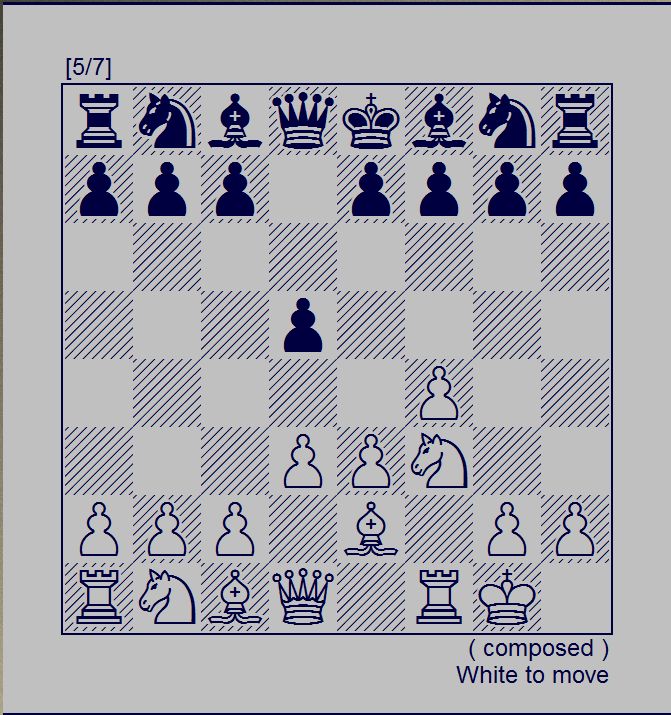


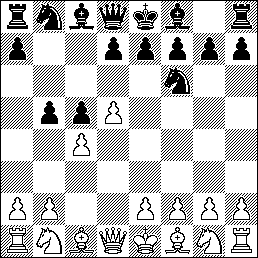
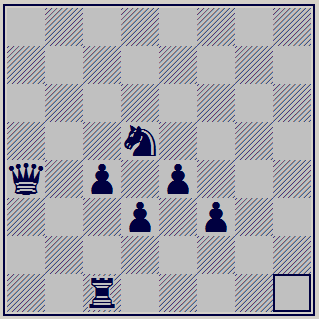
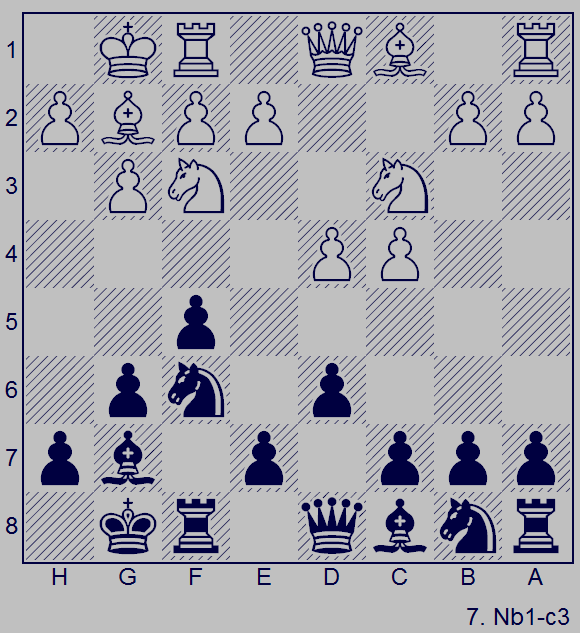
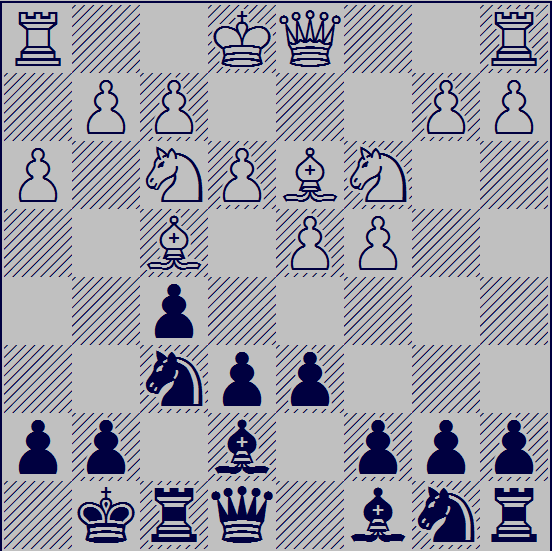
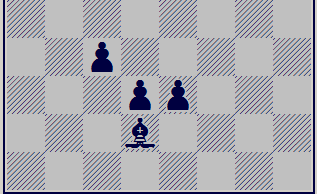
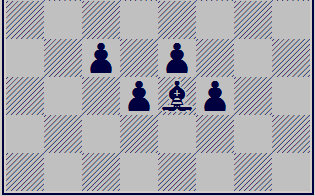
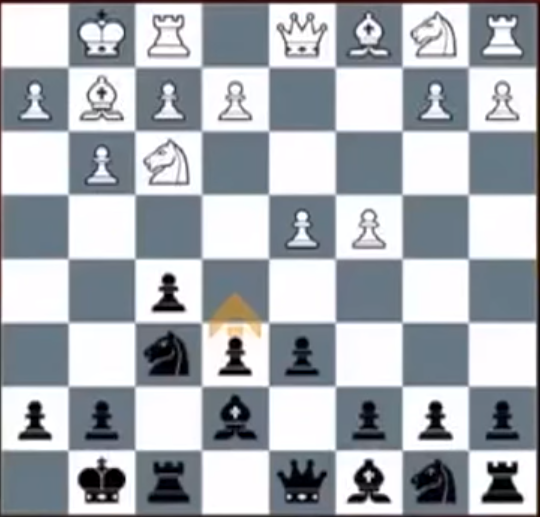
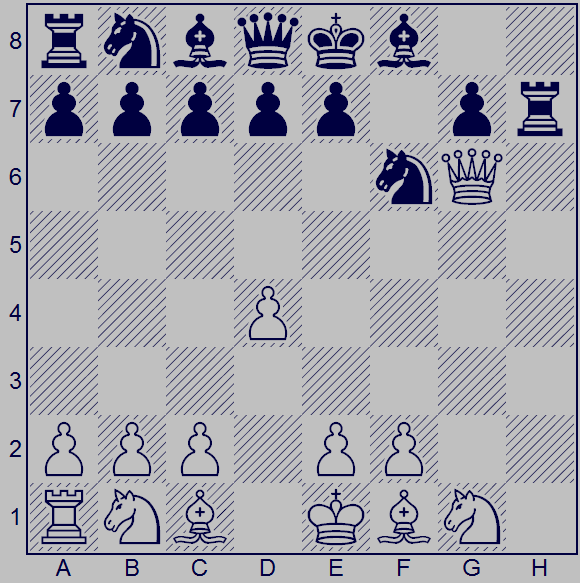
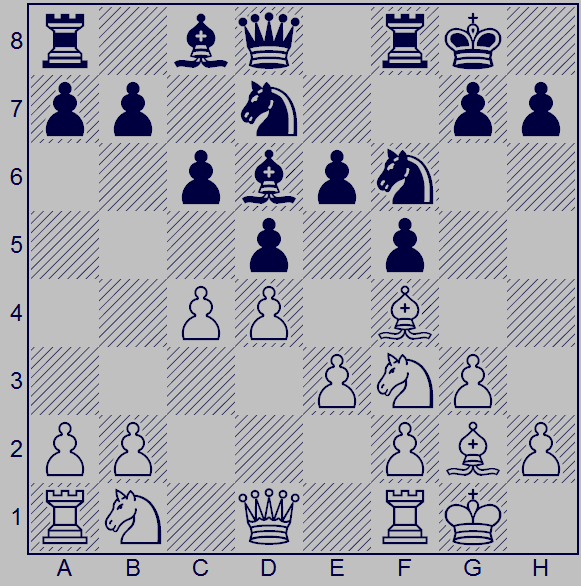
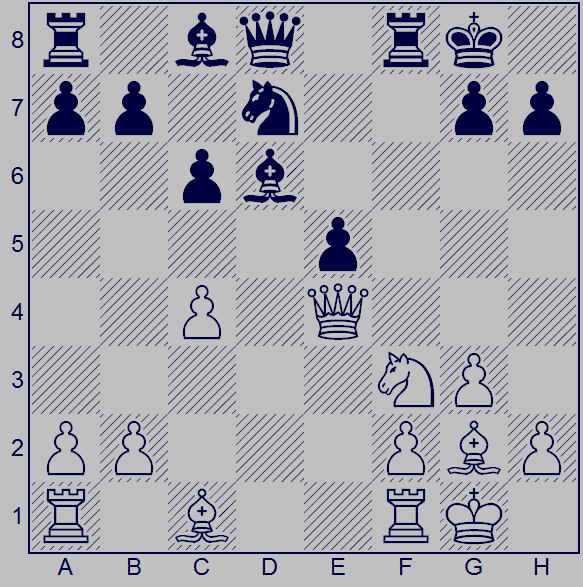
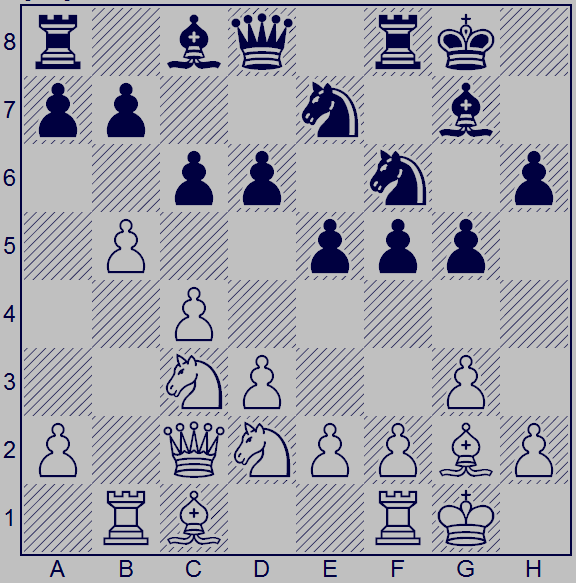


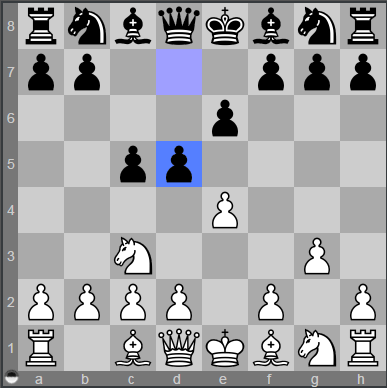
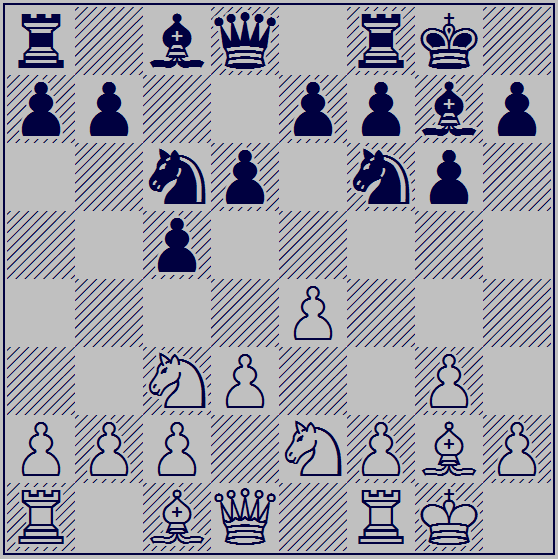

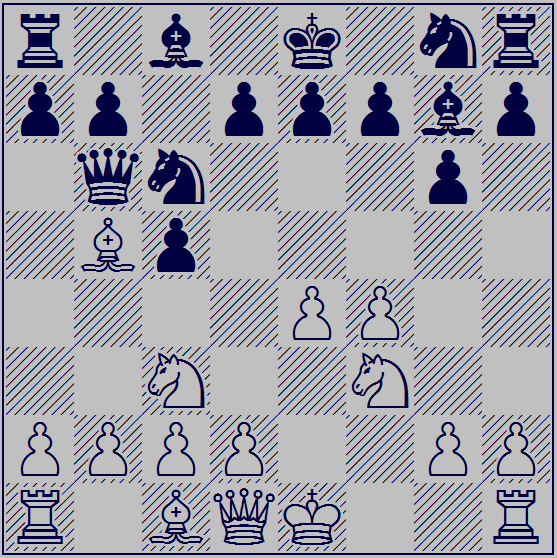
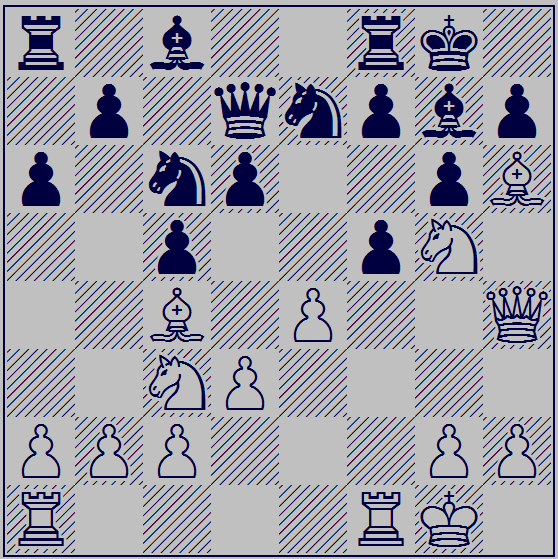
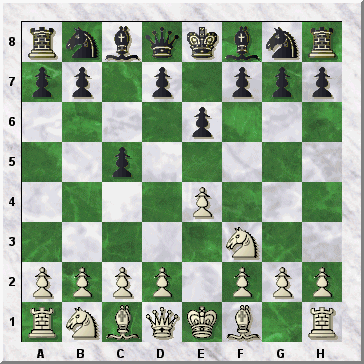
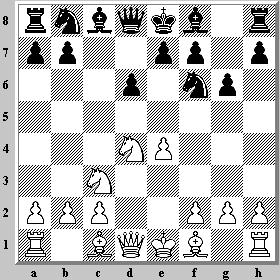
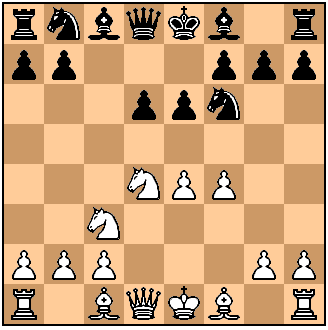
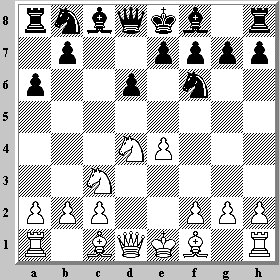
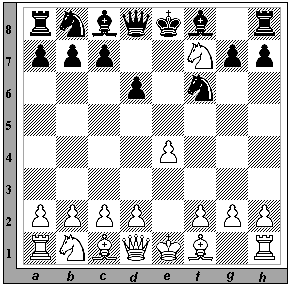
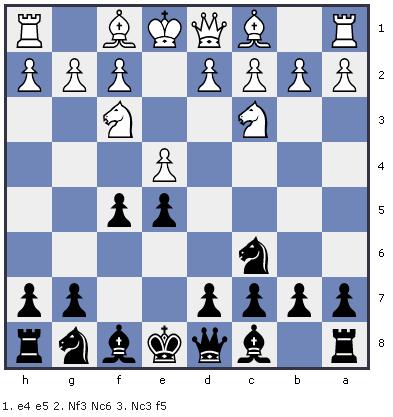
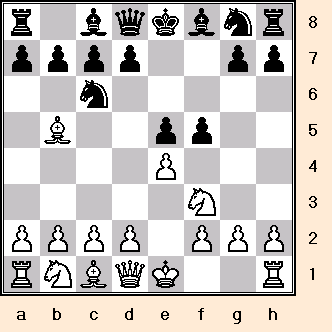
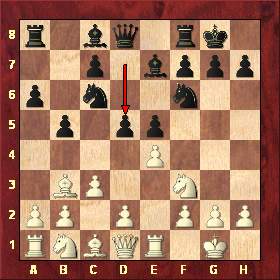

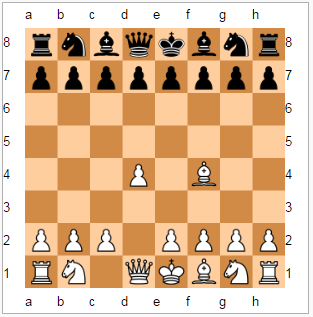
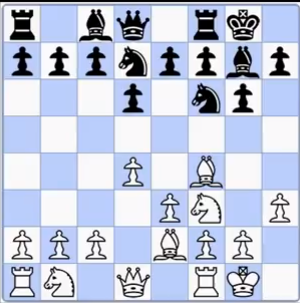

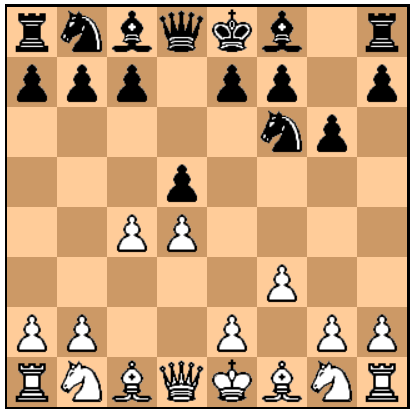


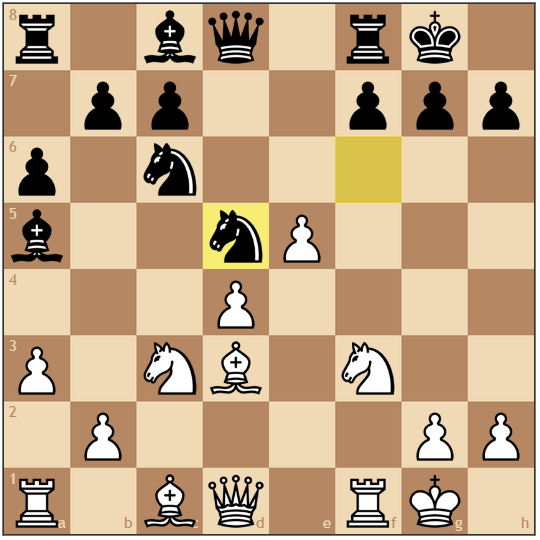
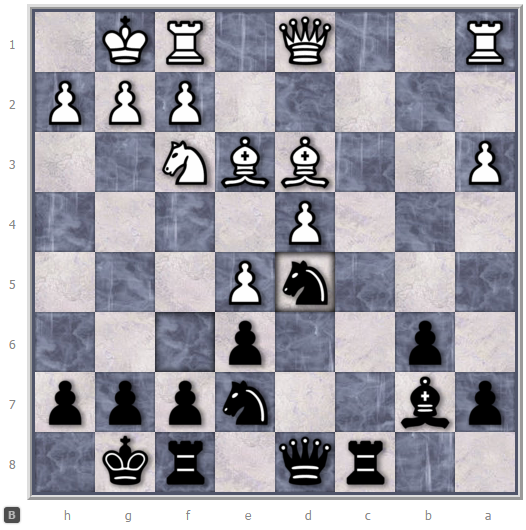
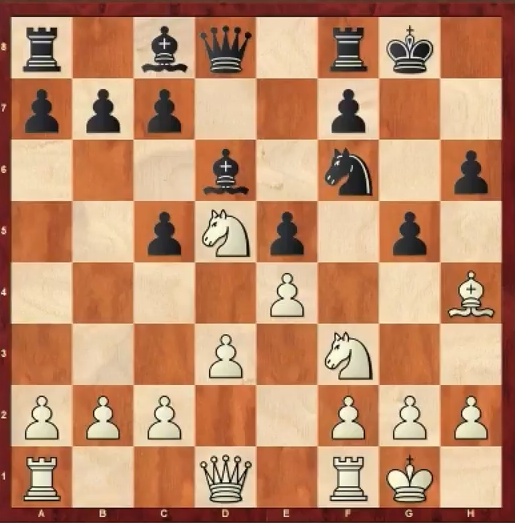
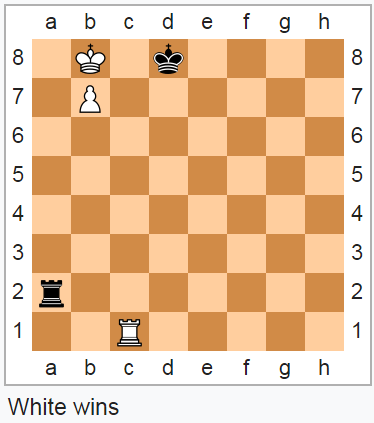
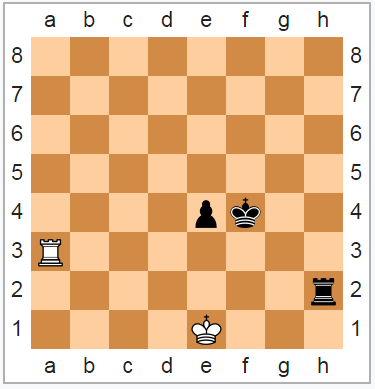
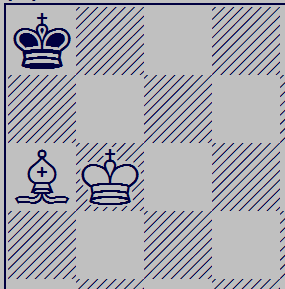
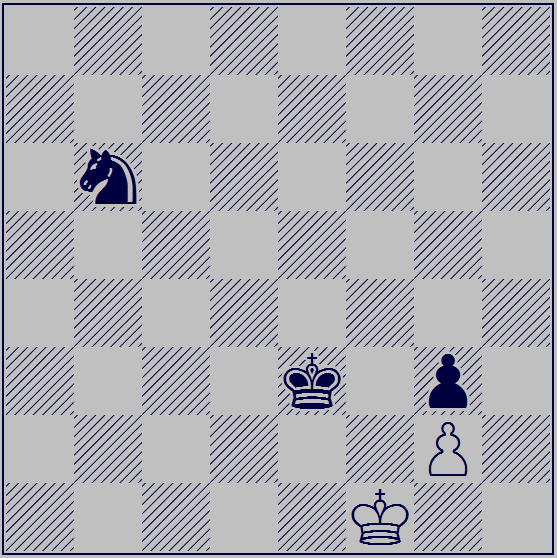

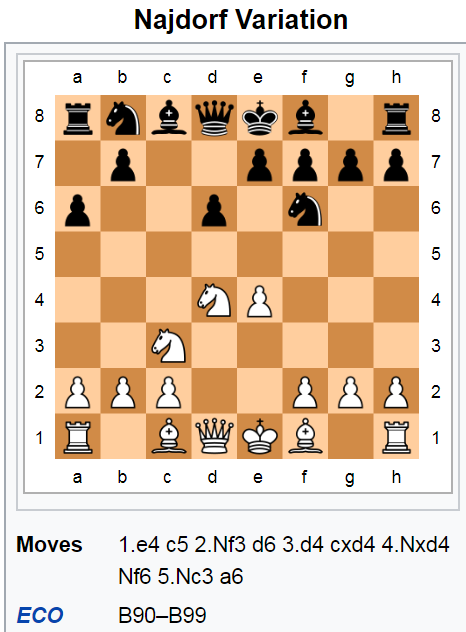







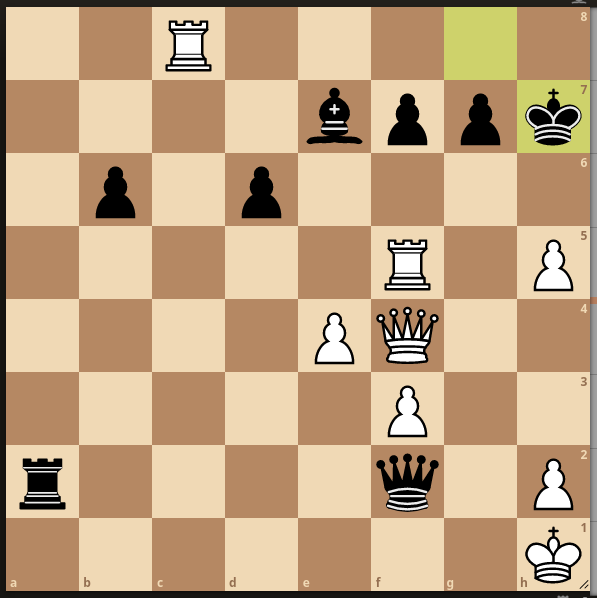



 [5]
[5]

 [6]
[6]
 [4]
[4]

 [8]
[8]
 [9]
[9]

![You Win[Gk]](./jpgs/escacs/youwin.jpg) [11]
[11]
 [12]
[12]

![KlinkBert[Gk]](./jpgs/escacs/klinkbert.jpg) [14]
[14]
![Efrafuvi[Gk]](./jpgs/escacs/efrafuvi.jpg) [15]
[15]
![Bofa[Gk]K-ti](./jpgs/escacs/bofa.jpg)
![Tysia[Gk]](./jpgs/escacs/tysia.jpg) [17]
[17]