
Loading...
Loading...
As the lecture room empties, Harry and Gert remain behind. After quite a few members of the audience have bought the lecture report, only Harry, Gert, Martin and Ivan are left.
“May we sit down, please?” Harry asks, thinking of Gert’s legs.
“Certainly, I think this room should be empty for a couple of hours,” Ivan replies. He has privately been disappointed with his student’s performance, which was just a rehash of what most people already knew, though his method of showing the sequences of photographs was a good touch.
They gather four chairs and sit in a small group so that each can see all the others.
Harry starts the discussion. “Ivan, about three weeks ago, maybe four, I phoned you with some story that had come my way about radio interference.”
Gert immediately speaks up. “Oh don’t talk to me about radio interference. There is a transmitter near my home and right across the radio band all I get is maddening popular music; well I can tell you that it isn’t popular with me!”
“No, it’s not that that I meant, although I am sure we all sympathise with you for the misery it brings. What I was referring to was a man in our village who has heard some strange sounds on his radio; they reminded him of Carl Sagan’s film Contact. Indeed he was convinced he had discovered extra-terrestrial beings.”
“Oh, God!” Ivan exclaims. “I was busy with something when you rang, and the whole matter went completely out of my mind. I’m terribly sorry, Harry. Look, let’s all go back to my office and we’ll discuss the matter.”
“You didn’t say anything to me about this,” Gert grumps at Harry.
Ivan stands up and leads the way. Gert, ever tidy, replaces the chairs in their correct positions, though in fact there isn’t any arrangement of them that is ‘correct’; students and visitors always find a free chair and desk, if they need one, and sit down. After several minutes she finds Ivan’s office, having got lost twice in the maze of corridors. Ivan has instructed Martin to find chairs for himself and their guests, which are already in place when Gert arrives.
“We haven’t started yet,” Ivan explains to Gert.
“I’m sorry, I was rearranging the chairs in your lecture room” — Martin smiles at this: the thought that the chairs had their own places and that it was Ivan’s lecture room — “but I got a bit lost getting here.”
“Don’t worry,” Ivan reassures her, almost adding ‘dear’, but trying not to be so condescending or sounding like Michael Winner.
“Sit here next to me, dear,” Harry tells her, without any of Ivan’s inhibitions or political correctness. “I met a man called Clifford who lives in our village and claims he’s found some radio signals that are rather like the sounds in the Carl Sagan film Contact, but faster. We discussed the possibility of life elsewhere in the universe, the existence of which he’s absolutely certain. I asked him for as much technical information as he could think of, such as time of day, radio frequency, exactly what did the sounds did — repeat, long or short pulses and so on. I wrote down what he told me. Then I phoned you with all the information he gave me.”
“Remind me of the details,” Ivan asks.
“Well they weren’t very precise. Like short and long beeps, but getting longer all the time until after a while there was silence for some seconds, then more beeps with pauses, all irregular. Then silence and the whole thing seemed to start again. They were at about 21 cm on the short wave. I’m afraid that’s all I can remember.”
“21 cm is the H-I line,” Martin explains trying to impress especially Ivan, as he is aware that the lecture went down like a lead balloon; he should have postponed it until he had more to say on the subject.
“What’s that?” Harry asks.
“It’s the principal spectral line of hydrogen; hydrogen is the most abundant material in the universe, so the assumption is that if there’s another civilization out there, and they are looking for other intelligences, they will look for signals at that wavelength,” Martin explains.
“I see. I don’t think Clifford understood all that, though he has seen the film; confidentially, he’s not the most intelligent of men, so I don’t think we can rely on getting any more from him.”
“Nevertheless, he’s possibly sparked an idea we could follow up. OK, let’s get onto the web right now. No time like the present.”
Subject: 2009UMa7
From: Ivan Bassinger
I’ve got some speculative news that might — just might — throw light on our star. Don’t get your hopes up!!!!!
(Gert wonders why these scientists use a whole string of exclamation marks, when only one would do.)
We have a report that someone — no names, no pack drill — has picked up some signals on the hydrogen I (21 cm) frequency. He says they are like beeps with short pauses, then more beeps, the beeps being quite fast and close together. He recalled Carl Sagan’s suggestion, used in the film ‘Contact’ that they were a bit like the first intelligent signals found there.
Can anyone confirm or investigate 2009UMa7 for this? It may be a total red herring. Sorry if this request inconveniences anyone, it’s just that we are clutching at straws right now, with no obvious way to proceed. Thanks, regards — IB
Ivan presses send. They all have coffee from the machine along the corridor. Then after five minutes a reply comes in:
Subject: 2009UMa7
From: Tom Hastings (Boise, Idaho)
Hi, Ivan.
I’m a math professor at the University of Boise, Idaho.
I had just started looking at this forum when the Black-Out came.
Now we can all communicate, hooray!
Just before the Black-Out I was looking at the 21 cm line for the star, when everything went blank. I didn’t notice anything odd about the H-I line at the time.
Last week I tried the H-I line on the star, but all I got was a lot of meaningless garbage, or that’s what it looked like to me. It certainly wasn’t the beeps you’re looking for, but it did seem to have some sort of structure, I just don’t know what. I’ll look again.
Keep happy — TH
“Well that’s something,” says Ivan. “Somehow I doubt that we are going to get much more. At least someone else with some technical skill seems to be looking at it.
“I’ll run you to the bus station, Gert and Harry. Martin and I will keep you in touch with any developments. But I fear we’ve reached the end of the line. Nobody understands the green flash and I’m afraid I haven’t got much faith in your friend’s beeps.”
At this moment the computer beeps and Ivan glances at the screen. A new message appears:
Subject: 2009UMa7
From: Jean le Camp
May be I beat you to it! Today I examine the H-I line and gotten the beeps. They are very fast. What I finded was Fundamental Time Unit (FTU) of about 1/10 second. After long continuous sound, there was silence of 1 FTU, beep of 2 FTU, siilence of 1 FTU, beep of 3 FTU, silence of 1 FTU, beep of 5 FTU, and so on. I taped them and then I slow them down to hear more easy.
Fantastic!
So separated by 1 FTU silences, I gotten 7 FTU beep, 11 FTU, 13, 17, 19, 23, 29, 31, 37, 41, 43, 47, 53, 59 etc. All prime numbers to 71, just like predict Sagan, though he did not say 71. After 1 FTU silence, 8 FTU beep, same sequence (prime numbers 2 to 71) then more beeps and silence all varying. After some time, more primes like before, with more beeps and waits after, different from before.
I have gotten all these on audio.
Does this help? — JlC
“Christ!” exclaimed Ivan. “This does look like a seam of gold.” He sends this reply to Jean:
Subject: 2009UMa7
From: Ivan Bassinger
Jean, this looks VERY interesting. Can you put the audio on the forum so we can all hear it, please? I’ve got a student working full-time on this and can assign more if needed. If anyone else sees anything useful in it, please notify forum or me — IB
Quite quickly he gets another message from Jean:
Subject: 2009UMa7
From: Jean le Camp
Audio file is attach to this message. I hope your student can find it is useful — JlC
Harry phones Ivan at least five times in two weeks to see if there is any progress. He gets the same response each time; Clive has put the audio data onto the computer in a more usable format and is still working on it.
Then late one Wednesday afternoon Harry gets a call from Ivan.
“We have hit gold!” he exclaims. “Can you and Gert get here tomorrow on the first bus? Phone me as soon as you arrive and someone will pick you up at the bus station. Martin and I will probably be working through the night checking the results, so it may be another student who collects you. If you can’t make it, I’m afraid I’ll have to go public with the news, but I’d prefer to tell you first, as it was your contact — sorry for the pun — who put us onto the right track. I have just called Jean le Camp and told him the news. I said I’m going public with it at lunchtime tomorrow. OK? I really hope you can both get here.”
“This sounds important news. I’ll try to get Gert to come, but the first bus leaves at 6:25. I’ll do what I can. I will definitely be there.”
Harry rings Gert. “I just had a call from Ivan who says they ‘have hit gold’. I assume he means they have cracked the code in the messages, if that’s what they are. He wants us to be on the 6:25 bus in the morning. He wants to tell us first and then he plans to make the information public at lunchtime. Can you make it?”
“Well it’s very early, but I’ll try to. If I’m too late getting to your house, you go ahead without me; I’ll catch a later bus.”
“I’ll phone you half an hour before I leave if you like — an alarm call.”
“Yes please. I’ll get to bed early and set my alarm clock. This is so exciting. I hope I can sleep.”
She sleeps well, right through the alarm clock. Fortunately Harry’s back-up call does stir her, so they both just make it to the early bus from Bossington to Tiverton.
“What’s all the excitement about prime numbers? It was key to Carl Sagan’s film, but I didn’t quite get it then. Do you understand it, Harry?” Gert asks on the bus.
“Yes, I think so.” He pauses for a moment to collect his thoughts. “If there’s another world with life on it somewhere out in space and its inhabitants want to communicate with us — always assuming we exist — they have to attract our attention to themselves. They have to assume that we are looking for them; they can’t put out a big banner saying ‘Hello’, obviously, so they first have to think of what we might be looking out for. That’s why the Hydrogen I spectral line is so important, because hydrogen is the most common element in the universe, and its first, or lowest energy line in its spectrum, is the H-I line which has a wavelength of about twenty-one centimetres. So they assume that anyone looking out is going to be looking out on that wavelength, and by the same logic, they transmit on that wavelength. Anything else would be more complicated, so the assumption we and they make is that H-I is the means of communication.”
“Yes, I think I understand that, though I’m not very familiar with spectrums, or is it spectra.”
“Spectra.”
“Right. But why the prime numbers? Those are numbers that can’t be divided by anything else, aren’t they? It’s a long long time since I did arithmetic at school.”
“That’s right. Remember that hydrogen is the most common element in the universe, so there’s a lot of stars and other things that are naturally sending out emissions on the H-I wavelength, almost all of it gobble-de-gook, just like solar flares and that sort of thing. So imagine these aliens are sending out messages on the H-I line and we are listening in on that wavelength. What messages can they send? If they have languages, they won’t be of much use to us; they are hardly likely to talk in English, French, Chinese or whatever, and we won’t know their languages either. They must have some way of distinguishing their signals from all the other junk on the H-I wavelength.”
“But why prime numbers?”
“The only ‘language’ that all intelligent species are likely to have in common is mathematics; maths is like a universal truth. Wherever you are from, 1 + 1 = 2, 38 − 7 = 31, and so on, whatever names you use for them. So numbers are the only universal method of communication. Now it is quite possible that a star, say, is transmitting continuously on H-I, and it is spinning. So for a small interval on each spin, we receive a beep from it, and of course they occur at completely regular intervals. We would hear ‘beep, pause, beep, pause, beep’ and so on, completely regularly. If it’s regular we might assume it is coming from an intelligent source. And we’d be wrong, it’s simply a natural signal from a spinning star.”
“But why prime numbers?” she insists.
“Bear with me, Gert, I’m getting there. We might get regular patterns of beeps from natural sources, like stars orbiting other stars, and because of that, one star eclipses the other, cutting off every seventh one of the beeps, say. So we have to resort to more sophisticated mathematics. Now the one thing in the world of numbers that is apparently completely random and yet is precisely predictable is the sequence of prime numbers. Whether you’re on the Earth or Struve 1495, the prime numbers are 2, 3, 5, 7, 11, 13, 17, 19, 23, 29, and so on. It doesn’t matter what language you speak, or how you count — ten fingers, whatever. So what we expect them to transmit, and what we’re looking for are strings of prime numbers.”
“Oh, now I see. That’s why they are so important, that’s why the French gentleman and your friend Ivan got so excited about them. And Mr Sagan.”
“Yes, we hope they are the key to everything!”
Gert and Harry arrive at the bus station in Tiverton and look around for Ivan or Martin or someone else who might be waiting for them.
A young woman comes up and asks: “Excuse me, are you Gert and Harry?” They nod. “I’m Anna, one of Ivan’s postgraduate students. Ivan asked me to apologise, but he’s working with Martin on the final presentation to be announced to the press at midday, so he couldn’t make it here to meet you.”
“You are a most acceptable replacement,” Harry tells her.
“My car is over there. I’ll drop you at the University entrance where I believe the porter is already briefed on your arrival.”
“Hello, my good friends!” Ivan cries as they enter the lecture room where everything is being set up for the press announcement. “I can’t spend long with you this morning. I hope all will be clear when we hold the conference. What Martin, Anna, Clive and Louisa have discovered is that the signals are indeed sequences of prime numbers, with other information between these sequences. Some of them appear to be pictures, and we are still working on them. It would be nice to be able to give the interpretation of the first today, but I fear we just haven’t got the time. If we go ahead too soon we might end up with egg on our faces. Martin is still working in hope, though.”
“Good to see you, too,” Harry replies. “The young lady, Anna, told us that you are holding the press conference at 12 o’clock. Thank you for asking her to collect us. And she wouldn’t take anything for the ‘taxi fare’.”
“Don’t worry about that; the pleasure’s mine.
“Now, to be brief, young Martin has been working 24 hours a day for the past week. The poor boy’s absolutely done in. But he has come up with some really worthwhile material. We plan to announce some of it at a rather quiet news conference today, with the promise to the press of more as soon as we’ve analysed the data. It’s not only Martin who’s been beavering away; the other three have too, but he’s emerged as the team leader.
“We are convinced that the signals are from an intelligent source; that’s from the prime number data that Jean le Camp sent us. At the same time, Jean is giving a news conference in Paris to release the same information. Anyway we have also been monitoring the source ourselves and have confirmed what he discovered. We have also looked at the data between the blocks of prime numbers and we think we know what this data represents: it looks like pictures, the first one we think is a stellar system, rather like our solar system. They seem to be trying to tell us about themselves. We won’t be saying any more than that today publicly. If anyone asks for more, we are simply still working on it. But there may be several pictures in the sequence, and we are attempting to understand their meaning. I must admit it is rather difficult. We wondered if you two would be able to help, with your non-scientific points of view — remember, Gert, our discussion about thinking outside the box?”
“I do indeed. I’m sure that Harry and I will be most willing to do whatever we can to help. It seems to me that we are on the edge of a completely new phase in the history of our world: contact with aliens.”
“That’s right. One aspect that we think most important is that we take the right political decisions, as well as the right scientific ones. Do we actually want to let some aliens know we are here? By the way, at the press conference we have agreed not to disclose any connection between the aliens and our world-wide Black-Out. That sort of thing can come later. They have already cut off our electricity supplies and done untold misery for over three months, or so we believe. It looks as though their intentions towards us are not at all friendly; was the Black-Out some sort of declaration of war on us? We are also keeping this press conference deliberately low key, with only our local paper and local BBC invited, and we have notified Reuters and the Press Association that we have made an important scientific discovery, but it’s quite likely that they won’t attend — we aren’t well-known scientists, just one obscure Doctor of Astrophysics and a handful of students. And Jean is, I believe, even less prominent in the profession.
“Also you’ll have gathered that I have assigned some more students to this project. As well as Martin and Anna, who you’ve already met, there’s Clive and Louisa. All four of them were studying other disciplines until the beginning of this term. When they got their bachelor’s degrees, they all wanted to go for doctorates in Astrophysics so I’ve taken them under my wing. Martin graduated in French with a first-class Honours degree, Louisa in Human Biology with an Upper Second, Anna in Oriental Theologies and Clive in PPE — Politics, Philosophy and Economics; both got Lower Seconds. So you’ll appreciate that although they are all obviously intelligent people, their knowledge of astrophysics may be rather poor, though their interest is large — otherwise I wouldn’t have taken them on as post-graduates.
“However, I do expect the world will come crashing in on us within a few days. It may well be that the government will issue a D-notice on our work; that would stop newspapers disclosing any facts about the case. Their excuse would be to avoid public panic. That is one of the reasons why Jean is giving the same information out in France; the British government would be stymied by that, as they can’t stop the French publishing. And in these days of international media — the internet, the information would soon be out.”
Harry interjects: “But I thought that D-notices were abolished ages ago.”
“Yes, officially they were, but don’t you believe it! They still have ways of suppressing information if they want to. MI5, MI6 and GCHQ don’t exist for their own amusement. It’s not just international terrorists and suicide bombers they’re after; any of us could be under their surveillance at any time. They can issue DA-Notices, that’s Defence Advisory Notices, and they can get judges to issue injunctions on almost any basis these days.”
“Most undemocratic. I thought all politicians were for ‘openness’ and ‘transparency’ these days.”
“If only...
“Please stay for the press conference, but, I’d be most obliged if you didn’t say anything, not even who you are or what your contribution to this research has been.”
“I think we understand,” Harry reluctantly agrees.
Just before noon, a small group of people come into the lecture room. The BBC’s local studio has sent a camera with its operator, who sets up his equipment centre stage. There is also a sound recordist whose microphone joins that of the Press Association. The PA and BBC are the only organisations to have sent reporters, apart from the local weekly newspaper whose reporter places a tape recorder on the table next to the microphones. Nothing is being broadcast live, as the reporters point out, so they request that if anything goes awry they just do it again, and the gaffes will be edited out.
As soon as the press teams are ready, Ivan comes into the room, accompanied by Martin. He has deliberately left Anna, Louisa and Clive out, to encourage the press to underestimate and play down the importance of the project, and because he wants also to keep them out of the limelight for the moment. They are all disappointed, but understand the necessity of keeping everything low-key for the time being.
Ivan starts: “Welcome, ladies and gentlemen,” — though there are few of either in the audience, barely a dozen — “I have called this press conference to announce an important scientific discovery, which could influence, or at least have important repercussions on the future of all of us. First I would like to introduce Martin Smith, my post-graduate student working on this and to thank him and some other amateurs who have contributed significantly to this discovery. I would also like at this stage to acknowledge the contributions made by other people on the international university’s astronomy forum on the internet, in particular, monsieur Jean le Camp from the University of Paris in France. Monsieur le Camp is giving a press conference in Paris right now on the subject. His conference will be essentially the same as this one.”
The local newspaper reporter interrupts to ask for the correct spellings of all these names.
“In outline,” Ivan continues, “we have discovered the existence of intelligent life on another star system in our galaxy. It was monsieur le Camp who put us onto the vital clue, although we and several others had been investigating this particular star system for some time. His data has been analysed, first by himself, and then by my team here to confirm and dig deeper into the data. Indeed Martin, here, hasn’t slept for some 72 hours to try to make this press conference as successful and as full of verified material as possible. For their unswerving devotion to duty we all owe him and some others a lot.
“We were studying the emissions from this star system on the Hydrogen I wavelength...”
“Excuse me, will you be taking questions?” the PA reporter asks.
“Yes.”
“In which case can you tell us where this star is, please?” asks the local newspaperman.
“Yes. It is in the constellation of Ursa Major, known popularly as the ‘Great Bear’, the ‘Plough’ or the ‘Saucepan’; it’s the constellation with the ‘Pointers’ to the Pole Star. So far as we are aware, the star we are talking about has three planets and the intelligent life form is on the outermost of these three.”
The local reporter is about to open his mouth with another question when Ivan stops him in his tracks and asks: “Perhaps you could save your questions until the end of this presentation, as the answers to them may already have been given by then.” ‘That should let me off the hook for a few minutes’, Ivan thinks; ‘now at least I’m in control of things.’
Or am I, he wonders, reflecting on what he’d said to Gert and Harry a few minutes ago about MI5, etc. Maybe his office, his telephone, his e-mails and everything else are or soon will be under surveillance. A horrible thought! But possible.
“Monsieur le Camp found signals coming from the star system, and noted that many of them represented the prime numbers from 2 up to 71. He told us and we were able to confirm his data and to make further discoveries from his and our own and other observations. The first important thing is that the signals represent these prime numbers. If any of you have seen the film Contact, based on a book by Carl Sagan, you will understand the significance of this. If you haven’t seen the film or read the book, there is a short, non-technical explanation of their significance that has been prepared by Martin, and he will make copies available later, and also answer any questions you may have on their importance.” (In fact it was Louisa who prepared the document, but he’ll explain and apologise to her later.)
“Eventually we realised that the prime-number sequence was occurring twice in every complete sequence of the data, which, by the way, keeps being repeated. We assume that the senders are repeating the message so that if anyone tunes in half-way through, they’ll eventually get the whole thing — a bit like going into the cinema half-way through the main film, if anyone remembers when cinemas were like that. The numbers 2 to 71 are a trailer to the big picture, as they give us the clue to the meaning of the remaining data. The prime number sequence occurs twice, suggesting that the remaining data is two-dimensional, the pictures are square or at least rectangular, in other words.
“We have been able to decode the first image and it appears to show their stellar system, with their own planet highlighted. We are still looking at the remaining set of images, so we won’t be able to give you any news on them at the moment.
“Well, that basically is all we have to say now. Are there any questions?”
“Are these signals directed straight at us, or are they being broadcast in all directions?” asks the BBC lady.
“Possibly at us, but we are by no means certain of that.”
“Why?”
“I’m not in a position to be able to answer that. I’m sorry; to be honest, we simply don’t know.”
“Has any of the information been censored by the government?” asks the Press Association man.
“No,” Ivan answered honestly but perhaps misleadingly as he knew more himself than he had told those present, particularly the connection with the Black-Out. But then, this wasn’t censorship by the government.
“If you have the code to understand the prime number information, why can’t you just use the same code on the rest of the data and see all the pictures?” This is the local reporter again.
“The code for the prime numbers has to be very simple or it would almost certainly be missed. Martin, can you please explain the significance of the prime numbers and the Hydrogen I line. I believe there is a page about it available.”
Martin stands up and allows time for microphones and other equipment to be rearranged. Then he gives an explanation that is quite similar to what Harry said to Gert on the bus earlier that day. Then all the communications equipment goes back to focus on Ivan.
“To continue with what I was saying, the prime number code has to be simple, but the same code is not really suitable for the remaining information. That is why we don’t have the full picture yet. We’re still working on it. Here is the first image received, thanks to the exhausting work done by Martin especially and myself, and printed copies are available.” Ivan switches on the monitor of his computer and displays the image on the white-board behind him. There is complete silence as the reporters take the image in, except for the BBC cameraman’s movements as he homes in and centres on it.
“What does it all mean?” asks the BBC reporter.
“I wish we knew. We could, but won’t, speculate. This morning is the first any of us have seen it. Join the honoured few!”
After the press corps has left, Ivan says to the rest of the group, Gert, Harry and his four students, for the other three have joined them now: “I’d like to thank you all for your contribution to this project. I realise that for you four especially, it has been a very long day! All you’re thinking about now is getting some well-earned sleep, so I won’t keep you any longer. Today is Thursday; let’s all meet up on Monday next week and we’ll all go out for a great lunch. Better not drive in to the university in the morning, as we’ll be having a bottle or two with the meal, and I’d hate to have things spoiled by someone getting caught drink-driving. Do you think you can join us, Gert, Harry?”
“It would be our pleasure,” Harry speaks for both of them.
“Do you think you could find your own way to the Roasted Duck restaurant for one o’clock? It’s not far from the bus station.”
The students are impressed — the Roasted Duck!
“And the rest of you, I shan’t want to see you before then! Have the next few days to recover. I know how draining it must have been on you. See you on Monday at one. Then next Tuesday, it’s back to work in earnest going through the rest of the data. I’ll keep you posted on any developments; I’m sure that Jean will get some reaction from the French scientific community, and there’s bound to be some stuff from the States, too.”
Ivan has a long conversation on the phone with Jean. His conference has apparently gone well; he had seven news organisations present. They agree to see what the reaction is and Ivan says he’ll phone tomorrow, Friday.
From the bottom of the previous column
That evening the local BBC television news spends several minutes on the story, saying that scientists at the University of Exmoor have detected life on another planet; they use numbers, just like us; and they have sent a picture which may be a map of their solar system, which is shown on the screen. Ivan isn’t impressed by their presentation of the facts; he nearly phones them to put the record straight, but before he makes up his mind to do so he gets a call from Reuters in London.
The caller identifies himself as the Chief Scientific Correspondent at the London bureau. “My name’s Al Schmidt. Our local reporter in Exeter has filed a report about alien life. I’ll read you what he’s reported,” which he does.
Al asks: “Is this report correct in general terms, and in its specific details? He has also faxed us an image that he says is the first picture received from the aliens. It’s a bit pixellated; can you let us have anything of higher quality?”
“I’m happy with the story. But please make it clear that you’re reporting our speculations about the data. We have a lot more work to do on it, and we may eventually revise some of our interpretations. The image is pixellated because that’s how we received it. I suggest you publish it as it is.”
An hour later, Ivan checks the BBC TV News channel. Their lead story is a report from Agence France Presse in Paris that French (!) astronomers have discovered life on another planet, and they show the image that Ivan showed at his own press conference. The reporter adds that nobody they have consulted in Britain has any comment to make or has heard anything about it! ‘Why didn’t they ask me?’ Ivan shouts at himself in his mind. ‘They think Patrick Moore is the only person to talk to, good though he is at presenting astronomy to the layman, or the Astronomer Royal.’ He turns the television off in disgust.
A few minutes later, the BBC reporter who attended his press conference phones to asks if he saw her report on the local news. He shouts down the phone at her: “Yes, and it was pretty poor. Didn’t you read the hand-outs? And why has your own 24-hour TV News channel just reported that the bloody French have discovered extra-terrestrial life? Why don’t you communicate between your own departments? Believe me, this is going to become a really big story when we’re through! Forget 9/11, forget the Boxing Day tsunami, this is big! Goodbye!” and he slams the phone down. Has he over-reacted?
After ten minutes the phone rings again. It is a woman who introduces herself as the Head of News at the local BBC station. “Dr Bassinger; one of my reporters was at your announcement today, and I’m afraid to say that she came to me just now rather upset at your attitude when she rang you.”
“I had no intention of upsetting her. I just wanted to point out that her report was awful, and what’s more the BBC News 24 channel, your news channel, has just reported that the French made this discovery. I’ll tell you what I told her: we did it, and this is going to develop into a big story, bigger than 9/11 or the tsunami. Sorry for any offence caused. Goodbye!” He hangs up.
Another call. The Press Association this time, Ewan O’Donnell, Head of Science from London. “We sent a reporter to see you today, but he seems to have missed half the information from his report. We’ve seen the AFP report on the wire and it seems to contain what you told us and a lot more.”
“Yes, we consulted with monsieur le Camp but it seems that your people, or perhaps other reporters at his conference in Paris, were more persistent, and managed to wheedle rather more from him than we had agreed to release at this stage. He has been cooperating with my team, as have several other scientists round the world. Look, we have been at it for 72 hours non-stop getting that first image that you’ve no doubt seen. The leg-work was terrific, and my student needs to take a rest. I also need some sleep myself. The image that you’ve got was discovered by us, not the French.
“I can assure you that it is going to be a big story for you in the press; I’ve already told the BBC it’ll be bigger than 9/11 and the Boxing Day tsunami. But what we need is time to analyse the data we’ve got, and quite possibly gather some more. I don’t know. I’m an astronomer not an astrologer.
“I’ll do a deal with you, subject to the consent of monsieur le Camp. You send a reporter here tomorrow morning, one who’s well qualified, and I mean that, one who can understand scientific procedures, and the way scientists think and work. He can interview me about anything to do with the aliens, and I will answer what I can. I’ll even describe our methods to him where I can; remember that a lot of the detailed work was done by my research student, and I’ve laid him off until next week; he really does need a rest.”
“That sounds great. I have a degree in Mathematics from Cambridge. Will I do?”
“OK. I may have to request an embargo on the release of some of the material. Would you agree to that?”
“Agreed.”
“Good. I trust you as a senior member of your organisation to respect my requests. Do you have a standard Non-Disclosure Agreement that we can both sign?”
“Yes, and I’ll get the Head of the London Bureau to sign it on our behalf. Your commitment is that you will not disclose any further information to any other party, any other news or scientific organisation, prior to its disclosure to us. You’ve already said that this is a really big story and consequently we assume that it has a financial value.”
Ivan hadn’t thought of that aspect at all; he was a scientist not a businessman. “I want no personal reward for the disclosure of this to you. However, I know that the University’s budget is always under great pressure, so perhaps we can come to some arrangement that will benefit us, as well as giving you first rights on the story. I will have to discuss this with the Bursar. I am sure some agreement can be secured. One question, the PA is an agency, right?”
“Ah-ha.”
“So if you sell the story to a newspaper, say, do you get a standard payment? Or do you simply tell the world in return for some sort of annual subscription?”
“It all depends. If it’s run-of-the-mill stuff, we distribute it to all our subscribers who pay an annual fee. If it’s a first-class story, it is offered to clients who often run that kind of story, and we get a special payment from them, so that they can claim it’s ‘exclusive’. I can see your next question coming: what’s in it for you if the story is really big.”
“Right. And I believe it is.”
“OK. Our standard Non-Disclosure Agreement covers simple cases. If it looks like a big story, we’ll have our lawyers talk to yours, and sort out the details. Is that OK with you?”
Ivan can’t see any significant obstacles to that — except that he is even sure that they have their own lawyers — so he agrees, and confirms that Ewan O’Donnell will phone him when he reaches town, and he, Ivan, will meet him.
As he sits back after putting down the telephone, Ivan says to himself: ‘What in God’s name have I let myself in for?’
Dr Ivan Bassinger is rather older than Ewan O’Donnell is expecting. And he is smartly dressed, not the ‘mad scientist professor’ type he had in mind. Ewan has looked Ivan up on the PA files, but found no mention of him. On the internet are quite a few references to him, mostly technical papers on research he has been engaged in. He could find nothing that would interest the general public, though a few of his papers have been published in scientific journals, like the Proceedings of the British Astronomical Association and a piece in Sky and Telescope several years ago.
Ivan asks him to sit down. They are in one of the main conference rooms, big but more secure than Ivan’s own messy office. “Are you planning to take notes, or tape our conversation?”
“With your agreement, I’d prefer to tape it.”
“OK. But if there are any things that crop up that I’d prefer not to go public on, would you mind turning it off? Any reports you file should be based on what’s on the tape.” Ewan turns the recorder on. “Have you got the paperwork we spoke of?”
Ewan passes Ivan one sheet of printed A5, folded across the middle to make four A4 pages. He quickly reads through it, and signs at the end of the document. Ewan adds his signature, saying: “And a second copy; you keep one, we’ll hold onto the other.”
“Can I summarise what we know? Then perhaps you could fill in the gaps, and tell us what more you know.”
Ivan nods his agreement.
“Monsieur le Camp said that you had put him on to some interesting signals from a certain star in Ursa Major, and that he had found that there was a part of the signal that consisted of a sequence of prime numbers from 2 to 71. He then analysed the remaining data which revealed a picture of their stellar system. The signal came in on the Hydrogen I wavelength. He said there were four planets going round the star, and the signals were from the third one out. That’s about it really.”
“One immediate correction, there are apparently only three planets — I don’t know where the story of the fourth came from — and the aliens are on the third. If you look at the image you’ll find that it shows only three, and the number ‘three’ is below the sketch of the system. The ‘three’ is that symbol there...” he points to a three-line ‘letter’ near the centre of the image, “... which we are interpreting as meaning that they are on the third planet. We may be wrong. It is of course important that anything you publish at this stage emphasises that quite a lot is speculation. We hope, of course, to confirm or firm up or correct the information as necessary. One other thing; the analysis that led us to the image of the aliens’ stellar system was done here, and I am not aware that monsieur le Camp has done any similar work — he certainly hasn’t informed us of any. We sent him a copy of the image, which he is apparently claiming as his own. I don’t want to undermine the contribution he has made, especially as he was first onto the details of the prime number sequence, but even that followed a tip-off from us.”
“That’s understood. Now some of this sounds like Carl Sagan’s Contact. Can you confirm whether the signals are of the same nature as his, or is the method of communicating, the ‘language’ if you like different?”
“It’s similar in principle, but the detail is different. Let me explain what the signal is like. On the H-I wavelength, 21 cm — you understand the significance of that?” Ewan nods; “— a binary signal is being transmitted, superficially like Morse code — no, that’s a bad analogy — just beeps and silence; the beeps are all at the same intensity, but not of the same length, so it’s really a binary code. The fundamental time unit — which we’ve abbreviated to FTU — is about one-tenth of a second, to be more precise, 0.09848 of a second. That’s the length of the shortest beep, and other beeps are multiples of the FTU. The silences between beeps are also multiples of the FTU. So we assume that a beep one FTU long represents the number one, or in graphic images, is a pixel that is ‘on’; an ‘off’ pixel is one FTU of silence. Still with me?”
“Yes,” Ewan replies. “It sounds straightforward so far, except that an FTU is very short. I’m surprised that you picked it up.”
“That’s Jean le Camp’s major contribution. We had a hint that something odd was occurring from a casual observation — that’s not to belittle its importance — from someone who thought the signals reminded him of the film Contact. So we looked at the data again, a whole community all over the world, and it was Jean who found the primes.”
“OK. One thing that no-one has asked so far is what star you’ve been looking at, and why?”
“The star is in Ursa Major, and is named ‘2009UMa7’. It appeared as a brown dwarf last year, on 17th June. We’ve been looking at it, on and off since then. Would you mind switching off the recorder?”
Ewan complies. “You’re going to tell me something rather important, I feel, but not for publication... yet.”
“You’ve hit the nail on the head. This is definitely not for publication at the moment, if ever. If you attempt to publish it, I’ll have the government slap an injunction on it right away. And believe me they’ll cooperate.”
“OK, agreed. No problem.”
“You remember — and who could forget — the Black-Out that occurred between 21st June and 8th October.” Ivan pauses. “We believe that the Black-Out was caused by an intelligent life form on a planet circling that star.”
“Whew!”
Ivan waits for the news to really sink in. “Now you understand why we’ve said this is not for publication, at least at present, and why the Government would slap an injunction on it.”
“Public panic?”
“Precisely. We are not certain about this, it’s only a theory at the moment, but to let the information out would be totally irresponsible, because it might well show that they have aggressive intentions towards us. I’d also request that you pass this information on to as few people as possible, if any, and that you emphasise to each of them the importance of non-disclosure. I haven’t really got much more to say about the Black-Out right now, but if you’ve got any immediate questions, I’ll try to answer them. There’s a lot we don’t know, so if I say I don’t know, that’s the way it is. Sorry. I’ve let you in on what we believe is the biggest story since Noah’s Ark, but I must ask you not to mention The Flood. This could be the War of the Worlds, but umpteen times worse than anything H.G.Wells wrote of, and if so, it would be for politicians across the world to deal with, not some astrophysics scientist in Tiverton, nor, with respect, a press agency editor in London.”
“I’m with you. You have my word on this. Why do you think there’s this connection between beeps in the sky and the Black-Out?”
“The star disappeared on the night the power went off, and reappeared the night it came on, each event within minutes or perhaps less of the other. Coincidence? Even with my scientific scepticism of chance coincidences... even I can’t stomach that one. No other stars seemed to be affected at that time. We don’t know why there is this connection, but we’re working on it. What’s more we have no idea how they caused the Black-Out, or why, or whether they’ll repeat it, assuming they were responsible.”
“Right. Can we go back to discussing the star? Can I turn the recorder on now?”
“Yes, go ahead.”
“So what form do the prime numbers occur in?”
Ivan hands him a sheet of paper.
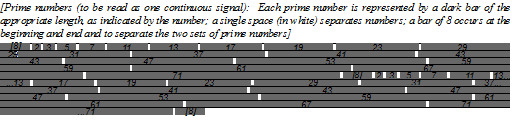
“The transmissions start with 8 FTUs of signal, 1 FTU of silence, 2 of signal, 1 of silence, 3 of signal, 1 of silence, 5 of signal, and so on. The 8 FTUs at the start are just a starting signal, we think. They also seem to use base 8 arithmetic, so that may be another clue. Then come more prime numbers each of the appropriate length of time and separated by one FTU of silence, till we get to 71 FTUs of signal. Then 1 FTU of silence, 8 of signal and the whole sequence is repeated, till a final 8 of signal. So, to recap, the prime numbers appear in two sequences from 2 to 71, each separated by 1 FTU of silence, and the two groups separated by 8 FTUs of signal, like this diagram where the signals are shown in grey and the silences in white, except that it’s all one long stream of data of course.”
“What happens then? We assume, I guess, that by sending the two sets of prime numbers they think they’ve got our attention. So they must have something more to say, yes?”
“Yes. What comes next has had us really thinking for a long while. It seemed that everything had broken up and it was just ‘noise’. Now a question for you: why do we get two blocks of prime numbers?”
“For confirmation?”
“No that doesn’t hold water. To really confirm that they are an intelligent life form they could have used the time just to continue on from 73 with a few more primes. We reckon that by sending 2 to 71 twice they feel they have done enough to show they’re intelligent. I’ll repeat the question; why two blocks of numbers?”
“Because they are telling us that the pictures that follow are two-dimensional?”
“Exactly. We live in a three-dimensional universe, but they want to tell us they were sending data in two-dimensional form. Possibly if they were to send us 3-D images they would have repeated the prime numbers three times, and so on; if they thought that any recipient would understand 4-D... Well, I’ll leave that to your imagination.”
“You said that the data just breaks up. Isn’t it still in 0’s and 1’s — like your spaces and grey bars in the diagram? Doesn’t it come out in FTU blocks?”
“No, that was initially the problem. It’s still a binary signal. Then we realised that the data was actually in half-FTU tempo, as it were. It may be that the two sets of primes was a hint that the data that followed had two bits per FTU; we didn’t know, and may just have been reading too much into it. Just step back a moment. If you add up all the primes from 2 to 71 it comes to 639; there are 20 primes here, and an extra space after the last, so you need 660 FTUs to transmit the sequence, including the 1 FTU spaces. Plus another 660 FTUs for the second block of primes. So that’s 1320 FTUs, plus 8 at the start, 8 to separate the two groups and 8 at the end; total 1344 FTUs — just over two minutes for the prime numbers. Immediately afterwards, the first image starts.
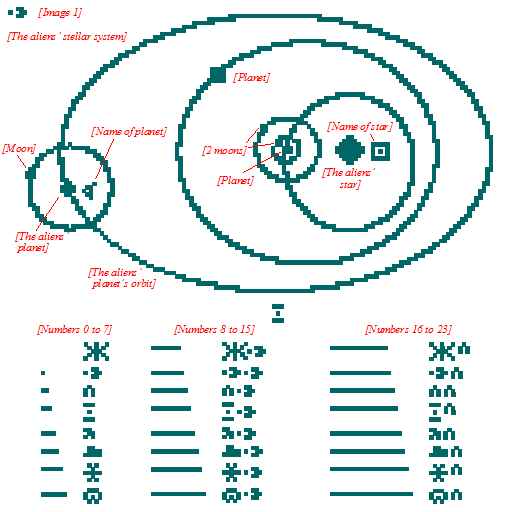
“So how big are the images, assuming that’s what the data is? We found a long sequence of data at half-an-FTU per item, though it took us some time to recognise the change of timing.
“I can assure you, it took us a lot of thought to work out what all that meant. A lot of brainstorming gave us the answer, which is as follows; I won’t bother you with all the blind alleys we went up! The primes go up to 71. 71 FTUs times 2 is 142 FTUs; so each line is composed of 142 pixels and there are presumably 142 lines if we have a square picture, 142 by 142 pixels. 71 times 142 is 10082 FTUs, or about seventeen minutes. We got the computer to draw each line, on the assumption that the image was formed like the good old traditional television picture — a line left-to-right, then the next left-to-right, and so on. It was just rubbish! We tried drawing from right-to-left instead of left-to-right; nothing; up-and-down, nothing. We played around with the end-of-line timing, adding or removing pixels, in case there was a check-sum or whatever, but still nothing came that meant anything.
“To cut a long and frustrating story short, we found that each line is 71 FTUs long, that is 142 pixels, and there seem to be 142 lines. But instead of every line going from left-to-right, or right-to-left, or downwards or upwards, if we alternate lines between left-to-right and right-to-left, we get an image that looks coherent. That’s the image you’ve seen already. The lines simply zig-zag back and forth.”
“Sounds like your student did a lot of work to get that lot sorted out.”
“He certainly did! I’ve told him to get some well-earned sleep now, as what follows isn’t quite so intensive in a mathematical way — not so much discovering the mathematical algorithms being used. From now, our job is to try to understand what the images mean. He, by the way, is a graduate in French, not a scientist or mathematician at all!”
“That’s pretty impressive, difficult even for a mathematician to sort out!”
“We’ve more or less got what the first image is. It’s the others that may prove to be more of a problem. I’m going to have to bring in some other people from other disciplines to help with this, as our blinkered vision may not be enough!”
“Can you talk me through the image we’ve already got? By the way, how many images are there altogether?”
“So far we’ve got eight. But after the first four there is a break for a repetition of the primes, and then image 1 is repeated followed by three new ones. That pattern may go on for a long time... who knows?”
“Take me through this image. I assume the three big rings are the orbits of the planets round the star.”
“Yes, that seems clear to us; there are three planets, the innermost one with two satellites, the second with none, and the third with one. We guess the symbol to the right of the star represents its name, and similarly the name of the third is to its right. By the way, the red annotations in brackets in italics are our interpretations of various words, numbers and parts of the image.”
“What’s the symbol in the top left corner?”
“Well, if you look at the bottom half of the image, there is a table; it’s in three groups of two columns each. The first column of each consists of simple lines of blips, of width 1, 2, 3 up to 23 half-FTUs, so we assume the symbols to the right of each represents how the aliens write these numbers. They clearly represent an eight-based number system. So the symbol shaped like a dot with a horizontal tuning fork in the top left is ‘1’; the next image starts with ‘2’, so these seem to be the image numbers. The symbol below the stellar system map is a ‘3’, which we believe represents the number of the planet the aliens are from, which could explain why they have named that one but not the other two.”
“That’s very good of you to explain all this. When you come down to it, it’s all very logical.”
“True, it has to be — this is one intelligent race hopefully ‘talking’ to another with only maths as their shared language. But the logic is not easy to follow. Meanwhile, as I have a lot to do to catch up on domestic university matters, can we say that this interview is over? What’s your next step?”
“Well, this story has already broken, though obviously not in the detail that you’ve just given me. Just one more question. Can you tell me who first put you onto the idea of this being a message from aliens?”
“Ha!” Ivan smiles as he remembers the first tale he had from Harry’s neighbour. “The first hint was from a man called... just a minute while I look for the details in this drawer. Ah yes, he’s called Clifford...” and he gives Ewan his full name and address. “Don’t say anything, but off the record, he’s a bit of a nutter. He’ll go berserk if you don’t credit him with the initial discovery. He heard some strange signals on his radio and thought of aliens and the film Contact. We got his message via an intermediary, and thought it might be worth trying — we were getting desperate for ideas at that stage — but that’s where his contribution ends, though I will admit it was a valuable kick to put us onto that track. May I suggest that you send your most junior reporter to see him, tell him to give the guy some credit for the initial discovery, but treat what else he says with a big pinch of salt. I’ve never spoken to him, but that’s what I’ve been told by a trusted friend.”
“OK. Fine. Thanks for your help. I think this is a story I’ll try to sell to one of the broadsheet Sunday papers, not the tabloids, who’ll make too much sensational rubbish of it. Let them go their own way. Can I request that you keep me informed of developments? I can see further follow-on stories here as you decipher more images.”
“Yes. Indeed.”
Ewan paused for a moment. “Look, I have a suggestion for you to consider. Can I put a reporter straight onto this case, one with a scientific background, who might be able to help your student prepare reports, and perhaps be of assistance with some of the leg-work?”
“I have no objection to that; it could well be of mutual benefit, I can see. Have you got someone in mind with the right qualifications and angle on science?”
“Yes, a guy called Assad Jamir, who’s pretty good with most science stories; first-class honours in Physics from Cambridge.”
“Well that sounds impressive enough. When can he start?”
“I’ll give him a call now, if I may?” Ewan calls Assad on his mobile phone. After a brief conversation with him, he asks Ivan: “On Monday morning?” Ivan nods his agreement and Ewan hangs up. “Can you book him into a decent hotel in Tiverton on my behalf. I saw The Royal Stag on my way up to here. Is it any good?”
“Yes, very good, but quite expensive.”
“That’s OK. Can you book him in from Sunday night for an indefinite period? Tell them the PA will pick up the tab. I’ll tell him to check in with you at, say, nine on Monday, ready for work.”
“Make it ten, as there are a few things I’ll have to do before that. Glad to have met you and had this conversation.”
“Likewise. Can we mention you by name in any articles?”
“Yes naturally, but don’t overdo my contribution; I’m just the team leader. The real workers are my post-grad students. I’ve got more than just one researcher on this, though I didn’t want to give too much away earlier; it’s clearly an important matter, but I want to play it low-key at first, so that my people get their due credit, without the Americans or French grabbing the credit.”
“Just one question? Why do you want this published in the national press rather than a scientific journal, like Science?”
“Mainly because it’s such an important story for the general public; it isn’t just an obscure piece of academic research. I think it’s only right that the public should get this story more or less directly from us, not by a hack journalist’s interpretation of a technical article, if you’ll excuse my language. We’d like you also, if you can, to get the science published. Otherwise we’d like to reserve the right to publish the scientific groundwork in a scientific journal.”
“Yes, I understand that. And thanks a lot for the interview.”
Nothing much appears in the following Sunday’s papers. One tabloid has an ‘exclusive’ report containing no more details than those from the press conference. There’s certainly nothing in the Sunday papers from the interview with Ewan. On Monday morning, Ivan checks his e-mails and the forum about the star. There’s a note from Ewan to say he’s heard from Assad, who has checked into the hotel.
Ivan calls his students into his office once they’ve all arrived at the University, to brief them on his interview with the Press Association and to tell them about the new member of the team. None of them objects to being named in any article that’s published, nor even to a group photo or individual ones. Then Assad arrives and is introduced to his co-workers and shown an office that he can use; the IT people make his laptop ‘known’ to the department’s intranet so that transfer of data and stories will be that much easier. They are all warned about Clifford trying to take all the credit, and then they wait for Harry and Gert to arrive. When they do so, they too are put into the picture. The whole ensemble walk to the restaurant, as the weather is fine and rather warm.
Lunch is excellent, both food and wine. Afterwards they relax in the restaurant’s coffee room, until a natural break-point comes along. Then they disperse.
Ivan takes Assad, who has taken only soft drinks and has remained completely sober unlike the others, back to his office and goes through the details of ‘the story so far’ with him. Ewan has already told him everything he knows on the subject, so Ivan essentially continues from there.
Ivan’s students return to their digs or student rooms to sleep off their well-earned meals.
Back in Bossington, Harry helps Gert up the hill and sees her indoors. She falls asleep, replete, on her sofa, and doesn’t wake up until Tuesday morning, with a rather sore head. But at least she enjoyed the day out, and the food was wonderful, without having had to prepare it herself.
When Harry gets home he soon receives a phone call from Clifford who says he’s been interviewed by a senior reporter from an important newspaper, though he doesn’t seem to know which one when Harry asks him. He has told him all about how he discovered the aliens, and had been in communication with them; Harry doesn’t bother pointing out that ‘communication’ is a two-way process.
A telephone rings.
“When the red, red robin...”
“Comes bob, bob, bobbin’...”
“At your door...
“Are you still with us?”
“If I’m needed.”
“We’d like to know what’s happening in the Astrophysics Department at the University of Exmoor in Tiverton. It might be a group of loony scientists, or they may be onto something big.”
“I will do what I can.”
The caller rings off.