
Loading...
Loading...
The four students and Assad assemble in Ivan’s office on Tuesday morning and plan the next phase of their work. So far they’ve decoded image 1 and started on image 2, which begins with a diagram showing the Plough.
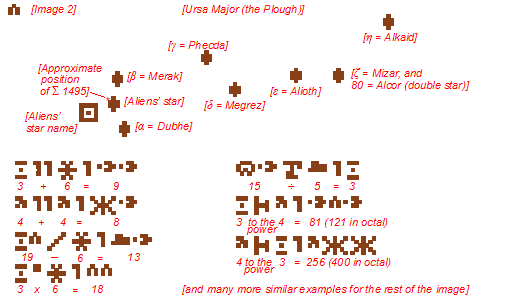
The remainder of the image seems to be a more ‘wordy’ piece. They notice that the number symbols appear fairly frequently, and they assume that arithmetic statements are being described, so that the recipients of the message might be able to learn just a little of their language. Arithmetic seems the logical place to start.
Louisa is given the task of trying to decode that part, and to start a dictionary; Ivan has asked her to do this as it will obviously be very useful, but also because Louisa seems a meticulous student, and her conscientiousness will, he hopes, rub off onto the others.
Images 3 and 4 look like paragraphs made up of the first ‘words’ in image 1’s list and some of the words from image 2. Those are Martin and Anna’s assignment.
At the end of image 4, the primes from 1 to 71 are repeated twice, as before.
Clive’s job is to continue reading the signals from the aliens and to put them into a form where the others can pick up his work. For each image, he is to try to discover what its structure is: ordered lists, diagrams; sets of paragraphs — to get some gist of what the image represents.
After the chart of Ursa Major the rest of Louisa’s image turns out, as she quickly discovers, to be a series of arithmetic statements, all using a base-8 number system, which she presents in the two forms (bases 8 and 10) in her report.
Louisa notes that there are a large number of expressions that use exponents (just like ‘3 to the power of 4 equals 81’, but which are more complicated), so she notes the fact, drawing it to the attention of her colleagues, and suggests that it may mean that very large numbers are involved in some of the further images. She deduces what the words between the numbers are from their possible arithmetic relationships. So she adds to the dictionary that already contains the numbers, the star and planet names, words for and/plus, are/equal/is, less/minus/without, times/multiplied by, divided by/distributed among, to the power of/with exponent. She also consults a thesaurus and adds other synonyms. Agreement among the four students confirms Louisa as the keeper of the dictionary, so she works for some time on the best way of organising alien words to ease the problem of looking them up. She consults a member of the Oriental Languages department for ideas for building dictionaries of non-alphabetic languages, if that’s what this is.
Martin and Anna’s images seem more complicated. They consist of an ordered list, with words and other numbers intermixed. They list the things they know, and then realise that many of the other words are the same. Some typical lines from image 3 (image 4 is similar but rather more complicated) are:
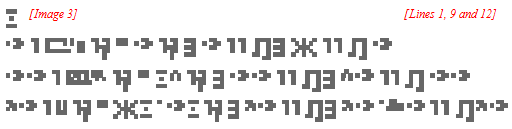
They come up with a skeleton translation that looks, for the first two, like:
1 equals aaa bbb ccc 1 ddd eee 1 plus fff 0 plus ggg 1
and
9 equals hhh bbb ccc 19 ddd eee 9 plus fff 10 plus ggg 9
where ‘aaa’, and so on, are unknown words or phrases; after some brainstorming they interpret these as:
1 is Hydrogen with mass 1 with 1 proton plus 0 neutrons plus 1 electron
and
9 is Fluorine with mass 19 with 9 protons plus 10 neutrons plus 9 electrons
They realise that the protons and electrons may be interchanged as in all neutral atoms there are equal numbers of each. The two images represent all the elements with atomic numbers from 1 (hydrogen) to 32 (germanium). What is more, some elements that have two common isotopes are shown, for 12 (magnesium), as:
12 is magnesium with mass 24 or 25 with 12 protons plus 12 or 13 neutrons plus 12 electrons
By the end of the day, they have a list of the names of 32 elements, and lots more words for Louisa’s dictionary. Of course they have cross-checked the information given with standard periodic tables of the elements. It has been quite a productive day’s work.
And Clive has already done a first pass of images 5 to 12 and further.
He has found that images 5 and 9 are exact copies, apart from the number, of image 1. Clearly the aliens want to repeat this elementary image as frequently as they can so that anyone entering the coded sequence at an arbitrary time would get the basic information fairly quickly.
Assad has been going to and fro between the researchers, noting things that look particularly interesting. He phones Ewan twice, asking for guidance on the journalistic side, and begins to prepare his first draft articles.
Image 6 starts with what looks like a very simple stellar system.
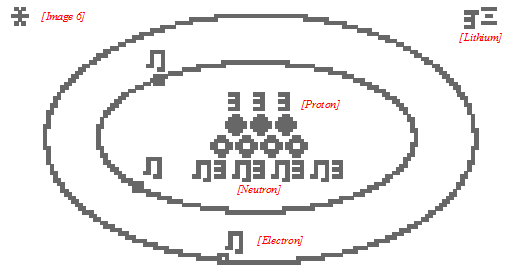
He checks Louisa’s dictionary and finds that the word above and to the right of the diagram is ‘lithium’, and quickly confirms the words for ‘proton’, ‘neutron’, ‘electron’ are as Martin and Anna have discovered; he also resolves the possible confusion (and so advises Louisa) between ‘proton’ and ‘electron’ from the diagram, which seems to represent the classical Bohr model of the Lithium-7 atom.
The remainder of image 6 contains paragraphs of some sort, which seem to contain some of the characters in the list that Anna and Martin are looking at, and some of the number symbols. Clive will suggest that they take a look at it when they’ve decoded their current piece.
Clive also finds that the prime number sequence and the elementary image 1 are repeated every block of four images, as far as his data extends. He goes through all this data dividing it up into separate images, to make further interpretations or translations easier to manage. He also checks that the copies of image 1 are indeed the same, to eliminate any possibility of missing new information. He goes as far as the 33rd image without finding any differences, apart from the image numbers, and the odd pixel that was present or missing from image 1. He notes all such ‘blips’ just in case they are significant rather than just transmission or reception errors. Presumably the whole sequence of images will be repeated after the last image, which will give them the opportunity of checking such blips.
At 5 p.m. they all meet in Ivan’s office.
“Progress reports, please,” says their group leader. “Let’s take them in image number order. Louisa, image 2, please.”
“The image consists of a chart of Ursa Major that shows where they are, as seen by us, followed by lots of arithmetic statements, like ‘15 divided by 5 equals 3’ — addition, subtraction, multiplication, division and exponentiation — which seems to be very common; my guess is that they’re going to present us with some really big numbers — no operations are shown on fractional numbers though, only whole numbers. This has enabled me to start the dictionary, which I’ve discussed with the specialists in the Chinese department, to find the most satisfactory way of creating dictionaries for non-alphabetic languages or languages that use an unknown alphabet. The dictionary is being updated by each of us as we discover new words. Also I’ve noticed that they don’t seem to distinguish between singular and plural forms, and the number of something follows the noun for whatever it is.”
“Excellent,” Ivan comments. “Sounds like a good piece of work. Presumably Ursa Major looks pretty much the same from where they are, as we seem to be so close to them.
“Martin and Anna, images 3 and 4?”
Martin explains that the two images are very similar in structure. “They’ve got statements in them like ‘12 is magnesium with atomic mass 24 or 25 with 12 protons and 12 or 13 neutrons and 12 electrons’ and go from hydrogen (atomic number 1) to germanium (32). Because the numbers of protons and electrons in a neutral atom are the same, these words could be swapped. Fortunately Clive has resolved this ambiguity.”
“Do the words all appear to be single symbols?” Ivan asks.
“Frankly,” Louisa replies, “it’s difficult to tell, as each word has a small number of components, perhaps only one. The jury’s out, but they certainly use multiple symbols to represent numbers with more than one digit, and their numbers are all to base 8. Also, their numbers are reversed compared with ours, so that ‘ten’ is ‘one-two’ for us in base 8, but they put it as ‘two-one’; I think we’re going to get confused by this in the future. Another problem is that as the pixellation of the images is so crude, the actual symbols that they use in writing are likely to be quite different, and maybe two different symbols come out the same in these images.”
“OK, good to be forewarned. Clive?”
“I’ve confirmed that the list of prime numbers up to 71 and image 1 are repeated every fourth image. Images 5, 9 and so on are the same as image 1, except for the image number. There are also a few odd blips, which I take to be transmission errors; however, I have logged them, just in case they have some significance. I’ve also split up all the remaining images up to image 20 into individual files, so the next images are already sorted out and printed, ready for analysis. It looks as if the sequence starts again after 20 and consists of 20 images with intervening prime numbers.
“Assad and I have also started on image 6 which has a diagram that is the classic Bohr model of a lithium-7 atom. There’s also some text underneath, which I think Anna and Martin should look at as it seems to contain some of the symbols on the images they’ve been looking at.”
“Well, that’s more than I’d’ve expected from you in one day — not belittling your potential, of course. What I mean is... you’ve all done a great job today.” Joking, he adds: “You haven’t met these aliens before have you? And last, but not least, Assad. How are things with you?”
“I’ve mostly been getting myself up to speed on what the others have been doing, and, of course, researching those aspects of astronomy that I’m not that familiar with.”
“Any problems?”
“No, not really. Your guys have been very cooperative and I’ve even prepared some draft material for publication. I’ve worked with Clive on image 6. I’ve also called Ewan a couple of times to clarify some of the issues regarding publication.”
“Let me tell you what I’ve been up to. After last week’s press conferences here and in Paris, a lot of people have asked for copies of the source data. I have resisted that, saying that it was Jean le Camp who first saw the data, so that its distribution would be up to him — I haven’t revealed yet that we’ve got far more images than he first found. Unfortunately — or perhaps fortunately — he’s on holiday skiing somewhere in the Alps, and nobody can contact him. So naturally they all came back to me to find out what we’d discovered. I fended them off by telling them how we decoded image 1 — all the zig-zagging — and said that my post-grad is working on the next image. I said ‘my postgrad’ simply because I don’t yet want anyone to know how much effort we’re putting into this project. I’m not going to give too much away at this stage, as I want us to get the major credit for whatever it is we discover, not the Americans, French or whoever! Am I being too chauvinistic with this or just trying to win brownie points?”
Martin answers for them all. “We’ll all work flat out from here, and we’d prefer to keep our head start.”
“Good. I hoped you’d support me.”
“Clive, Louisa and I will keep our heads down. Has anyone in the rest of the Press got properly onto the connection with the Black-Out?” Anna asks.
“Not yet, but time will tell. I have revealed the connection to the Press Association, on the basis that they will hold it back until I give them the OK. I think I can trust them, eh, Assad? After all, strictly we don’t know anything about the connection except that it exists coincidentally. We must press on while we’ve still got the ball in our court, eh?”
They all agree.
“Rather than having you working in individual offices, I’ve booked one of the meeting rooms downstairs so that there’s as much interaction among you as possible. I suspect the material is getting more complicated — they’ve told us the easy things like how they count, what the first group of elements are and how they are made up. You’re likely to need to do some real brainstorming. If any of you feels he or she wants to work privately on some decoding, feel free to go to your own office, but stick together when you can, and feel free to ask questions of each other and of me. There’s no shame in ending the day saying ‘I’m lost, I’ve done nothing, I’ve discovered nothing’ — that’s life. We are on totally alien territory — pun intended! See you all tomorrow morning. ‘Squad: dismiss!’ as my old Flying Officer used to say.”
The four students privately groan to themselves — how many times have they heard that? However, it has been a good day.
Wednesday is, for all of them, rather more challenging. They start image 6 from below where Clive had left off with the diagram of the lithium atom, by filling in all the words and symbols that are already in Louisa’s dictionary. It clearly is about some of the chemical elements, and contains numbers and operators too.
“Actually,” Anna observes, “there aren’t that many unknown words here. What’s the gist of it? Elements, numbers, operators... Could it be chemical formulae? Things like H2SO4 — not that, presumably, but that sort of thing.”
Clive adds: “Maybe they are telling us what their atmosphere is made up of.”
Silence while they all look at the print-out of image 6 under the lithium atom. They translate what they can, where ‘hhh’, etc. denote unknown words:
1 hydrogen is mass 1 with 1 proton and 0 neutrons and 1 electron
2 hydrogen is mass 2 with 1 proton and 1 neutron and 1 electron
3 helium is mass 3 with 2 protons and 1 neutron and 2 electrons
4 helium is mass 4 with 2 protons and 2 neutrons and 2 electrons
electron plus is electron with hhh plus iii jjj kkk lll mmm electron
electron minus is electron with hhh minus
1 hydrogen 2 is 2 hydrogen plus electron minus plus nnn electron minus plus electron plus is ppp 2
1 hydrogen plus 2 hydrogen is 3 helium plus ppp
3 helium 2 is 4 helium plus 1 hydrogen 2
3 helium plus 4 helium is 7 beryllium plus ppp
7 beryllium plus electron plus is 7 lithium plus nnn
7 lithium plus 1 hydrogen is 4 helium 2
7 beryllium plus 1 hydrogen is 8 boron plus electron minus plus nnn
8 boron is 8 beryllium plus electron minus plus ppp
8 beryllium is 4 helium 2
12 carbon plus 1 hydrogen is 13 nitrogen plus ppp
13 nitrogen is 13 carbon plus electron minus plus nnn
13 carbon plus 1 hydrogen is 14 nitrogen plus ppp
14 nitrogen plus 1 hydrogen is 15 oxygen plus ppp
15 oxygen is 15 nitrogen plus electron minus plus nnn
15 nitrogen plus 1 hydrogen is 12 carbon plus 4 helium
“Got it!” Martin exclaims after several minutes when they have all been juggling the words and numbers. “Where we talk about ‘lithium-7’, say, they use ‘7 lithium’; ‘1 hydrogen 2’ means ‘2 atoms of hydrogen-1’. So ‘2 hydrogen’ is actually deuterium.
“‘hhh’ in lines 5 and 6 means ‘charge’. I don’t know about the extra words in line 5, the ‘iii jjj kkk lll mmm’; it seems a bit complicated with five consecutive words or symbols that they haven’t given us a clue about. Perhaps it just means that an electron and a positron are otherwise the same, except for the charge.
“Has anyone got a book on elementary nuclear reactions? The next four lines are the proton-proton cycle, and ‘nnn’ and ‘ppp’ are photons or neutrinos, I can’t remember the details — which is which. The next lines with beryllium, lithium and boron are different ways the fusion reaction can go. The last few lines are a description of the carbon-nitrogen cycle. All of these reactions basically generate one helium atom from four hydrogen atoms, and give off a hell of a lot of energy. That’s basically how the Sun works. It’s probably how their star works too.”
From the bottom of the previous column
“Hang on,” Anna interjects. “Aren’t brown dwarfs supposed to have no nuclear reactions? They are stars that never had enough material in them to collapse into proper stars that emit light by converting hydrogen to helium; they just burn themselves out by releasing gravitational energy, or something like that — I’m not an expert!”
Louisa has found a book with these nuclear reactions described. “You’re right, Martin. ‘ppp’ is a photon and ‘nnn’ is a neutrino.”
Martin is feeling a little cocky now. “I bet E = mc2 comes along soon, in some form or another. Maybe Einstein took his summer holidays on their planet. Actually it’s really interesting that their scientific knowledge parallels ours.”
“Let’s have lunch and then look at images 7 and 8.” Agreed.
After lunch in the University’s main refectory, they resume from where they left off. Assad joins them.
Louisa summarises the story so far, to give the others time to think.
“Does everyone agree with that summary?”
“Sounds fine to me,” they all concur.
They look at the print-outs of image 7. At the top of the image is a copy of the image of the alien stellar system, but without the moons.
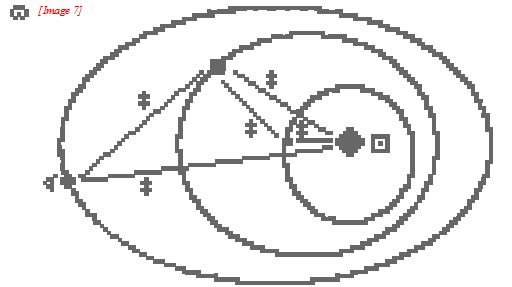
“Why is the same symbol alongside those lines, the line with two cross signs?” Martin asks. “And it even joins two of the planets, no, two pairs.”
“That symbol is called a ‘diesis’ or ‘double-dagger’. They might be telling us that something is the same no matter where you look,” suggests Assad. “Could it mean ‘gravity’?”
“Why would they tell us that there’s gravity in their stellar system?” asks Clive. “Isn’t that obvious to us? After all, they’ve assumed that we’ll understand what a stellar system is — we’re in one — and that we’ll be able to interpret their material about the structure of elements, electric charges, and so on. It must be something more.”
Martin chips in: “No. It’s not gravity. They are saying something about a universal constant. Look. Below the picture is something that explains the symbol. It is saying that ‘‡ is qqq rrr sss is’ and then there’s a number.”
“It’s a huge number, there’s the symbol for exponentiation there as well, and look at all those digits,” Anna adds.
“I told you they’d be telling us something involving huge numbers!”
Clive cautions them: “Yes, it’s huge, but we don’t know what the units are. If one unit was the radius of the hydrogen nucleus, then anything bigger than atoms and molecules would probably — certainly — involve enormous numbers.”
“What universal constants are there?” Martin asks, adding “Dimensions or masses of protons, electrons, atoms — maybe it’s to do with lithium, after all they went into some detail on that earlier.”
“True, but lithium’s a bit odd. What significance could it have?” Clive replies. “They can’t be a lithium-based life-form, and lithium isn’t likely to be the most prolific element on their planet, is it? No, they used lithium before because it’s a simple element — the first such one in the periodic table — with an unequal number of protons and neutrons. Surely they’d go for hydrogen, the most common material in the universe if they were going to describe something to do with an atom. Lithium’s too complicated, I’m sure.”
“I agree,” says Louisa. “It’s either hydrogen or nothing to do with any specific element.”
There is silence again while they all mull over the problem. Clive leaves the room and goes to his office.
Five minutes later he returns. “Got it! It’s the speed of light. I looked up a list of other physical universal constants and they are all very small — things like the mass of an electron, proton, Planck’s constant, the charge on an electron, etc. The only other big one is Avogadro’s constant.”
“What’s that?” someone asks.
“The number of molecules in a gram-molecule of a substance. But that’s too obscure, I’d have thought,” Clive adds. “No, I’m sure it’s the speed of light, about 3×10⁸ metres per second. If it had been something to do with Avogadro’s number, they’d have got us closer to the ideas of molecules and collections of them, or something like that, first.”
“Could be,” Martin tentatively agrees. “But speed involves two dimensions, a length and a time.”
“We’ve got a candidate for the time unit,” says Clive. “One FTU or 0.09848 of a second; or possibly half an FTU. We haven’t seen anything about lengths though. We need some standard length to be able to confirm it’s the speed of light.”
“There’s one length that’s staring us in the face!” Louisa suddenly exclaims after a period of quiet thought by everyone. They all look at her blankly. “How about 21 centimetres? It’s the wavelength all this stuff uses!”
There is a race on the four computers to see who can confirm this first. Is 21.1062 centimetres per 0.9848 second versus 2.997 925×108 metres per second the number ‘ttt’ that follows ‘‡ is qqq rrr sss is ttt uuu divided by vvv’ when it is converted to base 8?
“Shit!” Martin cries. “I’m out by a factor of exactly two!”
“Me too,” Anna adds. But after a moment: “But hang on. All this data is being transmitted at ½ FTU. So it’s correct then! ‘qqq rrr sss’ means ‘speed of light’, and their measurement system uses ½ FTU as the base for time and 21 centimetres for length.”
“Just one thing. Why would they want to tell us what the speed of light is? We know their number system, their arithmetic operations, what their solar system looks like, what atoms are like, a list of atoms. Where is all this going?”
Assad asks. “Does anyone think we should involve Ivan yet?”
“No, maybe later. We’ve just discovered how they measure length and time, and they’ve told us their words for ‘length unit’ (uuu) and ‘time unit’ (vvv). I think we should carry on. At least let’s finish this image,” says Martin.
“We’ve got another hour before he’s expecting us. Come on guys! Don’t give up yet!”
But the next sentence on this image has them stumped; it reads ‘ʘ is photon 0 plus neutrino 0’. What does it mean? “They seem to be saying that their star — ʘ — emits no photons or neutrinos,” Clive comments. “But we’ve been examining its spectrum, so we’ve seen their photons. And that same sentence is repeated time and again right to the bottom of image 7. So it must matter to them.”
Louisa adds, “Yes, but their photons aren’t produced by nuclear reactions. Don’t forget that this is a brown dwarf. It could be that their system is so feeble in emissions that they are crying ‘Help us, we’re dying.’”
This thought from Louisa stuns them all a bit.
“I’ve got the feeling that this is getting interesting, and important. So far, they’ve told us nothing new — how arithmetic works, a list of elements, how hydrogen gets converted into helium, but with lots of photons! Now they seem to be telling us something about their star, and it looks as if they’re saying there are no photons coming from it, — well, no nuclear-generated ones,” Anna remarks. “The only other thing they told us was the structure of their solar system and they are on the third of three planets — that’s interesting and may be useful, but not particularly exciting. They didn’t bother to give us a scale for their diagram; maybe that’s not important.”
“Do we really know much about brown dwarf stars?” Clive asks. “My feeling is that they’re not just stars with too little mass to form properly. I’ll see if I can find out more by tomorrow. Does anyone else know much more than that about them?”
There is silence.
“There’s a big diagram on image 8. What is it?” Clive asks.
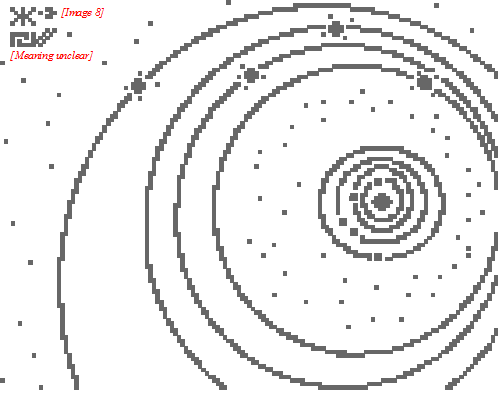
Louisa observes that it looks like another stellar system diagram, but this time with a lot more planets. “Perhaps it’s where they used to come from... No?” as the others look sceptically at her suggestion. “It’s not another atom is it, with radioactivity?”
Clive comments: “I don’t think it’s an atom. There seem to me to be eight planets round a star. Some of the blobs for planets are bigger than others. And what’s all that mess, those specks, between planets four and five, and outside the orbit of planet eight? Do you think they’re just noise in the transmission? I found some odd glitches in other versions of image 1.”
“No, they are too well organised for that, though they do look random. There are some more specks near some of the planets, too. Could they be satellites?”
“Could be. There’s some words below the image number. I wonder what they mean,” asks Anna. “Are any of them in the dictionary?”
“No, none of them,” Louisa replies after checking. They all look closer at the diagram.
Assad observes: “There seem to be two planets in the third orbit.”
“Oh, no!” Clive cries out. “What bloody fools we are. Eight — or nine — planets going round a star, small objects between the fourth and fifth, and outside the eighth, and some satellites. It’s us! It’s our solar system!”
They all incredulously check the diagram; there’s Mercury, Venus, Earth and the Moon in the same orbit, then Mars, the asteroids, Jupiter and some satellites, Saturn ditto, Uranus and Neptune, and more.
Louisa asks, “What’s that,” pointing to an irregular spray of dots beyond Neptune.
Clive replies, “It could represent the Kuiper Belt or the Oort Cloud.”
“What are they?”
“The Kuiper Belt is outside the orbit of Neptune from roughly 30 to 50 astronomical units from the Sun — an AU is the distance between the Earth and the Sun. It’s got up to a hundred million, 108 small icy bodies and is where the short-period comets come from, like Halley’s Comet,” Clive explains. “Pluto used to be classified as a planet, but now it’s just another, admittedly large, member of the Kuiper Belt. The Oort Cloud is much much bigger than the Kuiper Belt; it may contain a trillion, that’s a million million, 1012 objects; every now and then, the orbit of one of them is perturbed and it comes hurtling towards the Sun, goes once round as a comet and is never seen again. The Oort Cloud is about 50,000 astronomical units from the Sun, maybe up to 100,000; nobody knows for sure that it exists, but it explains a lot about the Solar System. There was an object discovered a few years ago, called ‘Sedna’, which may be on the inner edge of the Oort Cloud; it’s over a thousand kilometres across and has a highly eccentric orbit that goes out to nearly 1000 astronomical units.”
“How come you know all this?” Anna asks.
“Didn’t you know I’m studying trans-Neptunian objects for my thesis?”
After a pause while everyone takes in what Clive has said, Martin laughs. “I’ve always thought that our Moon is too big to be classified as a satellite, and because its orbit is always concave to the Sun, we should classify it as a planet. It doesn’t really go round the Earth; the pair do a sort of dance around the Sun together! Earth and Moon are a binary planet, like a binary star.”
“Nice theory!” Clive remarks, not totally convinced.
“Try working out the orbit of the Moon then! You’ll see I’m right.”
Anna asks: “What do we think the words under the image number mean?”
“Oh, something like ‘Your Solar System’ or ‘You dumbos out there!’” Martin facetiously replies.
“I think I’ll add the first translation to the dictionary,” Louisa smiles.
“So is it now the right time to report to Ivan?” Clive asks. “It’s half-past four. We aren’t going to get much done in the next half an hour.”
Right on cue, Ivan enters the room.
“How’s today gone? Anything to report?”
“Only that Clive has discovered us!” Martin replies.
“What’s that supposed to mean?” he smiles, his curiosity aroused.
“Let’s go back to the start of the day and summarise each image,” Louisa, always so organised, suggests. “At the end of yesterday, we’d found that image 6 starts with a diagram of the lithium-7 atom. Then the image continued with descriptions of the hydrogen and helium atoms, defining protons, neutrons and electrons again. It also described the nuclear reactions that convert hydrogen to helium, both via beryllium-8 and the carbon-nitrogen cycle. So we know their words for photon and neutrino. And they keep repeating that their star emits no photons or neutrinos.”
“What? No photons?”
“Only gravitationally generated ones presumably, not those from nuclear fusion because it isn’t converting hydrogen into helium, it’s just collapsing, just gravitational energy,” Clive intervenes. “They keep repeating it, time after time, as if they are crying out for help in some way. It’s clearly very important to them.”
“Image 7...” Louisa continues her status report, “... has a diagram of their stellar system again, but this time the emphasis is on something that is the same for all pairs of objects, planets and their star. There are lines joining the star to planets, and planets to each other, and they all have the same symbol against them. We concluded that they were telling us about some invariant in their system. Eventually we homed in on the speed of light as being that invariant, because the description below referred to a huge number. Now, the speed of light involves two measures, length and time, and we needed to know them both to verify our interpretation of the number. After a lot of thought and argument we decided that the basic unit of time for their transmissions is ½ FTU and the H-I wavelength, 21 centimetres, is their standard length. That worked perfectly and gave us the number on their image once we’d converted 3×10⁸ metres per second into their units, or was it the other way round — it doesn’t matter.”
“That sounds like a fantastic day’s work!” exclaims Ivan.
“We aren’t through yet,” Martin adds. “I said that Clive has discovered us. There’s another diagram in image 8. It’s of our own solar system! Sun, planets, moons, asteroids, even the Kuiper Belt or Oort Cloud, we’re not sure which.
“And the aliens seem to agree with me that the Earth-Moon system is really a double planet!” Martin claims, repeating what he’d told the others: “I believe that our Moon is so big, and because its orbit is always concave to the Sun, we should treat it as a planet. It doesn’t really go round the Earth; the pair sort of dance around the Sun together around their common centre of gravity, which happens to be inside the Earth!
“That’s as far as we’ve got. We haven’t quite finished image 8. Clive’s going to find out a bit more about brown dwarf stars, as we feel there’s something missing in our understanding of them.”