|
|
Localization
and the Changing Role of Linguistics
©
Anthony Pym 2000
Paper presented
to the conference “Traduction humaine, traduction automatique,
interpretation”, Université Tunis I, 28-30 September
2000
Abstract:
The discourse of localization, now generalized beyond
the domains of software and product documentation, has
successfully outflanked restricted linguistic notions
of translation. This new situation has certain consequences
for the traditional role of linguistics, notably with
respect to the enhanced need for projects based on interlingua
architectures. This includes the use of multilingual
terminology databases, controlled writing, disambiguity
tagging, and the integration of MT, such that most linguistic
intervention is effectively prior to the moment of actual
translation. These features call into question the usefulness
of comparative or contrastive linguistics, especially
when limited to language pairs. At the same time, what
is urgently needed is empirical study of the ultimate
commercial and cultural effects of the various localization
strategies.
We
begin with a bad joke, based on the originally American
form of the ‘dumb blonde’ joke. That form is now operative
in many languages and many cultures (we will say,
many ‘locales’), and may be adapted (let’s say, ‘localized’)
to many purposes. Here the archetypically vapid blondes
have transcended mere sexism and, with equal lack
of justice, have turned into comparative linguists.
This is unfair. But here goes anyway:
A
comparative linguist is walking along and comes to
a river. They look across and, seeing another comparative
linguist on the other side, call out ‘How do I get
to the other side?’. This, after all, is the fundamental
problem of translation, to get to the other side,
to reach that culture B from the known culture A.
And the second comparative linguist replies, of course,
‘But you are on the other side!’
The
moral of the story might be that the problem of translation
(getting across the river) is not the problem of comparative
linguistics (comparing the two sides of the river).
Or more philosophically, arriver chez l’autre (translation)
is not quite the same thing as analyser l’altérité
(in linguistics). This is a profound difference. One
might continue to think in terms of the following:
 But
then, that arrow in the middle might as well go both
ways, from source text to target text and back again.
All the work that allows one side to understand the
other also allows the reverse comprehension. However,
translation—and by extension translation studies—is
condemned to deal with movement, with asymmetries
in time and place, and with the consequent changing
of cultural relations, hopefully for the better. Linguistics
of the comparative kind avoids such asymmetries by
presupposing confronted systems, be they of tongues,
cultures or fields, in such a way that what is essential
to either side should remain that way and ideally
survive the process of translation. That is essentialist
thought par excellence. It is also part of the noble
struggle to preserve the diversity of human languages
and cultures. And this is so even when the theories
and models of linguists cannot grasp the challenge
they confront. Without substantial directionality,
a strong arrow going one way and not the other, such
theories cannot see movement as anything more that
the illusory threat of sameness, of a globalized culture,
of the non-academic future as disaster. The noble
struggle is thus fought blind.
But
then, that arrow in the middle might as well go both
ways, from source text to target text and back again.
All the work that allows one side to understand the
other also allows the reverse comprehension. However,
translation—and by extension translation studies—is
condemned to deal with movement, with asymmetries
in time and place, and with the consequent changing
of cultural relations, hopefully for the better. Linguistics
of the comparative kind avoids such asymmetries by
presupposing confronted systems, be they of tongues,
cultures or fields, in such a way that what is essential
to either side should remain that way and ideally
survive the process of translation. That is essentialist
thought par excellence. It is also part of the noble
struggle to preserve the diversity of human languages
and cultures. And this is so even when the theories
and models of linguists cannot grasp the challenge
they confront. Without substantial directionality,
a strong arrow going one way and not the other, such
theories cannot see movement as anything more that
the illusory threat of sameness, of a globalized culture,
of the non-academic future as disaster. The noble
struggle is thus fought blind.
Here
I would like to consider something between those two
poles. The discourse of localization has not developed
from translation theory, nor is it an invention of
academic linguistics, as far as I know. It comes from
practice, perhaps from the best-paid mediating practice
of our time. The term ‘localization’ originally referred
to the production of software for many languages and
cultures, ‘locale’ being a convenient term for a particular
configuration of language and culture. Localization
would thus mean taking the (usually) American software
and rewriting it so that it can work in a different
locale. This would involve both translation (in the
restricted sense of replacing user-visible natural
language strings) and adaptation (adjusting to the
local conventions of numeric representation, currency,
dates and so on). A rough idea of this can be grasped
from your computer. Here I am working with Microsoft
Windows98: I go to Configuration in the Start Menu,
select Control Panel, select Regional Configuration,
and I find a long list of locales. Try it. For English
we have Australia, Canada, the Caribbean, the United
States, Ireland, Jamaica, New Zealand, the United
Kingdom and South Africa. For Spanish, there are 20
such locales listed. Microsoft also gives us the same
locales for the actual languages concerned (in Word97,
go to the Tools menu, select Language, select Set
Language, and you should find the same list). Of course,
you have to buy the dictionaries and thesauruses to
make all those locales work. But it is possible to
do so. I use Word97 to correct my Catalan.
That
much seems simple enough: there are localized versions
of the best-selling software; the multinational can
help develop the local. When people in IT talk about
localization, however, they are most concerned with
what we might call the non-translational aspects.
Given the complexity of software programmes, the replacement
of user-visible natural-language strings costs far
less than the necessary re-engineering of the programme,
the changing of dialogue boxes, the re-allocation
of hot-keys, the coordination of all the various changes,
the testing of the localized version, and the project
management necessary to organize all the teams involved
with strict time constraints. By most accounts, translation
would account for about a third of total localization
costs. In other words, to put things bluntly, the
kinds of linguistic problems that our traditional
comparative linguists deal with are no more than a
third of the problems that the fastest-growing language
industry has to deal with.
Confronted
by extremely high localization costs in the 1990s,
Microsoft successfully reduced those costs by ‘internationalizing’
their products prior to the moment of translation
(Brooks 2000). This involved taking the American product
and deleting all elements that were in some way specific
to the American market. The most significant part
of this was double-digit encoding of all natural-language
fonts (instead of the single-digit encoding used for
English) so that the source codes could then be transferred
into the Oriental languages. Such localization-sensitive
software engineering meant that all the hard work
was put into producing just the one generic product,
which could then be localized into any number of languages
and cultures.
This
would seem to be the main message of software localization:
investments in a generic product mean savings in multiple
locales. Admittedly, ‘internationalization’ is not
a happy term for this generic product—nations have
little to do with this—and one might talk more fashionably
about ‘delocalization’ as the step to the middle stone.
Whatever the term, the basic model would be something
like the following:

In
recent years the discourse of localization has extended
its range of application beyond software. It is now
common enough to talk about the localization of websites,
of product documentation, or of news items (see Sprung
2000 for a series of case studies). This is proving
to be a very successful theory, commercially outflanking
anything mainstream translation theorists have done
in recent decades. Why the success? Well, people can
be made to understand these terms; these are words
and concepts that are easily explained to clients
or managers; they bring the aura of things happening
now, the Jetztzeit of the New Economy. Second, the
fundamental model is constantly tested in practice,
in ways that seek and need little from university
locations or academic prestige. Third, the process
can be shown to save money, and to do so in the sectors
where the most money is moving. Fourth, as a consequence
of the above, it is the basis of a high-pay job market
that is currently hungry for competent language professionals.
There are thus quite a few very good reasons why a
university translator-training school might pay close
attention to the discourse of localization, and why
we should be training localizers and not just translators
(for further reasons, see Pym 1999). Localization
theory is achieving virtually everything that traditional
translation theory has ceased to achieve.
Then
again, you will object, the concept of localization
is bringing us nothing essentially new. And that is
quite right. Translation theorists have been talking
about ‘language and culture’ or ‘the cultural component’
for at least 30 years. If we should now have a convenient
word for the thing (‘locale’ is at least shorter),
the conceptual advance is not of overwhelming proportions.
More important, the basic idea of producing an intermediary
generic text has long been applied in many fields,
and in many facets of standard translation procedures.
We might name the following as examples of the same
underlying idea:
-
Certain theorists (perhaps starting with Gouadec 1989)
insist that the first stage of the translation process
is to revise and verify (‘établir’) the source
text so as to remove any potential typographical errors
or otherwise disturbing ambiguities prior to the moment
of translation as such.
-
When we emphasise the need for documentation and terminology
research prior to the moment of translation, we are
similarly investing effort in the ‘before’ so as to
save effort in the ‘after’.
-
When the Bible translators of the SIL work into all
kinds of exotic languages, their immediate source
is not the Hebrew or Aramaic texts but skilfully annotated
English versions, giving all the glosses and explanations
needed for the actual translation process.
-
When screen dialogues are dubbed or subtitled (from
English, at least), the source text is increasingly
marked with instructions for the translation, glossing
culture-specific words, tagging ambiguities, and in
some cases indicating the importance of certain implicatures.
-
By extension, our work on standardized terminologies
of all kinds might be seen as effort invested prior
to translation so as to make actual translation easier.
-
The same could be said of the text alignment at the
basis of translation-memory software, where the distribution
of major linguistic effort is similarly focused on
the preparatory phase.
-
And from that perspective, the integration of post-edited
machine translation is yet another application of
the same principle: the more effort we invest in the
MT databases, the better the outputs and the less
the effort needed for post-editing.
-
The production of source texts in a controlled language
(with a limited vocabulary and syntactic repertoire),
necessary for the successful use of MT, can be seen
in terms of the same logic. This is by no means new:
the idea of Basic English has been with us from at
least the 1920s.
Translation
theorists might thus rightfully claim that the discourse
of localization is a simple case of new polish for
old shoes. The idea of an intermediary version has
indeed been around for a long time. So should we refrain
from paying attention to these overpaid commercial
upstarts?
There
does remain one fundamental difference that might
yet justify the term ‘localization’.
If
we look closely at the above list of long-established
and otherwise mainstream procedures, we usually find
a mix of two architectures: the principles are considered
to be the same no matter whether we are moving from
one locale to another (i.e. mediated but paired transfer)
or from a generic version to many locales (i.e. one-to-many
transfer). What we need for moves from French to Arabic
might thus be more or less what we need for moves
from French to the ten other official languages of
the European Union; our research may serve both purposes.
In localization, on the other hand, the emphasis is
consistently on the one-to-many, or on what MT knows
as an ‘interlingua’ (rather than ‘transfer’) architecture.
This, I believe, is a very fundamental difference.
There are at least three reasons for stressing the
point:
-
The very notion of localization, in denominating a
process of working into a locale, incorporates a degree
of directionality and thus asymmetry that is lacking
models where cultures simply face cultures. Admittedly,
this is slightly paradoxical, given that the notion
of internationalization or human interlinguas incorporate
enough naïve aspirations to crown a modernist
Tower of Babel. Yet the underlying geometry of movement
remains unavoidable.
-
In emphasising the many non-translational operations
that language professionals are called upon to perform,
the discourse of localization recognizes that our
graduates will be have to be able to do things other
than translate. They will have to compile terminology
bases, leverage natural-language strings, revise controlled
inputs, post-edit MT outputs, hopefully manage projects,
and so on. A narrow view of translation would leave
students without training in this wide range of marketable
skills.
-
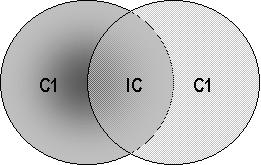
The basic geometry of the ‘intermediate product’ model
further dovetails into a mode of thought that can
no longer place translators in the falsely homogeneous
space of a native or mother language. The professionals
carrying out localization are active in the overlaps
of cultures, in places inhabited by teams of complementary
competencies whose job it is to work on relations
between cultures. Instead of Culture 1 (C1) facing
Culture2 (C2), we would have to think in terms of
an Interculture (IC), which would be the more or less
narrow intersection of the two larger entities:
-
Finally, the ‘intermediate product’ model necessarily
emphases the need to work into many target languages,
and not just the few major languages that can afford
major extensive linguistic defence. We are made to
think about entire sets of languages, placed in a
hierarchy o market priorities (medieval language hierarchies
once measured distance from divine utterance; now
they quantify market potential). We would then defend
not the particular case of Catalan, for example, but
of all similarly stateless European languages of limited
extension.
This
last point requires some elaboration. For example,
the Systran machine translation system used by the
Translation Service of the European Commissions works
very well for transfers between French and Spanish.
But this is because the primitive transfer architecture
has been enhanced by extensive databases and many
years of pair-specific linguistic parsing. The political
result (although not the personal intention of those
concerned) is undoubtedly an indefinite extension
of French as a viable source or intermediate language
in the EU context, along with a certain privilege
for the Romance languages that share many of the syntactic
features of French. But the non-Romance languages
consequently sink toward the bottom of the language-effort
hierarchy, and there is little perspective of Europe’s
many minor languages entering the Systran epiphany.
Would the years of terminological work and syntactic
rule-writing also be invested for Catalan or Welsh?
On the other hand, some such effort might become worthwhile
if an interlingua architecture were adopted for controlled-language
inputs in highly specified official domains. To that
extent, there might yet be political ideals to be
attained through thinking about localization.
What
is to be done?
The
basic concept of localization calls for a departure
from some of the classical linguistic concerns of
translation studies. It implicitly calls into question
the usefulness of pair-restricted comparative or contrastive
linguistics. Yet that criticical potential, at best
appropriate to only some parts of linguistic studies,
is no saving grace. We cannot assume that adopting
the language of Microsoft will lead us to some kind
of earthly paradise. On the contrary, the globalizing
companies using localization are implanting globalizing
culture under the guise of linguistic difference.
Using Microsoft in French is not the same as using
Microsoft in English, but in both cases the mode of
operation is still Microsoft more than anything else.
It is through localization, not in spite of it, that
professional users of technology become the same across
the globe.
That
might be why, even in the age of an international
tongue, there is a growing demand for translations,
mainly from English to the larger languages of consumption.
Localization ultimately takes place to keep producers
separate from readers, agents from end-points, centre
from periphery, internationalization from translation,
sometimes in the name of protecting cultures, always
in the name of identifying and expanding markets.
Thus are maintained the technology gaps that have
long been the secret of economic imperialism. Localization
may not be a good thing (the spread of non-native
English might even be preferable). But the beast must
be named before we can attempt to assess its ultimate
effects.
References
Brooks,
David (2000). ‘What Price Globalization? Managing
Costs at Microsoft’. In Robert C. Sprung, ed. Translating
into Success. Cutting-edge strategies for going multilingual
in a global age. Amsterdam/Philadelphia: John Benjamins.
43-57.
Gouadec,
Daniel (1989). Le traducteur, la traduction et l’entreprise.
Paris: AFNOR Gestion.
Pym,
Anthony (1999). ‘Localizing Localization in Translator-Training
Curricula’, Linguistica Antwerpiensa 33. 127-137.
Sprung,
Robert C., ed. (2000). Translating into Success. Cutting-edge
strategies for going multilingual in a global age.
Amsterdam/Philadelphia: John Benjamins.
-
- Last update
26 December 2000
|
© Anthony
Pym 2014
URV. Av. Catalunya, 35
45002 Tarragona, Spain
Fax: + 34 977 299 488
|