Cabinet and national authorities
- Office of the Reich Chancellery (Hans Lammers)
- Office of the Party Chancellery (Martin Bormann)
- Office of the Presidential Chancellery (Otto Meissner)
- Privy Cabinet Council (Konstantin von Neurath)
- Chancellery of the Führer (Philip Bouhler)
Reich offices
- Office of the Four-Year Plan (Hermann Göring)
- Office of the Reich Master Forester (Hermann Göring)
- Office of the Inspector for Highways
- Office of the President of the Reich Bank
- Reich Youth Office
- Reich Treasury Office
- General Inspector of the Reich Capital
- Office of the Councillor for the Capital of the Movement (Munich, Bavaria)
Reich ministries
- Reich Foreign Ministry (Joachim von Ribbentrop)
- Reich Interior Ministry (Wilhelm Frick, Heinrich Himmler)
- Reich Ministry for Public Enlightenment and Propaganda (Joseph Goebbels)
- Reich Ministry of Aviation (Hermann Göring)
- Reich Ministry of Finance (Lutz Schwerin von Krosigk)
- Reich Ministry of Justice (Otto Thierack)
- Reich Economics Ministry (Walther Funk)
- Reich Ministry for Nutrition and Agriculture (Richard Walther Darré)
- Reich Labour Ministry (Franz Seldte)
- Reich Ministry for Science, Education, and Public Instruction (Bernhard Rust)
- Reich Ministry for Ecclesiastical Affairs (Hanns Kerrl)
- Reich Transportation Ministry (Julius Dorpmüller)
- Reich Postal Ministry (Wilhelm Ohnesorge)
- Reich Ministry for Weapons, Munitions, and Armament (Fritz Todt, Albert Speer)
- Reich Ministers without Portfolio (Konstantin von Neurath, Hans Frank, Hjalmar Schacht, Arthur Seyss-Inquart)
Estructura del Govern
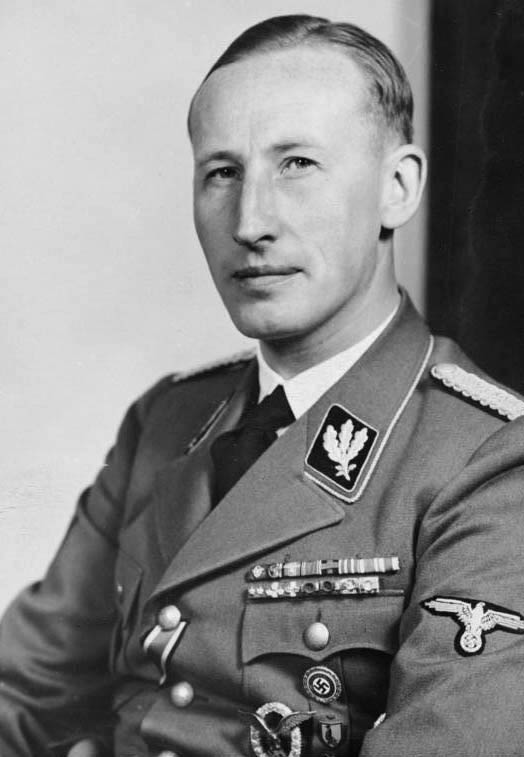
| Reinhard Heydrich
Director de la Oficina Central de Seguridad del Reich
"The man with the iron heart"
|
|
| Hermann Göring
SA-Gruppenführer (Lieutenant General)
Reichsluftfahrtminister, head of the Luftwaffe.
Luftwaffe Field Marshal (Generalfeldmarschal).
Reichsmarschall
Commander-in-Chief of Forschungsamt ("FA"),
the Nazi underground monitoring services
for telephone and radio communications
|

|
|
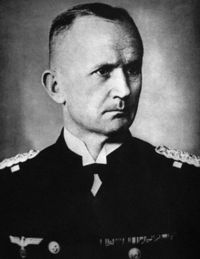
| Karl Dönitz
Grand Admiral (Großadmiral)
Commander-in-Chief of the German Navy (Oberbefehlshaber der Kriegsmarine)
Reich President
Va firmar la rendicióo de Alemania a la WWII
|
|
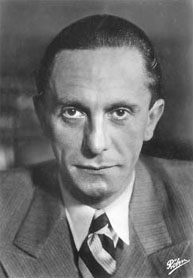
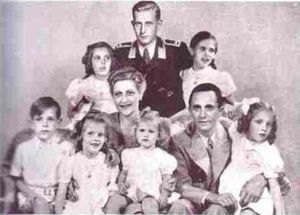
| Joseph Goebbels
Propaganda Minister
Chancellor of Germany (Reichskanzler)
Promoted the distribution of inexpensive single frequency
radio receivers (the so-called Volksempfänger, "People's radio")
to the German public
which ensured that millions of people heard the output of the Reich's propaganda ministry
|
|
|
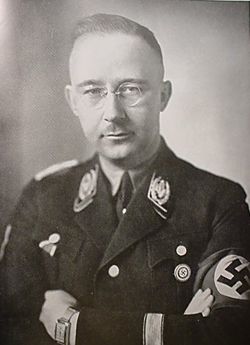
| Heinrich Himmler
Commander of the German Schutzstaffel (SS)
As Reichsführer-SS he controlled the SS and the Gestapo.
From 1943 onwards he was both Chief of German Police and Minister of the Interior.
|
|
|
|
- SS - Schutzstaffel. Literally "Protection Squadron"
- SA - Sturmabteilung.
Paramilitary wing of the Nazi Party (NSDAP).
- SD - Security Service of the Reichsführer-SS.
Branch of the SS.
It was the intelligence agency of the SS and the Nazi Party in Nazi Germany.
Triumph des Willens , 1935
On 5 September 1934
20 years after the outbreak of the World War
16 years after the beginning of German suffering
19 months after the beginning of the German rebirth
Adolf Hitler flew once again to Nuremberg to hold a military display over his stalwarts
Diferencia
- Gestapo - policia secreta de l'estat a l'Alemanya nazi
- Wehrmacht - nom de les forces armades alemanyes - policia militar alemanya
Arquitectura
El Führer tuvo tres arquitectos de cabecera: Paul Troost, Hermann Giesler y Albert Speer.
El primero murió prematuramente.
El segundo se centró en los trabajos en Weimar, Múnich y Linz.
Y el tercero fue quien supo llegar realmente al corazón de Hitler.
LV
Joachim Fest, biógrafo de Speer, apuntó que entre mecenas y artista existía una extraña corriente homoerótica.
- Oficialmente la Segunda Guerra Mundial comenzó la madrugada del 1 de septiembre de 1939
con los disparos del acorazado alemán “Schleswig Holstein” sobre la Westerplatte, en Gdansk
- *** fi de la WW2 - 9 de Maig de 1945 -
ru,
es ***
- Berghof - near Berchtesgaden, Bavaria
- Wolfsschanze - near Rastenburg, East Prussia (Polonia now)
- Maisy battery, in Normandy
- Erich Ludendorff -
chief policymaker in a de facto military dictatorship that dominated Germany for the rest of the war (WW1)
- 11 de Maig de 1939 a Mongolia