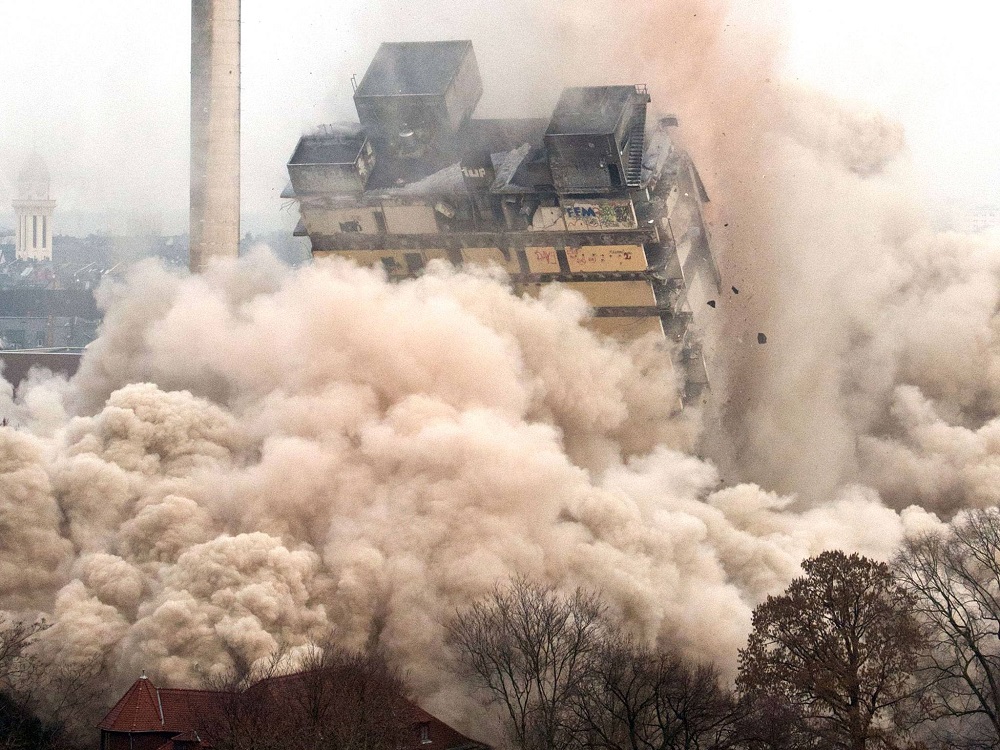
What some people think should happen to new monstrosities — demolition of a 116-metre University tower block in Frankfurt, Germany
You can click on pictures in the sections below to see enlargements.
See also my web pages about London Buildings and the River Thames.
Favelas of Brazil — the boundary between wealth and poverty. A Favela is the generally used term for a shanty town in Brazil. In the late 18th century, the first settlements were called bairros africanos (African neighbourhoods). This was the place where former slaves with no land ownership and no options for work lived. Over the years, many freed black slaves moved in.
Even before the first favela came into being, poor citizens were pushed away from downtown and forced to live in the far suburbs. However, most modern favelas appeared in the 1970s, due to rural exodus, when many people left rural areas of Brazil and moved to cities. Without finding a place to live, many ended up in a favela.
Census data released in December 2011 by the Brazilian Institute of Geography and Statistics (IBGE) shows that in 2010, about (6%) of the population lived in slums in Brazil. It means that 11.4 million of the 190 million people lived in the country areas of irregular occupation and lack of public services or urbanization — called by the IBGE of “subnormal agglomerations.”
The concept of subnormal agglomerate was used for the first time in the 1991 Population Census. It contains a certain level of generalization in order to encompass the diversity of irregular settlements that exist in Brazil, known as favelas, invaded properties, caves, slums in glens, poor communities, shanty towns, slums in backwaters, mocambos (a type of shack), and stilt houses among others.
Here’s a whole raft of jigsaw puzzles, including this skyscraper (45 or 150 pieces) and others of Chicago. But I couldn’t find one of this photo — maybe the jig saw cut through one of the cables before the puzzle was finished. Don’t they have Health and Safety laws in the USA?
At over 829.8 metres (2,716.5 feet) and more than 160 stories, Burj Khalifa currently holds the following records:
Not only is Burj Khalifa the world’s tallest building, it has also broken two other impressive records: tallest structure, previously held by the KVLY-TV mast in Blanchard, North Dakota, and tallest free-standing structure, previously held by Toronto’s CN Tower. The Chicago-based Council on Tall Buildings and Urban Habitat (CTBUH) has established three criteria to determine what makes a tall building tall. Burj Khalifa wins by far in all three categories: Height to architectural top; Highest occupied floor; Height to tip.
See the video.
The view from the skyscraper Burj Khalifa in Dubai, United Arab Emirates. The building has 163 floors. Its name means ‘Khalifa Tower’,and it was known as ‘Burj Dubai’ prior to its inauguration. It is currently the tallest man-made structure in the world, at 829.84 metres (2,723 feet). Construction began on 21st September 2004, with the exterior of the structure completed on 1st October 2009. The building officially opened on 4th January 2010, and is part of the new two-square-kilometre (490-acre) flagship development called Downtown Dubai at the ‘First Interchange’ along Sheikh Zayed Road, near Dubai’s main business district.
And on the right is the view looking down from the Burj Khalifa skyscraper in Dubai on a clearer day.
Selgas Cano are an architect duo from Madrid. Both José Selgas and Lucía Cano were born in Madrid in 1965 and graduated as architects from ETSA Madrid in 1992. ETSA (Escuela Técnica Superior de Arquitectura) is a large collection of university and commercial architecture institutes throughout Spain; see their Wikipedia entry (in Spanish). There are more pictures of this building on the Selgas Cano web-site. Selgas Cano have received many prestigious awards and prizes in the last twenty years.

Rizzi House in Brunswick (Haus Rizzi, Braunschweig), Germany.
The Rizzi house, designed by James Rizzi is in Braunschweig (German; Low German: Brunswiek; English: Brunswick). Brunswick is a city of 247,400 people in the federal-state of Lower Saxony, Germany. It is north of the Harz mountains at the farthest navigable point of the Oker river, which connects to the North Sea via the rivers Aller and Weser.
The Magniviertel (St Magnus’ Quarter), a remainder of ancient Braunschweig, lined with cobblestoned streets, little shops and cafés, centred around the 13th-century Magnikirche (St Magnus’ Church). Here is also the Rizzi-Haus, a highly distinctive, cartoonish office building designed by architect James Rizzi for the Expo 2000.
The Rock Island Restaurant on a cliff on the east coast of Zanzibar; depending on the tide the restaurant can be reached both on foot and by boat.
Paris computer games store. In fact, the floor is absolutely flat. [How do they know it’s flat? Einstein’s General Theory of Relativity might explain that there are some black holes to be found under the floor!]
The international border between Belgium and the Netherlands in a café.
It reminds me of when I drove many years ago from Belgium to Holland; the border was a permanently green traffic light on the dual carriageway, with an apparently derelict shack (also known as a Customs Building) in the central reservation. Also, on the ‘old’ road between Spain and France on the Mediterranean coast, the border is simply marked by signs saying “France” and “España”, as if you were passing from one town to the next — no sign of border guards. Now with the Schengen agreement in force, this sort of thing is quite common.
These photos are all taken by photographers in an upright position, or possibly stone drunk.
Cubic Houses, Rotterdam
Atomium, Brussels (built for the 1958 Brussels Expo)
Alexandria Library [the modern one], Egypt
National Library, Minsk, Belarus
Wooden Skyscraper, Archangelsk, Russia
Snail House, Sofia, Bulgaria
Some more Crazy Buildings like the Gherkin and the Shard are in the page about London.
And see the Banpo Bridge, Seoul and other crazy bridges.
Experience Music Project, Seattle (front and rear)
Mammy’s Cupboard, Natchez, Mississippi
Wonder Works Pigeon Forge, Tennessee
Longaberger Basket Building, Newark
Ripley’s “Believe it or not” Museum, near Niagara Falls, Canada
Habitat 67 Apartment Complex, Montreal
Olympic Stadium, Montreal
Stone House, Guimares, Portugal
Graz Art Museum [video]
Eden Project, Cornwall (where they study biodiversity)
The Bullring, Birmingham (When I was a kid, the Bullring was a tangle of roads and flyovers which, once you’d got in could never get out!)
Church of Hallgrimur, Reykjavik
La Tete au Carre Library, Nice
Palais Bulles, Cannes
Le Palais Ideal, Hauterives, France (built in the 19th century by a Post Office worker, it took 30 years to build)
National Stadium, Beijing
National Theatre, Beijing
Cathedral of Brasilia, Catedral Metropolitana Nossa Senhora Aparecida (exterior and interior)
Dynamic Tower, Dubai (still under construction, each floor moves independently)
Crooked House, Sopot, Poland
Upside-down House, Shimbark, Poland
Edificio Mirador, Madrid (in Spanish)
Tenerife Auditorium, Canary Islands
Casa Pueblo, Maldonado, Uruguay
Nautilus House, Mexico
Calakmul, the Washing-Machine Building, Mexico
Lotus Church, India
Casa Battló by Gaudí, Barcelona
Besides the Casa Battló [above right], Barcelona has many more examples of Gaudí’s work, the most famous [on the right] probably being the unfinished Sagrada Família [web link in Catalan]. On 7th June 1926, Antoni Gaudí was taking his daily walk to the Sant Felip Neri church for his habitual prayer and confession. While walking along the Gran Via de les Corts Catalanes between Girona and Bailén streets, he was struck by a passing tram and lost consciousness. Assumed to be a beggar because of his lack of identity documents and shabby clothing, the unconscious Gaudí did not receive immediate aid. Eventually a police officer transported him in a taxi to the Santa Creu Hospital, where he received rudimentary care. By the time that the chaplain of the Sagrada Família, Mosén Gil Parés, recognised him on the following day, Gaudí’s condition had deteriorated too severely to benefit from additional treatment. Gaudí died on 10th June 1926 at the age of 73 and was buried two days later.
Don’t want visitors? Just unhook the cable.
[Next] Not during the hurricane season, thank you.
Most people use trees for a windbreak.
Consider the panic if you hear a branch crack.
[Next] Got a little problem with dampness at your house?
How did they get that car in there?
Long climb after a day’s work. (See the ladder hanging down?)
Tree below... Flowers above... Some people are just weird!
Better tell them about global warming.
I’ve heard of people’s bridgework, but this is ridiculous!