A Rare Albino Humming-Bird
A rare treat... an albino humming-bird, something that is seldom seen and almost NEVER photographed.
Fifteen-year-old photographer Marlin Shank was fortunate enough to capture several images of a rare albino ruby-throated hummingbird while in a park in Staunton, Virginia, USA.
Very high quality photographs for such a fleeting subject.
Birds of Paradise
Most birds of paradise come from the rain forests of Papua New Guinea, though there are some in other nearby areas too, especially Australia.
Here are just a few; use Google Images for Birds of Paradise to see more.
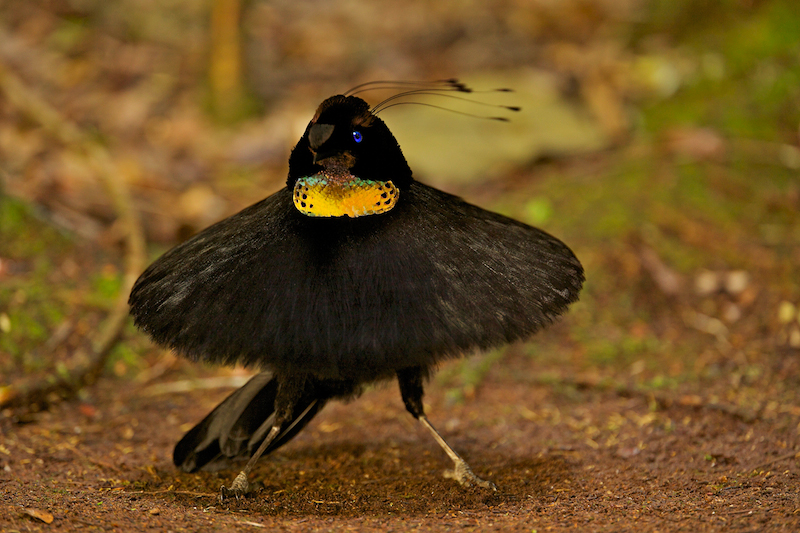
A Western Parotia or Arfak Parotia (Parotia sefilata).
A Superb Bird-of-paradise (Lophorina superba), also known as the Smiley Bird Of Paradise. There are an unusually low population of females, so competition amongst males is fierce. This has led them to a most bizarre and elaborate courtship displays. After meticulously preparing a “dance floor”, the male attracts a female with a loud call. After she approaches, his folded black feather cape and blue-green breast shield springs upward and spreads widely and symmetrically around its head, transforming the frontal view into a spectacular ellipse-shaped creature that rhythmically snaps its tail feathers against the ground while hopping in frantic circles around the female. This display leaves the blue plumage in a cartoon face pattern.
A ground-dwelling Superb lyrebird (Menura novae-hollandiae) from Australia, called “Weringerong”, “Woorail” and “Bulln-bulln” in Aboriginal languages.
Wilson’s Bird-of-paradise (Cicinnurus respublica). Edward Wilson was a British ornithologist.
Wallace’s Standardwing (Semioptera wallacii) drawn by Richard Bowdler Sharpe. Alfred Russel Wallace, OM, FRS (1823 – 1913) was a British naturalist, explorer, geographer, anthropologist and biologist. He is best known for independently conceiving the theory of evolution through natural selection, which prompted Charles Darwin to publish his own ideas in On the Origin of Species. Richard Bowdler Sharpe (1847 – 1909) was an English zoologist.
Barraband’s mystery 18th-century painting of what may be an undescribed species or hybrid, or simply an inaccurate depiction of the Twelve-Wired Bird-of-paradise (Seleucidis melanoleucus). Jacques Barraband (1767 – 1809) was a French zoological and botanical illustrator, renowned for his lifelike renderings of tropical birds.
A King Bird-of-paradise (Cicinnurus regius). An extraordinary display is performed by the male with a series of tail swinging, fluffing of its abdomen white feathers that makes the bird look like a cottonball, and acrobatic pendulum displays.
A Victoria’s Riflebird (Ptiloris victoriae), also known as “Duwuduwu” to the local Aboriginal people, is endemic to the Atherton Tableland region of northeastern Queensland, Australia. It was discovered by John Macgillivray in 1848 and is named after Queen Victoria.
A female Albert’s Lyrebird, (Menura alberti) from Mount Warning, New South Wales, Australia, named in honour of Prince Albert, the husband of Queen Victoria.
Neville William Cayley’s illustration of the immature male, mature male and female Magnificent Riflebird (Ptiloris magnificus).
Starlings and Other Birds
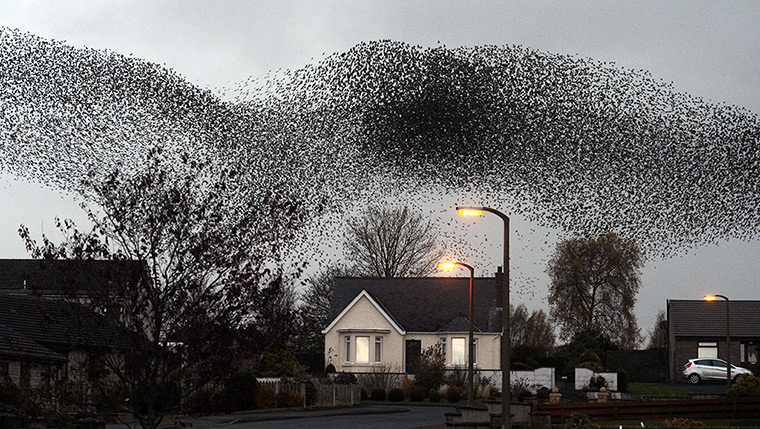
A murmuration of starlings over Gretna.
Greedy Parrots take off from the courtyard of a house after gorging themselves on grain.
In Bilbao, Spain, a Bird of Prey glides at sunrise while rain threatens from the distance.
Happy Landing: This most colourful bird is about to land on a twig.
What a Beautiful Morning!: The world wakes up. This makes me think of After the Storm from Beethoven’s Pastoral Symphony.
Robin and Worm: A robin strains to pull a worm from the ground somewhere in Wisconsin (not that that’s important, except to the robin and ex-worm). The American Robin (Turdus migratorius) is the “state bird” of Connecticut, Michigan and Wisconsin, a migratory songbird of the thrush family, named after the European robin (of the flycatcher family) because of its reddish-orange breast.
Hungry Chicks “All together now — MUM, where are you? We’re HUNGRY”.
Enjoying Being Wet, dipping its head into Carshalton Pond; he doesn’t mind getting wet
Sad and Soaking Wet, this
Little Owl gets a Soaking. “I’m fed up with all this rain! When’s it going to stop?”.
Hot Birds Shading: The beach can even get too hot for sea-birds!
Friendly Penguins: “Hold my hand and you won’t slip over”
:)
Watch the birdie! Smile!
The Cambodian tailorbird (orthotomus chaktomuk), a small bird which has a black-feathered throat and is the size of the more common wren; it lives in thick, lowland scrub in Phnom Penh and other sites in the nearby floodplain. The species is under threat due to declining habitat from agricultural and urban expansion.
Penguins sailing away from their ice-sheet home on their own private iceberg.

