A database of information about births, marriages and deaths, kept by the Mormon Church.
In 1752 the change from one year to the next was moved from 25 March to 1 January. So before then, any date between 1 January and 24 March needs the following year appended, thus: 23 February 1732/33. This helps resolve the apparent inconsistency of a birth on 13 October 1655 and the death of the same person on 13 January 1655; three months actually separated the two events.
Before 1874 it was not compulsory to register births, marriages and deaths, so official sources may be incomplete.
In Fitz-Steven’s Description of London, published in 1180, the following words occur:
When the great fenne or moore (which watereth the walls of the citie on the North side) is frozen, many young men play on the yce asome tye bones to their leete and under their heeles, and shoving themselves with a little picked staffe do slide as swiftlie as a birde flyeth in the aire or an arrow out of a cross-bow.
At what period the use of metal runners was introduced is unknown, but it was possibly not long after the introduction into northern Europe in the 3rd century AD of the art of working in iron. By the time of Charles II, skating had become popular, with the aristocracy as well as the people, as is proved by entries in the diaries of Pepys and Evelyn.
As in ancient times, skating is most practised by the Scandinavians, Finns, Dutch and British, to whom in modern days have been added the Germans, Swiss, Austrians, Canadians and Americans. All these nations have central organizations which control skating, the British, founded in 1879, being the National Skating Association.
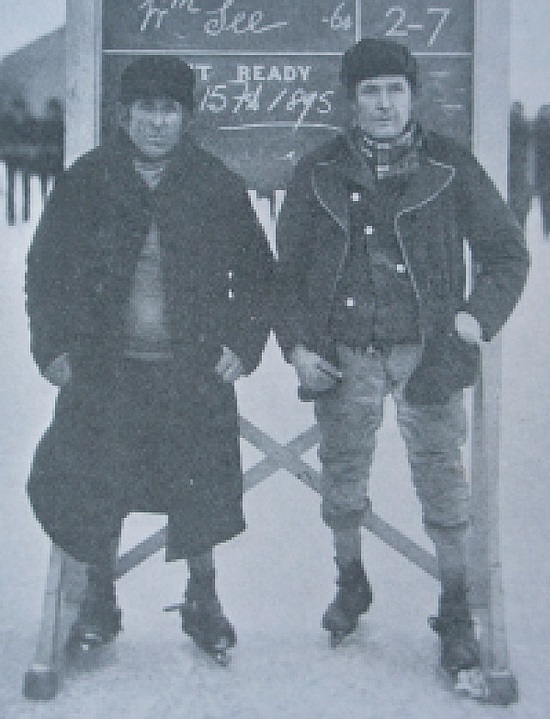
‘Gutta Percha’ See and ‘Turkey’ Smart (right) in 1895, two famous fenskaters
Of the earliest skating races no records have been kept. That racing was a popular pastime in Holland two centuries and longer ago is proved by the numerous paintings of the time depicting racing scenes. In England the first skating match recorded was that in which Youngs of Mepal beat Thomson of Wimblingdon, both men of the Fens, in the year 1814. The Fen country has remained the chief English home of skating, owing to the abundance of ice in that district, and most British champions have been Fensmen, notably the Smarts of Welney. In January 1823 the Sporting Magazine recorded the first amateur match, which was between teams of six gentlemen from March and Chatteris, Mr Drake of Chatteris finishing first. In the same year a match took place for a silver bowl on the Maze Lake, Herts, over a course 5 miles long, the winner being Mr Blenkinsop. Racing, more or less intermittent, continued annually, the Fen skaters generally triumphing. In 1854 appeared the celebrated William ‘Turkey’ SMART, who, after defeating Larmen Register in that year, remained champion for more than a decade. His nephew George ‘Fish’ SMART won the championship in 1878 and held it until 1889, only to relinquish it to his younger brother James SMART. The first amateur championship of England was held in 1880 at Hendon, and was won by Mr F. Norman, a Fen skater.
Owing to the great area of Canada and the northern United States, and the long and cold winter, the sport of skating is indulged in to a greater extent in North America than anywhere else, and local matches have been held for years in many places. Owing to the reputation of Charles June, who was considered to be the best American skater from 1838 for many years, his place of residence, Newburgh, N.Y., on the Hudson river, became the headquarters of American speed skating. This city also is the birthplace of the Donoghue family, who may be called the Smarts of America. The most noted members of this family were Mr T. Donoghue and his two sons, Tim and J. F. Donoghue, each in his day the fastest skater in the world, Joseph Donoghue winning every event at the international championship meeting at Amsterdam in 1891. There is practically no professional skating in America.
Skating received a great impetus during the last decade of the 19th century, profiting both by the growing devotion of athletics and by increased facilities of communication, which led to international competitions and the institutions of skating clubs in Switzerland and elsewhere, especially those of Davos, St Moritz and Grindelwald, where ice is available every winter. Although skating instruments are so simple, the evolution of the skate has advanced considerably, contributing to marked improvement in the skater’s skill. In speed-skating an epoch was marked, first, by the almost universal adoption of the Norwegian type of racing skate; and, secondly, by the institution in 1892, at an international congress held in Holland, of annual races for the championships of Europe and of the world.
The Norwegian skate, introduced and perfected (1887 to 1902) by Axel Paulsen and Harald Hagen, is constructed with a view to lightness, strength, and diminution of friction. The blade, of specially hardened steel, is set in a hollow horizontal tube of aluminium, and connected by similar vertical tubes with footplates riveted to a closely-fitting boot with thin leather sole. It is 16 to 17¾ in. long and ¾ to 2 millimetres thick (i.e. 0.029 to 0.078 in.), the average employed for hard ice being ¾ mm., often thinner towards the heel. This thickness is suitable for hard ice, but for softer ice 2 mm or 0.078 in. is preferable. The blade is flat on the ice throughout, except for an inch in front; this flatness distributes the weight, and with the extreme thinness of blade reduces friction to a minimum. The edges are right-angled and sharp.
The skater’s style has been modified. The blade, when planted on the ice with weight upon it, describes a nearly straight line, the last few feet only curving slightly outwards as the skate leaves the ice. Hence the stroke of the best modern skaters is almost, if not entirely, on the inside edge, a gain in directness and speed, the outside edge being used for curves only. The length of stroke has tended to diminish. Contrasted with the 12 to 18 yards stroke attributed to the old English champion, William ‘Turkey’ SMART, which was partly on the outside edge, the modern racing stroke rarely exceeds 10 yds., and is usually nearer 6 or 7. Particular instances vary with conditions of ice, etc, but at St Petersburg, in 1896, Eden’s stroke in the 10,000 metre race averaged about 7.4 yds., that of P. Oestlund at Davos, in 1900, the same (for one lap, 8 yds.). J. F. Donoghue’s stride in 1891 was computed at about 6 yds. The general effect has been vastly increased speed, and a conjoint cause is the stricter training undergone before important races.
The races held annually since 1892/1893 for the championships of Europe and of the world, under the auspices of the International Skating Union, have assembled representatives from the skating countries of Europe and from America.
In England races are still skated, with rare exceptions, on straight courses, with a sharp turn round a post or barrel, the distance prescribed for N.S.A. championships being 14 m. with three turns. The Continental and international system involves a course with straight sides and curved ends of such a radius that no slackening of speed is necessary.
The curves are skated with a step-over-step action, and the direction is always from right to left. Hence, on entering the curve the right foot is brought across in front and set down on the inside edge, the left passing behind on the outside edge, and being in its turn set down on an outside edge in front. The strokes thus form a series of tangents to the curve, and are little shorter than in the straight. With a radius of 25 and 30 metres, as at Davos, the curves can be skated with safety at full speed.
See contemporary records in the Field, Outing, and other sporting journals, as well as the annual almanacs; A Bibliography of Skating by F. W. Foster (London, 1898); Skating, in the Badminton Library (1892); Skating, in the Oval Series (1897); ‘Skating’ article in the Encyclopaedia of Sport (1899); Skating, in the Isthmian Library (1901); Skating, by W. T. Richardson (New York, 1903).
George Smart, after starting his life in William ‘Turkey’ Smart’s large family of agricultural labourers, became a self-made man training in the new trade of Steam Engineer he became resident engineer for ‘The Manea Drainage Board’ at The Colony Steam Pumping station and then started a business as Steam trashing Contractor employing his sons Herbert and John, running a number of traction engines at the time of his death. Amy Hankins, granddaughter of George Smart, remembers his Steam Traction Engines when she was a tot, as a fearsome machine hissing and steaming whistling when they sounded the steam whistle she used to be taken to the bridge by her grandmother to see great-grandfather filling up with water from the Bedford River after 10 days Thrashing.
These days Elstree might seem an unlikely venue for winter sports, but in the late 19th Century it was chosen to host one of the first national ice skating competitions. More than 500 people gathered at Elstree Reservoir in January 1881 to watch a professional and amateur contest hosted by the newly-formed National Skating Association.
The speed skating event involved a professional tournament, with cash prizes, and the London Amateur Championship, both of which were run over a distance of one mile. The professional contest was dominated by G. ‘Fish’ Smart, from Welney, the national champion of the time, who beat H. Carter, from the same club, in the final. A report about the competition in The Sporting Life newspaper recorded that skating fans were ‘looking to Fish Smart to give them a sample of his powers’ on the day.
The races were run over a track 410 yards long, with three turns to the mile, and many of the spectators took to the ice on skates to get close to the action.
However, another contemporary newspaper report noted that the venue, off Watford Road, had proved controversial, because it was inconvenient to get to. There were very few train services from London to Elstree at the time, and people who did arrive at the station were faced with a two-mile uphill walk to the reservoir. Although the report continued: ‘Once at the course nothing could have been better for the racing and the weather, the scene and the amusement were all that could be desired.’ ‘Fish’ Smart breezed through the professional contest, easily defeating opponents in the three rounds before the final, and his best time of the day was 3mins 17secs.
There was some drama in the first round of the amateur championship, when T. Jones, racing the former London champion W. A. Smith, collapsed due to exhaustion. In the final a well-known bicyclist, C. Crute, was too quick for J. Goodliffe, from Huntingdon, who pulled up at three-quarters of a mile and did not finish.
The National Skating Association had been established two years before the competition at Elstree Reservoir, in order to regulate ice skating events on the fens.
James Charles Aveling, born at Elm, Cambs, in 1869, the fourth son of James Thomas Aveling of March, Cambs, JP and Deputy Lieutenant of Cambs and Hunts was a descendant of the line of Stephen (1712-1774). He grew up sharing the pleasures of cricketing and skating, born into the ‘Golden Age of Fen Skaters’ he sought to emulate his idol, friend, and compatriot the legendary Professional Champion James Smart.
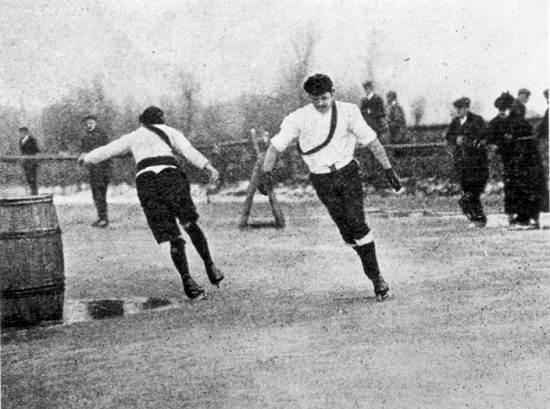
James Smart rounds the barrel turn; fen skaters go around the barrel during the fen skating competition
In 1890 at the age of 21 he had his first success, finishing fourth in the National Championships, and followed it up by beating the champion in a race at Wisbech. In December 1891 the National Skating Association decided to send him to the World Championships in Norway, he created a good impression on the Norwegians who taught him to ski, and on his return to England introduced the speed skate as we know it today, his own personal skates being made by ‘Heinie’ father of Sonia the greatest figure skater of her time, becoming one of Hollywood’s legendary film stars. He arrived back from Norway too late to participate in the British Championships and at the first opportunity soundly defeated the new champion.
The next championship to be held in 1892/1893, at the age of 23, was to be his finest year, three world records, the quarter mile, the mile and the mile and a half, whilst his brother Bob collected the world 200-yards record. So many firsts, he was the first winner of the Duddlestone Cup, he defeated leading continental skaters in winning the Prince of Orange Vase, he became the first skater to win the National Skating Association’s Gold Badge, and he became the British Champion at all the distances from the quarter-mile up to three miles. His record time for the quarter-mile stood until 1938 a period of 45 years. Above all he was always remembered for his grace and beauty of style on skates. In 1894 he represented his country in the World Championships in Sweden where he acquitted himself with a fifth placing, being at a considerable disadvantage on the oval courses, in direct contrast to the straight up and down English courses, the continentals being able to generate greater speed on the bends with their foot over foot cornering.
In Wikipedia, see Turkey Smart and Fen Skating.
The FRC was formerly in Islington, N London, but is now incorporated in the PRO in Kew, SW London.
A register kept by the ecclesiastical parish, containing all baptisms (christenings), marriages, and burials conducted by the parish church. There’s more detail below.
Before 1812 parish incumbents made returns to their archdeacons for six years out of seven, the seventh normally being a Bishop’s Visitation year. From 1813 all returns were made to the bishop. There’s more detail below.
From the Surnames web-site
Surnames became necessary when governments introduced personal taxation. In England this was known as a Poll Tax. Throughout the centuries, surnames in every country have continued to develop often leading to astonishing variants of the original spelling.
This is a patronymic, that is, “the son of Adam”, itself coming from the Hebrew adama meaning red earth. The first man, according to the Book of Genesis, was so named because God fashioned him out of the earth. Adam (without surname) occurs in the Domesday Book of 1086. The surname first appears in 1281 – Alianor Adam, (Assize Court Rolls of Cheshire). The patronymic form is first recorded in Scotland towards the end of the 13th Century. The first recorded spelling of the family name is that of John Adamsone, which dated 1296, “Records of Berewyke County”. Surnames became necessary when governments introduced personal taxation. In England this was known as Poll Tax.
This very interesting surname is of Old French origin, and is thought to have been introduced into England by the Normans after the Conquest of 1066. It derives from the male given name Clement, itself adopted from the Latin Clemens, and meaning “merciful”. The original popularity in England from the mid-12th Century on, was due to the (re-discovered) fame of St. Clement, a disciple of St. Paul, and because a number of popes selected the name “Clement” for its symbolic values. Early examples of the personal name recordings include Clemens in 1153, in the Records of St. Benets Abbey, Norfolk, and Clemens filius Clementis, in the Curia Regis rolls for Essex in the year 1212. William Clement as a surname is recorded in the 1275 Hundred Rolls of Norfolk, whilst Richard Clemence is listed in the Huntingdonshire Hundred Rolls of 1279. The many spellings of Clement showing its great medieval popularity, range from Clem, Clemas, Clemes, Clements, Clemon(t)s, Clemetts and Clem(m)ens, to Clemence, Climance, Clemen(t)son and Clemerson, and the Cornish Clemo, Clemow, Climo, Clymo, and many others. Amongst the interesting recordings associated with the surname are Thomas Clements who was one of the early emigrants to the American Colonies, leaving London on the “Abraham” in October 1635, bound for Virginia. The coat of arms was granted in Plymouth in 1620. This has the blazon of a silver field, two red bends wavy, and on a red chief, three gold estoiles. The crest is a gold griffin on a green mount. The first recorded spelling of the family name is shown to be that of Robertus Clemens, which was dated 1155, in the Knight Templars rolls of Oxfordshire, during the reign of King Henry II, known as “The Builder of Churches”, 1154 – 1189.
This interesting name, with the spellings of Croad, Crowd, Crowd, Crowther, Crother and Crewther, is of early medieval English origin. It derives from the Middle English (1200 — 1500) “crouth” or “croude”, related to the Welsh “crwth”, meaning “crowd”, a popular medieval bowed stringed instrument. A quotation from Luke XV. 25. reads: But his eldre sone was in the feeld, and whanne he cam and neighede to the hous he herde a synfonye and a crowde. A further reference to the instrument appears in Spencer’s Fairy Queen: the pipe, the tabor, and the trembling crowd. Crowder, and its variant forms, was originally given as an occupational name to a player on the crowd. The surname was first recorded in the late 13th Century (see below), and further early recordings include: Hugo le Crouder of Leicestershire, in the Hundred rolls of 1278; and rather later Garrett Crowd, at St Andrews Church, Enfield, Middlesex, in 1588. Hugh Crode married Ellen Carrier at St Dunstans, Stepney, on December 17th 1628, while on November 18th 1641 Lucy Croad was christened at the church of St Mildred Poultrey, London. Hugh Crowder, who embarked from London on the ship “Bona Nova” in 1619, was recorded in a muster of the inhabitants of James City, Virginia, in that year. He was one of the earliest recorded namebearers to settle in the New World. The first recorded spelling of the family name is shown to be that of Richard le Cruder, which was dated 1273, in the Hundred Rolls of Kent, during the reign of King Edward I, known as “The Hammer of the Scots”, 1272 — 1307.
This interesting surname recorded as Garden and Gardyne, both metonymics for a gardner, and Gardener, Gardenner, Gardiner, Gardinor, Gairdnar, Gairner and Gardner, is of French origins. Recorded widely in England, Ireland, and Scotland, it is both a status and an occupational name, and relates to the head gardner of a noble or even royal house. Derived from the Northern French word “gardin” and introduced into the British Isles after the Norman Invasion of 1066, it is itself a diminutive of the pre-7th century Germanic word gard, meaning an enclosure. The function of the “gardiniere” in medieval times was a very important one. He was responsible for the kitchen garden, which provided almost the only source of fresh food and herbs, and hence played a critical part in maintaining the health of the household. The use of the word “gardener” refers to one who tends ornamental lawns and flower beds, and is a later application. Interesting examples of early surname recordings include: William le Gardinier of the county of Rutland in 1199, William Gardin of Huntingdon in 1218, and John atte Gardyne of Sussex in the Subsidy Tax Rolls of that county in 1296. Later recordings include: Richard Gardiner, who was a seaman aboard the famous ship “Mayflower” which carried the Pilgrim Fathers to the New World in 1620, but it is understood that he returned to England with the ship, and Peter Gardner actually emigrated to the Virginia Colony on the ship “Elizabeth of London” in 1635. The first recorded spelling of the family name is believed to be that of William del Gardin, in the charters of Oxford in 1183.
Recorded as Lund, Lune, Lunn, Lone, Lound, Lunt, Lunne, this is an English name, also recorded in Ireland and Scotland. It derives from the pre-7th century Scandanavian-Viking word lundr and literally means “one who lived in or by a wood or grove”.
In some cases it is locational, from places such as Lund in Lancashire, as well as in both East and West Yorkshire; Lunt also in Lancashire, and Lound in Lincolnshire, Nottinghamshire and Suffolk. Locational surnames are usually ‘from’ names, that is to say, surnames given to people after they moved from their original homes to somewhere else. In so doing they took or were given as their surname the name of their former village. Spelling being at best erratic and local dialects very thick, often, as with this name, this lead to a variety of spellings. One Henry Lunne is listed in the Register of the University of Oxford in 1581, and Mary Lunn was married to Giles Allington at St. Mary Aldermary in London on 29th May 1687. The first recorded spelling of the family name is believed to be that of Ralph de la Lunde, which was dated 1183, The Yorkshire Pipe Rolls, during the reign of King Henry II, The Builder of Churches, 1154 — 1189.
The “Sally Lunn” cake is probably a corruption of the French phrase “soleil et lune” referring to a type of cake originally made by Protestant refugees from France but other derivations have been given. A Bath tea shop bears the name.
This most interesting surname derives from a number of possible origins. Firstly, it may be a topographical name for a person who lived at a place where wild roses grew. It may also have been given to a “dweller in a house bearing the sign of the rose i.e., an Inn”. It is also found, especially in Europe, as a nickname for a man of rosy complexion. In each of these instances the surname derives from the Middle English and Old French rose or the Germanic female personal name Rose or Royse, which was recorded in the Domesday Book of 1086 as Rothais and is composed of the elements hrod, “renown” plus haid(is), “king”. Finally, the name may also have originated from the Yiddish female personal name Royze, derived from the word for the flower. One Richard Roys appeared in the Subsidy Rolls of Suffolk in 1327. Interesting namebearers include Sir George Rose (1782 – 1873) who was appointed judge of the Court of Review and knighted in 1831; he also became first chairman of the Law Life Insurance Society in 1844. Hugh Henry Rose (Baron Strathnairn) in 1801 – 1885 who served in Syria, India and Ireland with the British army and was appointed Field-Marshal in 1877. The first recorded spelling of the family name is shown to be that of Robert Rose, which was dated 1302, in the “London Court Rolls Register”, during the reign of King Edward I.
Recorded as Smart and Smartman, this is an English surname. In origin it was either a medieval nickname surname for a brisk or active person, deriving from the Old English pre-7th century word “smeart” meaning quick, or it may be an occupational name for a person who was probably a handyman or similar. It is an example of a sizeable group of early European surnames that were gradually created from the habitual use of nicknames. These were given in the first instance with reference to a variety of skills or characteristics, or even in some cases physical or mental characteristics, some highly offensive! Even a supposed resemblance to an animal or bird’s appearance or disposition was usefully employed in the creation of such names. One of the earliest examples of this surname recording, was that of William Smert in the Subsidy Tax Rolls of Worcester in the year 1275. Later examples include William Smart, aged 20, who was one of the earliest settlers in the English colonies of the New World. He embarked from the port of London on the ship “Thomas and John” bound for the colony of Virgina, in June 1635, whilst a recording from the surviving church registers of the city of London is that of Benjamin Smart, the son of John and Martha Smart, christened on 6th October 1642, at St. Benet Fink. The first recorded spelling of the family name is shown to be that of Lifwinus Smart. This was dated 1180, in the archives of Canterbury Cathedral, Kent, during the reign of King Henry II of England, 1154 – 1189.
Soham, Cambridgeshire: see Wikipedia.
Alton Pancras, Dorset: see Wikipedia.
Buckland Newton, Dorset: see Wikipedia.
Piddletrenthide, Dorset: see Wikipedia.
Folkingham or Falkingham, Lincolnshire: see Wikipedia.
The village owes its origin to the meeting place of traders, farmers, huntsmen, robbers and pedlars. The name “Folkingham” (or “Falkingham”, as the village was previously written) derives from the Domesday entry “Folchingeham”, and is said to derive from the word Folch or Falx, meaning a sickle. Another spelling, also based on Domesday is “Fulchingeham”, which has been interpreted as “the Ham of Fulca’s people”.
Spanby, Lincolnshire in 1876 from White’s Directory of 1876:
Spanby is a small village in a well-wooded vale 4 miles NNE of Folkingham and 2½ miles from Scredington railway station, and has in its parish only 115 souls and 1019 acres of land. The trustees of the late William Cragg Esq., who are lords of the manor, and Captain Cragg, Sir Thomas Whichcote, R Kelham Esq., and Captain Smith are chief owners of the soil. The site of the ancient manor house is now a moated orchard. The church consisting of a nave and chancel is a low small structure, which has been of larger dimensions. The rectory is united with the vicarage of Swaton. A yearly rent-charge of about 4s 10d per acre is paid in lieu of tithes. Principal Inhabitants are: Dawson BELLAMY—farmer & assessor of taxes of Holland rd farm; William BELLAMY—land agent at Grantham; Speed LUNN—parish clerk; John DODSWORTH—farmer; Joseph HARDSTAFF—farmer; Thomas HORSMAN—farmer. And see Wikipedia.
Charlton, London: see Wikipedia.
Plumstead, London: see Wikipedia.
Welney, Norfolk: see Welney’s web site. Entry in Kelly’s Directory for Cambridgeshire, Norfolk & Suffolk 1883, (Cambridgeshire section).
WELNEY is a parish, situated partly in the Isle of Ely, and county of Cambridgeshire and partly in Norfolk, in the hundred of Wisbech, union and county court district of Downham, rural deanery of Fincham, archdeaconry of Norfolk and diocese of Norwich; it is on the banks of the Old Bedford river, 5 miles west from Manea station, 13 south-east from Wisbech, and 10 south-east from March. In 1826 the Rev. William Gale Townley erected at his own expense a handsome suspension bridge across the Hundred-foot river, thus connecting the village with Littleport and Ely, which could previously only be reached by ferry. In 1848 the old church was taken down and a new one erected and named in honor [sic] of St.Mary the Virgin: it is a handsome stone building in the Early English style; the cost was defrayed by funds furnished by Marshall’s charity: it consists of chancel and nave, with a bell turret containing 2 bells and has sittings for 420: there is a handsome stained east window. The registers are amongst the oldest in the deanery, dating from the year 1642. The living, formerly a chapelry of Upwell, is now a rectory in the gift of Charles Watson Townley esq. Lord Lieutenant of Cambridgeshire, and held by the Rev. Edward Russell Wilford M.A. of Christ’s College, Cambridge, who is also a surrogate in the diocese of Norwich and diocesan inspector of schools in the deanery of Fincham; a substantial rectory house was built in the year 1864. The tithe is commuted at £1,258 18s. 2d. and there are 13 acres of glebe. The Baptists and Primitive Methodists have chapels here. The funds of Marshall’s charity are derived from lands left by W. Marshall esq.: this estate, which formerly only realised about £70 a year, has now so increased in value as to bring in a net income of about £700 a year: the property is vested in the hands of the trustees and the income is divided in the following manner; one-third is given to the widows in the parish and two-thirds are appropriated to the church, the schools and the roads. Charles Watson Townley esq. is lord of the manor. The principal landowners are F. R. Beart, esq., W. R. Beart, esq, Morley Beart, esq. William Little esq. James Failes esq. and Joseph Morton esq. The soil is clay and fen; subsoil clay. The chief crops are wheat, beans and roots. The area is 5,444 acres; rateable value of Cambridge portion £3,426, and of Norfolk portion £5,920; the population, who are wholly dependent on husbandry, numbered in 1881, 499 in the Isle of Ely and 527 in Norfolk, making a total of 1,026.
TIP’S END is 2½ miles north-west, and the Wash to the south
Parish Clerk, Jeremiah Jacobs.
Hebden Bridge, West Yorkshire: see Wikipedia.
A ‘parish’ is an area of land served by a church and its Incumbent (a vicar, rector or curate)
It is the smallest unit of church administration. The system of ancient parishes began before the Norman Conquest. However, the boundaries of parishes have changed over time and parishes vary considerably in size
Each parish was managed by a Vestry, which included the incumbent, churchwardens and leading inhabitants
The parish taxed its local inhabitants to pay for the upkeep of the church, care for the poor and sick, maintain the highways and pay the constable
Until the late 19th century, the parish church was at the centre of people’s lives. It was also an important meeting place where people worshipped together, baptised their children, got married and were buried!
Parish registers are volumes kept by the incumbent of each parish to record baptisms, marriages and burials
1538, Thomas Cromwell, a Minister in the Government of Henry VIII, ordered that a record of baptisms, marriages and burials should be kept by each parish
Most entries were recorded on paper, some on loose sheets which were subsequently lost or destroyed
1597, baptisms, marriages and burials were to be recorded in bound parchment volumes and previous records copied into them
1598, copies of all events recorded in the registers were to be sent to the bishop so beginning the records known as Bishop’s Transcripts
1653, responsibility for keeping registers was transferred to a secular official, the ‘Parish Register’. Elected by local ratepayers and approved by a JP, the minister or parish clerk usually took this role
1660, the 1653 Act was repealed when Charles II was restored to the throne
Hardwicke’s Marriage Act 1753 required that both marriages and banns be recorded. From 1754 marriages were to be recorded in a separate bound volume on standard printed sheets. The registers had to be signed by both parties and witnesses. Baptisms and burials still recorded together in a separate volume
Rose’s Act 1812 required that both baptisms and burials be recorded in separate bound volumes. From 1813 a new standard format for baptism and burial registers was introduced
1837, Introduction of the civil registration of births, marriages and deaths. Marriage registers were created in duplicate, one copy being passed to the Superintendent Registrar
The Diocesan Record Office should hold most parish registers for their area. The local County Record Office usually acts as the Diocesan Record Office on behalf of the Bishop
A small number may still be with the parish, check with your local County Record Office who will be able to tell you where the registers are kept
Early registers are normally very brief. Baptisms, marriages and burials were recorded in one register on blank sheets of paper or parchment. Some Incumbents recorded more than others. Incumbents and parish clerks also varied in ability for spelling, handwriting, accuracy and completeness
Early baptism entries usually only record the name of the child, the date of baptism and the name of the father, although the name of the mother may also be included
After 1812, baptism registers include the date of baptism, the name of the child, the names of both parents (if married), the parish of abode and the father’s occupation
Late 20th century baptism registers usually include dates of birth and the names of godparents
Baptisms usually took place in church, but if a child was not expected to live they may have been baptised at home soon after birth. This should be recorded in the register with an annotation, for example, ‘privately baptised’, ‘PB’ or ‘half-baptised’. If the child survived, it was usually ‘received’ into the church by a public baptism and a second entry would therefore be recorded
Children were often baptised soon after birth, but it is not uncommon to find that a child was baptised several years later
Annotations may appear in the register to show that a child was illegitimate. Common phrases include ‘spurious’, ‘base’, ‘base-born’, ‘merry begot’ or just a capital ‘B’. If the child was illegitimate the father’s name is usually not recorded
Banns were the proclamations read in church upon three successive Sundays prior to a wedding ceremony to allow time for any objections to the marriage to be made
From 1754, the reading of banns was recorded with the marriage entries, but separate banns registers were also kept by parishes and these usually record the names of the bride and groom, marital status and the parish in which they lived
After 1754 marriage registers record the names of the bride and groom, the parishes in which they lived, marital status e.g. bachelor, spinster, widow, widower, the date of the marriage, whether the marriage was by banns or licence and the signatures of the bride, groom and two witnesses
After 1837 marriage registers contain exactly the same information as marriage certificates. A marriage certificate is simply a copy of the entry in the marriage register
Until 1929, boys could marry at 14, girls at 12. After 1754, minors, those aged 20 or under, could only marry with the permission of their parents
By tradition, marriages usually took place in the bride’s home parish
Early burial entries usually only record the name of the person and the date of burial, but the names of husbands, whether they were a widow or widower, or age may also be recorded
After 1812, burial entries included the age of the deceased and the place of residence. Each entry was signed by the officiating minister
If the person buried had not lived in the parish they may be referred to as a ‘stranger’
People buried in a municipal cemetery, a workhouse burial ground, or on private land may sometimes not be recorded in the parish burial register
