MIGUEL BALLESTER, A CATALAN FROM
TARRAGONA.
Both
Miguel Ballester and Pedro Casaus, also Catalan and father of Bartolomé took
part in Columbus’ second voyage to the New World in 1493 and both were given
lands and estates. In 1493 Pedro Casaus returned to Seville where he lived with
his family. He took with him a young Tain Indian native as a slave for his
fourteen-year-old son Bartolomé. The slave became the centre of attraction and
the envy of all his companions.
Later,
the young Casaus was to convert his name to the Castilian version of Las Casas,
as was the custom with emigrants who embarked with the squadrons of Castile to
the Indies. In 1502 Queen Isabel of Castile published an order whereby all of
the approximately three hundred Indian slaves who had been brought to Spain were
to be returned to their country of origin. One can imagine how upset Bartolomé
must have been at having to part with his slave after four years of careful
coaching and who had probably become a close friend and companion. This was a
significant event in his life, which was to lead Bartolomé to become a strong
defender of the rights of the native Indians of the New World for the rest of
his life.
Many
years later Brother Bartolomé de la Casas was to write of Miguel Ballester the
Catalan sailor from Tarragona in his “Historia de las Indias”, stating that
‘Miguel certainly seemed to be Catalan because he spoke Spanish imperfectly,
but that he was an honest and virtuous man with a simple and sincere nature and
that he was well known to him’.
|
Despite the interest value of its content the “Historia” was not
published until three hundred years later in 1885. However during this
time the work was used and consulted by historians even though some of
them were strong adversaries of its content, namely Juan Ginés de Sepúlveda,
chronicler of the Emperor Charles V. |
|


1454:
Ballester and Columbus provoke a rebellion between peasants and landowners on
the Island of Majorca.
Miguel
and Simon Ballester together with the two brothers Joan (Christopher) and
Bartolomé Columbus (later known as Colón) were fighting on the side of the
peasants against the landowners in Majorca in 1454. The revolt was motivated by
the abusive increase implicated in the lease of the land to the peasant tenants
and the heavy taxes levied by the King of Aragon.
With
reference to these events the Majorcan writer, José María Cuadrado, in his
work “Forenses y cuidadanos” (1847) wrote ‘ Resistance collapsed without
the support of the two Columbus brothers, who on the publication of an edict
pardoning all the rebels except themselves escaped together with Miguel
Ballester, son of Simon Ballester, head of the conspiracy’. This revolt was
suppressed by the arrival of 2000 well-armed and equipped troops sent from
Naples by King Alfonso V of Aragon.
|
|
|
Map
of the Catalan lands. (Gran
Enciclopèdia Catalana. Barcelona ,1978).
Territoris de la Corona d’Aragó. |

1470:
Miguel and Simón Ballester in Genoa and Savona, together with the Columbus
family of Cuneo.
Juan Gil and Consuelo Varela in their book “ Cartas de particulares a Colón y Relaciones coetáneas”(Personal letters to Columbus and contemporary relationships) (1984) in Ch.XVI “ Relationship of Miguel de Cuneo” pages 235-236 write ‘ In 1470 a certain Simon of Cuneo a weaver is mentioned in a document together with other members of this profession, one of whom is Domenico Colombo, where they establish the price they should be paid for their work. (Racc. ,II p.115, 33). Shortly afterwards a certain Bartolomé of Cuneo appears as resident of Savona and together with Dominico Colombo and other artisans is involved in drawing up a series of union statutes (Racc., II, I, p. 141, 8, the agreement is dated 7th. December 1474). ‘It consequently seems more logical thus’ say the writers, ‘that Miguel de Cuneo was descended from that same family of wool weavers, fellow citizens of the Columbus family and that he had known the future Admiral Christopher Columbus from childhood’. Gil and Varela were surprised to observe, as they later added, ‘Here lie some stray but not fortuitous strands in the thick tangle woven about Columbus with respect to his Italian acquaintances, as in this case where they make a fleeting entry onto the scene only to withdraw immediately in “discretisimo mutis”
COLOM
- COLOMBO - COLÓN
On
our behalf and facing the facts analysed we deduce that the families Ballester
and Columbus, the latter later known as Colombo in Genoa, (1470) as Scolvus in
Scandinavia (1477), as Colom when he lived in Portugal, and as Colón before
leaving for Castile in 1484 are the same Columbus family of Jewish-Catalan
sailors, subjects of the Crown of Aragon, who for religious and economic reasons
were obliged to emigrate to the Liguran Coast, according to the Galician
investigator Salvador de Madariaga. We believe that they are the same Colombo
family that lived in the region of Genoa from 1470-1474. In the five notarial
registers and other Genoese documents all dated between 1470 and 1474 the
Columbus family are registered as Colombo. According to Las Casas the Columbus
family were known as being from “Terra
Rubra” or “Terra Ruja” the
region on the Ligurian Coast of
Catalan-Aragonese Sardinia and were privateers in the Mediterranean Sea. This is
also confirmed by Columbus’ son Hernando Columbus in his “Historia del
Almirante”, where in the first chapter he writes ‘Colombo, was in fact the
family name or surname of his elders, but he in accordance with the new land in
which he was to dwell and begin a new life, filed off the end of his surname in
order to conform better to the old style and for his descendants to be able to
make a distinction from other similar name forms, and thus called himself Colón’.
Here
we observe that if it were necessary as his son Hernando says, to file down his
name, then he was most likely originally called Colom
and not Colombo, as filing down would
have meant reducing the third part of the letter “m” to convert it into an
“n”, whereas, had he been called Colombo,
he would have had to eliminate the syllable “bo” as well as substituting
“m” with “n”
False
and adulterated Italian documents
It has been demonstrated that the Italian documents on which the hypothesis of Columbus being Genoese was based, are either false or adulterated. The same can be said of his lineage when in 1498 he is said to have confirmed being from Genoa ‘because I was born there and lived there’. Another disqualified document is that of Assereto which appeared in 1904 with the intention of confirming the birth of Columbus in the city of Genoa in 1451 and in accordance with the Genoese hypothesis. Along the same lines, the letter addressed to a certain Jenaro Annari of Savona known as “Relazione de Michele de Cuneo” to which Gil and Varela make reference previously, appeared suspiciously in the year 1885, just previous to the Italian commemorations in 1892 of the IV Centenary of the Discovery of America. This same year, the historian from Savona, A. Bruno published the illustrious article “La Saona” e la suposta Relazione de Michele de Cuneo in which he states that after having investigated in great detail the registers and archives of his city, he found no reference at all to this particular person.
The conclusion we
may therefore make from an assessment of these facts is that Michele
de Cuneo is a fictitious character made up by the chroniclers of that time to substitute the
person ofMiguel Ballester, in order to strengthen the unverified authenticity of
the discoverer being of Genoese origin. Miguel Ballester, the sailor from
Tarragona was always to be a key figure in Columbus’ life, True and loyal
friend from childhood, he later participated in Columbus’ mercantile ventures,
either selling wares at the medieval markets of Cuneo or in Savona or Genoa, or
in the establishments belonging to the wool traders and taverners Domenico and
Bartolomé Columbus, and his father Simon, all of which traded in the
merchandise obtained from the spoils of the privateering practice in the
Mediterranean Sea.
“TERRA RUBRA” on the Ligurian Coast of Catalan-Aragonese Sardinia.
Punta
de Terra Ruja (Terra Rubra in Latin) is
situated at the Capo de Cazzia (Cape
of the Hunt), the western arm of Port del
Compte and the largest natural port in the Mediterranean Sea. Known today as
Il
Porticciolo it is the only place on the whole continental or insular
coast of the Western Mediterranean which corresponds to the toponym denoting the
region from which the Columbus family are said to have come. The situation and
orography of the region would have made it the ideal place for an emigrant
Jewish-Catalan family of sailors involved in privateering, to settle. Moreover,
the place is very near L’Alguer, which had been repopulated in 1384 with
Catalans, particularly from the province of Tarragona. The emigrants had
maintained the Catalan language for cultural and safety reasons, and it remains
today, L’Alghero being known as “la citta catalana de Italia” (the Catalan
city of Italy).
In
1460, Juan II of Aragon declared L’Alguer a free port in order to protect that
coast from the piracy to which it was continually exposed.
|
Map of Capo de Cazzia (Cape of the Hunt) where Punta
de Terra Ruja (Terra Rubra in Latin) is situated. It is near to the Cala
del Infierno (Hell’s Cove) and the Island of Foradada with its Grottes
de Palombini (the Doves’ Cave) and the larger caves of Neptuno and la
Verda, which were used as warehouses by the pirates of that time. (Map
published in the leaflet “Il Promontorio più bello della Cerdeña”
enclosed in the Italian magazine Airone, November 1982 issue. |
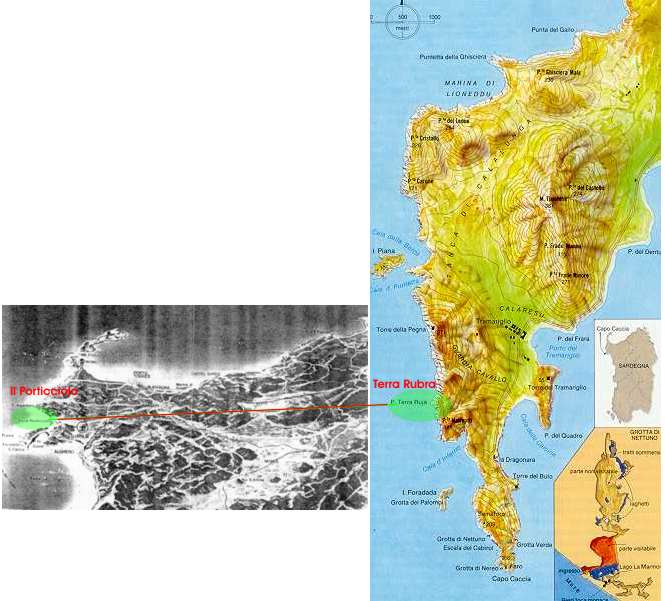 |
Map of the
northwest coast of the Island of Sardinia with the toponym Il
Porticciolo, in place of Terra
Ruja or Terra Rubra. |
THE
ORIGINS OF THE COLUMBIAN VENTURE.
There
is no doubt that Joan (Christopher) Columbus was an expert and knowledgeable
Sailor
who had studied under the supervision of excellent teachers. His many and
extensive writings show him to have possessed a very good literary style and a
command of Latin and the grammar. From the age of 14, when he first began to
sail, he constantly acquired culture by reading and by his experiences in
dealing with important people of all walks of life. He held long and interesting
conversations on the most diverse subjects whenever he spent time berthed at a
port or in a city. He himself writes in a missive addressed to the Catholic
Monarchs in 1501: -
‘I have already sailed to all parts of the Earth
known today, which was my desire and for which God has given me the spiritual
strength. He made me an expert in the art of sailing, gave me the knowledge of
astrology, geometry, and arithmetic that I needed. He gave me strength of spirit, hands to use and so occupy myself
while waiting by drawing cities, rivers, mountains, islands and ports all in
place on a chart. In all this time, I have visited and dedicated study to all
that I have written; cosmography, history, chronicles, and philosophy of other
arts of which Our Lord gave me understanding and made it possible for me to sail
to the Indies.’
An
analysis of this paragraph explains that the “exploit of discovery” had been
in preparation ever since Columbus had begun to navigate at the time of Pope
Borja -Calixto III, King Alfonse V of Aragon (the Magnanimous) and when Alfonse’s
brother (later Juan II and father of Ferdinand “the Catholic King)) was made
Lieutenant General of Catalonia as representative of the King in 1454.
Pedro
de Urrea had held the Archbishopric of Tarragona for nine years, and would
continue to do so for another forty-five years, dying three years after the
Discovery of America. Calixto III, as soon as he became Pope in 1455, named
Urrea Captain General of the Pontifical Squadron which was to create and
organise the fleet of seven vessels re to go and fight the Infidel Turks who had
taken over Byzantine. The Turks were a danger to the Church of Rome as well as a
hindrance to the passage of the vessels of the Crown of Aragon and other states
sailing to the Orient where they participated in the very lucrative Spice Trade.
When Pope Calixto III died in the summer of 1458, and King Alfonso V of Naples
died in the autumn of the same year, Pedro de Urrea decided to return to the see
of the Archbishopric of Tarragona. He thence became the right-hand-man in
ecclesiastical and military affairs of the new King Juan II of Aragon during the
ten-year war against the Generalitat (the Catalan Government) from 1462-72.
|
|
|
|
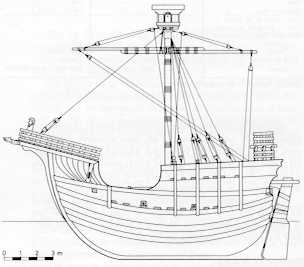
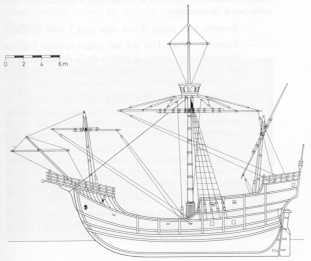
The Catalan vessel of 1454 |
The
vessel“Santa
Maria” |
A
PRIVATEER NAMED COUMBUS.
Hernando
Columbus, in Ch. V of his Historia del Almirante says:
“Cuando
al principio y motivo de la venida del Almirante a España y de haberse él dado
a las cosas del mar, fue causa un hombre señalado de su nombre y familia,
llamado Colombo, muy nombrado por la mar por causa de la armada que él traía
contra los infieles, y también por causas de su patria, tal que con su nombre
espantaba a los niños en la cuna”
(This
is a reference to how famous Columbus was as a sailor and how his name was
feared and respected even by children).
In
another letter, which Columbus wrote to the Catholic Monarchs from La Española
in January 1495, he spoke of the differences and errors that frequently occur
when plotting courses and piloting, saying:
“A
mi acaeció, que el Rey Reynel, que Dios tiene, me envío a Túnez, para prender
la galeaza “Fernandina”, y estando ya sobre la isla de san Pedro, en Cerdeña,
me dijo un saetia....”
(It
happened that King Reynel sent me to Tunisia to take the large galley
“Fernandina”, and whilst on the Island of San Pedro in Sardinia, I was told
about a “saetia”).
It
is important to add that King Reynel of Provence had died in 1470 and it was
precisely in that same year that the “Consulado del Mar (Maritime Consulate)
of Barcelona had published a “warning” to sailors regarding a privateer
named Columbus who with his fleet of seven vessels was causing havoc along the
Catalan coast.
From
1470-74 the names of Christopher Columbus and his father Domenico appear
in
the five notarial registers of Genoa in acts of a mercantile nature, meaning
that at this time the Columbus clan lived and carried out their activities in
the Ports of Genoa, Savona and in the city of Cuneo where a very important
market took place and which people from all corners of the Earth attended.
|
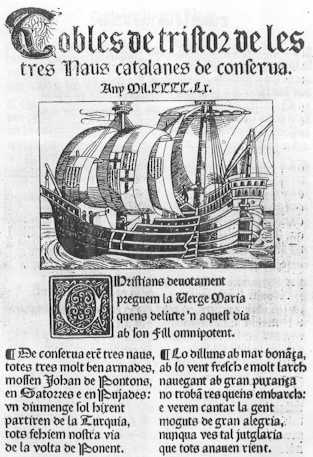
Narrative poem, purchased by
Hernando Columbus in Tarragona in 1513 according to the information on the
back cover of the publication. The Admiral’s son, founder of the
Columbian Library, used to note down the place, date and price of every
purchase he made. |
|
THE
ADMIRAL’S STAY IN PORTUGAL WAS DIRECTLY RESPONSIBLE FOR HIS DISCOVERY OF THE
WEST INDIES.
Something
happened in 1476 that was to give the Admiral his lasting ties with Portugal.
Hernando Columbus gives the following account:
‘…The young Columbus had been sailing for a long
time when eventually they came upon four large Venetian galleys between Lisbon
and the Cape of San Vicente, which is in Portugal. They attacked the galleys,
which were returning from Flanders, and fought fiercely and with great feelings
of hate, wounding each other badly both with firearms and other weapons. They
fought from dawn till dusk and many were killed or badly wounded on both sides.
Columbus’ ship caught fire together with one of the galleys, and he was
obliged to swim to shore, hanging on to the remains of an oar.
Fortunately he was an excellent swimmer as the distance was two leagues
from land. He was convinced that God had spared him for more important things…’
By
fortune and by chance, when the future Admiral arrived in Lisbon, Portugal, the
Scandinavian King, Christian of Denmark, was looking for one or more Portuguese
sailors capable of taking part in a naval expedition to Iceland, or further
afield.
There
is no doubt that Columbus took part in that voyage, because not only is it
confirmed by Hernando Columbus in his Historia del Almirante, and by Las Casas in his Historia
de las Indias, but also Luis Ulloa Cisneros in Noves proves de la Catalanitat de
Colom, makes a reference to these mentioned works saying that they are
written as though they had been copied directly from a text written by Columbus
where he himself says:
“I sailed in 1477, in the month of February to Tile, an isle of one
hundred leagues, of which the southern part is found at a latitude of 73º and
not of 63º as some say.
This
is a fact, which is not admitted by the Genoese thesis, but it is however, known
and accepted, that in February 1477 Columbus sailed to Tile in Greenland. There
are several historians that confirm this voyage as Ulloa exposes:
‘The Director of the Copenhagen University Library,
the knowledgeable Sajus Larsen, has published (1925-26) a series of studies,
which after what I have just exposed clears up many points, says Ulloa, ‘Mr.
Larsen has demonstrated, with his studies that in the year 1476, King Christian
of Denmark, together with the Portuguese King Alfonse V, sent out a naval
expedition, under the command of the Norwegian corsairs, Pining and Poshort,
which reached Greenland. The navigator (N.B.) was a certain Joannes Scolvus (which
translated into Catalan is Joan Colom), according to the Latin text written by
the famous Portuguese geographers Mercator and Friscius on one of their globes
made in 1537, which is now in Zerbest.
What
we know today of the Vikings is largely due to the sagas written down during the
XIIIth. Century, which had previously been transmitted orally from generation to
generation. According to the Greenland sagas and those of Erik the Red, in the
year 1000 Leif Erikson (son of Erik) reached an unknown land to which he gave
the name of Vinland. That land was situated on the northeast coast of the
continent, and is known today as America, the New World, which 500 years later
and at a more southerly point, was discovered by the great sailor Christopher
Columbus, and was later to be explored, colonised and evangelised.
Columbus
had verified on his previous “field trip” on this ocean voyage with the
Norwegians in 1477 that by way of the Ocean, he was to reach the East by sailing
west.
|
|
|
“Live
Erikson discovers America” (five centuries before Columbus) By Christian
Krong. 1893 |

COLUMBUS’
TIES WITH PORTUGAL.
Hernando
Columbus and Las Casas inform us that: ‘As
soon as he returned from this exploit, Columbus went to Lisbon, where he was
well known, had many friends, and was well received. So well received was he
that he established a home there and married a noblewoman Doña Felipa Muñiz,
daughter of Don Pedro Muñiz de Perestrelo and,at the time a novice at the
Monatery of Todos Los Santos. His father-in-law being deceased, Columbus and his
wife were to live with his mother-in-law, who on discovering her son-in-law’s
zeal for cosmography explained to him that her husband had been a great man of
the sea and had voyaged together with two other sea captains under license of
the King of Portugal to discover new lands. They had made a pact to share what
they discovered in three parts, so when they reached the undiscovered Islands of
Madeira and Porto Santo, they divided Madeira into two parts, the third part
being Porto Santo. By drawing lots Perestrelo was to receive the Island of Porto
Santo, which he governed until his death. Seeing that Columbus was so keen and
interested in voyages of this type, his mother-in-law handed over to him all her
late husband’s documents and maps, upon which he became even more enthusiastic
searching for information about other voyages made by the Portuguese to the Mina
de Oro and the Guinea Coast, and he delighted in talking to those who had
navigated to these places’. Columbus, on obtaining all this information,
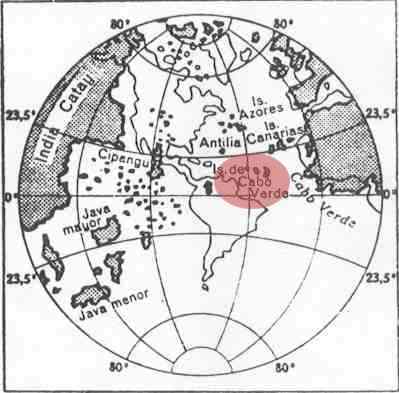
became convinced beyond a doubt that to the west of the Canary Islands and the
Isles of Cabo Verde, lay many lands waiting to be discovered.
During
those prodigious years from 1476-84, whilst he was living between Portugal, the
colonies of Guinea, Porto Santo and the Isle of Madeira, a series of important
events had taken place. First his compulsory arrival in Lisbon in August 1476,
the voyage to Greenland in 1477, and then his marriage to Doña Felipa Muñiz,
and perhaps his move to Porto Santo, where probably his eldest child, Diego was
born. Columbus’ time spent on the Isles of Madeira had been very positive for
him, as he had had direct access to information from the old Madeiran sailors
and others who birthed and set sail from these ports, and who spoke of islands
and lands on the horizon of that undiscovered dark and sinister ocean.
While
living on the Island of Porto Santo, he got to know about the sugar cane
plantations and the elaboration techniques. In the XVth. Century, sugar was a
luxury commodity and extremely expensive. He sailed to African Equatorial Guinea
on various voyages of discovery and “rescue”, which meant, not trading
voyages, but rather voyages to discover and explore warmer lands and collect
seeds and produce to transplant in the “Indies”. It is quite possible that
he took natives as slaves from these lands, to work in the elaboration of these
crops.
|
Sketch outlining the geographical ideas of Columbus |
|
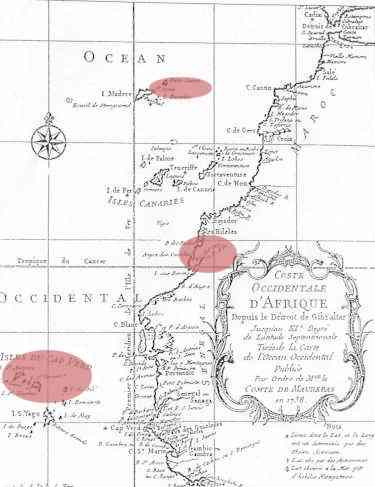
Map of the
West Coast of Africa, with the situation of the South of Spain, the Isles
of Madeira and Porto Santo, the Canary Islands with Hierro and Gomera and
La Mina de Oro on the Portuguese Guinean Coast. |