Past Tense - Leo Samama
for alto saxophone and guitar (1997)
"Past Tense" was written in the summer of 1997 for saxophonist Carola Cuypers and the guitarist Enrique M. Lop. As is usual, the idea for this piece came up under a very tight timetable. An unfulfilled promise leads to guilt feelings, holidays are coming and other compositions are in process. From just "tinkering" with the rather unusual sound possibilities of an alto saxophone and a guitar, an idea slowly grew up to write not a wild piece, not a saxophone piece with guitar accompaniment, but a composition in which both instruments merge into each other. In short, the saxophone has to restrain itself and, on the contrary, the guitar has to be not such a modest instrument. Besides, strongly retrospective musical ideas were developed in the creative process, both in its lyric use and in certain melodic and harmonic formulas which "automatically" got the colour of the "past". This was how the title of this piece grew out from its own notes: "Past Tense".
Autobahnkrieg - Chiel Meijering,
"Highway war"
for soprano saxophone and guitar (1997)
In "Autobahnkrieg", Meijering denounced the typical phenomenon of this century: the morbid, aggressive way of driving on the highways of Europe, which can often result in shootings. Not in the way Mozart maybe could travel by carriage from city to city, dreamily looking over green fields and "W”lder", finishing a string quartet or a symphony in his mind. Neither like Gershwin or Strawinsky who were inspired by the rhythmical patterns of the train on the rails and their switches. More in the style of the Punk-movement and Nina Hagen. Rough and wild with a wink to the savage side of society. As a contrast, the piece starts rather lovely and innocent in a jazzy, Latin-American style. That is at least what the composer had in mind. But it goes beyond his control, perhaps inadvertently. Like with the so-called "Ha-Ha-motif" which suddenly cracks into the piece and breaks the serious story style with which the composer seemed to have started with. Casually he quotes a sixties-song, which he rhythmically streches as a piece of chewing-gum. To write a serious piece with exposition, development, etc. does not seem the world of Meijering. Rather he ZAPS associatively, pop-art-like from one to the other, with a Satie-like humour. Over an enormous sax slurring, he teasingly writes "Don't forget to practice your scales every day, honey!..."
Meanwhile the guitar player ruins his nails on his instrument, like a flamenco guitar player infected by a dangerous Heavy-Metal virus.
Pas de Deux - Theo Abazis,
for alto saxophone and guitar (1997)
"Pas de Deux" is a small piece of program-music. It has been inspired by the sculpture Pan and Venus and describes a love-game, starting from the first encounter, the shy steps of approaching, till the wild chase and the final serenity of acceptance. The romantic innocence of the piece is not pretentious, but rather the result of the original idea which has no intention of being academic. The form is defined by the rhythm, making the intention of the game stronger. The saxophone and the guitar do not serve only for casting the roles, they are also providing the right timbres for the colouring of the story in soft shades.
3 Gedichten - Gez· Frid,
"3 Poems" for narrator, alto saxophone and guitar (1976)
(ed. Donemus, Amsterdam)
Panegyric to my housewife (Ode aan mijn Huisvrouw) - Igor Streepjes
Boutade - De GÈnestet
The seven Knaves (De zeven Boeven) - Albert Verwey
|
Frocta - Dick Visser,
for soprano saxophone and guitar (1996)
"Frocta" (Latin) meant, at the time, "an assortment of happy making things". At the end of the 15th and at the beginning of the 16th century, during the so called third generation "Dutch", the later "frotolla" was developed into a dance-song with instruments. Mostly a blowing instrument and a plucking instrument. Now, for example, 400 years later, the soprano saxophone and the guitar. Many style features of four centuries ago are kept: imitation of complete or fragmented melodies and the typical repetition of motifs. But the contemporary approach led to a free atonality and the use of rhythms like the South American rumba.
Atmospheren - Elisabeth Reijken,
"Atmospheres"
for alto saxophone and live-electronics (1993)
Walking in a conservatory, through a long corridor with little rooms on both sides where diligent student saxophonists are working -this is possibly the fastest way to glimpse the most clear and known motifs of the classical saxophone literature. In "Atmospheren" some of those motifs are captured and absorbed, which gives an almost schizophrenic effect: on one side, the feeling of recognition of those motifs, and on the other side, the spheres of this piece. Initially, driven with pedals by the player, the live electronics have a supporting function, but now and then they take the saxophone out of the sunken (atmo)spheres in which it seems to fall down, making use of the saxophone sounds themselves.
Different Worlds - Henny de Wolff,
for soprano / alto saxophone and guitar (1998)
"Different Worlds" is the result of ideas coming to my mind looking around to the four cardinal points. Four different worlds immediately appear: North, cold and silent; East, the arrival of light; South, a warm and quiet sea of sand; West, water moving by the wind. Those worlds are the product of the composer¼s imagination and never a musical picture of a specific place. These are the sensations I want to reflect here: cold, light, warm and wet, which might bring the listening audience to the different worlds of their own imagination.
| | | | | |
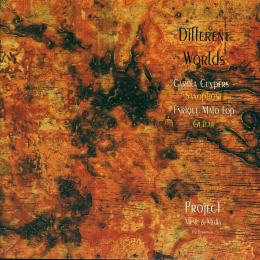 An integrated whole of rhythms, timbre changes, slaps and key clicks on the saxophone, knockings and Bartok pizzicatos on the guitar, players' talking, stamping, etc.; a colourist variety produced by the guitar and the saxophone playing in harmony, challenging the players up to the limit. Close co-operation of both performers clearly gives the music an additional dimension. This CD clearly shows their professional skills with their instruments. Members of the duo had classical training with maestros as Iwan Roth (sx), DaniÎl Deffayet (sx), Claude Delangle (sx), JosÈ Tom·s (gt), Carles Trepat (gt) and Manuel Gonz·lez (gt). Their repertoire is mainly focused on classical contemporary music, for which they feel a special affinity.